Table of Contents
You’ve finally decided to upgrade your walls — and the first stumbling block is already here. Timber or WPC? On the surface they look alike: both can give you that warm, natural aesthetic that screams premium quality. But under the surface, the differences couldn’t be more dramatic. The wrong choice won’t just cost you money up front — it will keep costing you in repairs, treatments, and premature replacements for years to come. Before you commit to thousands of square metres of wall cladding, let’s settle the debate once and for all.
Quick Answer
WPC (Wood Plastic Composite) wall panels are the better choice for most residential and commercial projects. They outperform timber in weather resistance, maintenance requirements, lifespan, and total cost of ownership. While solid timber offers an unmatched raw natural grain for premium interior applications, WPC panels replicate that beauty with superior durability — making them the smarter long-term investment for both interior and exterior wall cladding.
1. What Are WPC Wall Panels?
WPC stands for Wood Plastic Composite — a modern engineered material that combines recycled wood fibres (typically 50–70%) with thermoplastics such as polyethylene, polypropylene, or PVC, along with UV stabilisers, colourants, and bonding agents. The result is a panel that carries the warmth and texture of natural wood while inheriting the resilience of plastic.
Key characteristics of WPC wall panels include:
- Waterproof and moisture-resistant core
- High resistance to rot, mould, and insect damage
- UV-stabilised finishes that resist fading
- Available in a wide variety of textures, colours, and wood grain patterns
- Suitable for both interior accent walls and exterior facade cladding
- Lightweight and easy to install with tongue-and-groove or clip systems
Originally developed to address the shortcomings of natural timber in outdoor applications, WPC wall panels have rapidly evolved into a design-forward product used in hotels, retail spaces, residential properties, and commercial developments worldwide.
2. What Are Timber Wall Panels?
Timber wall panels are manufactured from solid wood or engineered wood species — including cedar, pine, teak, oak, hardwood, and various tropical timbers. They have been used in construction for centuries, prized for their natural beauty, warmth, and the prestige associated with genuine wood.
Common types of timber wall panels include:
- Solid hardwood cladding (teak, oak, mahogany)
- Softwood cladding (pine, cedar, spruce)
- Engineered wood panels (plywood-backed veneer)
- Thermally modified timber (heat-treated for improved stability)
- Accoya and other acetylated wood products
Timber wall panels deliver an authenticity and grain variation that is difficult to replicate perfectly. However, this natural beauty comes with significant care requirements, especially in outdoor and high-humidity environments.
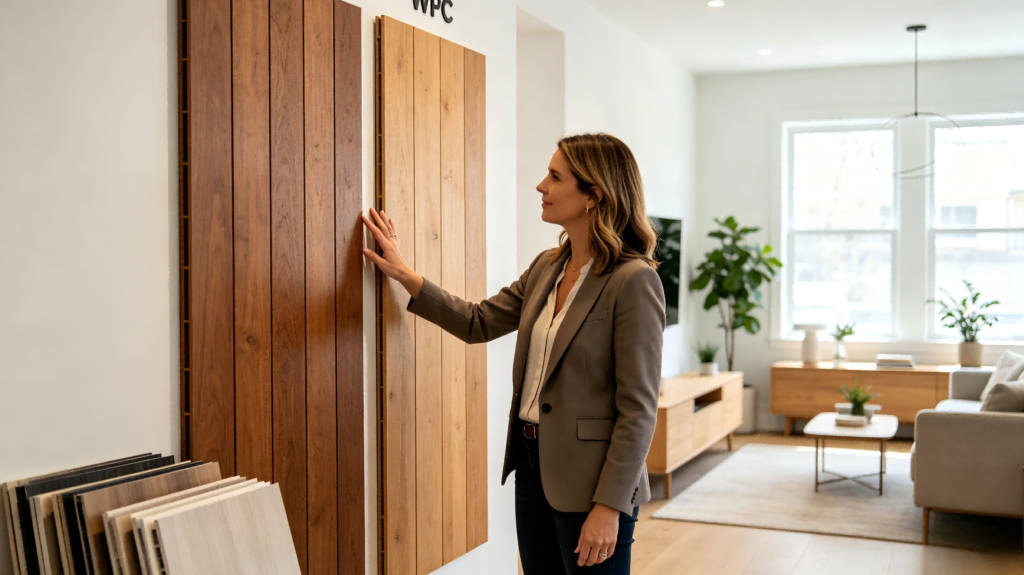
3. WPC vs Timber Wall Panels: Head-to-Head Comparison
Let’s break down the most critical performance categories to help you make a truly informed decision:
| Feature | WPC Wall Panels | Timber Wall Panels |
| Durability | 25–30 years | 10–20 years (variable) |
| Weather Resistance | Excellent – waterproof | Poor to moderate |
| Maintenance | Virtually none | High – annual treatment |
| Rot & Insect Resistance | Fully resistant | Vulnerable without treatment |
| Cost (upfront) | Moderate | Low–High (varies by species) |
| Lifecycle Cost | Lower | Higher |
| Aesthetics | Natural wood look, many options | Premium natural grain |
| Eco-Friendliness | Recycled materials, sustainable | Depends on sourcing |
| Installation | Easy, DIY-friendly | Requires skilled labour |
| Fire Resistance | Good (fire-retardant options) | Poor without treatment |
| Color Stability | Excellent UV-stable options | Fades over time |
| Moisture Warping | None | Common |
3.1 Durability & Lifespan
WPC wall panels: When properly installed, quality WPC wall panels carry a typical lifespan of 25 to 30 years with minimal degradation. The composite structure does not crack, split, or warp when exposed to temperature fluctuations, rain, or high humidity.
Timber wall panels: Natural timber, particularly untreated softwood, may begin showing signs of deterioration within 5 to 10 years in outdoor environments. Even premium hardwoods such as teak and iroko typically require ongoing maintenance to approach a 20-year outdoor lifespan.
Verdict: WPC wins on durability — particularly for exterior applications in wet or variable climates.
3.2 Maintenance Requirements
This is arguably the most significant practical difference between the two materials, and the one most buyers underestimate.
WPC panels require virtually no ongoing maintenance. An occasional rinse with water or a mild detergent is all that is needed to keep them looking fresh. There is no sanding, staining, sealing, or painting required — ever.
Timber panels demand a consistent maintenance programme. Depending on the wood species and exposure level, this typically involves:
- Annual oiling or staining of exterior surfaces
- Re-sealing every 2–3 years
- Sanding back and recoating when the finish starts to grey or peel
- Regular inspection for rot, insect damage, or crack formation
- Spot treatment for mould and algae in damp climates
If you are a property developer, facility manager, or homeowner who values a low-hassle solution, WPC wall panels will save you significant time and maintenance budget over the life of the installation.
Verdict: WPC wins comprehensively on maintenance — the lifetime cost of maintaining timber is often 2–3x the material cost itself.
3.3 Weather Resistance & Moisture Performance
Moisture is the number-one enemy of natural wood. When timber absorbs water, it swells. When it dries, it contracts. Repeated through hundreds of seasonal cycles, this movement leads to cracking, warping, joint failure, and ultimately rot.
WPC panels are engineered to be waterproof. The plastic matrix in the composite prevents moisture absorption at the core level — meaning there is no swelling, no warping, and no moisture-driven decay. This makes WPC wall panels particularly well-suited for:
- Coastal and marine environments
- High-humidity tropical climates
- Regions with heavy rainfall or freeze-thaw cycles
- Exterior facades, pergolas, and feature walls
- Bathroom and pool surround feature walls (interior)
Verdict: WPC is the clear winner for any application where moisture exposure is a concern.
3.4 Cost Comparison: Upfront vs Lifecycle
This is where the analysis gets particularly important for builders, developers, and procurement managers.
Upfront material cost: Entry-level timber cladding (pine, fir) can cost less per square metre than WPC panels. However, premium hardwoods (teak, iroko, oak) often cost significantly more than quality WPC alternatives.
Lifecycle cost (10-year horizon): When you factor in maintenance labour, treatment products, and replacement of failed sections, timber typically costs 40–70% more than WPC over a 10-year period in an exterior installation.
For commercial projects where maintenance scheduling is complex and labour costs are high, WPC offers a compelling total-cost-of-ownership advantage that often justifies a higher initial investment.
Verdict: WPC wins on lifecycle cost. Timber can win on initial material cost for budget softwood products, but this advantage disappears within 3–5 years.
3.5 Aesthetics & Design Flexibility
Natural timber carries a prestige that is genuinely difficult to replicate — particularly for interior applications where guests are close to the surface and the grain, texture, and scent of real wood are part of the experience. High-end boutique hotels, luxury residences, and heritage restoration projects often favour genuine timber for exactly this reason.
That said, modern WPC manufacturing technology has closed the gap dramatically. Co-extruded WPC panels with deep embossed grain patterns, multi-tonal colour variations, and brushed surface finishes can be visually indistinguishable from natural timber at normal viewing distances — especially for exterior applications.
WPC design advantages include:
- Available in dozens of colours and wood-effect finishes
- Consistent appearance across the entire installation (no knots, colour variation, or defects)
- Special effect options: brushed, matte, stone-effect, and 3D textured profiles
- Custom lengths available for large-format projects
- Colour does not change significantly over time (UV-stable options)
Verdict: Timber wins for premium natural aesthetics in close-contact interior applications. WPC wins for design consistency, variety, and colour stability.
3.6 Sustainability & Environmental Impact
The sustainability equation is more nuanced than it first appears. At first glance, natural timber seems like the obvious eco-friendly choice. In reality, the picture depends heavily on sourcing.
Timber sustainability depends on: Whether the wood is FSC-certified, the distance it has been transported, the processing energy required, and whether the installation will last long enough to offset the carbon cost of harvesting.
WPC sustainability advantages: Quality WPC wall panels use recycled wood waste (sawdust, shavings) and recycled plastic content — diverting both material streams from landfill. WPC panels also last longer, meaning fewer replacement cycles and less total material consumption over the life of a building.
Additionally, WPC panels do not require chemical treatments, stains, or solvents during their operational life — reducing the chemical load on the local environment compared to regularly treated timber.
Verdict: WPC has a strong sustainability case, especially when made from recycled content. Well-sourced FSC timber can be competitive, but requires careful verification.
3.7 Installation Ease
WPC wall panels are designed for efficient installation. Most modern systems use a hidden clip or bracket mechanism that allows for rapid fitting, clean aesthetics (no visible fixings), and the ability to replace individual panels if required without disturbing the entire installation.
WPC installation advantages:
- Consistent dimensions — no warping or bowing during fitting
- Lightweight — easier to handle, especially on scaffolding
- Standard tongue-and-groove or aluminium clip systems
- Can be cut and drilled with standard woodworking tools
- Less skill-intensive than precision timber carpentry
Timber installation, particularly for high-quality cladding, requires experienced carpenters who understand movement allowances, grain direction, and correct fixing techniques. Incorrect installation can result in visible gaps, cupping, or board failure within months.
Verdict: WPC wins on installation — faster, more consistent, and less labour-intensive.
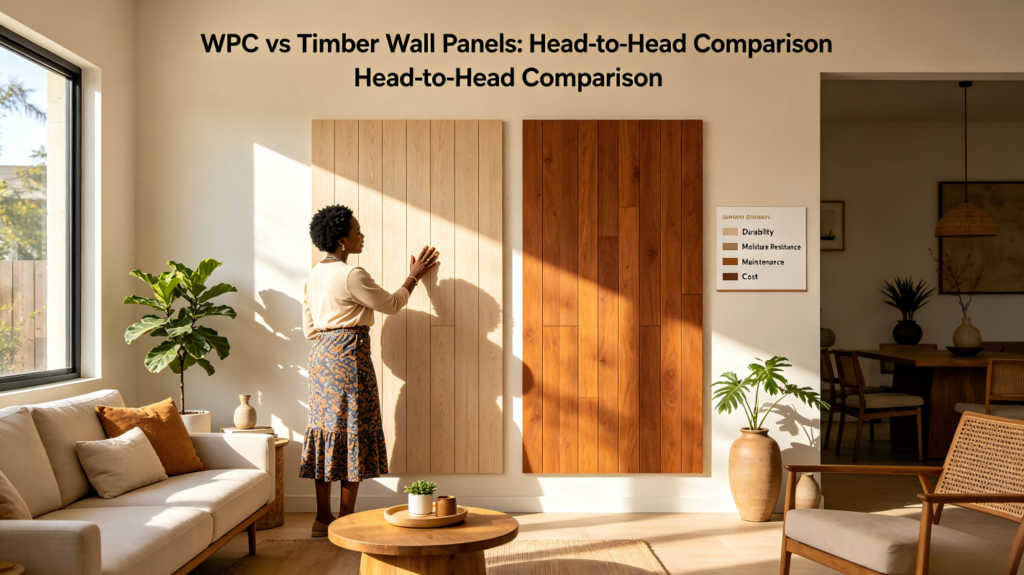
4. When Should You Choose WPC Wall Panels?
WPC wall panels are the better choice when:
- The installation is exterior or semi-exposed (balconies, facades, pergolas, feature walls)
- The climate involves significant rainfall, humidity, or freeze-thaw cycles
- Low maintenance is a priority (rental properties, commercial buildings, hospitality)
- Budget for maintenance is limited or unpredictable
- A consistent, defect-free appearance across large areas is required
- The project is on a tight installation schedule
- Sustainability and use of recycled materials is a specification requirement
- The project involves pool surrounds, bathrooms, or high-moisture interior zones
- Long-term cost certainty is important (development projects, investment properties)
5. When Should You Choose Timber Wall Panels?
Genuine timber wall panels remain the right choice when:
- The project is a high-end luxury interior where authenticity is non-negotiable
- Clients specifically request natural materials and can smell/touch the surface
- The design calls for bespoke joinery that cannot be replicated in WPC
- A heritage or restoration project requires period-accurate materials
- The installation is in a controlled interior environment with no moisture exposure
- A maintenance programme is already planned and budgeted
- The specification requires FSC-certified genuine hardwood
6. Why Most Professionals Are Switching to WPC
The trend in the construction and design industry is clear. Architects, developers, and contractors who have experienced both materials are increasingly specifying WPC wall panels as the default choice — particularly for exterior and mid-range interior applications.
Here is what drives that shift in practice:
No call-backs. Contractors report far fewer warranty claims and customer complaints with WPC installations compared to timber. Warped boards, greying surfaces, and failed sections are simply not issues with quality WPC products.
Easier project management. WPC arrives dimensionally consistent from the factory. There is no need to sort boards for quality, acclimatise the material on site, or allow for movement gaps that differ by batch.
Better client retention. Clients who are not repeatedly called on to spend money on maintenance are happier clients. This is particularly true in the build-to-rent and property management sectors.
Specification compliance. Many modern green building specifications and developer sustainability targets are more easily met with WPC panels made from recycled content than with virgin timber.
7. How to Choose the Right WPC Wall Panel for Your Project
Not all WPC wall panels are created equal. If you have decided that WPC is the right material, here are the key specifications to evaluate before purchasing:
7.1 Co-extrusion vs Single-Extrusion
Co-extruded WPC panels have an outer protective polymer shell bonded over the composite core. This dramatically improves scratch resistance, stain resistance, and UV colour stability. For exterior or high-traffic applications, always specify co-extruded WPC.
7.2 Wood Fibre Content
A higher wood fibre ratio (60–70%) delivers a more natural appearance and better thermal properties. A higher plastic content improves moisture resistance. The ideal balance for exterior wall panels is typically 55–65% wood fibre content.
7.3 Surface Texture & Finish
Deep embossed grain patterns look more realistic than shallow pressed textures. Ask for physical samples and compare them at arm’s length in natural light before approving a product for a large-scale project.
7.4 Profile & Fixing System
Verify that the panel profile is compatible with your substructure system. Hidden clip systems provide a cleaner aesthetic and allow for thermal expansion. Ensure the supplier provides the full system — panels, clips, trims, and corners — to avoid compatibility issues on site.
7.5 Fire Rating
For commercial, hospitality, or multi-residential projects, verify the fire classification of the WPC panels against your local building code requirements. Many suppliers offer fire-retardant WPC formulations that meet Class B or Class C fire ratings.
7.6 Supplier Reliability & Quality Certification
Request documentation for CE marking, ISO 9001 quality certification, and relevant regional building standards. Ask for project references and, where possible, visit installed projects before committing to a large order.
8. Real-World Applications: WPC Wall Panels in Action
To illustrate the practical advantages of WPC wall cladding, consider these common use cases:
Hotel & Resort Exteriors: Coastal resort properties in tropical climates are among the most demanding environments for wall cladding. WPC panels in teak-effect finishes deliver the premium aesthetic required by hospitality designers while withstanding salt air, UV exposure, and heavy seasonal rainfall — year after year, without repainting.
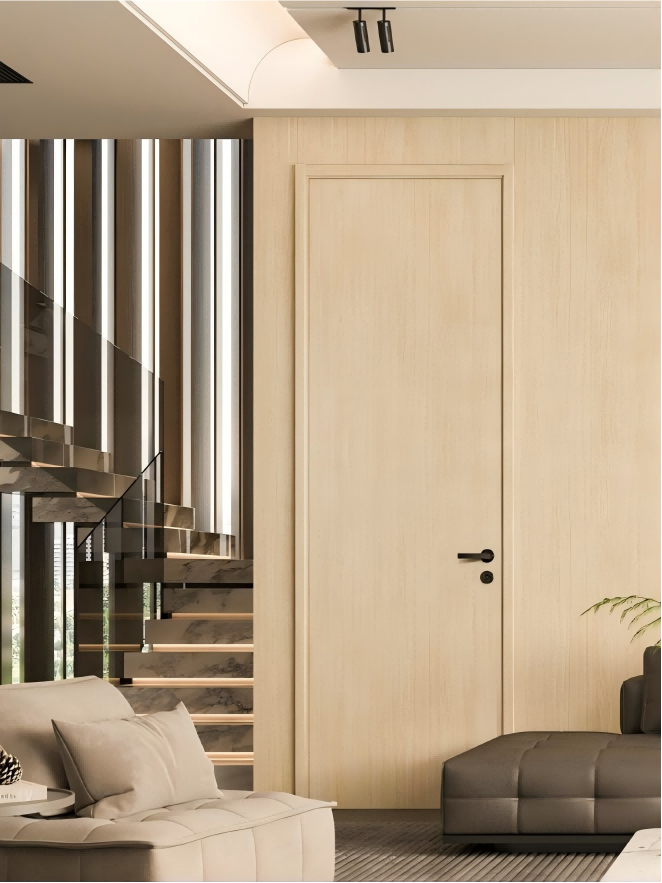
Residential Feature Walls: Interior WPC accent walls in living rooms and bedroom headboards are increasingly popular with homeowners who want a dramatic timber-effect look without the cost of real wood. The texture, warmth, and depth of modern WPC panels create stunning focal points that consistently impress.
Commercial Building Facades: Office developments and retail centres use WPC cladding to break up the visual monotony of concrete and glass facades. WPC’s dimensional consistency and ease of replacement make it ideal for large-scale commercial applications where appearance must be maintained over many years.
Apartment Balconies & Terraces: The combination of an exposed position, foot traffic, and moisture from rain and planters makes apartment balconies a particularly challenging environment for wall cladding. WPC panels handle all of these conditions without complaint.
9. Frequently Asked Questions
Can WPC wall panels be used outdoors?
Yes. Quality WPC wall panels are specifically engineered for outdoor use. They are waterproof, UV-resistant, and unaffected by rot or insects — making them an excellent choice for exterior facades, balcony feature walls, and garden structures.
How long do WPC wall panels last?
A high-quality co-extruded WPC wall panel system typically lasts 25 to 30 years. Many leading manufacturers back their products with 15–25 year warranties, which reflects genuine confidence in the material’s longevity.
Are WPC panels cheaper than timber?
WPC panels are generally comparable to or slightly more expensive than mid-range timber options on a per-square-metre basis. However, when maintenance costs are factored in over 10 years, WPC is almost always cheaper in total — often by 40–60%.
Do WPC wall panels look like real wood?
Modern co-extruded WPC panels with deep-embossed grain patterns closely replicate the appearance of natural timber at normal viewing distances. For interior applications where guests will touch the surface, a close inspection will reveal the difference — but visually, the effect is very convincing.
Can I install WPC wall panels myself?
Yes. Most WPC wall panel systems are designed for straightforward installation using standard woodworking tools and hidden clip fixings. DIY installation is feasible for smaller interior projects, though professional installation is recommended for large exterior facades.
What is the minimum order quantity for WPC wall panels?
This varies by supplier. Most manufacturers can accommodate orders from as little as 50–100 square metres, while wholesale pricing typically activates at 500+ sqm. Contact our team to discuss your project size and get an accurate quote.
Conclusion: WPC or Timber — The Verdict
The debate between WPC and timber wall panels is not really a close one for most applications. WPC wall panels win on durability, maintenance, weather resistance, lifecycle cost, and sustainability credentials. Timber retains an edge only in premium natural-aesthetic interior applications where authenticity and touch are part of the design experience.
For architects, developers, contractors, and property owners who want a beautiful, long-lasting wall cladding solution that performs reliably with minimal ongoing cost — WPC wall panels are the answer.
The market has spoken: WPC wall panel specification is growing year on year as professionals and homeowners discover that they no longer need to choose between aesthetics and performance.