You’re narrowing down your wall panel shortlist and two acronyms keep appearing side by side: WPC and SPC. They look almost identical in product listings. Both are engineered composites. Both are marketed as waterproof, durable, and low-maintenance. Yet specifying the wrong one — WPC where SPC is needed, or SPC where WPC would excel — can mean premature failure, unhappy clients, and costly replacements. If you’ve ever asked “aren’t these basically the same thing?” this article will give you the clarity you need before you place a single order.
Quick Answer
WPC (Wood Plastic Composite) and SPC (Stone Plastic Composite) wall panels differ fundamentally in their core material. WPC blends wood fibre with thermoplastic polymer, creating a lighter panel with natural warmth, softer texture, and good acoustic insulation — best suited for residential interiors. SPC uses a rigid stone-plastic core (limestone powder + PVC), making it denser, harder, 100% waterproof, and far more dimensionally stable under temperature fluctuations — ideal for commercial spaces, wet areas, and high-traffic environments. WPC offers better comfort; SPC offers superior durability and moisture immunity. The right choice depends on where the panels are installed, the level of foot traffic, humidity exposure, and your budget.
What Is WPC? (Wood Plastic Composite Explained)
WPC — Wood Plastic Composite — is an engineered material produced by blending natural wood fibre or wood flour with a thermoplastic polymer (typically PVC, PE, or PP), along with additives such as UV stabilisers, fire retardants, and colour pigments. The mixture is extruded under heat and pressure into panel profiles, then surface-finished with co-extrusion coatings, film lamination, or paint.
The result is a panel that delivers the natural warmth and visual character of wood, while overcoming wood’s primary weaknesses: rot, insect damage, moisture absorption, and high maintenance. WPC has been widely adopted in both residential and commercial interior wall cladding applications for over a decade.
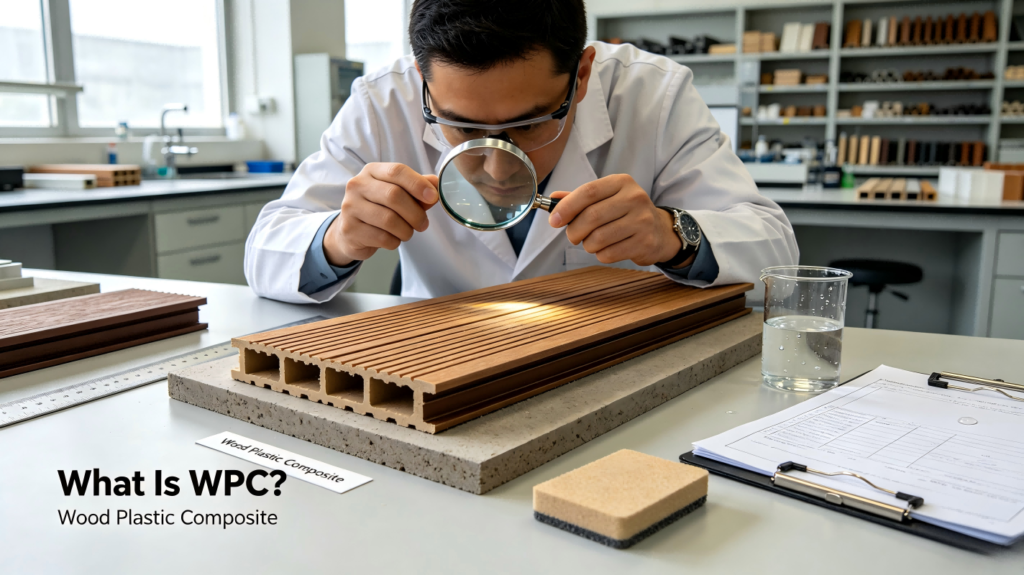
| 🌿 WPC Core Composition: Wood fibre (40–70%) + Thermoplastic polymer (PVC / PE / PP) + UV stabilisers + Fire retardant additives + Colour pigments. The ratio of wood to polymer determines panel density, rigidity, and moisture performance. |
WPC panels are typically hollow-core or have a foam-core construction, which contributes to their lighter weight, better acoustic dampening, and improved thermal insulation compared to solid-core alternatives.
What Is SPC? (Stone Plastic Composite Explained)
SPC — Stone Plastic Composite — is a newer generation of rigid composite panel, engineered by combining limestone powder (calcium carbonate) with PVC resin and plasticisers, then processed into an ultra-dense, rigid core board. Unlike WPC, SPC contains no wood fibre — it is a mineral-plastic hybrid engineered specifically for maximum dimensional stability and waterproofing.
SPC panels have rapidly gained traction in commercial flooring and, increasingly, in wall cladding applications where extreme durability, 100% waterproofing, and resistance to temperature-driven expansion and contraction are critical requirements.
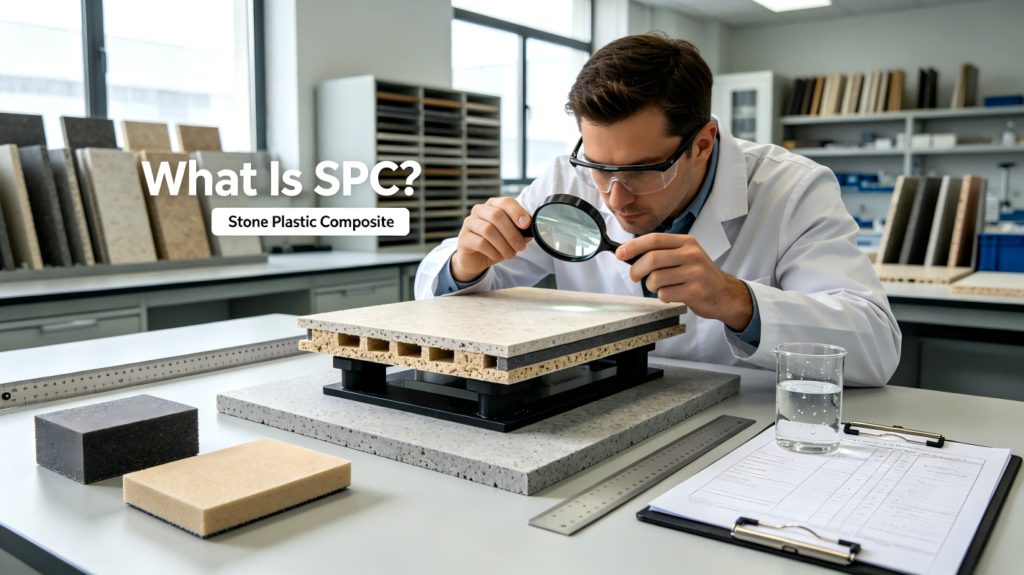
| 🪨 SPC Core Composition: Limestone powder / Calcium carbonate (50–60%) + PVC resin + Plasticisers + Stabilisers + Co-extrusion surface layer. The stone-heavy core gives SPC its defining rigidity, density, and total waterproofing. |
SPC panels are typically produced in a solid-core or semi-solid construction, making them heavier and more dimensionally rigid than WPC — a property that eliminates expansion gaps in many applications and delivers exceptional flatness across large wall surfaces.
| WPC — Wood Plastic Composite Wood fibre + PVC/PE/PP polymer Lighter | Warmer | Softer feel Better acoustic & thermal insulation Ideal: Residential interiors, feature walls, bedrooms, offices | SPC — Stone Plastic Composite Limestone powder + PVC resin Heavier | Denser | Harder surface 100% waterproof | Maximum stability Ideal: Bathrooms, kitchens, commercial spaces, wet areas |
WPC vs SPC Wall Panels: 7 Key Differences That Matter
1. Core Composition and Material Structure
The single most important difference between WPC and SPC is what’s inside the panel. This compositional difference flows through every other performance characteristic — from weight and waterproofing to acoustics and cost.
WPC panels are built on an organic-inorganic hybrid: wood fibre provides bulk, texture, and a natural feel; the polymer binder provides structural cohesion and moisture resistance. The presence of wood fibre, even though encapsulated, means WPC panels retain some micro-porosity and organic character.
SPC panels are built on a fully inorganic core: limestone powder provides extreme rigidity and density; PVC provides the binding matrix. There is no organic fibre content, which is precisely why SPC achieves true 100% waterproofing that WPC panels — even premium ones — cannot fully match.
Key takeaway: If the panel’s core composition matters for your application (wet room, chemical exposure, outdoor), SPC’s inorganic stone-plastic core is the safer choice.
2. Waterproof and Moisture Performance
This is where SPC holds a decisive technical advantage. Because SPC contains no wood fibre, there is nothing to absorb moisture — the panel is genuinely 100% waterproof from core to surface. It can be fully submerged without structural degradation, making it the correct choice for bathrooms, shower rooms, steam rooms, and outdoor wet-area applications.
WPC panels offer excellent water resistance — significantly better than natural wood or MDF — but they are not perfectly waterproof in the strictest technical sense. High-quality WPC panels with co-extruded surfaces perform very well in humid environments, but for applications involving direct water contact or prolonged submersion, SPC is the more reliable material.
| Moisture Scenario | WPC Performance | SPC Performance | Recommendation |
| High-humidity interior | Excellent | Excellent | Either |
| Bathroom wall cladding | Good | Excellent | SPC preferred |
| Direct water splash | Good | Excellent | SPC preferred |
| Steam room / sauna wall | Moderate | Excellent | SPC only |
| Outdoor wall cladding | Good (UV coat required) | Excellent | SPC preferred |
| Standard living room wall | Excellent | Excellent | Either |
3. Durability, Hardness, and Impact Resistance
SPC’s stone-heavy core makes it significantly harder and more impact-resistant than WPC. If you run a fingernail or key across a premium SPC panel surface, you’ll find it considerably more scratch-resistant than an equivalent WPC panel. This hardness advantage is most pronounced in commercial environments with high foot traffic, trolley movement, or risk of physical impact.
WPC panels are not fragile — far from it. In residential and light commercial settings, WPC durability is more than adequate. However, the lower density and softer organic fibre content means WPC is more susceptible to surface denting and deep scratching under sustained mechanical stress.
Durability verdict: SPC wins on hardness and scratch resistance. WPC wins on impact absorption (the elasticity of the polymer-wood blend dissipates energy, making it more forgiving under accidental knocks).
4. Weight, Density, and Installation
Density is a direct consequence of composition. SPC panels, with their stone-heavy core, are noticeably denser and heavier than WPC panels of equivalent dimensions — typically 30–50% heavier. This has direct implications for installation, structural loading, and transportation costs.
- WPC panels: typically 1.2–1.5 kg/m² for wall panel profiles — light enough for easy single-installer handling
- SPC panels: typically 1.8–2.5 kg/m² for wall panel profiles — heavier, may require two-person installation for large formats
- Wall substrate load: SPC adds more load per m² — relevant for stud or lightweight partition walls
- Shipping cost: SPC costs more per m² to ship due to higher weight
Both WPC and SPC panels are generally available with click-lock or tongue-and-groove installation systems. WPC’s lighter weight makes it faster to handle and re-position during installation. SPC’s rigidity means it sits flat with no flex, which can actually speed up alignment on large flat walls.
| 🔧 Installation Tip: For wall applications on standard stud framing, both WPC and SPC can be installed over existing surfaces with appropriate adhesive or mechanical fastener systems. Always check substrate flatness first — SPC’s rigidity means it will not bridge minor undulations that WPC’s slight flex might accommodate. |
5. Thermal and Acoustic Insulation
This is where WPC holds a genuine advantage. The wood fibre content and hollow or foam-core construction of WPC panels gives them measurably better thermal insulation properties than the dense, solid SPC core. WPC panels feel warmer to the touch and contribute more to a room’s thermal envelope — a meaningful benefit in cold climates or energy-sensitive projects.
On acoustic performance, WPC panels also outperform SPC. The fibrous, slightly elastic structure of WPC absorbs sound energy more effectively than SPC’s dense, rigid, stone-heavy core, which tends to reflect sound. In bedrooms, home offices, recording spaces, and hospitality settings where acoustic comfort is a priority, WPC is the preferred choice.
| Performance Metric | WPC Wall Panels | SPC Wall Panels |
| Thermal insulation | ★★★★☆ Good | ★★★☆☆ Moderate |
| Sound absorption | ★★★★☆ Good | ★★☆☆☆ Lower |
| Warmth to touch | ★★★★★ Warm | ★★★☆☆ Cooler |
| Dimensional stability | ★★★☆☆ Good | ★★★★★ Excellent |
| Temperature range | ★★★☆☆ -20°C to 60°C | ★★★★★ -30°C to 80°C |
6. Aesthetics, Surface Options, and Design Versatility
Both WPC and SPC wall panels are available in an extensive range of finishes — wood grains, stone effects, solid colours, brushed textures, embossed patterns, and contemporary abstracts. The surface finish is applied via co-extrusion, UV coating, or film lamination, so the raw core material does not limit the aesthetic range of either product.
However, subtle differences do exist:
- WPC panels tend to feel slightly warmer and more natural to the touch, which many interior designers prefer for residential applications
- SPC panels have a harder, cooler surface — more similar to ceramic tile — which reads as more contemporary and industrial in high-end commercial settings
- WPC’s lighter core makes it easier to produce more complex extruded profiles (decorative grooves, 3D textures, curved sections) without structural compromise
- SPC’s greater rigidity means large-format flat panels maintain perfect alignment across wide wall surfaces with no bowing or flexion
For projects where aesthetics are the primary driver and functional demands are moderate, WPC’s warmer feel and profile versatility give it an edge. For minimalist, large-format, high-gloss commercial wall installations, SPC’s flat, rigid surface delivers a more consistently flawless result.
7. Price, Cost-Effectiveness, and Long-Term Value
In most markets, WPC wall panels carry a modest price advantage over SPC — the wood-fibre feedstock is generally less expensive than the refined limestone powder and higher-grade PVC used in SPC production. However, the price gap has narrowed significantly as SPC manufacturing has scaled globally.
- Typical WPC wall panel price range: $8–$25 USD/m² (ex-factory, varies by profile, finish, and order volume)
- Typical SPC wall panel price range: $12–$32 USD/m² (ex-factory, varies by thickness and surface treatment)
- Installation cost: Comparable for both — WPC slightly faster to handle, SPC slightly faster to align
- Maintenance cost: Near-zero for both — periodic wipe-down only
- Replacement rate: SPC typically lasts longer in demanding commercial environments
- Long-term value: SPC delivers better ROI in high-stress applications; WPC in moderate residential use
When evaluating cost, always consider the full lifecycle — not just the material price. SPC’s superior durability in high-traffic and wet environments means lower replacement frequency, which often justifies its higher upfront cost in commercial projects.
WPC vs SPC Wall Panels: Complete Side-by-Side Comparison
| Feature / Criterion | WPC Wall Panels | SPC Wall Panels | Winner |
| Core Material | Wood fibre + PVC/PE/PP | Limestone + PVC resin | — |
| Waterproof Level | Highly water-resistant | 100% waterproof | SPC |
| Density / Weight | 1.2–1.5 kg/m² (lighter) | 1.8–2.5 kg/m² (heavier) | WPC |
| Hardness | Moderate | High (stone-hard surface) | SPC |
| Scratch Resistance | Good | Excellent | SPC |
| Impact Absorption | Better (elastic) | Lower (rigid) | WPC |
| Thermal Insulation | Good — warmer feel | Moderate — cooler feel | WPC |
| Sound Absorption | Good | Moderate | WPC |
| Dimensional Stability | Good | Excellent | SPC |
| Temperature Tolerance | -20°C to +60°C | -30°C to +80°C | SPC |
| Fire Rating Capability | B1 achievable | B1 achievable | Tie |
| Design / Finish Range | Extensive (warmer feel) | Extensive (harder feel) | Tie |
| Installation Ease | Easier (lighter weight) | Easy (rigid alignment) | WPC slight edge |
| Price (ex-factory) | $8–$25 / m² | $12–$32 / m² | WPC |
| Best Environment | Residential, offices, bedrooms | Wet areas, commercial, outdoor | — |
| Eco / Recycled Content | Yes (wood & plastic recycled) | Yes (mineral & plastic) | Tie |
| Warranty (typical) | 10–25 years | 10–25 years | Tie |
When to Choose WPC Wall Panels
WPC wall panels are the ideal choice in the following scenarios:
- Residential living rooms, bedrooms, and dining areas where warmth and acoustic comfort are priorities
- Home offices and study spaces where sound insulation improves productivity and focus
- Feature accent walls where wood-look warmth and tactile texture create a natural, organic atmosphere
- Cold-climate interiors where better thermal performance reduces heating demands
- Lightweight partition walls and stud-framed structures with lower load capacity
- Projects where budget is a primary constraint and conditions are moderate (no extreme moisture)
- Hospitality interiors (hotel rooms, guest corridors) where acoustic comfort is a key guest experience metric
- Retail and showroom environments where complex panel profiles and premium wood aesthetics elevate brand perception
| 🏠 WPC is Perfect When: You need a wall panel that looks and feels warm and natural, performs reliably in non-wet interior environments, offers excellent sound insulation, and can be produced in complex decorative profiles — at a competitive price point. |
When to Choose SPC Wall Panels
SPC wall panels are the ideal choice in the following scenarios:
- Bathroom, wet room, and shower area wall cladding where 100% waterproofing is non-negotiable
- Kitchen backsplash and splashback wall cladding in both residential and commercial kitchens
- Commercial and hospitality venues with very high footfall where maximum durability is required
- Outdoor and semi-outdoor wall cladding (balconies, covered terraces, external facades)
- Swimming pool surrounds and spa facility wall finishes
- Healthcare, education, and institutional buildings requiring hygienic, easy-clean wall surfaces
- Regions with wide temperature swings where dimensional stability is critical to avoid panel movement
- Large-format flat wall installations requiring perfect rigidity and zero panel deflection
- Projects in tropical or highly humid climates where sustained moisture exposure is expected
| 🏨 SPC is Perfect When: You need a wall panel that is genuinely 100% waterproof, provides maximum dimensional stability in temperature-variable environments, withstands heavy commercial use, and delivers a clean, hard-wearing surface in demanding conditions. |
Can WPC and SPC Wall Panels Be Used Together?
Absolutely — and in practice, experienced architects and interior designers often specify both materials in the same project, assigning each to the zones where it performs best.
A typical mixed-specification approach might look like this:
- Bedroom and living room walls: WPC panels — for warmth, acoustic comfort, and natural aesthetics
- En-suite bathroom walls: SPC panels — for 100% waterproofing and hygienic surface
- Kitchen splashback: SPC panels — for grease resistance, waterproofing, and easy cleaning
- Corridor and hallway walls: SPC panels — for high-traffic durability and impact resistance
- Home office feature wall: WPC panels — for acoustic absorption and premium wood aesthetic
When combining materials, ensure you match surface finishes, colour palettes, and profile thicknesses at transition points to achieve a seamless visual result. Discuss mixed specifications with your manufacturer early — they can advise on colour matching across both product lines.
Frequently Asked Questions: WPC vs SPC Wall Panels
Q: Is SPC always better than WPC for wall panels?
No. SPC outperforms WPC in waterproofing, hardness, and temperature stability. But WPC outperforms SPC in thermal insulation, acoustic absorption, weight (easier installation), and price. The best choice is always project-specific — neither material is universally superior.
Q: Can WPC wall panels be used in bathrooms?
High-quality WPC wall panels can be used in bathrooms with moderate humidity, provided they carry a co-extruded waterproof surface coating and are properly sealed at joints. However, for wet-zone walls (directly above showers, tubs, or anywhere subject to direct water contact), SPC is the technically correct specification.
Q: Is SPC wall panelling more expensive than WPC?
Generally yes — SPC typically costs 15–30% more than WPC at equivalent specifications, reflecting the higher cost of limestone powder processing and the denser, heavier panel. However, in high-volume commercial orders, the gap narrows significantly. Always obtain like-for-like quotes from your manufacturer.
Q: Do WPC and SPC wall panels look the same?
From a visual standpoint, WPC and SPC panels can be produced with virtually identical surface finishes — the same wood grains, stone textures, and solid colours are available in both. The key tactile differences are that WPC feels slightly warmer and softer, while SPC feels harder and cooler. Side by side in identical finishes, most non-specialists cannot distinguish them by appearance alone.
Q: Which is more eco-friendly — WPC or SPC?
Both can be manufactured using recycled content — WPC from recycled wood fibre and plastic; SPC from reclaimed limestone fines and recycled PVC. WPC has a slight edge in organic material use (wood fibre is a renewable resource). However, SPC’s longer lifespan in high-stress applications may reduce total material consumption over time. Both are significantly more sustainable than natural hardwood or PVC-only panels.
Q: Which is easier to install — WPC or SPC?
WPC’s lighter weight makes individual panel handling easier and faster, particularly on large wall surfaces. SPC’s rigidity means it self-aligns more accurately on flat substrates. Both typically use click-lock or groove systems. Overall, WPC is marginally faster to install due to lighter handling, but the difference is small for experienced installers.
Market Trends: How WPC and SPC Are Evolving
Hybrid WPC-SPC Products
The market is beginning to see hybrid composite panels that attempt to capture the best of both worlds — a lightweight core with high mineral content, engineered to sit between WPC and SPC in terms of waterproofing, density, and acoustic performance. These are still niche but represent the direction of R&D investment in the composite panel category.
SPC Gaining Ground in Wall Applications
While SPC was originally a flooring-dominant material, it is rapidly gaining specification share in wall cladding applications, particularly in the commercial hospitality and healthcare sectors where waterproofing and durability requirements have historically defaulted to ceramic tile. SPC’s lighter weight and faster installation compared to tile make it an increasingly compelling alternative.
WPC Premium Segment Growth
In the residential premium segment, WPC wall panels are seeing strong growth driven by biophilic design trends, Japandi aesthetic demand, and the desire for tactile warmth in living environments. High-end WPC panels with realistic wood-grain embossing, micro-texture surfaces, and bespoke colour matching are commanding significant price premiums over entry-level options.
Sustainability Driving Both Segments
Both WPC and SPC manufacturers are under increasing pressure from green building standards (LEED, BREEAM, WELL) to reduce VOC emissions, increase recycled content, and provide Environmental Product Declarations (EPDs). Forward-looking manufacturers in both categories are investing in clean chemistry formulations and third-party carbon footprint verification.
| Need WPC or SPC Wall Panels for Your Next Project? Whether your specification calls for WPC’s natural warmth and acoustic comfort, or SPC’s absolute waterproofing and commercial-grade durability — we manufacture both to the highest international standards. CE certified, SGS tested, and available in 200+ finishes with flexible MOQ and full customisation support. Request free samples, technical data sheets, and a personalised project quotation today. We respond within 24 hours. |
Understanding the difference between WPC and SPC wall panels is not just technical knowledge — it is the foundation of sound specification decisions that protect your project, your budget, and your professional reputation. Use this guide as your reference point every time a new project brief lands on your desk.