Table of Contents
Walk into a panel supplier’s showroom and ask for “composite panels” — and you might be shown aluminum sheets bonded to a polyethylene core, fiberglass boards saturated with resin, wood-plastic blends, PVC foam panels, or a dozen other things, depending on who you ask. Ask specifically for “WPC” and you will narrow it down to one distinct material category. Yet in project specifications, supplier catalogues, and even architectural documentation, the terms “WPC” and “composite panel” are routinely used interchangeably — and that confusion leads to projects specified with the wrong material, priced against incompatible alternatives, and performing nothing like what was intended. If you’ve ever tried to clarify what separates WPC from composite — or whether the two terms mean the same thing — this guide gives you the complete, unambiguous answer.
Quick Answer — The Direct Definition
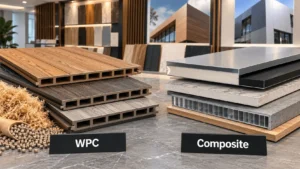
WPC (Wood Plastic Composite) is a specific type of composite panel — but composite panel is a broad category that includes many distinct material types, of which WPC is only one. The term “composite panel” describes any building panel formed by bonding two or more different materials together to create combined performance that neither material could achieve alone. This category includes aluminum composite panels (ACP), fiberglass reinforced panels (FRP), high-pressure laminate (HPL)-faced panels, PVC composite panels, fiber cement panels, and WPC. WPC specifically means panels manufactured from a blend of wood or bamboo fiber (typically 40–70% by weight) with thermoplastic polymers such as HDPE or polypropylene. Its defining characteristic is real wood fiber content, which gives it an organic grain appearance and tactile quality that no other composite type possesses. The most common confusion is WPC vs. ACP: WPC contains genuine wood fiber and excels in warm interior and semi-exterior applications; ACP uses aluminum face sheets over a polymer core, making it the dominant choice for exterior building facades due to its superior fire rating, weather resistance, and lightweight construction.
1. What Does “Composite Panel” Actually Mean?
The word “composite” in the context of building materials describes any product formed by combining two or more constituent materials that, when bonded together, produce a combined structure with properties superior to any single component in isolation. The combination is always deliberate: one material contributes structural rigidity, another provides surface hardness or aesthetic quality, a third might add fire resistance or moisture impermeability. Together they achieve a performance profile that neither could reach alone.
In construction and architecture, “composite panel” most commonly refers to flat panel building products consisting of a core material sandwiched between two outer face sheets. But the core and face sheet materials vary enormously across the category — and these material differences produce products with dramatically different performance, cost, aesthetic character, and appropriate applications.
The composite panel category is best understood as a family tree with one structural principle — two or more materials combined for superior performance — and many divergent branches, each optimized for different use environments, regulatory requirements, and design briefs.
The Composite Panel Family — Seven Distinct Material Types
The principal composite panel types used in commercial and residential construction worldwide include:
- — Aluminum Composite Panels (ACP)
- — Two thin aluminum face sheets permanently bonded to a polyethylene (PE) or mineral-filled fire-resistant core. The dominant exterior cladding composite worldwide.
- Fiberglass Reinforced Panels (FRP) — Glass fiber strands embedded in a thermoset polyester or vinyl ester resin matrix. Preferred for high-traffic interior hygiene applications.
- Wood Plastic Composite (WPC) — Wood or bamboo fiber blended with thermoplastic polymers. The only composite type containing real wood fiber. The subject of this comparison guide.
- HPL-Faced Composite Panels — High-pressure laminate decorative face sheet over a structural composite core. Premium interior cladding with exceptional scratch resistance.
- PVC Composite Panels — Rigid PVC foam core faced with PVC skins. Cost-effective interior panels for budget fit-outs and partitions.
- Fiber Cement Composite — Portland cement, cellulose fiber, and silica pressed into dense, durable panels. Class A fire rated and suitable for exterior cladding.
- Aluminum Honeycomb Panels — Hexagonal aluminum honeycomb core bonded between aluminum face sheets. Premium performance for large-format curtain wall and ceiling systems.
WPC is one branch of this family — a meaningful and distinctive one, with genuine advantages in specific applications — but it represents one of seven major composite panel technologies, not a synonym for the whole category. Understanding where WPC sits within this broader family is the essential foundation for making accurate specification decisions.
2. What Is WPC? — A Precise Material Definition
Wood Plastic Composite (WPC) is a hybrid engineered material produced by blending finely milled wood or bamboo fiber — typically 40 to 70% by weight of the total panel composition — with thermoplastic polymers, most commonly high-density polyethylene (HDPE) or polypropylene (PP). This primary blend is combined with processing aids, UV stabilizers, colorants, and fire-retardant additives appropriate to the intended application, then processed through extrusion or hot-press forming to produce finished panels in the required dimensions and surface profile.
The resulting material occupies a carefully considered performance space between natural timber and conventional synthetic panels: it has the visual character and tactile warmth of natural wood — because it genuinely contains wood fiber — combined with the dimensional stability, moisture resistance, and reduced maintenance demand of a polymer-based material. It is neither wood nor plastic, but a material that integrates the most useful properties of both while mitigating the primary limitations of each.
WPC Core Material Properties
- Wood fiber content: 40–70% by weight — the remainder is thermoplastic polymer, coupling agents, and performance additives
- Density: 800–1,200 kg/m³, making WPC heavier than ACP but lighter than stone or fiber cement
- Moisture resistance: significantly superior to natural timber — WPC panels do not swell, split, or warp under normal humidity cycling
- Dimensional stability: substantially better than natural timber — no seasonal movement from moisture changes means tight joint tolerances can be maintained
- Surface appearance: genuine organic woodgrain variation and tactile texture generated by the actual wood fiber content — not a print or simulation
- Fire rating: typically Class B; fire-retardant formulations approaching Class B-s2,d0 classification available; Class A generally not achievable due to wood fiber combustibility
- Maintenance: requires no painting, staining, oiling, or recoating — periodic cleaning with mild detergent is sufficient for the product’s service life
- UV stability: exterior-grade WPC with appropriate UV stabilizer packages is suitable for covered or semi-exposed exterior conditions; prolonged fully exposed UV exposure degrades surface quality over time without additional treatment
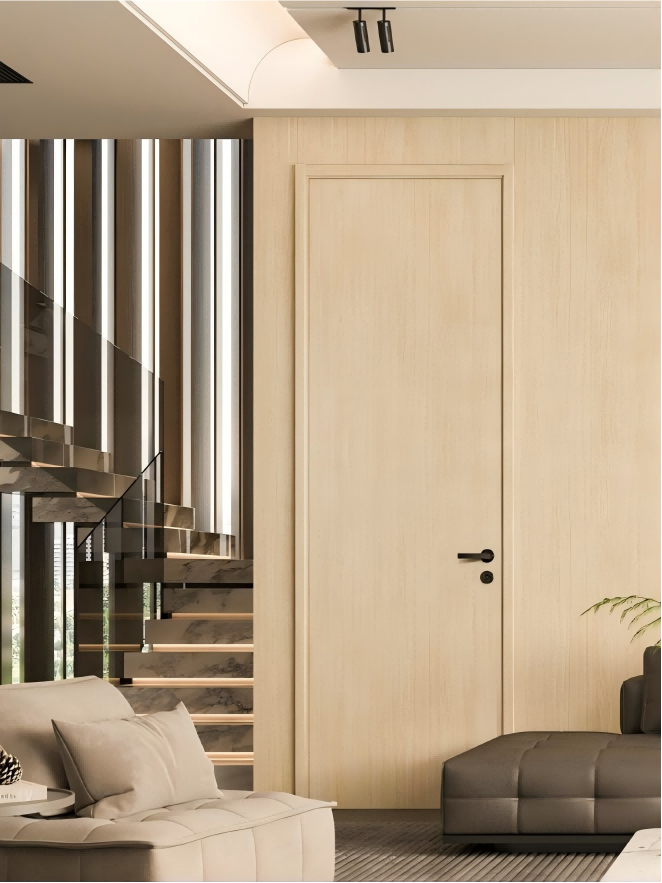
WPC is used across a wide range of interior and semi-exterior applications: interior feature walls and reception cladding, conference room accent surfaces, restaurant and hotel lobby environments, retail interior fit-outs, covered terrace wall cladding, entrance canopy linings, and any application where a genuine natural wood aesthetic combined with low maintenance and moisture resistance is the governing specification brief.
3. What Is ACP? — Defining the Most Common “Other Composite”
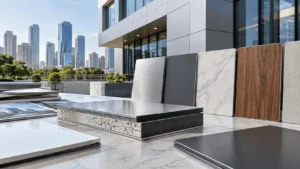
When “composite panel” is used without further qualification in commercial construction specifications — particularly for exterior facades, curtain walls, and interior cladding in commercial offices and high-rise buildings — it most commonly refers to Aluminum Composite Panel (ACP): the largest-volume composite panel type in global commercial building construction.
ACP consists of two thin aluminum face sheets, typically 0.3 to 0.5mm thick, permanently bonded to a core material: either a polyethylene (PE) foam compound for standard applications, or a mineral-filled fire-resistant compound for projects requiring Class A fire performance. Total panel thickness is typically 3 to 6mm; 4mm is the most common commercial specification. The aluminum face sheets are pre-coated with PVDF (polyvinylidene fluoride) or polyester paint systems that define the panel’s color, finish, and UV durability.
ACP Core Material Properties
- Weight: 4–8 kg/m² — among the lightest cladding materials available, significantly reducing structural load versus stone, fiber cement, or WPC
- Fire rating: Class A / A2 achievable with mineral-filled fire-resistant core — the highest available classification for composite panels and compliant with the most stringent exterior cladding building regulations
- Weather resistance: excellent — PVDF-coated ACP maintains color and surface integrity under full exterior weathering for 20–25 years
- Surface finish options: virtually unlimited — solid colors, metallic and brushed finishes, printed stone-effect, printed woodgrain, pearlescent and special-effect coatings
- Contains no wood fiber: ACP core and face sheets are entirely inorganic or polymer-based — this eliminates fire risk from combustible wood content and makes true Class A fire rating achievable
- Dimensional stability: outstanding — the bonded aluminum and composite structure has very low thermal expansion coefficients and maintains precise flatness in large-format panels
- Typical cost: $15–$50/m² depending on core specification, coating quality, panel thickness, and order quantity
ACP’s combination of lightweight construction, design flexibility, and Class A fire performance in a cost-effective and readily installable package makes it the default composite specification for exterior facades, canopy soffits, curtain wall infill panels, interior lobby cladding, column covers, and signage backing on commercial buildings worldwide.
4. WPC vs Composite (ACP): The Critical Differences Explained
The most practically important comparison in this guide is WPC against ACP — because these are the two products most frequently confused when specifiers and buyers use the term “composite panel” without qualification. The differences between them are significant, material-level distinctions that directly determine which is appropriate for a given application.
4.1 Material Composition: Organic vs Engineered
| WPC — Contains Real Wood WPC is composed of 40–70% actual wood or bamboo fiber blended with thermoplastic polymer. The wood fiber is not a coating, print, or simulation — it is a structural component of the panel material itself. This organic content is what gives WPC its distinctive natural appearance, tactile warmth, and genuine material character. | ACP — Entirely Synthetic Construction ACP contains no wood fiber or any other natural material. Its core is synthetic polymer (PE) or mineral compound, and its face sheets are aluminum. Every material component is precisely engineered and manufactured to consistent specification. ACP’s appearance is determined entirely by its surface coating system. |
4.2 Appearance: Genuine vs Simulated Wood
This is the difference that most directly affects specification decisions in design-driven projects, and it is more significant than many specifiers initially appreciate.
| WPC — Organic, Non-Repeating Visual Character WPC’s woodgrain appearance is generated by real wood fiber distribution within the panel. Each panel is visually unique — grain variation, color shifts between fiber clusters, and surface texture are genuinely organic and non-repeating. At close range, WPC is essentially indistinguishable from natural timber veneer because it contains the same material. | ACP — Printed Pattern on Aluminum Surface Wood-grain ACP uses PVDF printing or sublimation transfer to apply a timber pattern to the aluminum face sheet. The result is visually convincing at normal viewing distances (2m+) but is a printed simulation rather than genuine material expression. The grain pattern repeats across panels produced from the same print master. |
For applications where surfaces will be viewed at close range or touched directly — reception walls, feature cladding in hospitality spaces, executive office interiors — WPC’s organic material authenticity is a meaningful specification advantage that the best printed ACP cannot fully replicate. For exterior facades and large interior wall areas viewed from across a room, ACP’s printed finishes are visually sufficient and its performance advantages become the decisive factor.
4.3 Fire Performance: The Most Critical Technical Difference
| WPC — Class B Fire Rating WPC contains combustible wood fiber. Even with fire-retardant additive packages, WPC panels are typically rated Class B or C. They cannot be specified for exterior cladding on buildings above regulated height thresholds where Class A (A2) non-combustibility is mandated by building regulations in the UK, Europe, and many other jurisdictions. | ACP — Class A / A2 Fire Rating Available ACP with mineral-filled fire-resistant core achieves Class A (A2-rated) fire performance — the most stringent classification for exterior cladding currently required by building regulations. This makes ACP the only composite panel type that can be legally specified on high-rise buildings where Class A fire performance is mandated. |
This fire performance difference is non-negotiable and cannot be overcome by specification workarounds. If the project requires Class A exterior cladding — as most buildings above 18 meters in the UK and equivalent thresholds in other jurisdictions do — WPC is simply not a compliant option for that application, regardless of its other merits. ACP with FR mineral core is the appropriate composite specification. For interior applications where fire codes typically permit Class B materials in non-escape-route areas, WPC is usually compliant.
4.4 Weather and Moisture Resistance
| WPC — Good in Covered / Semi-Exterior Conditions WPC is moisture-resistant and will not swell, warp, or rot under normal interior humidity cycling or intermittent moisture contact in covered exterior conditions. However, sustained direct exposure to weathering — UV radiation, driving rain, freeze-thaw cycles — degrades surface quality over time without additional UV-stabilizing treatment. WPC is primarily specified for interior use and covered exterior applications. | ACP — Full Exterior Exposure Performance PVDF-coated ACP is engineered for full exterior exposure across a wide range of climatic conditions. Aluminum face sheets are impervious to moisture. PVDF coatings resist UV degradation, chalking, and color fade for 20–25 years under direct weathering. ACP is appropriate for fully exposed exterior facades, canopies, and cladding in all climates including coastal marine environments. |
4.5 Weight
ACP at 4–8 kg/m² is substantially lighter than WPC, which typically weighs 10–20 kg/m² depending on wood fiber content and panel thickness. For interior applications this difference is rarely a governing factor. For exterior high-rise facades where cumulative cladding dead load affects structural design, ACP’s weight advantage reduces structural engineering cost and simplifies facade subframe design.
4.6 Cost Comparison
Both WPC and ACP fall in the medium price range of the composite panel family. Material cost for standard WPC panels is typically $20–$50/m²; standard PE-core ACP is $15–$30/m² and fire-resistant FR-core ACP is $25–$50/m². Installation costs are broadly similar for interior applications. For exterior high-rise facade applications, ACP is the only compliant option regardless of relative material pricing.
On total cost of ownership over 25 years, both materials are low-maintenance. Neither requires repainting, oiling, or specialist treatments. WPC maintenance is limited to periodic cleaning; ACP maintenance is equally minimal, with the added advantage of easier color-matched replacement panels if individual panels need replacement.
5. Full Composite Panel Comparison — WPC vs All Major Types
The table below compares WPC against all four major composite panel types across the specification factors most relevant to commercial and residential project decisions. WPC columns are highlighted in warm amber; ACP in steel blue.
| Specification Factor | WPC | ACP | FRP | PVC Composite |
| Primary composition | Wood fiber + HDPE/PP | Aluminum + PE/mineral core | Glass fiber + resin | PVC foam + PVC skin |
| Contains wood fiber | ✓ Yes (40–70%) | ✗ No | ✗ No | ✗ No |
| Weight (kg/m²) | 10 – 20 | 4 – 8 | 1.5 – 3 | 1 – 3 |
| Fire rating | Class B (FR option) | Class A / A2 (FR core) | Class A available | Class B |
| Full exterior exposure | ◑ Covered/semi only | ✓ Full exposure | ✗ Interior only | ✗ Interior only |
| Interior use | ✓ Excellent | ✓ Good | ✓ Good (hygiene) | ✓ Basic |
| Moisture resistance | Very good | Excellent | Excellent | Excellent |
| Natural wood look | ✓ Genuine (organic) | ◑ Printed simulation | ✗ No | ✗ No |
| Tactile wood feel | ✓ Yes (real fiber) | ◑ Embossed only | ✗ No | ✗ No |
| Typical cost ($/m²) | $20 – $50 | $15 – $50 | $15 – $35 | $8 – $20 |
| Maintenance (25 yr) | Very low — cleaning only | Very low — cleaning only | Very low | Low |
| Best application | Feature walls, terraces | Facades, all-purpose | High-traffic interiors | Budget partitions |
Key: ✓ = Fully suitable ◑ = Suitable with product confirmation ✗ = Not recommended. Costs are indicative USD/m² supply only. Fire ratings shown are best-available product variants.
6. When to Choose WPC: The Right Project Conditions
WPC is the right specification when the following project conditions apply:
6.1 The Design Brief Calls for Genuine Natural Wood Character
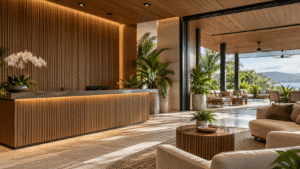
When the design intent requires a material that communicates natural warmth and organic authenticity — not a printed simulation of it — WPC is the composite panel type that delivers. This is particularly important in applications where occupants will be in close proximity to the surface and will register the material’s genuine texture and grain variation: reception desks and feature walls, executive office cladding, hotel room interiors, restaurant and bar environments, and spa or wellness facilities where the biophilic quality of the material is a meaningful dimension of the guest or occupant experience.
6.2 Interior or Semi-Exterior Covered Applications
WPC is optimized for applications that are fully interior or in covered exterior conditions: sheltered terraces, entrance canopy linings, covered walkways, semi-enclosed outdoor dining areas. Its moisture resistance is sufficient for these conditions without additional weatherproofing treatment. For fully exposed exterior facades with continuous UV and precipitation exposure, WPC should be specified only with explicit UV-performance confirmation from the manufacturer and an understanding of the expected maintenance cycle.
6.3 Biophilic Design and Wellbeing-Focused Environments
Research in environmental psychology consistently links nature-referencing materials — including genuine wood-fiber surfaces — to reduced occupant stress, improved perceived spatial quality, and longer voluntary occupancy. Corporate offices pursuing WELL Building Standard certification, healthcare and educational facilities applying evidence-based design principles, and hospitality environments seeking to create distinctively warm and memorable guest experiences all benefit from WPC’s genuine natural material character in ways that synthetic alternatives cannot fully replicate.
6.4 Sustainability and Natural Material Content Requirements
WPC contains a significant proportion of natural, renewable wood fiber — typically sourced from wood processing industry by-products rather than primary timber extraction. For projects with explicit requirements for natural material content, or for occupiers seeking to demonstrate a materials philosophy around natural and renewable resources, WPC provides documented natural content that no other composite panel type can claim.
7. When to Choose ACP or Other Composites Over WPC
7.1 The Application Is Exterior and Fully Exposed
For building facades, canopy soffits, and any exterior cladding application involving direct and sustained exposure to UV, precipitation, and temperature cycling, ACP with PVDF coating is the appropriate composite specification. Its 20–25 year exterior performance warranty, full weather resistance, and compatibility with all standard facade engineering systems make it the default choice for exterior commercial cladding at any scale.
7.2 Class A Fire Rating Is Required
Where building regulations mandate Class A (A2) fire performance for exterior cladding — including all high-rise buildings above regulated height thresholds in the UK, Europe, and increasingly in other international jurisdictions — ACP with mineral-filled FR core is the only composite panel type that can meet this requirement. WPC cannot achieve Class A fire rating due to its combustible wood fiber content, and cannot be substituted for ACP in applications where Class A compliance is a regulatory condition of the building consent.
7.3 Large-Format Panels with Precision Flatness Are Required
ACP’s bonded aluminum construction maintains panel flatness with exceptional precision in large formats — enabling panel sizes up to 1,220 x 5,800mm or larger without visible bow, deflection, or oil-canning effect. This precision flatness is critical in large commercial facade applications where visual panel uniformity is a design requirement. WPC panels in large formats can exhibit surface variation and edge deflection that is acceptable in close-range interior applications but would be visually problematic in the context of a large commercial facade.
7.4 Non-Wood Aesthetic Is Specified
When the design brief calls for solid colors, metallic finishes, stone-effect patterns, or any visual expression other than a wood grain aesthetic, ACP is the appropriate material. WPC’s visual range is inherently limited to woodgrain expressions derived from its wood fiber content. ACP’s virtually unlimited color and finish range makes it the only composite panel type that can deliver any aesthetic the designer specifies.
7.5 High-Traffic Hygiene Applications
For office corridors, washrooms, kitchens, and any interior space where impact resistance, moisture impermeability, and easy chemical cleaning are the governing brief, FRP (Fiberglass Reinforced Panel) is the appropriate composite specification. FRP’s smooth, nonporous surface is more hygienic than WPC’s textured grain surface and more resistant to impact damage than either WPC or ACP in high-traffic conditions.
8. The Terminology Trap: Why “Composite” Is So Often Misused
Understanding why the terms “WPC” and “composite panel” are confused in practice — and what the real-world consequences of that confusion are — is as important as understanding the technical differences between the materials themselves.
8.1 How the Confusion Arises
The confusion has several sources. In the residential construction and landscaping sectors, WPC decking and cladding are the dominant composite panel products — and “composite” has become informal shorthand for WPC in everyday usage among homeowners, landscape contractors, and residential architects. When this usage migrates into commercial project specifications, it creates ambiguity that commercial facade contractors and suppliers are not positioned to resolve without clarification.
In parallel, commercial facade specifications sometimes use “composite panel” without qualification when the intent is specifically ACP — relying on industry context to narrow the interpretation. When those specifications are read by teams outside the commercial facade sector, or by international suppliers less familiar with the contextual shorthand, the ambiguity leads to misinterpretation.
A third source of confusion is marketing: some composite panel manufacturers describe their products simply as “composite” in commercial materials to maximize apparent applicability. This is commercially rational but does not help specifiers make accurate comparisons across product types.
8.2 Real-World Consequences of the Confusion
Specification confusion between WPC and composite (ACP) has practical consequences in real projects:
- — Tender price incompatibility
- — When contractors price “composite cladding” against different material types, tender returns become incomparable. One contractor prices ACP at $25/m² material; another prices WPC at $40/m² for the same specification — the lowest tender wins on price but delivers the wrong product.
- Fire rating non-compliance — WPC substituted for specified ACP in an application requiring Class A fire rating creates a building regulations compliance failure that may not be identified until the fire engineer’s inspection, requiring costly and program-disrupting rework.
- Aesthetic failure — Printed woodgrain ACP supplied in place of specified genuine-fiber WPC fails to deliver the close-range tactile and visual quality that the interior design intent required — a disappointment that cannot be corrected without remobilization and re-installation.
8.3 The Solution: Always Specify the Full Material Description
Specification Best Practice
Never use the generic term “composite panel” as a complete specification. Always specify the full material description in project documentation: “Aluminum Composite Panel with A2-rated fire-resistant mineral core, PVDF-coated, 4mm total thickness” or “Wood Plastic Composite Panel for interior feature wall use, 40% wood fiber content, Class B fire rated, [species/tone] finish.” This removes ambiguity from tender documentation, eliminates substitution risk, and ensures that all supply chain parties are pricing and delivering exactly the same product.
Frequently Asked Questions
Is WPC a type of composite panel?
Yes — WPC (Wood Plastic Composite) is a specific type within the broader composite panel category. The composite panel category includes seven or more distinct material types; WPC is one of them. What makes WPC distinctive within the composite family is its wood fiber content — typically 40 to 70% by weight — which gives it a genuine organic appearance and tactile character that no other composite type possesses. All WPC panels are composite panels, but most composite panels are not WPC.
Can WPC be used on building exteriors?
WPC can be used in covered or semi-exterior exterior conditions — sheltered terraces, covered walkways, entrance canopy soffits, and similar applications where direct precipitation and sustained UV exposure are limited. For fully exposed exterior facades in all-weather conditions, exterior-grade WPC with documented UV stabilizer performance may be specified, but the product’s performance limits under prolonged UV exposure should be confirmed with the manufacturer. High-rise exterior facades requiring Class A fire performance cannot use WPC regardless of weather resistance, as WPC cannot achieve Class A fire rating due to its combustible wood fiber content.
Which is more durable — WPC or ACP?
They are durable in different ways and for different reasons. ACP is more durable in exterior weathering conditions: its PVDF coating maintains color and surface quality under full UV exposure for 20–25 years, and its aluminum face sheets and polymer core are unaffected by moisture. WPC is more durable than natural timber in interior conditions: it does not swell, rot, warp, or require recoating, and its service life in covered conditions exceeds that of natural timber without maintenance. Neither is more durable in absolute terms; each is optimized for its appropriate application environment.
Is WPC the same as composite decking?
Yes, in the residential sector, “composite decking” and “WPC decking” typically refer to the same material category: panels manufactured from wood fiber blended with thermoplastic polymer and processed into deck boards or cladding panels. The residential decking market’s use of “composite” as shorthand for WPC is the primary source of the terminology confusion this guide addresses. In commercial construction, “composite panel” typically refers to ACP rather than WPC, which is a source of genuine misunderstanding when residential builders or homeowners research commercial cladding options.
Can ACP replicate the look of WPC?
ACP can be produced with high-quality printed woodgrain finishes that are visually convincing at normal viewing distances (typically 2 meters and beyond). At close range and especially on touch, printed woodgrain ACP is distinguishable from genuine WPC because the grain is a surface print rather than an organic material expression, and the surface texture, while embossed in quality products, does not precisely replicate the irregular tactile depth of genuine wood fiber. For exterior applications viewed at distance, high-quality woodgrain ACP is an excellent specification. For close-range interior applications where material authenticity is part of the design intent, WPC delivers a result that printed ACP cannot fully match.
How do I specify correctly so suppliers know exactly what I need?
Use the full material description in all project documentation: specify “WPC” with its key technical parameters (wood fiber content percentage, polymer type, fire classification, surface finish, and intended application — interior or semi-exterior) or “ACP” with its parameters (total thickness, core type — PE or FR mineral, face sheet thickness, coating system — PVDF or polyester, color reference, and fire classification). Avoid the generic term “composite panel” as the complete specification. If in doubt, request a pre-approval submittal from shortlisted suppliers and review against a physical sample and the full technical data sheet before confirming the order.
Conclusion: Same Category, Fundamentally Different Materials
The difference between WPC and composite panel is not a subtle technical nuance — it is a foundational distinction that determines which product is appropriate for a given application, what fire rating it achieves, whether it can be used in exterior conditions, what its visual character is at close range, and how it performs over its service life. WPC is a composite panel; most composite panels are not WPC. Getting this distinction right is the difference between a project that delivers on its design intent and a specification that creates compliance, aesthetic, or performance problems after installation.
WPC belongs on interior feature walls, reception surfaces, hospitality interiors, and covered exterior terraces — applications where its genuine organic material character, warmth, and biophilic quality are specification advantages. ACP belongs on building facades, high-rise cladding, large-format interior installations, and any application requiring Class A fire performance — where its lightweight construction, superior fire rating, and all-weather durability are the decisive specification factors. Other composite types — FRP, HPL, PVC composite, fiber cement, honeycomb — each have their own optimal application spaces within the family.
When your project specification uses the word “composite,” the question to ask immediately is: which composite? The answer to that question shapes every downstream decision — from structural engineering and fire engineering to interior design and lifecycle maintenance planning. This guide is designed to help you answer it confidently every time.
Not Sure Which Panel Is Right for Your Project?
Our technical sales team helps architects, developers, and procurement teams select, specify, and source the right composite panel — WPC, ACP, FRP, or any other type — for their specific project requirements. We supply across the full composite panel family with full technical documentation, fire certificates, and physical samples dispatched within 48 hours.
Tell us your application, location, aesthetic brief, and fire rating requirement — we will recommend the right product and provide a detailed quotation within 24 hours.
Contact us today — right panel, right project, right first time.