Think about the last time you walked into a hotel room and immediately felt at ease — or, on the flip side, when something about the space felt cold, noisy, or simply off. Chances are, the walls had more to do with that impression than you realized. Walls are the largest surface in any guest room, and yet they are often the last thing hoteliers address with real intentionality. Whether you are refurbishing a tired business hotel or specifying interiors for a brand-new boutique property, the wall panel materials you choose will shape how thousands of guests feel, sleep, and review their stay — night after night, year after year.
Table of Contents
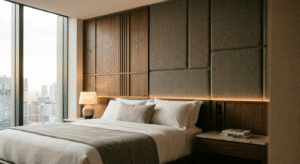
Quick Answer : The wall panels that work best for hotel guest rooms are acoustic fabric panels for luxury and full-service properties, decorative wood or MDF panels for boutique and lifestyle hotels, and high-durability PVC or vinyl panels for budget and extended-stay segments. The ideal choice depends on four key factors: acoustic performance (to ensure quiet and restful stays), visual quality (to reinforce your brand identity), maintenance ease (to reduce long-term operating costs), and fire-safety compliance (to meet building codes). Most top-performing hotel projects combine two panel types — a primary decorative panel across large wall surfaces and a dedicated acoustic panel behind the bed headboard wall — to maximize both aesthetics and sound control. |
Why the Right Wall Panel Is a Revenue Decision, Not Just a Design Decision
Hotels are in the business of selling experiences. According to data from multiple global hotel satisfaction studies, room comfort and quietness consistently rank among the top three drivers of guest satisfaction and repeat bookings. Noise — through walls, from corridors, or from HVAC systems — is the most cited complaint in hotel reviews worldwide. Meanwhile, the visual atmosphere of a guest room directly influences how guests perceive value, justify the rate they paid, and whether they share positive photos on social media.
Wall panels address both of these revenue-critical concerns simultaneously. A well-specified wall panel program can improve a hotel’s noise complaint rate, elevate TripAdvisor scores, extend renovation cycles by years, and reduce maintenance labor costs — all from a single design decision made at the specification stage.
This is why hotel designers, procurement officers, and asset managers treat wall panel selection as a strategic investment rather than a commodity purchase. The right panel pays for itself. The wrong one costs you in refurbishments, negative reviews, and lost bookings.
The 6 Types of Wall Panels Commonly Used in Hotel Guest Rooms
Not all wall panels are created equal, and the hospitality market offers a wide range of solutions — each with distinct performance profiles. Here is an honest breakdown of each type:
1. Acoustic Fabric-Wrapped Panels
Acoustic fabric panels consist of a rigid or semi-rigid core — typically fiberglass, recycled polyester, or melamine foam — wrapped in a durable, cleanable fabric facing. They are engineered to absorb mid-to-high frequency sound waves, reducing echo within the room and dampening noise transmission through walls.
Best for: Luxury hotels, full-service properties, conference hotel guest rooms, urban hotels with high ambient exterior noise.
Key benefits:
- NRC (Noise Reduction Coefficient) ratings typically between 0.70 and 1.00, meaning they absorb 70–100% of sound energy
- Available in hundreds of fabric textures and colors to match any design concept
- Class A fire-rated options widely available
- Can be custom-printed with brand patterns or imagery
- Modular installation allows easy replacement of damaged panels
Consideration: Fabric surfaces require periodic cleaning and may need replacement in high-humidity bathrooms. Best specified for the sleeping zone and bedroom walls rather than wet areas.
2. Decorative Wood and MDF Panels
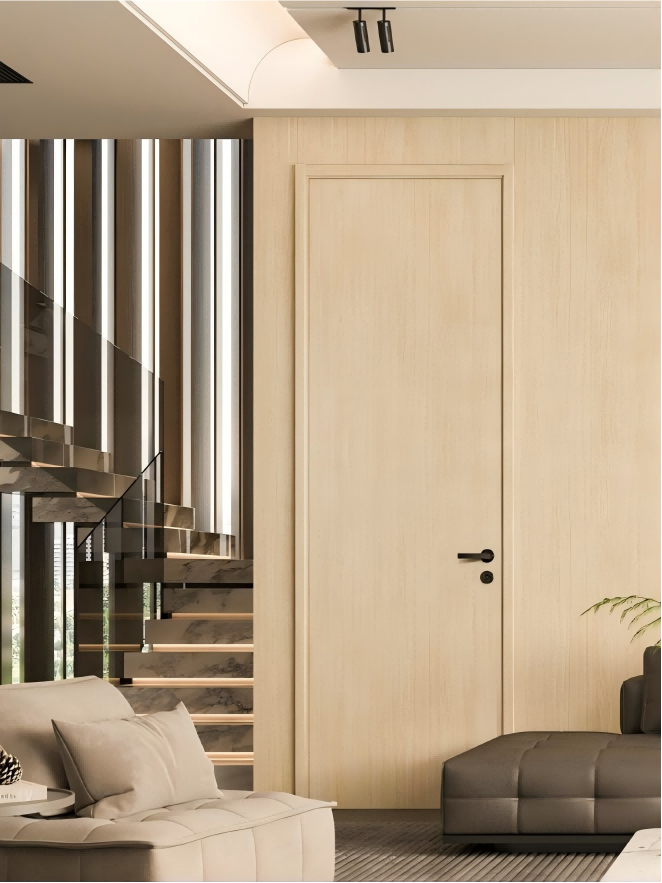
Wood and medium-density fiberboard (MDF) panels remain among the most popular choices for hotel guest rooms because they deliver warmth, tactile richness, and premium perceived value at a manageable cost. They can be specified as solid wood veneer, engineered wood, or MDF with a painted or laminated finish.
Best for: Boutique hotels, lifestyle brands, resort properties, Scandinavian or biophilic design concepts.
Key benefits:
- High aesthetic impact — wood grain and texture communicate quality immediately
- Durable surface resists scuffs, dings, and everyday wear
- Can be routed with acoustic perforation patterns to add sound absorption while maintaining the wood look
- Available as large-format panels that reduce visible seams
- Veneer options allow for FSC-certified sustainable sourcing
Consideration: Solid wood responds to humidity and temperature changes. In humid climates or near air conditioning outlets, engineered wood or high-pressure laminate (HPL) alternatives are more stable. Fire treatment is required; specify Class B or better panels with documented flame-spread data.
3. PVC and Vinyl Wall Panels
PVC and vinyl wall panels have evolved significantly. Modern hotel-grade PVC panels offer realistic stone, wood, and textile finishes at a fraction of the cost and with exceptional maintenance advantages. They are waterproof, easy to wipe clean, and virtually immune to dents and scratches.
Best for: Budget hotels, extended-stay properties, bathroom-adjacent zones, high-traffic corridors leading to guest rooms.
Key benefits:
- Extremely low maintenance — simple damp-cloth cleaning
- Moisture and mold resistant, ideal for humid environments
- Fast installation, often click-lock systems requiring no adhesive
- Very competitive cost per square meter
- Consistent finish quality across large quantities
Consideration: Lower perceived luxury value compared to fabric or natural materials. Not recommended as the primary wall finish in premium guest rooms. Best used in secondary areas or as wainscoting.
4. 3D Textured Panels
Three-dimensional wall panels — manufactured from materials including MDF, plaster, polyurethane foam, recycled paper composites, and high-density polystyrene — create dramatic relief surfaces that catch light and add architectural interest to guest room walls without additional artwork or decorative elements.
Best for: Feature walls (behind the bed), lobbies spilling into guest-room corridors, boutique and design-forward hotel brands.
Key benefits:
- High visual impact — Instagram-worthy surfaces that guests photograph and share
- Can be painted any color on-site for flexibility
- Adds modest acoustic benefit through surface irregularity
- Available in a vast range of geometric and organic patterns
- Lightweight polyurethane options are easy to install and ship
Consideration: Textured surfaces accumulate dust in deep recesses and require periodic cleaning with compressed air or soft brushes. Specify sealed or painted finishes for easier maintenance. Not suitable as a full-room wall treatment in most hotel categories.
5. Natural Stone and Marble Panels
At the upper end of the market, thin-cut natural stone panels — marble, travertine, slate, and onyx — deliver an unmistakable quality statement. Modern stone panel technology uses stone veneers as thin as 3–5mm bonded to composite backing boards, reducing weight while retaining the authentic material look and feel.
Best for: Luxury and ultra-luxury hotels, flagship suites, resort spas, properties where the material itself is part of the brand story.
Key benefits:
- Unmatched premium perception — guests can feel and verify the authenticity of the material
- Extremely long lifespan with proper sealing and maintenance
- Unique veining means every installation is one-of-a-kind
- Adds thermal mass, helping rooms maintain a comfortable temperature
Consideration: Highest cost per square meter among all panel types. Heavy weight requires structural assessment. Sealing is required annually or biannually to prevent staining. Poor acoustic properties — best paired with dedicated acoustic elements elsewhere in the room.
6. Commercial Wallcovering (Type II Contract Fabric)
Though technically a wallcovering rather than a panel, Type II commercial wallcovering deserves mention because it is the most widely specified wall finish in mid-scale and upper-midscale hotel guest rooms globally. Applied directly to drywall, it provides a consistent, updatable finish in thousands of colors and textures.
Best for: Brand-standardized properties, mid-scale and upper-midscale hotels, high-volume renovation programs where consistency across hundreds of rooms is critical.
Key benefits:
- Very cost-effective for large room counts
- Easy to specify in standard hotel brand palettes
- Good durability — Type II wallcovering withstands 100+ scrub cycles
- Wide contractor availability for installation and replacement
Consideration: Does not provide meaningful acoustic benefit on its own. Requires combination with acoustic insulation in the wall cavity or separate acoustic panels to improve sound performance.
At-a-Glance Comparison: Wall Panel Types for Hotel Guest Rooms
| Panel Type | Durability | Acoustics | Aesthetics | Maintenance | Cost |
| Acoustic Fabric | High | Excellent | High | Medium | $$ |
| Decorative Wood/MDF | High | Good | Excellent | Low | $$$ |
| PVC / Vinyl | Very High | Poor | Medium | Very Low | $ |
| 3D Textured Panel | High | Good | Excellent | Low | $$$ |
| Natural Stone/Marble | Very High | Poor | Premium | Low | $$$$ |
| Wallcovering (fabric) | Medium | Good | High | Medium | $$ |
Note: Cost ratings are relative. $ = lowest cost per m²; $$$$ = highest. Ratings reflect typical commercial hotel-grade specifications.
5 Critical Factors to Evaluate Before Specifying Hotel Wall Panels
1. Acoustic Performance — The Factor Most Often Underestimated
Hotel guests are not acoustics engineers, but they know immediately when a room is noisy. Every hour of sleep lost to sound transmission is a negative review risk. When evaluating wall panels for acoustic performance, look at two distinct metrics: NRC (Noise Reduction Coefficient), which measures how much sound the panel absorbs within the room, and STC (Sound Transmission Class), which measures how well the wall system blocks sound from traveling between spaces.
A standalone panel will not solve STC issues — that requires a comprehensive wall assembly approach. However, high-NRC panels positioned on the headboard wall, opposite the entry door, and on the shared wall with the adjacent room can make a significant subjective difference in how quiet guests perceive the room to be.
2. Fire Safety Compliance — Non-Negotiable
Every wall panel specified for a hotel interior must meet the fire safety standards of the jurisdiction where the property is located. In the United States, this typically means compliance with ASTM E84 (the Steiner Tunnel Test), with a Class A flame-spread index of 0–25 and a smoke-developed index of 0–450. In the EU, the relevant standard is EN 13501-1, with most hotel applications requiring Class B or B-s1,d0.
Always request certified test reports with every panel specification, not just a supplier’s claim of compliance. Fire-related liability in hotels is severe, and design teams, procurement officers, and owners all share exposure. Never accept a panel without documented, third-party fire test data that matches the actual product being installed.
3. Durability and Lifecycle Cost
A hotel guest room experiences approximately 250–365 occupied nights per year. Multiply that by the number of guests, the rate of incidental contact with walls, and the frequency of housekeeping traffic, and you begin to understand the mechanical stress wall surfaces endure. A panel that looks premium at installation but requires replacement or major repair within five years has failed from a lifecycle-cost perspective — even if its upfront cost was low.
When evaluating durability, ask suppliers for:
- Impact resistance ratings (relevant for luggage and cart contact zones)
- Abrasion resistance data (Taber abrasion cycles to surface failure)
- Washability certification (number of wet scrub cycles before surface degradation)
- Warranty terms and replacement lead times
4. Maintenance Integration — Think Like Your Housekeeping Team
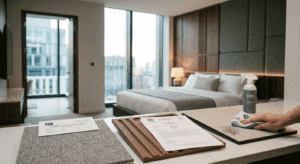
The most overlooked stakeholder in wall panel specification is the housekeeping department. If a wall panel cannot be cleaned efficiently with the hotel’s standard cleaning products and procedures, it will either deteriorate faster than expected or housekeeping staff will avoid cleaning it — resulting in a visibly dirtier room. Before finalizing any specification, test cleaning compatibility: apply your standard hotel cleaning spray to a sample panel, leave for the required contact time, and wipe clean. Note any discoloration, surface dulling, or texture change.
Pro tip: Specify panels with a surface coating or sealant rated for the cleaning chemicals your property uses. Ask your supplier to confirm compatibility in writing.
5. Brand Alignment and Guest Experience Narrative
Wall panels are one of the most powerful tools available to communicate a hotel brand’s identity. The material, texture, color palette, and scale of wall panels set the emotional tone of the room before a guest has touched the bed or sat in a chair. A boutique eco-resort might specify reclaimed wood panels and natural cork to reinforce its environmental commitment. A sleek business hotel might choose large-format, matte-lacquered MDF panels in a monochromatic palette to signal efficiency and modernity. A heritage property might use plaster-finish panels with classical molding profiles to connect to its architectural legacy.
Do not specify wall panels in isolation from your brand positioning brief. The best hotel wall panel programs are developed collaboratively between the interior designer, the brand standards team, and a supplier who understands hospitality environments at a commercial scale.
What Leading Hotel Brands Are Specifying in 2024–2025
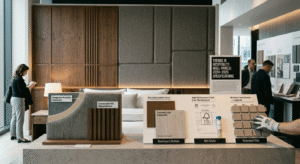
While design trends vary significantly by brand positioning and geography, several clear directions have emerged across the global hotel market:
- Full-service and luxury hotels are increasingly combining wood veneer panels on major surfaces with integrated acoustic panels behind the headboard wall — creating a layered design that is both visually coherent and acoustically effective.
- Lifestyle and boutique brands are specifying large-format panels in unexpected materials — including recycled leather, concrete-look composites, and hand-applied plaster finishes — to create differentiated, memorable room environments.
- Mid-scale and select-service brands are moving toward high-performance vinyl and PVC systems that offer the look of premium materials with dramatically reduced maintenance requirements and renovation cycle costs.
- Sustainability-focused properties are prioritizing panels with recycled content, low-VOC adhesives and finishes, and FSC or equivalent certification — responding to both guest demand and corporate ESG commitments.
- Extended-stay and aparthotel brands are specifying easy-to-replace modular panel systems that allow targeted section replacement rather than full-room refurbishments when panels are damaged.
5 Common Mistakes Hotels Make When Specifying Wall Panels
- Specifying panels based on sample appearance alone, without reviewing certified acoustic and fire performance data for the specific product and assembly to be installed.
- Selecting a visually striking panel without consulting the housekeeping team on cleanability — resulting in rapid surface degradation and an expensive early replacement.
- Treating the entire guest room as a single acoustic zone, rather than prioritizing panel placement strategically on the headboard wall and shared-party-wall surfaces where acoustic intervention delivers the highest return.
- Failing to order a sufficient quantity buffer — typically 10–15% overage — to allow for waste, damage during installation, and future patching after minor repairs.
- Working with suppliers who cannot provide fire-rated samples, certified test documentation, and local installation references — exposing the project to compliance risk and quality uncertainty.
Frequently Asked Questions
How thick should wall panels be for hotel guest rooms?
Thickness depends on the panel type and application. Decorative MDF panels typically range from 9mm to 18mm. Acoustic fabric panels range from 25mm to 50mm depending on the NRC rating required. PVC panels are typically 5mm to 10mm. Thicker acoustic panels deliver better low-frequency absorption but require more wall clearance. Always confirm available depth behind the panel face with your interior architect before specifying.
Can wall panels be installed in hotel bathroom areas?
Yes, but material selection is critical. For wet zones — shower enclosures and areas subject to direct water contact — specify waterproof PVC, composite stone, or porcelain panels with fully waterproof adhesives and sealed joints. For bathroom walls outside the wet zone, moisture-resistant MDF or moisture-tolerant wallcovering can be appropriate. Fabric and standard acoustic panels are not suitable for wet areas.
How long do hotel wall panels typically last?
Lifespan varies considerably by material and use intensity. High-quality fabric acoustic panels in guest rooms typically last 10–15 years before the fabric shows significant wear. Wood veneer panels can last 15–20 years with proper maintenance. PVC panels can last 20+ years in low-impact zones. Natural stone panels, if properly sealed, have a lifespan exceeding 25 years. The most common reason for early replacement is not material failure but design refresh cycles, which typically occur every 7–12 years in full-service hotels.
Do wall panels require special installation expertise?
Most commercial wall panel systems are designed to be installed by general interior contractors with basic millwork skills. However, acoustic panel systems and large-format wood veneer panels benefit from installation by contractors with specific hospitality or commercial experience. Incorrect installation — particularly inadequate substrate preparation, poor seam management, or incorrect adhesive selection — is the primary cause of panel failure in hotel environments. Always require installation references from your contractor and consider specifying factory-authorized installation for premium systems.
What is a realistic budget for hotel guest room wall panels?
Budget ranges vary widely by material and market. As a general guide for supply-only cost in major markets: commercial wallcovering runs approximately $8–$20 per square meter; PVC panels, $15–$35; acoustic fabric panels, $40–$120; decorative wood veneer panels, $60–$180; 3D textured panels, $30–$90; and natural stone panels, $150–$500+. Installation adds 30–60% to material cost depending on panel complexity and local labor rates. A realistic total-installed budget for mid-scale hotel guest room walls typically falls in the $50–$150 per square meter range; luxury applications can reach $300+ per square meter.
Ready to Specify the Right Wall Panels for Your Hotel Project?
Selecting wall panels for a hotel guest room is a decision with long-term financial, operational, and guest-experience consequences. The information in this guide gives you a solid foundation — but the right specification for your specific project depends on your hotel category, design concept, acoustic requirements, local fire codes, budget framework, and installation timeline.
Our team specializes in hotel-grade wall panel solutions for hospitality projects of all scales — from boutique properties to large full-service hotel refurbishments. We provide certified product samples, fire and acoustic test documentation, project-specific specification support, and competitive pricing for volume orders.
Final Thoughts
The best wall panel for a hotel guest room is not the most expensive one, nor the one that looks most impressive on a sample card. It is the one that performs reliably across thousands of guest nights, requires predictable maintenance, meets every safety standard, and tells your brand story every time a guest walks through the door.
Invest the time upfront to evaluate materials against all five criteria in this guide — acoustics, fire safety, durability, maintenance, and brand alignment — and your wall panel decision will deliver returns for a decade or more. Take shortcuts, and the walls will tell that story too.