Table of Contents
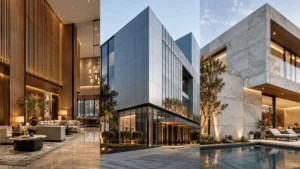
Walk into any premium hotel, contemporary office tower, or architect-designed villa, and you are almost certainly looking at a composite wall panel of one type or another. But here is what most buyers — and even many contractors and specifiers — do not realise: the term ‘composite wall panel‘ covers at least seven structurally distinct material categories, each with fundamentally different compositions, performance profiles, cost structures, and appropriate applications. Choosing the wrong composite panel type for your project is not just a specification error — it is an investment in future problems. Choosing the right one can define the quality, durability, and visual impact of an entire development for decades. This guide maps every major composite wall panel type, explains what each is made from, and tells you precisely which projects each one belongs on.
Seven main types of composite wall panels exist in the construction market: (1) WPC — Wood Plastic Composite panels combining wood fibre and polymer, best for hotels, villas, and exterior facade cladding; (2) HPL — High-Pressure Laminate panels, best for commercial interiors, schools, and healthcare; (3) ACM — Aluminium Composite Material panels, best for lightweight commercial facades; (4) Fibre Cement Composite panels, non-combustible, best for exterior cladding on public and civic buildings; (5) GRC — Glass Fibre Reinforced Concrete panels, for architectural feature facades; (6) FRP — Fibre Reinforced Polymer panels, for industrial and marine environments; (7) SPC — Stone Plastic Composite panels, primarily for wet-area wall tiles. WPC is currently the fastest-growing category due to its unique combination of natural aesthetics, structural performance, and low maintenance.
1. Understanding Composite Wall Panels: What Makes a Panel ‘Composite’?
A composite material is one in which two or more constituent materials — with different physical or chemical properties — are combined to produce a material with characteristics superior or different from those of the individual components. In the context of wall panels, ‘composite’ describes a broad category of engineered cladding products that use multi-material construction to achieve performance combinations that no single material can deliver alone.
The term therefore encompasses a wide range of products: from wood-polymer hybrids to metal-faced aluminium sandwiches, from glass-fibre-reinforced concrete to high-pressure resin-impregnated laminates. What they share is an engineered multi-material structure. What they do not share is any common performance profile — the performance differences between composite panel types are as significant as the differences between the categories’ constituent materials themselves.
Understanding these differences before specifying or purchasing is the foundation of a successful wall panel project.
Key principle: ‘Composite wall panel’ is a category, not a product. Specifying ‘composite wall panels‘ without defining the type is equivalent to specifying ‘shoes’ without defining whether you need running shoes or steel-toe boots.
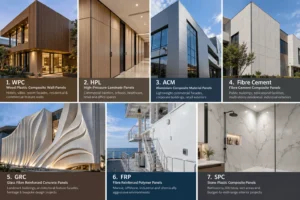
2. The Seven Types of Composite Wall Panels
TYPE 1 WPC — Wood Plastic Composite Wall Panels
Composition
WPC panels are manufactured from a blend of wood fibre or flour (typically 50–70% by weight), thermoplastic polymer (polyethylene, polypropylene, or PVC as a minor binder), and processing additives including UV stabilisers, coupling agents, lubricants, and pigments. The compound is extruded through a die to form the panel profile. Premium products use co-extrusion technology to add a polymer-rich protective outer shell over the WPC core.
Key Performance Characteristics
- Appearance: Deep embossed natural wood grain or stone texture finishes — the most visually realistic of all composite panel types at normal viewing distances
- Structural strength: Solid core WPC achieves 40–60 MPa compressive strength and density 950–1,200 kg/m³ — the densest and strongest of the polymer-based composite panel types
- Moisture resistance: Waterproof when specified as solid core — no internal voids for moisture accumulation; suitable for exterior facades and wet areas
- Outdoor performance: Co-extruded WPC is UV-stable and specifically engineered for exterior cladding applications — the only polymer-based composite panel appropriate for outdoor use
- Fire performance: Class B or C (EN 13501-1); fire-retardant formulations available; no chlorine-based combustion products (unlike PVC panels)
- Maintenance: Near-zero — no sealing, staining, or painting required throughout the service life
- Lifespan: 25–30 years with 10–25 year manufacturer warranties on quality products
Best Applications
- Hotel guest rooms, corridors, and public areas
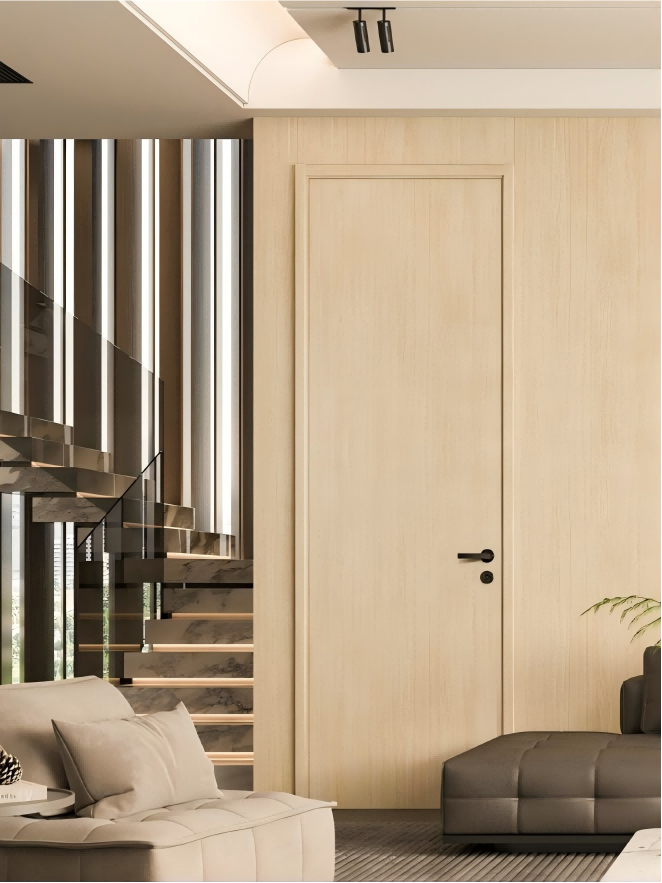
- Luxury villa and high-end residential interior and exterior walls
- Resort and hospitality exterior facades
- Commercial feature walls and retail environments
- Bathroom and pool surround feature walls (solid core)
- Exterior pergolas, deck surrounds, and landscape structures
Cost Range
$18–55/m² FOB China, depending on product grade, co-extrusion specification, and profile complexity. Mid-range co-extruded WPC for commercial exterior use: $28–42/m².
WPC advantage: The only composite panel type that combines natural wood-grain aesthetics with genuine outdoor durability, solid-core structural strength, and near-zero maintenance — making it the preferred specification for premium hospitality, residential, and commercial projects globally.
TYPE 2 HPL — High-Pressure Laminate Panels
Composition
HPL (High-Pressure Laminate) panels are manufactured by impregnating multiple layers of kraft paper with thermosetting resins (typically phenol-formaldehyde for core layers and melamine-formaldehyde for the decorative surface), then consolidating the stack under high pressure (60–80 bar) and heat. The result is an extremely dense, hard, and rigid sheet. For exterior use, HPL sheets are typically bonded to an aluminium honeycomb, foam, or mineral core to create a structural composite panel system.
Key Performance Characteristics
- Appearance: Virtually unlimited surface graphic and colour options — from solid colours to photographic-quality images, metallic effects, and real wood veneer surfaces. High resolution printing capability makes HPL the most design-flexible composite panel surface.
- Surface hardness: Rockwell hardness 110–130 — significantly harder than WPC or ACM. Extremely scratch-resistant and abrasion-resistant, making it ideal for high-traffic interior surfaces.
- Fire performance: Class B (EN 13501-1) in standard formulation; Class A2 available in compact mineral core versions — suitable for high-rise and public building specification.
- Moisture resistance: Good in standard formulation; excellent in compact HPL without substrate. Not suitable for continuous water immersion.
- Outdoor performance: Exterior-grade HPL with UV-resistant surface is suitable for facade applications, though surface print can fade faster than WPC co-extrusion colours under intense UV.
Best Applications
- Commercial and educational building interiors — lockers, toilet cubicles, surface cladding
- Healthcare interiors — hygienic wall surfaces, operating theatre surrounds
- Retail store facades and brand-specific graphic wall treatments
- Office interior feature walls where graphic design is the brief
- Exterior facade cladding on commercial buildings (exterior-grade HPL)
- Kitchen and bathroom furniture panels
Cost Range
$25–80/m² depending on core material (aluminium honeycomb, foam, mineral), surface decoration complexity, and format size. Exterior compact HPL: $35–65/m².
HPL limitation: Standard HPL lacks the natural warmth and three-dimensional texture of WPC. It reads as a flat graphic surface rather than a natural material — appropriate for graphic and brand-driven applications but not for projects seeking organic warmth and tactile quality.
TYPE 3 ACM — Aluminium Composite Material Panels
Composition
ACM panels consist of two thin aluminium face sheets (typically 0.3–0.5mm each) bonded to a solid or mineral-filled polyethylene or fire-retardant core. The total panel thickness is typically 3–6mm. ACM panels are extremely lightweight, rigidly flat, and available in a wide range of surface finishes including PVDF-coated solid colours, brushed metal, mirror, and printed wood-effect surfaces. Note: ACM panels with standard polyethylene cores were implicated in fire spread in several building disasters; mineral-filled fire-retardant core ACM is the appropriate specification for any application where fire performance matters.
Key Performance Characteristics
- Weight: 3–5 kg/m² — the lightest of all composite panel types. This makes ACM particularly suitable for large-format cladding on tall buildings where structural loading is a concern.
- Flatness: ACM panels are dimensionally the flattest of all composite panel types — ideal for sleek, graphic modern facade designs where waviness would be unacceptable.
- Appearance: Solid PVDF-coated colours, brushed metal, and mirror finishes — high-performance surfaces that maintain colour and gloss for 20+ years with proper coating specification.
- Fire performance: CRITICAL: Standard PE-core ACM is highly combustible and should not be specified for any facade application. FR (fire-retardant) core ACM achieves A2 classification and is the only ACM appropriate for facades.
- Impact resistance: Moderate — thin aluminium face sheets can dent under concentrated impact. Not appropriate for pedestrian-level surfaces subject to regular contact or impact.
- Thermal expansion: High — aluminium expands significantly with temperature change. Facade systems must accommodate movement with appropriate joint design.
Best Applications
- Commercial office building facades — large panel format, elevated positions
- Retail and corporate showroom exteriors
- Signage and branded facade elements
- Interior reception and lobby wall cladding (solid colour, high-end commercial)
- Architectural fascias and canopies
Cost Range
$20–60/m² for standard FR-core ACM panels in common sizes and PVDF finishes.
ACM fire warning: Always specify FR (fire-retardant) mineral core ACM for facade applications. Standard PE-core ACM should never be used on building exteriors — it is a documented fire risk. Confirm fire certification in writing before procurement.
TYPE 4 Fibre Cement Composite Panels
Composition
Fibre cement panels are manufactured from a mixture of Portland cement, cellulose or synthetic fibres, silica sand, and water, which is formed under pressure into sheets and then cured. Modern fibre cement panels are typically factory-primed or painted and are available in smooth, textured, or clapboard profiles. They can also be produced with wood-grain embossing or rendered surface textures for contemporary architectural applications.
Key Performance Characteristics
- Fire performance: Class A1 non-combustible — the best fire classification of any composite wall panel type. Fibre cement does not burn, does not contribute to fire spread, and does not produce toxic combustion products.
- Weight: 12–22 kg/m² — significantly heavier than polymer-based composites. Structural substrate must be rated to carry the imposed load; this can add cost in refurbishment projects.
- Dimensional stability: Excellent — cement-based materials have very low thermal and moisture expansion. Long-term dimensional stability is superior to all polymer-based composite panel types.
- Moisture resistance: Good with properly maintained paint or coating system. Unprotected fibre cement is permeable to water — re-coating every 7–10 years is required for exterior applications.
- Aesthetics: Modern fibre cement panels offer a range of architectural finishes, but cannot match WPC for natural wood-grain depth or HPL for graphic print quality. Best suited for contemporary minimal or industrial aesthetic directions.
Best Applications
- Exterior cladding on civic, educational, and government buildings
- Multi-storey residential facades where non-combustibility is mandated
- Industrial building exteriors where long-term durability is the primary driver
- Architectural screen and brise-soleil elements
- Heritage and period building extensions where a render-effect finish is required
Cost Range
$15–40/m² material cost; total installed cost higher due to weight-related fixing and substrate requirements.
Fibre cement advantage: The only composite panel type that achieves A1 non-combustibility — the specification requirement for the most demanding fire safety applications. For high-rise and public buildings where fire performance is the defining constraint, fibre cement is often the mandatory specification.
TYPE 5 GRC — Glass Fibre Reinforced Concrete Panels
Composition
GRC (also known as GFRC — Glass Fibre Reinforced Concrete) panels are manufactured by spraying or casting a cement-based mixture reinforced with alkali-resistant glass fibres into moulds. The result is a thin-section concrete element — typically 10–20mm thick — that achieves the appearance and durability of cast concrete at a fraction of the weight (typically 60–80% lighter than equivalent solid concrete). GRC panels can reproduce almost any architectural surface texture, from smooth polished finishes to complex three-dimensional relief patterns.
Key Performance Characteristics
- Design freedom: GRC can be cast into virtually any three-dimensional form — complex curves, deep relief patterns, large-format architectural feature elements that no flat panel system can replicate.
- Fire performance: A1 non-combustible — concrete matrix does not burn.
- Weight vs solid concrete: GRC panels at 12–18 kg/m² are significantly lighter than solid precast concrete, but still heavier than polymer-based composites.
- Cost and lead time: GRC is a premium specialist product — complex moulds, bespoke form design, and extended production lead times (6–12 weeks) make it the most expensive panel type per square metre for most applications.
- Maintenance: Low for standard finish; sealing recommended every 10–15 years for exposed positions.
Best Applications
- Landmark civic and institutional building facades
- Feature architecture requiring three-dimensional sculptural relief
- Heritage building restoration and contextual design
- High-profile commercial developments where architectural distinction is the brief
Cost Range
$80–200/m²+ for standard GRC cladding; complex bespoke forms significantly higher. GRC is a premium material and premium budget is required.
TYPE 6 FRP — Fibre Reinforced Polymer Panels
Composition
FRP (Fibre Reinforced Polymer, also called GRP — Glass Reinforced Plastic) panels are manufactured by embedding glass, carbon, or aramid fibres in a thermosetting polymer resin matrix (typically polyester, vinyl ester, or epoxy). The fibre reinforcement dramatically increases the strength-to-weight ratio of the polymer matrix. FRP panels are formed by hand lay-up, resin transfer moulding, or pultrusion processes, depending on the required profile and performance.
Key Performance Characteristics
- Corrosion resistance: FRP is completely immune to corrosion — it does not rust, oxidise, or degrade in chemical or marine environments where metals and natural materials fail rapidly. This is its defining advantage over all other panel types.
- Weight: 4–8 kg/m² — lightweight despite high structural performance, particularly relevant for marine and offshore applications where weight is critical.
- Chemical resistance: Resistant to a wide range of acids, alkalis, and solvents — specification appropriate for industrial environments where other materials are chemically incompatible.
- Fire performance: A2 classification achievable with specific formulations; standard glass-reinforced polyester is typically B or C class. Specialist fire-retardant formulations available.
- Appearance: Smooth, painted finishes are standard. FRP is not typically specified for aesthetic applications — it is a performance material for demanding environments.
Best Applications
- Marine and offshore structures — boat hulls, offshore platform walls
- Industrial processing facilities — chemical plant cladding, tank linings
- Water treatment and desalination plant interiors
- Cooling tower cladding and other high-humidity mechanical environments
- Agricultural building applications where chemical resistance is needed
Cost Range
$30–90/m² depending on fibre type, resin specification, and panel format. Carbon fibre FRP significantly more expensive than glass fibre.
FRP positioning: FRP is a specialist performance material for chemically aggressive or marine environments — not an aesthetic wall panel for hospitality or residential use. Its corrosion immunity is unmatched, but this advantage is irrelevant in most architectural applications.
TYPE 7 SPC — Stone Plastic Composite Panels
Composition
SPC (Stone Plastic Composite, also called Stone Polymer Composite) panels are manufactured from a core of limestone powder (calcium carbonate), PVC resin, and stabilising additives, topped with a photographic print layer and a wear-resistant surface coating. Originally developed as a flooring product, SPC has been adapted into wall panel formats primarily for bathroom, kitchen, and wet-area applications where a tile-effect aesthetic is desired without the weight and installation complexity of ceramic or porcelain tile.
Key Performance Characteristics
- Waterproof: 100% waterproof — the limestone/PVC core absorbs no moisture at all, making SPC genuinely appropriate for wet areas including showers, bathrooms, and splash-back zones.
- Appearance: High-definition photographic print layers reproduce marble, stone, wood, and tile patterns convincingly at normal viewing distances — the same surface technology used in SPC flooring.
- Weight: 5–8 kg/m² — heavier than standard PVC but lighter than ceramic tile (18–25 kg/m²). SPC wall panels can typically be installed on any structurally sound substrate without additional reinforcement.
- Fire performance: SPC contains PVC resin — the same fire and combustion concerns that apply to PVC wall panels apply to SPC. Not appropriate for applications requiring B or A2 fire classification.
- Outdoor suitability: SPC is not rated for exterior applications — UV exposure degrades the PVC binder and print layer. Interior wet areas only.
Best Applications
- Bathroom and shower wall panels (budget to mid-range residential)
- Kitchen splashbacks and wet utility areas
- Commercial bathroom and cloakroom applications
- Budget renovation projects where tile aesthetics are desired without tile installation
Cost Range
$20–45/m² for standard SPC wall panels; premium stone-effect or large-format panels at the higher end.
SPC positioning: SPC is a cost-effective waterproof panel for budget-to-mid-range wet area applications. It is not a premium architectural material and is not appropriate for premium hospitality or exterior applications.
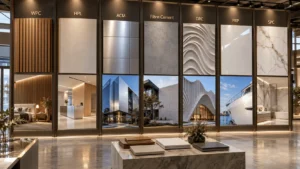
3. At-a-Glance Comparison: All Seven Panel Types
The table below provides a structured comparison of all seven composite panel types across the most critical specification dimensions:
| Factor | WPC | HPL | ACM | Fibre Cement | FRP | SPC |
| Appearance | Natural wood/stone | Graphic/solid colour | Metallic/solid | Textured concrete | Smooth/painted | Stone-look tile |
| Weight (kg/m²) | 4–12 | 8–14 | 3–5 | 12–22 | 4–8 | 5–8 |
| Exterior use | ✔ Yes | ✔ Yes | ✔ Yes | ✔ Yes | ✔ Yes | ✗ No |
| Interior use | ✔ Yes | ✔ Yes | ✔ Yes | Limited | ✔ Yes | ✔ Yes |
| Moisture resist. | Excellent | Good | Excellent | Very good | Excellent | Excellent |
| Fire performance | B–C class | B–C class | A2 non-comb. | A1 non-comb. | B class | A2 class |
| Impact resistance | High | Moderate | Low–Moderate | High | High | Moderate |
| Thermal expansion | Low | Very low | High | Very low | Very low | Moderate |
| Maintenance | Near zero | Low | Low | Low | Near zero | Near zero |
| Cost (FOB China) | $18–55/m² | $25–80/m² | $20–60/m² | $15–40/m² | $30–90/m² | $20–45/m² |
| Lead time (wks) | 2–4 | 3–6 | 2–4 | 3–5 | 4–8 | 2–4 |
| Lifespan (yrs) | 25–30 | 20–30 | 30–40 | 40–50 | 30+ | 15–20 |
| Best for | Hotels, villas | Commercial, schools | Offices, retail | Exteriors, civic | Industrial, marine | Wet areas, tiles |
4. Project Selector: Which Type Is Right for Your Application?
Use this project-based selector to match your specific application to the most appropriate composite panel type:
| Project Type | Best Panel Type | Match Score | Primary Reason |
| 5-star hotel — guest rooms & corridors | WPC | ★★★★★ | Natural aesthetics, sound mass, fire performance, fixing strength |
| Hotel / resort — exterior facade | WPC | ★★★★★ | Weatherproof co-extruded; UV stable; low maintenance |
| Luxury villa — interior walls | WPC | ★★★★★ | Wood grain depth; solid core; 25-year lifespan |
| Villa / residential — exterior | WPC / Fibre Cement | ★★★★★ | WPC for wood look; fibre cement for modern render look |
| Commercial office — facade | ACM | ★★★★★ | Lightweight; metallic aesthetic; fast installation |
| Commercial office — interior | HPL | ★★★★★ | Design flexibility; graphic print options; impact resistance |
| School / hospital — interior | HPL / Fibre Cement | ★★★★★ | Hygienic, durable, fire-rated; easy to clean |
| Industrial / marine environment | FRP | ★★★★★ | Corrosion-proof; chemical resistant; no rusting |
| Public building — exterior | Fibre Cement / GRC | ★★★★★ | Non-combustible; heritage appearance; civic scale |
| Retail fitout — feature walls | WPC | ★★★★★ | Speed of install; design range; premium finish |
| Bathroom / wet area (budget) | SPC / WPC | ★★★★★ | Waterproof; tile-effect; SPC for floor-to-wall continuity |
| Airport / government — all areas | WPC / ACM / Fibre Cement | ★★★★★ | Fire rating critical; structural performance; public safety |
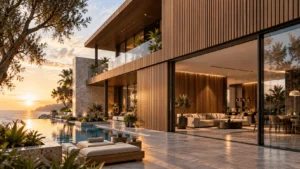
5. Why WPC Is the Fastest-Growing Composite Wall Panel Type
Among all seven composite panel types, WPC has experienced the most rapid growth in adoption over the past decade — and the reasons illuminate why it occupies a unique position in the market.
5.1 The Aesthetic Gap Is Closing
The historical knock on WPC was that it looked like a plastic imitation of wood — unconvincing under scrutiny. Co-extrusion technology, combined with advances in deep-emboss die design and multi-tonal pigment formulation, has transformed this. Modern premium WPC panels with textured surfaces are routinely described by interior designers as ‘indistinguishable from timber at normal viewing distances’ — a claim that was not credible ten years ago but is consistently validated by installed project photography today.
5.2 The Maintenance Equation
Every other panel type in the composite category requires some level of periodic maintenance — HPL needs careful cleaning with approved chemicals; ACM requires inspection and recoating of joint sealants; fibre cement must be recoated every 7–10 years; GRC requires periodic sealing. WPC’s near-zero maintenance requirement — occasional washing with water — is a genuine differentiator in the context of commercial buildings where maintenance scheduling is complex and maintenance labour is expensive.
5.3 The Lifecycle Cost Advantage
WPC’s combination of premium material cost offset by near-zero maintenance, long lifespan (25–30 years), and low installation labour (compared to stone, fibre cement, and GRC) produces a total lifecycle cost that is competitive with or better than most alternatives when calculated over 10+ years. For commercial property investors and hotel asset managers who think in 20-year cashflows, WPC’s predictable low-cost profile is highly attractive.
5.4 The Environmental Shift
WPC made from recycled wood fibre and recycled polymer content offers a sustainability narrative that resonates with green building specifications and ESG-driven developer requirements. As LEED, BREEAM, and other green certification frameworks gain traction in more markets, WPC’s recycled content credentials are becoming a genuine specification advantage over virgin-polymer alternatives like PVC, SPC, and standard ACM.
Market direction: WPC panels are increasingly the default first-choice specification for premium interior and exterior wall cladding in hotels, villa developments, and commercial projects in Asia, the Middle East, Europe, and Australia. The performance case, aesthetic quality, and cost profile together make it difficult for any other composite panel type to compete across the full range of project requirements.

6. How to Choose the Right Composite Wall Panel Type: A Decision Framework
When evaluating composite wall panel options for a specific project, work through the following decision criteria in order:
Step 1 — Define the Fire Performance Requirement
Fire classification is often the constraint that eliminates options before any other factor is considered. Determine the applicable building regulation fire class requirement for your project location, building type, and facade position. If A1 or A2 non-combustibility is mandatory, specify fibre cement or FR-core ACM (A2). If B class is acceptable, WPC, HPL, and FRP all qualify. If no specific fire class is mandated, move to Step 2.
Step 2 — Define the Exposure Environment
Is the installation exterior, interior, or semi-exposed? Will it be subject to direct UV, rain, freeze-thaw cycling, or chemical exposure? Exterior applications immediately narrow the field to: co-extruded solid-core WPC, exterior-grade HPL, FR-core ACM, fibre cement, GRC, and FRP. Interior-only panel types (standard PVC, SPC) are eliminated. Chemical or marine environments point specifically to FRP.
Step 3 — Define the Aesthetic Requirement
What visual outcome is the specification trying to achieve? Natural wood grain warmth → WPC. Graphic print or solid colour → HPL or ACM. Metallic or mirror finish → ACM. Concrete or render appearance → fibre cement or GRC. Tile-effect wet area → SPC. There is often limited overlap between the aesthetic strengths of different panel types — defining the aesthetic direction early significantly simplifies the selection.
Step 4 — Define the Budget Parameter
Evaluate total lifecycle cost, not just material cost per square metre. Include installation labour, maintenance, and expected replacement cycles. WPC and SPC offer low maintenance that partially offsets higher material cost. Fibre cement and GRC have high installation costs due to weight. ACM installs quickly on lightweight sub-frames. Evaluate the full picture.
Step 5 — Verify Supplier Capability
For each shortlisted panel type, confirm that your prospective supplier can provide: the specification you require (fire class, dimensions, finish), the volume you need in a consistent batch, certification documentation appropriate for your market, and references from comparable installed projects. A panel type that cannot be reliably sourced to your specification is not a viable specification, regardless of its theoretical merits.
Frequently Asked Questions
What is the most popular type of composite wall panel for hotels?
WPC (Wood Plastic Composite) wall panels are the dominant specification in the hotel and hospitality sector, particularly for guest rooms, corridors, and feature walls. The combination of natural wood-grain aesthetics, solid-core structural performance, near-zero maintenance, and competitive lifecycle cost makes WPC the preferred choice for hotel developers and interior designers across Asia, the Middle East, and beyond. For exterior hotel facades, co-extruded solid-core WPC and fibre cement are the most common specifications.
Which composite wall panel type is completely non-combustible?
Fibre cement panels and GRC (Glass Fibre Reinforced Concrete) panels achieve A1 non-combustibility — the highest fire classification under EN 13501-1. FR-core ACM (Aluminium Composite Material with fire-retardant mineral core) achieves A2. WPC, HPL, and FRP typically achieve Class B or C. SPC (Stone Plastic Composite) contains PVC resin and has less favourable fire performance. For applications where non-combustibility is mandatory — high-rise facades, hospitals, schools — fibre cement or FR-core ACM are the appropriate specifications.
Can any type of composite wall panel be used outdoors?
Not all composite panel types are appropriate for exterior use. Co-extruded solid-core WPC, exterior-grade HPL, FR-core ACM, fibre cement, GRC, and FRP are all suitable for exterior applications with appropriate specifications. Standard PVC panels and SPC panels are interior-only products and degrade under UV exposure. Always confirm the specific product’s exterior rating and UV performance warranty — not all products within a category carry exterior ratings.
What is the cheapest type of composite wall panel?
Fibre cement panels have the lowest material cost at $15–40/m², and SPC wall panels are also competitively priced at $20–45/m². However, total installed cost must be evaluated rather than material cost alone — fibre cement’s weight increases installation labour and substrate requirements; SPC is interior-only and not appropriate for all applications. WPC at $18–55/m² material cost often represents the best total lifecycle value for quality interior and exterior applications.
Which composite wall panel has the longest lifespan?
GRC and fibre cement panels have the longest theoretical service lives — 40–60+ years in maintained exterior installations. ACM with PVDF coating is warranted for 30+ years of colour performance. WPC quality products are typically warranted for 15–25 years and designed for 25–30 year service lives. HPL achieves 20–30 years in appropriate applications. FRP panels in appropriate chemical environments have service lives exceeding 30 years. SPC panels have the shortest expected lifespans at 15–20 years for interior applications.
How do I get WPC composite wall panel samples to evaluate?
Contact Melinco Group directly to request a free WPC wall panel sample pack. We supply physical samples across our full product range — solid core exterior panels, co-extruded interior panels, and custom colour specifications — along with technical datasheets, CE/SGS certification documentation, and UV weathering test reports. Our team can also provide technical consultation to confirm whether WPC is the correct specification for your specific project type and environment.
Conclusion: Seven Types, One Right Answer for Each Project
The composite wall panel market offers genuine diversity — seven distinct material types with genuinely different performance profiles, aesthetic qualities, and appropriate applications. The right choice is never automatic, and it cannot be made on price alone.
Fibre cement and GRC win on non-combustibility and longevity for civic and high-rise applications. HPL wins on graphic design flexibility for commercial interiors. ACM wins on weight and flatness for large-format commercial facades. FRP wins on corrosion resistance for chemical and marine environments. SPC provides a budget waterproof option for wet areas.
And WPC — Wood Plastic Composite — wins in the largest and most commercially significant segment of the market: premium hospitality, luxury residential, and high-specification commercial interior and exterior applications where the combination of natural aesthetics, structural performance, outdoor durability, near-zero maintenance, and competitive lifecycle cost is the specification brief. It is the composite panel type that has grown fastest and continues to grow — because it is the one that most consistently delivers on the promise of premium quality across the widest range of demanding applications.
Need the Right Composite Wall Panel for Your Project?
Melinco specialises in premium WPC composite wall panels — the panel type chosen by the world’s leading hotel brands, luxury villa developers, and landmark commercial projects for its unmatched combination of aesthetics, performance, and lifecycle value.
✔ Free WPC sample pack + comparison with your current spec
✔ OEM, custom colour & profile available
✔ CE / SGS certified