Every wall panel failure starts with the same root cause: the wrong materials, used in the wrong proportions. Whether you’re sourcing WPC wall panels for a large-scale commercial project, importing them for resale, or evaluating a new supplier, understanding what goes into the production process is the difference between a product that impresses for years and one that disappoints within months. The material formula behind a WPC wall panel is where quality is built — or broken — long before a single panel ever reaches a wall.
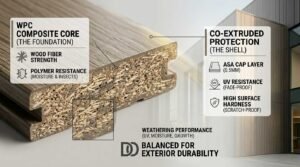
WPC (Wood Plastic Composite) wall panels are produced using three core material groups: wood fiber or wood flour (typically 40–70% of total composition by weight), a thermoplastic polymer binder such as PVC, PE, or PP (typically 25–50%), and a carefully formulated package of functional additives including UV stabilizers, antioxidants, lubricants, coupling agents, colorants, foaming agents, and optional flame retardants. Premium WPC wall panels also incorporate a co-extruded protective cap layer made from ASA or PMMA resin, which delivers superior surface hardness, UV resistance, and color stability. The precise ratio of these materials, the grade of each input, and the additive package all directly determine the panel’s structural strength, moisture resistance, dimensional stability, and long-term outdoor performance.
Understanding WPC: More Than Just a ‘Wood-Look’ Surface
WPC stands for Wood Plastic Composite — a category of engineered building material that combines the natural aesthetics of wood fiber with the structural advantages of thermoplastic polymers. Unlike solid wood or pure plastic profiles, WPC achieves a unique performance balance: it resists moisture and insects like plastic, while providing the warm visual texture and machinability associated with natural wood.
In wall panel applications specifically, this balance is critical. Exterior wall cladding must withstand UV radiation, thermal expansion and contraction, moisture ingress, impact, and biological growth — all while maintaining an attractive appearance for years or even decades. The WPC formula is engineered to meet these demands by precisely combining different material inputs at controlled ratios.
What makes WPC wall panel production particularly complex is that each raw material plays a distinct role — and the failure of any single component to meet specification can compromise the entire panel system. This is why material knowledge is the single most important foundation of intelligent sourcing.
The Core Materials in WPC Wall Panel Production
WPC wall panel production involves four main material categories. Here is a detailed breakdown of each one.
1. Wood Fiber or Wood Flour
Wood fiber is the defining component of any WPC product — it gives the material its natural look, texture, and machinability. In most WPC wall panel formulations, wood content accounts for between 40% and 70% of total weight, depending on the product type and performance targets.
Common sources of wood fiber used in WPC production include:
- Pine flour — the most common, cost-effective, and widely available
- Bamboo flour — favored for its hardness and sustainability credentials
- Rice husk or agricultural residues — used in eco-focused product lines
- Reclaimed wood from sawmill waste, furniture manufacturing, or construction demolition
The particle size and moisture content of the wood flour are critical quality parameters. Wood flour used in premium WPC production is typically milled to 40–80 mesh and dried to below 3% moisture content before compounding. Excess moisture in the wood flour is one of the most common causes of surface blistering, internal voids, and long-term delamination in low-quality WPC panels.
A higher wood content generally results in a more natural appearance and better machinability, but it can reduce moisture resistance and require a more robust additive protection system. Manufacturers targeting outdoor performance carefully balance wood content against polymer content to maintain dimensional stability in humid or wet environments.
2. Thermoplastic Polymer: PVC, PE, or PP
The thermoplastic polymer is the binding matrix that holds the wood fiber in suspension, gives the composite its structural strength, and provides the primary barrier against moisture and biological degradation. The three most commonly used polymer binders in WPC wall panel production are:
PVC (Polyvinyl Chloride): PVC is the dominant polymer used in WPC wall cladding, particularly for exterior applications. It offers excellent dimensional stability, outstanding flame-retardant properties, and superior weathering resistance compared to PE or PP. PVC-based WPC panels also exhibit significantly lower thermal expansion and contraction — a major advantage for exterior cladding systems where large temperature swings are common. Most premium-grade exterior WPC wall panels are built on a rigid or foam-core PVC matrix.
PE (Polyethylene): High-Density Polyethylene (HDPE) is widely used in North American and European WPC decking products, and also appears in some wall panel formulations. PE-based WPC has a softer feel and higher flexibility compared to PVC-based WPC, and processes at lower temperatures. However, it has higher thermal expansion coefficients and is generally considered less suitable for vertical exterior cladding in climates with wide temperature variation.
PP (Polypropylene): PP-based WPC is gaining traction in some Asian manufacturing markets due to PP’s relatively low cost and good chemical resistance. It is typically used in interior WPC applications rather than exterior cladding, given its lower UV stability and higher thermal expansion compared to PVC.
The polymer binder typically accounts for 25–50% of total WPC panel weight. The grade of polymer used — virgin resin versus recycled resin, standard grade versus weather-grade — is a key differentiator between budget and premium WPC products.
3. Performance Additives — The Hidden Heroes of WPC Quality
This is where most product quality differences actually originate. The additive package is often the least visible — and least discussed — component of WPC wall panel production, yet it may be the single most important factor determining how a panel performs over time.
Manufacturers who compete primarily on price frequently reduce or substitute additives first, making this the ‘invisible compromise’ that buyers often don’t discover until 12 to 24 months after installation. Here are the key additives used in WPC wall panel production:
UV Stabilizers: Ultraviolet radiation from sunlight is the primary cause of color fading, surface chalking, and structural degradation in outdoor WPC products. UV stabilizers — typically Hindered Amine Light Stabilizers (HALS) and UV absorbers such as benzotriazoles — are added to the polymer matrix to absorb and dissipate UV energy before it breaks down polymer molecular chains or oxidizes the wood fiber. High-quality exterior WPC panels use premium UV stabilizer systems at loadings of 0.5–2% by weight. Budget manufacturers often use generic stabilizers at minimal loadings that show visible fading within 1–2 years of outdoor exposure.
Antioxidants: Thermal oxidation during high-temperature compounding and extrusion can degrade both the polymer matrix and the wood fiber, reducing mechanical properties and causing surface discoloration. Antioxidants — typically phenolic primary antioxidants combined with phosphite secondary antioxidants — protect the material during processing and extend long-term service life.
Coupling Agents (Compatibilizers): Wood fiber is hydrophilic (water-attracting), while thermoplastic polymers are inherently hydrophobic (water-repelling). Without a coupling agent, the interface between wood fiber and polymer matrix remains weak and susceptible to moisture infiltration, leading to delamination, swelling, and loss of mechanical strength over time. Maleic anhydride-grafted polyethylene (MAPE) or polypropylene (MAPP) are the most commonly used coupling agents in WPC production. This is a component that budget manufacturers frequently under-dose to reduce formulation costs — with significant consequences for long-term durability.
Lubricants: External and internal lubricants — including stearic acid, paraffin wax, polyethylene wax, and calcium stearate — control the flow behavior of the WPC compound during extrusion. Proper lubrication is essential for achieving smooth, defect-free surface quality and maintaining stable output rates during production. Imbalanced lubrication results in rough or pitted surfaces, die buildup, and variable panel dimensions.
Foaming Agents: Many WPC wall panel products use chemical or physical foaming agents to create a cellular foam-core structure within the panel. Foaming reduces panel weight, lowers material cost per panel, and can improve thermal and acoustic performance. However, foam-core panels require tighter quality control to maintain consistent cell structure and prevent surface sinking or mechanical weakness. High-quality foam-core WPC panels use carefully balanced foaming agent systems to achieve consistent density and smooth surface finishes.
Colorants and Pigments: Inorganic pigments — primarily iron oxide pigments for earth tones, carbon black for dark colors, and titanium dioxide for lighter shades — achieve the desired color in WPC wall panels. High-quality pigment systems are selected for both color accuracy and long-term UV stability. The use of low-grade or organic pigments can cause rapid color fade even when UV stabilizer loading is otherwise adequate.
Impact Modifiers: In PVC-based WPC formulations, impact modifiers such as CPE (chlorinated polyethylene) or ACR (acrylic impact modifier) are added to improve toughness and impact resistance. Without adequate impact modification, WPC panels can be brittle in cold temperatures, making them susceptible to cracking during handling and installation.
Flame Retardants (Optional): For interior commercial or hospitality applications, flame-retardant additives may be added to meet building code requirements for fire spread classification. This is particularly relevant for WPC wall panels used in hotels, shopping centers, and public buildings where fire safety certifications are mandatory.
4. The Co-Extruded Cap Layer: ASA or PMMA
This premium feature separates high-performance WPC wall panels from standard products — and it is one of the first things a knowledgeable buyer should ask about when evaluating any WPC cladding solution.
Co-extrusion adds a thin but highly protective surface layer — typically 0.3 to 0.8mm thick — to the WPC substrate during the extrusion process itself. This cap layer is made from either:
ASA (Acrylonitrile Styrene Acrylate): An acrylic-modified terpolymer with exceptional UV resistance, weatherability, and surface hardness. ASA-capped WPC wall panels demonstrate dramatically better color stability and surface integrity in long-term outdoor exposure testing compared to uncapped products. ASA is used by leading WPC manufacturers globally for exterior cladding products and is the current industry standard for quality assurance.
PMMA (Polymethyl Methacrylate / Acrylic): Offers excellent optical clarity and surface gloss, making it suitable for specific decorative finishes. However, PMMA is more brittle than ASA and generally less preferred for exterior cladding applications where impact resistance is important.
The cap layer not only protects against UV radiation and weathering but also determines the tactile surface finish — whether matte, wood-grain embossed, brushed, or high-gloss — making it a key part of both performance and aesthetics. A WPC wall panel without a co-extruded cap layer relies entirely on the additive package within the core for UV and surface protection, which is generally inadequate for exterior cladding where long-term warranty performance is expected.
How Material Ratios Affect WPC Wall Panel Quality
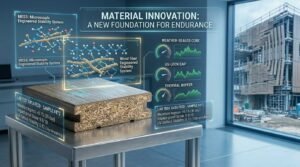
The individual quality of each raw material is important, but the ratio in which they are combined is equally critical. WPC wall panel production is governed by compound formulation design — a carefully engineered balance of wood content, polymer content, and additive loading that determines the final product’s physical and mechanical performance.
Consider the key tradeoffs involved:
- Higher wood content (above 65%) → more natural appearance, lower cost, but reduced moisture resistance
- Higher polymer content → better moisture resistance and structural performance, but higher material cost
- Higher foaming agent → lighter panels, lower cost per unit, but potentially reduced mechanical strength if over-foamed
- Reduced UV stabilizer loading → lower formulation cost, but significantly accelerated fading outdoors
Premium WPC wall panel manufacturers develop proprietary compound formulas that optimize across all these dimensions — typically through years of material testing, accelerated weathering trials, and real-world installation feedback. Budget manufacturers often copy basic formulation ratios without fully replicating the additive package, which is why price alone is never a reliable guide to WPC quality.
Premium vs. Budget WPC Wall Panels: A Material-Level Comparison
Understanding how material choices create quality differences helps buyers make more informed sourcing decisions. The table below compares premium and budget WPC wall panels at the material level:
| Factor | Premium WPC | Budget WPC |
| Wood Fiber | Dried to <3% moisture, uniform mesh size | Variable moisture & particle inconsistency |
| Polymer | Virgin-grade PVC or PE resin | Recycled or mixed-grade resin |
| UV Stabilizer | Premium HALS system, ≥0.8% loading | Generic, low-loading or under-dosed |
| Coupling Agent | Properly dosed MAPE/MAPP | Reduced or absent |
| Cap Layer | ASA or PMMA co-extruded | None, or surface paint coating only |
| Color Stability | 10+ year fade warranty | 1–3 year color life |
| Dimensional Stability | Low thermal expansion, tight tolerances | Variable dimensions, high expansion |
| Certifications | SGS, CE, REACH, ISO | Limited or unverified |
Environmental and Sustainability Considerations
One of the frequently cited advantages of WPC production is the ability to incorporate recycled materials. Many WPC manufacturers use recycled wood fiber from sawmill waste, recycled PE from post-consumer plastic, or recycled PVC from industrial off-cuts — reducing both material costs and environmental footprint.
However, it is important to distinguish between recycled content that maintains performance standards and low-grade recycled material that compromises quality. Reputable WPC manufacturers using recycled inputs subject them to the same quality controls as virgin materials — verifying moisture content, particle size distribution, melt flow index, and contaminant levels before use in production.
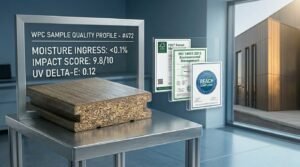
Many leading WPC wall panel manufacturers hold certifications such as FSC (Forest Stewardship Council) for wood fiber sourcing, ISO 14001 for environmental management systems, and REACH compliance for chemical safety. These certifications provide buyers with documented assurance that the materials used in production meet international environmental and safety standards — a critical consideration for projects with green building requirements such as LEED or BREEAM.
What to Look for When Choosing a WPC Wall Panel Supplier
Armed with a solid understanding of WPC material composition, here are the key questions every buyer should ask a potential supplier before placing an order:
- What polymer base is used — PVC, PE, or PP? For exterior cladding, PVC-based WPC is generally preferred for superior dimensional stability and fire performance. Ask for the specific resin grade and whether virgin or recycled resin is used.
- Is the panel co-extruded with an ASA or PMMA cap layer? This is the single most important differentiator for outdoor applications. If the supplier cannot confirm the cap layer specification, treat this as a significant quality risk.
- What UV stabilizer system is used, and at what loading? Ask for the technical data sheet. Reputable suppliers will disclose their UV stabilizer type and loading level. If this information is unavailable, expect poor long-term color stability.
- Can the supplier provide SGS or third-party test reports? Legitimate WPC manufacturers regularly test for UV resistance (ASTM G154 or ISO 4892), moisture absorption, flexural strength, and dimensional stability. Request current test reports, not just marketing claims.
- What is the moisture content and particle size of the wood flour used? Suppliers who can answer this question in detail are demonstrating genuine quality control processes.
- Does the panel carry fire-performance certification? For commercial applications, ask for EN 13501-1 (Europe) or ASTM E84 (USA) classification data.
- What is the warranty, and what is specifically covered? A meaningful 10-year or 15-year warranty covering color stability, structural integrity, and surface finish signals genuine confidence in the material formula.
Frequently Asked Questions About WPC Wall Panel Materials
Q: Is WPC better than solid wood for wall cladding?
For most exterior and high-humidity interior applications, WPC outperforms solid wood in terms of moisture resistance, insect resistance, dimensional stability, and maintenance requirements. Solid wood requires regular painting, staining, or sealing; quality WPC is essentially maintenance-free under normal conditions.
Q: Can WPC wall panels be used outdoors?
Yes — but the specific formulation matters. Only WPC panels formulated for exterior use, with co-extruded ASA cap layers and premium UV stabilizer packages, are suitable for long-term exterior applications. Interior-grade WPC panels should never be used outdoors.
Q: How do I verify a WPC panel uses quality materials?
Request the technical data sheet, third-party test reports, and material composition disclosure from the supplier. Look for SGS certifications, UV fade test results (ASTM G154 or equivalent), and written confirmation of a co-extruded cap layer. Physical samples evaluated against weathering standards are also valuable before committing to a large order.
Q: Are WPC wall panels waterproof?
WPC panels have very low moisture absorption rates — typically below 1% for quality products — but are not fully waterproof at the structural level. Proper installation with appropriate joint systems, drainage gaps, and water-resistant fixings is still required for exterior applications.
Q: How long do WPC wall panels last?
With a high-quality material formulation — virgin-grade polymer, ASA cap layer, premium UV stabilizer system, and proper installation — WPC wall panels typically provide 15–25 years of service life in exterior applications. Budget formulations with compromised material inputs may show significant surface degradation within 3–5 years.
Conclusion: Material Knowledge Drives Better Sourcing Decisions
The question of what materials go into WPC wall panel production is not just technical trivia — it is the most important question any buyer, architect, or project manager can ask when evaluating WPC products or selecting a supplier.
The performance gap between premium and budget WPC wall panels is almost entirely explained by material decisions: the grade of the polymer, the quality of the wood flour, the completeness of the additive package, and the presence or absence of a protective cap layer. None of these differences are visible to the naked eye when panels sit in a showroom — but all of them become visible within 2 to 3 years of real-world use.
If you are looking for WPC wall panels that deliver consistent performance, long-term color stability, and structural durability — backed by verifiable material standards and third-party certifications — we invite you to connect with our team today.