Table of Contents
You’re sourcing WPC wall panels for a large-scale project — or building a product line — and suddenly you realize: not all factories are created equal. Some suppliers cut corners on raw materials. Others promise lead times they simply cannot deliver. And when quality problems surface on-site, the factory is thousands of miles away and suddenly unreachable. So how do you tell a genuinely premium WPC wall panel factory from one that only looks good on paper?
Quick Answer
What Makes a Premium WPC Wall Panel Factory?
A premium WPC wall panel factory is defined by six core pillars: high-grade composite raw materials, advanced extrusion equipment, certified quality management systems (ISO 9001), comprehensive surface-finish capabilities, flexible OEM/ODM customization, and reliable after-sales support. When all six are present, the factory can consistently deliver panels that meet international standards — whether for residential, commercial, or hospitality applications. The sections below break down each factor so you can evaluate any supplier with confidence.
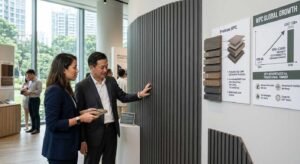
1. What Is WPC Wall Panel and Why Is It Growing So Fast?
Wood-Plastic Composite (WPC) wall panels have rapidly become a leading choice for interior and exterior cladding in residential buildings, commercial spaces, hotels, and retail environments. These panels combine wood fiber — or bamboo or rice husk — with thermoplastic polymers such as PVC, PE, or PP, along with carefully balanced chemical additives. The result is a material that outperforms traditional timber in almost every category: moisture resistance, dimensional stability, fire retardance, and longevity.
The global WPC market was valued at over USD 6 billion in 2023 and is projected to grow at a CAGR of more than 10 % through 2030, driven by rising demand for sustainable, low-maintenance building materials. Architects, developers, and distributors worldwide are turning to WPC wall panels as a modern, eco-friendly alternative to solid wood cladding, ceramic tiles, and gypsum boards.
But this booming demand has also attracted a flood of substandard manufacturers. Knowing what separates a premium WPC wall panel factory from a mediocre one is not just a quality consideration — it is a business-critical decision that directly affects your project outcomes and your brand reputation.
2. Core Pillar #1 — Superior Raw Material Standards
The quality of any WPC product begins with the formulation. Premium factories do not simply buy the cheapest wood fiber or recycled plastic available. They maintain strict supplier-qualification processes and batch-test incoming materials before they enter production.
What to Look For
- Wood/bamboo fiber content and particle size: Consistent fiber-to-resin ratios ensure mechanical strength and surface appearance. Premium manufacturers control this with precision mixing systems.
- Virgin vs. recycled PVC/PE: Using recycled content is environmentally commendable, but the ratio matters. Excessive recycled plastic without proper re-stabilization leads to color fading, brittleness, and uneven texture.
- Chemical additives: UV stabilizers, heat stabilizers, foaming agents, coupling agents, and impact modifiers all affect performance. Premium factories use laboratory-tested branded additives, not generic alternatives.
- Moisture content of wood fiber: High moisture causes bubbles, porosity, and delamination. A premium factory dries fibre to below 3 % moisture before mixing.
Sourcing premium materials costs more upfront. Factories that compete purely on price are almost certainly compromising at this stage. When you ask a potential supplier about their material sourcing and formulation R&D, the depth and specificity of their answer reveals a great deal about their commitment to quality.
3. Core Pillar #2 — Advanced Manufacturing Equipment
The sophistication of a factory’s production line directly determines what quality it can achieve — and sustain — consistently. The main production technologies used for WPC wall panels are co-extrusion, single-screw extrusion, twin-screw extrusion, and hot-press lamination.
Key Equipment Indicators of a Premium Factory
- Twin-screw co-extruders: These produce panels with a dense, hard-wearing outer shell (ASA or PMMA capstock) bonded to a WPC core. The result is superior surface durability, UV resistance, and scratch resistance versus standard single-layer extrusion.
- Precision calibration tables and cooling lines: These ensure panels emerge flat, dimensionally accurate, and free from warping — critical for longer panels used in commercial cladding.
- Automated CNC cutting and trimming: Reduces dimensional tolerances to within ±0.2 mm, which matters enormously during installation.
- In-line quality monitoring: Sensors and automated inspection systems that continuously measure thickness, width, density, and surface uniformity indicate a manufacturer operating at the highest level.
When visiting a factory — in person or via video audit — the age, brand, and maintenance condition of equipment tells a compelling story. A factory investing in Battenfeld, KraussMaffei, or equivalent-grade machinery is sending a clear signal about its quality ambitions.

4. Core Pillar #3 — Rigorous Quality Control and Testing
Even the best materials and equipment can produce inconsistent results without a structured quality management system. Premium WPC wall panel factories implement QC at every stage: incoming material inspection, in-process monitoring, and final product testing before shipment.
What a Robust QC System Looks Like
- ISO 9001 certification: This internationally recognized standard confirms that the factory follows documented procedures for production, testing, corrective action, and continuous improvement.
- In-house testing laboratory: Premium factories test their own panels. Testing includes tensile strength (ASTM D638), flexural strength (ASTM D790), water absorption (ASTM D570), impact resistance (ASTM D256), and fire performance (EN 13501-1 or equivalent).
- Dimensional tolerance control: Every batch is measured against specified tolerances for length, width, thickness, and straightness.
- Color and surface consistency: Advanced spectrophotometers ensure color batches match within a defined Delta E tolerance, preventing visible variation when panels from different batches are installed side by side.
- Accelerated weathering tests: UV chamber testing (ASTM G154 / ISO 4892) simulates years of outdoor exposure to verify that surface colour and structural integrity hold up over time.
Ask any potential supplier for their test reports — and verify the testing dates. Outdated or vague documentation is always a warning sign worth investigating further.
5. Core Pillar #4 — International Certifications and Compliance
Certifications are not bureaucratic formalities. For importers and distributors, they are often mandatory for entering certain markets, and for all buyers, they represent independent third-party validation of a factory’s claims.
Key Certifications to Look For
| Certification | What It Confirms |
| ISO 9001 | Quality management system in place |
| ISO 14001 | Environmental management — responsible production |
| CE Marking | Meets EU health, safety & environmental standards |
| FSC / PEFC | Wood fiber from responsibly managed forests |
| REACH Compliance | No restricted hazardous substances (EU market) |
| CARB Phase 2 | Low formaldehyde emissions (US market) |
Premium factories actively maintain these certifications and provide up-to-date documentation on request. They understand that their customers’ ability to sell the product — particularly in regulated markets like the EU or North America — depends on having clean, current paperwork.
6. Core Pillar #5 — OEM/ODM Customization Capabilities
One of the most important differentiators for importers, distributors, and brand owners is a factory’s ability to produce to custom specifications. A premium WPC wall panel factory is not just a catalogue supplier — it is a genuine product development partner.
What Genuine OEM/ODM Capability Looks Like
- Custom dimensions: Ability to produce panels in lengths from 0.5 m to 6 m+, widths from 120 mm to 400 mm+, and thicknesses from 8 mm to 25 mm depending on application.
- Custom surface textures: Wood grain, stone grain, brushed, and embossed geometric patterns produced via textured extrusion dies or hot-press lamination.
- Custom colors: Matching Pantone or RAL codes with consistency across production batches.
- Private labelling and branded packaging: Including custom carton design, sticker application, barcode placement, and multi-language installation guides.
- Custom formulation for specific performance requirements: Fire-rated panels, anti-mould formulations for high-humidity environments, and Class A fire resistance for commercial buildings.
Premium factories have dedicated product development engineers — not just salespeople who forward customer requests to the production manager. They can produce samples within 7–15 business days and complete full mould or die tooling for large-scale OEM programmes.
7. Core Pillar #6 — Surface Finish Technology and Aesthetic Range
WPC wall panels are, by nature, a design product. Builders, architects, and interior designers specify them not only for performance but for aesthetics. A premium factory invests heavily in surface technology to offer a range that competes with natural materials while outperforming them in durability.
Technologies That Define Premium Surface Finish
- Co-extrusion with ASA capstock: ASA (acrylonitrile styrene acrylate) is a UV-resistant polymer co-extruded over the WPC core, providing exceptional colour stability and surface hardness.
- Deep embossing: Advanced embossing rolls create realistic wood grain depth (2–5 mm relief) that closely mimics natural timber, including the tactile feel of grain.
- Brushing and wire-brushing: Creates a natural matte finish that conceals minor scratches over time — popular in high-end residential and hospitality markets.
- Transfer printing: High-definition printing allows photorealistic wood, stone, or custom graphic patterns to be applied, dramatically expanding design options.
The breadth of decors, colors, and finishes a factory can produce signals its investment level in design and its ability to serve diverse market segments simultaneously.
8. Pricing Transparency and MOQ Flexibility
Premium factories understand that pricing is not just a number — it is about transparency and trust. They provide detailed, itemised quotations that separately clarify material cost, processing cost, surface treatment, packaging, and logistics. This makes it easy to compare quotes across suppliers on a genuine apples-to-apples basis.
What to Expect from a Premium Factory
- Clear minimum order quantities (MOQs): Typically 500–1,000 m² for standard products, with negotiated minimums for custom items.
- Volume discount structures: Transparent tiered pricing based on annual volume commitments.
- Sample pricing policy: Many premium factories offer free or low-cost samples (at shipping cost) to serious buyers.
- Fair payment terms: 30 % deposit / 70 % balance against copy of B/L is industry standard. Be cautious of factories demanding 100 % upfront.
Opaque pricing or frequent unexplained price changes after initial quotation are red flags worth taking seriously.
9. After-Sales Support and Technical Assistance
The relationship with a premium WPC wall panel factory does not end when the container leaves the port. Installation issues, color variation claims, and product failures in the field — these are the moments that truly define a factory’s quality commitment.
Markers of Premium After-Sales Support
- Dedicated export manager or technical account manager: A single, responsive point of contact who is technically knowledgeable and empowered to resolve issues.
- Documented warranty policy: A written product warranty — typically 5 to 25 years depending on the product and application — with clear terms for claims.
- Technical installation guides: Multi-language documentation covering substructure specifications, clip system instructions, expansion gap requirements, and maintenance guidance.
- Replacement stock for verified claims: A factory that proactively ships replacement product for confirmed defects, rather than engaging in months of dispute.
- R&D feedback loop: Genuine willingness to collect installer and end-user feedback and incorporate it into product improvements.
Strong after-sales support protects your margins, your customer relationships, and your brand reputation. It is one of the hardest things to assess from a brochure — so always ask for references.

10. How to Evaluate a WPC Wall Panel Factory Before Your First Order
With so many WPC factories in China, Vietnam, Malaysia, and other manufacturing hubs, a structured evaluation process is essential. Here is a practical checklist to guide you through the process.
Pre-Visit / Remote Evaluation
- Request a complete company profile: production capacity, number of lines, annual output, and employee count.
- Ask for ISO and certification documents and verify validity dates independently.
- Request third-party test reports (SGS, Intertek, Bureau Veritas) for key product lines.
- Ask for customer references — ideally in your target market — and follow up directly.
- Request a factory audit questionnaire and review responses carefully.
Sample Evaluation
- Order samples across 3–5 products in your target category.
- Evaluate dimensional accuracy with calipers against stated specifications.
- Perform a basic water resistance test: submerge for 24–48 hours and measure weight change.
- Assess surface quality in different lighting conditions, including oblique light that reveals surface defects.
- Test the click or clip system for ease of installation.
Commercial Evaluation
- Review payment terms, lead times, and packing specifications.
- Ask about capacity utilization to assess whether the factory can commit to your schedule.
- Understand the factory’s policy for quality claims and defective goods.
11. Red Flags to Watch Out For
Not every warning sign is obvious. Here are the subtler indicators that a factory may not meet premium standards:
- Generic, low-resolution product photos reused across multiple different brands or supplier websites — reverse image search them.
- No in-house R&D or engineering team; purely assembly-based operations with no real product development capability.
- Inability to provide third-party test reports, or offering reports dated more than two years ago.
- No ISO 9001 or equivalent QMS certification — or holding certification from an unrecognized, non-accredited body.
- Extremely low pricing inconsistent with genuine raw material costs — a strong indicator of recycled or substandard inputs.
- Inconsistent answers across different contacts at the same factory.
- No willingness to allow a factory audit, even remotely via video call.
12. Why Partnering with a Premium Factory Is a Business Advantage
Choosing a premium WPC wall panel factory over a lower-cost alternative is not just a quality decision — it is a strategic business investment with measurable returns.
When you work with a factory that consistently delivers on specification, you:
- Reduce project risk by eliminating costly on-site defects and installation delays.
- Protect your brand reputation by delivering products that perform as promised.
- Streamline operations by minimizing QC inspections, claims handling, and re-ordering cycles.
- Unlock higher-margin market segments — architects and commercial developers pay a premium for certified, tested products with documented performance.
- Build a scalable supply chain based on a reliable manufacturing partner who grows with your business.
The price difference between a premium factory and a mediocre one is often smaller than buyers expect — but the difference in risk and business outcome is enormous.
Conclusion — Ready to Find Your Premium WPC Wall Panel Partner?
Not all WPC wall panel factories are built the same. The truly premium ones invest relentlessly in raw material quality, manufacturing technology, testing infrastructure, certifications, customization capability, and customer support. They think beyond the transaction — and so should you.
Whether you are a distributor building a product line, a developer sourcing for a large project, or a brand owner looking for a reliable OEM partner, the criteria in this guide give you a clear, practical framework for identifying the right factory and asking the right questions.