Table of Contents
Picture two nearly identical commercial buildings going up side by side. Same floor area. Same facade coverage. Same completion deadline. One spec calls for polished granite cladding; the other for high-quality aluminum composite panels. Six months later, both buildings look sharp, both deliver professional credibility, and most passersby cannot tell the difference. But the project cost accountants can: the granite building’s cladding package cost three to five times more than its composite counterpart — and that gap doesn’t close when you factor in installation, structural reinforcement, logistics, and the maintenance bills that follow over the next 25 years. If you’re evaluating cladding options and cost is a material factor in your decision, this guide gives you the numbers you need.
Quick Answer — The Direct Cost Verdict
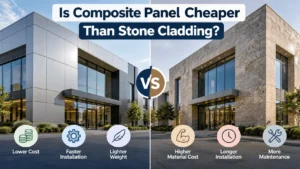
Yes — composite panels are significantly cheaper than stone cladding across every dimension of project cost. Aluminum composite panels (ACP) typically cost $15 to $50 per m² for material supply, compared to $80 to $300+ per m² for natural stone depending on species. But material price is only the first saving: composite panels weigh 4 to 8 kg/m² versus 50 to 120 kg/m² for stone, eliminating the need for structural reinforcement and heavy-lift equipment. They install in a fraction of the time, require less skilled labor, and need virtually no maintenance over their service life. When all five cost dimensions — material supply, structural engineering, installation labor, logistics, and 25-year maintenance — are compared on a like-for-like basis, composite panel cladding systems typically deliver 60 to 75% total lifecycle cost savings compared to equivalent natural stone cladding. For a 2,000 m² commercial building facade, this translates to a potential saving of $300,000 to $1,000,000 or more.
1. Why Material Price Alone Doesn’t Tell the Full Story
When procurement teams first compare composite panels against stone cladding, the instinct is to reach for the price list and compare cost per square metre of material supply. That comparison is revealing — composite panels are typically 4 to 10 times cheaper than natural stone per m² of material — but it understates the true cost advantage, because the material price gap amplifies across every downstream project cost driver.
A complete cost comparison between composite panel and stone cladding must account for five distinct dimensions:
- Material supply cost — the panel or stone unit price per m²
- Structural and foundation cost — the engineering implication of the cladding’s weight on the primary structure
- Installation cost — labor, specialist trades, scaffolding program duration, and site wastage
- Logistics and equipment cost — transport, offloading, storage, lifting plant, and cranage
- Lifecycle maintenance cost — cleaning, repointing, sealing, damage repair, and panel replacement over 25 years
Only when all five dimensions are evaluated together does the true economic case for composite panel versus stone cladding become clear — and it is a case that is not close. This guide works through each dimension in turn, with indicative figures referenced to real commercial project conditions. All pricing figures are indicative and will vary by location, project scale, material specification, and market conditions; use them as a framework for comparison, and engage your supply chain for project-specific pricing.
2. Material Supply Cost — Composite Panel vs Stone Cladding
The material cost difference between composite panels and natural stone cladding is substantial and immediately apparent. The table below presents indicative market price ranges for the most commonly specified composite panel types alongside the most commonly used natural stone cladding materials.
| Cladding Material | Typical Range ($/m²) | Weight (kg/m²) | Fire Rating |
| Standard PE-core ACP | $15 – $30 | 4 – 6 | Class B (PE core) |
| FR Mineral-core ACP | $25 – $50 | 5 – 8 | Class A / A2 |
| Stone-effect fiber cement | $20 – $40 | 14 – 20 | Class A |
| HPL-faced composite panel | $35 – $70 | 8 – 14 | Class A (interior) |
| Sandstone / Limestone | $80 – $180 | 60 – 90 | Non-combustible |
| Granite cladding | $150 – $300 | 70 – 100 | Non-combustible |
| Marble cladding | $200 – $500 | 60 – 100 | Non-combustible |
| Slate cladding | $100 – $250 | 50 – 80 | Non-combustible |
Note: Composite panel rows are shaded white/grey. Stone cladding rows are shaded amber. Prices are indicative USD/m² supply only, excluding installation. Stone prices assume standard commercially available thickness (20–30mm). Prices vary significantly by origin country, finish (polished, honed, flamed, bush-hammered), and project quantity.
2.1 What Drives Stone Cladding’s Higher Material Cost?
Natural stone cladding is expensive for reasons that go beyond mere scarcity. The production chain from quarry to delivered panel is long, capital-intensive, and loss-heavy. Quarrying requires significant equipment and energy input to extract large blocks from the natural rock face. Blocks are then transported to processing facilities — often in a different country from the quarry — where gang saws and diamond wire saws cut them into slabs. These slabs are then cut again to the required panel sizes, with further wastage at every stage. The finished panels are then surface-treated — polished, honed, or textured — before quality selection, packaging, and international freight to the project site.
At every stage of this chain, material is lost: typical stone yield from quarry block to finished cladding panel is 30 to 50%, meaning more than half the original quarried stone is waste. This extraction-to-waste ratio is embedded in the price of every finished stone panel. And because stone is a natural material, color and veining variation between panels from different production batches means large projects often specify excess material to ensure they have sufficient matched panels — further increasing effective material cost per installed m².
2.2 What Determines Composite Panel Pricing?
Composite panels are manufactured products — produced in controlled factory environments from consistent input materials. The primary cost components are the aluminum sheet material, the core compound, the PVDF or polyester coating system, and the panel cutting and surface treatment process. Because every input is consistent and the manufacturing process generates minimal waste, composite panel pricing is stable, predictable, and not subject to the natural material variation and supply chain uncertainty that characterize stone cladding.
Premium ACP specifications — including fire-resistant mineral-filled cores, high-quality PVDF coatings, and custom colors or wood/stone effect finishes — command a price premium over standard PE-core products, but even the highest-specification ACP products remain materially less expensive per m² than standard natural stone alternatives.
3. Structural and Foundation Cost — The Hidden Weight Penalty
Of all the cost advantages of composite panels over stone cladding, the structural implication is the one most frequently underestimated by project teams evaluating cladding options for the first time. It is also the one with the most significant downstream cost consequences — because the structural design implications of heavy cladding propagate through the entire building’s engineering specification.
3.1 The Weight Gap Is Enormous
Aluminum composite panels typically weigh between 4 and 8 kilograms per square metre, depending on panel thickness and core specification. Natural stone cladding panels in standard commercial thicknesses (20 to 30mm) weigh between 50 and 120 kilograms per square metre depending on the stone species, finish, and format. For a 2,000 m² building facade, this weight difference is:
- Composite panel: 8,000 to 16,000 kg total cladding weight (8 to 16 tonnes)
- Stone cladding: 100,000 to 240,000 kg total cladding weight (100 to 240 tonnes)
This is not an abstract engineering number. Every additional kilogram of cladding weight must be supported by the building’s structural frame, transferred through floor plates and columns, and eventually carried by the foundations. A building specified with stone cladding must carry 10 to 30 times more dead load from its facade than the same building clad in composite panels. This additional dead load drives heavier structural sections, larger foundation systems, deeper pile groups, and more concrete — all of which carry direct cost implications.
3.2 Structural Engineering Cost Implications
The structural cost premium attributable to stone cladding versus composite cladding varies significantly by building type, height, and structural system. On a low-rise building with a robust existing frame, the premium may be modest. On a high-rise building where structural efficiency is critical to project economics, or on a project where the structure is being designed from scratch specifically for the cladding load, the premium can be very significant.
Structural engineers on medium- and large-scale commercial projects have reported structural engineering cost premiums attributable to stone cladding — in terms of heavier sections, additional columns, and enhanced foundation specification — in the range of $30 to $100 per m² of facade area over what would be required for equivalent composite panel cladding. On a 5,000 m² commercial building facade, this represents $150,000 to $500,000 in additional structural cost before a single stone panel is fixed.
3.3 Foundation and Ground Engineering Implications
In ground conditions where foundation capacity is marginal — soft clays, made ground, filled sites, brownfield locations — the additional dead load of stone cladding may require foundation enhancement that would not be necessary with composite panel cladding. This can range from increased pad footing or strip footing dimensions, to additional pile rows, to deeper pile depths to achieve adequate bearing capacity. Foundation cost is notoriously difficult to control once identified, and stone cladding’s weight contribution to foundation demand represents a meaningful and often overlooked project cost risk.
4. Installation Cost — Labor, Time, and Specialist Trades
Installation is typically the second-largest cladding cost component after material supply, and it is where the gap between composite panels and stone cladding is most visible on a construction site. The difference in installation complexity between the two materials is not incremental — it is categorical.
4.1 Composite Panel Installation
Aluminum composite panel installation is performed by facade contractors working from standard scaffolding or mobile elevated work platforms. The installation process involves fixing the subframe system to the structural substrate, then cutting panels to size on site or installing pre-fabricated panels to the subframe using mechanical fixings or structural adhesive. Standard ACP cassette systems, rainscreen systems, and curtain wall infill systems are all engineered for efficient installation with a competent facade team.
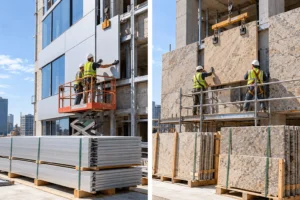
ACP installation productivity rates on commercial projects typically range from 8 to 15 m² per operative per day for standard installations, rising to 20+ m² per operative per day for experienced teams working with well-coordinated pre-cut panels. The lightness of ACP — individual panels typically weigh less than 25 kilograms, handleable by two operatives — means no mechanical lifting equipment is required for the panel fixing operation itself, eliminating the cost and programme implications of crane dependency.
4.2 Stone Cladding Installation
Natural stone cladding installation is a specialist masonry trade requiring specifically trained stone masons with experience in the anchoring systems appropriate to the stone species, thickness, and fixing method specified. Stone panels must be individually drilled, slotted, or grouted to receive the mechanical anchor system that transfers their weight to the structural substrate. This process is slow, requires precision, and cannot be rushed without compromising the structural integrity and long-term performance of the installation.
Stone panel installation productivity typically ranges from 2 to 6 m² per operative per day, depending on panel size, weight, anchor system complexity, and working conditions. Larger stone panels — above approximately 0.5 m² per panel — typically require mechanical assistance (suction lifters, panel cranes, or a tower crane allocation) to handle safely, adding crane time and operator cost to the installation program.
The practical result of this productivity differential is significant. Clad the same 2,000 m² facade in ACP at 12 m²/operative/day and in stone at 4 m²/operative/day with a six-operative team and the ACP installation takes approximately 28 days while the equivalent stone installation takes approximately 84 days — three times longer. Three times as long on scaffolding is three times the scaffolding rental and erection cost.
4.3 Waste and Material Handling
Stone cladding generates significant site waste in the form of cut-offs, broken panels, and rejected material. Stone is brittle — dropped or improperly handled panels crack or chip, requiring replacement at full material and procurement lead-time cost. Matching a specific stone batch for replacements can be difficult or impossible if the original quarry supply has been exhausted.
Composite panels are robust and relatively waste-efficient. Cut-offs from ACP can often be used as smaller panels, flashing pieces, or trims elsewhere in the facade. Damaged ACP panels can be replaced with panels from the same color specification at standard lead times, and the extensive PVDF color inventory maintained by major manufacturers means color matching years after initial installation is straightforward.
5. Logistics, Transport, and Equipment Costs
The cost of getting cladding material from factory or warehouse to installed position on the building is a real and significant project cost that the material price comparison alone does not capture.
5.1 Transport Cost
Natural stone is heavy and fragile. Transport from European or Asian quarrying regions to project sites in other countries requires specialist packing — typically timber crates or wooden A-frames with padding — to prevent transit damage. Weight is the primary determinant of freight cost for overland and sea transport, so the 10 to 15 times weight premium of stone over composite panels translates directly into proportionally higher freight cost per m² of material transported. For projects sourcing premium stone from Italy, Portugal, India, or China, international freight adds meaningfully to the delivered cost per m².
Composite panels transport efficiently. Standard ACP sheets are typically palletized flat with interleaving protection, and multiple pallets per truck are standard. The weight-to-coverage ratio of ACP means a single truck can carry material sufficient to clad substantially more facade area than the same truck loaded with stone panels — improving logistics efficiency and reducing per-m² freight cost proportionally.
5.2 Site Storage and Handling
On constrained urban construction sites — the typical context for commercial cladding work — site storage space is a premium. Stone panels require flat-bed storage on A-frames or pallets, with careful management to prevent weight-induced cracking at support points. Composite panels can be stored vertically or flat on standard pallets with minimal site footprint and lower handling risk.
The weight of stone panels also requires heavier lifting equipment at the point of installation — suction pads rated for heavy panel weights, crane allocations for large-format stone, and additional edge protection requirements. These equipment costs add directly to the installation cost per m² and extend crane program time on the project.
6. Maintenance and Lifecycle Cost — The Long Game
The initial project cost comparison between composite panels and stone cladding — already substantial — extends further when lifecycle maintenance costs are included. This dimension is the most frequently overlooked by project teams making initial specification decisions, and it is the one that building owners and asset managers encounter most directly throughout the operational life of the building.
6.1 Composite Panel Maintenance — Minimal by Design
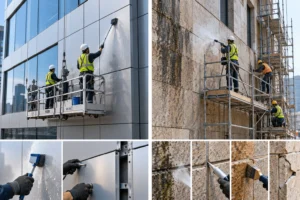
Aluminum composite panels with PVDF coating systems are engineered to be essentially maintenance-free for their designed service life of 20 to 25 years. The PVDF topcoat is chemically inert, UV-stable, and self-cleaning to a significant degree — natural rainfall removes the majority of airborne particulate contamination from vertical and near-vertical panel surfaces. In typical commercial urban environments, an annual wash-down using mild detergent and low-pressure water is sufficient to maintain ACP facades in their specified appearance.
If individual ACP panels are damaged — by impact, vandalism, or accidental construction damage — replacement is straightforward. Panels are removed from the subframe, new panels ordered from the manufacturer’s standard color inventory, and replacement panels installed by a standard facade team. The panel specification, color reference, and material thickness are all documented and consistent, making like-for-like replacement routine. Total maintenance cost for a well-specified ACP facade over 25 years is typically in the range of $2 to $5 per m² — effectively the cost of periodic cleaning only.
6.2 Stone Cladding Maintenance — Frequent and Complex
Natural stone cladding requires a materially higher level of ongoing maintenance intervention than composite panel systems. The specific maintenance requirements depend on the stone species, the fixing system, the climate exposure, and the building’s urban pollution environment, but the following maintenance operations are typically required across the 25-year lifecycle of a stone-clad commercial building:
- — Stone surfaces accumulate biological growth (algae, lichen, moss) and atmospheric pollution deposits that reduce visual quality and, over time, can penetrate the stone surface to cause staining and surface deterioration. Professional cleaning with specialist stone-safe chemical agents or steam cleaning is typically required every 3 to 7 years depending on the pollution environment. Periodic deep cleaning
- — Mortar or sealant joints between stone panels degrade under weathering over time, losing adhesion and allowing moisture ingress behind the cladding. Systematic repointing at 10 to 15 year intervals is typically required to maintain weather exclusion performance. Joint repointing
- — Porous stone species (limestone, sandstone) require periodic application of penetrating sealers to maintain water repellency and prevent salt crystallization damage in the stone surface. Application frequency varies by stone species and climatic exposure, typically 5 to 10 years. Stone sealing
- — The mechanical anchoring systems that connect stone panels to the building structure must be periodically inspected for corrosion, fatigue, and structural adequacy. In coastal environments or where dissimilar metals have been used, anchor corrosion can accelerate significantly, requiring remediation programs that involve removing stone panels to access and replace compromised anchor hardware. Anchor inspection and remediation
- — Stone panels crack, chip, and spall under impact, thermal stress, and anchor point overload. Replacement of individual damaged panels requires sourcing matching stone from the same quarry batch — which may no longer be available — at full stone material, processing, and installation cost. Panel replacement
The cumulative maintenance cost for natural stone cladding over 25 years on a commercial building in an urban environment is typically in the range of $40 to $120 per m², depending on stone species, fixing system, maintenance frequency, and geographic location. Against a composite panel maintenance cost of $2 to $5 per m² over the same period, this represents a maintenance cost premium of 10 to 20 times — a significant and recurring operational cost that the building’s asset manager must budget for across the building’s lease cycles.
7. 25-Year Total Lifecycle Cost Comparison
The table below consolidates all five cost dimensions into a side-by-side lifecycle cost comparison between aluminum composite panel cladding and natural stone cladding on a typical commercial building project. All figures are indicative USD per m² of installed facade area.
| Cost Category | Composite Panel (ACP) | Natural Stone | Stone Premium (vs ACP) |
| Material supply (per m²) | $25 – $50 | $120 – $300 | 4× – 6× higher |
| Structural reinforcement | Minimal / none | Significant | $30 – $80/m² extra |
| Installation labor (per m²) | $15 – $30 | $60 – $150 | 3× – 5× higher |
| Scaffolding program | Shorter duration | Extended duration | 20 – 40% longer |
| Logistics & cranage | Standard plant | Heavy-lift crane | $50k+ on large projects |
| Maintenance (25-year total) | $2 – $5/m² | $40 – $120/m² | 10× – 20× higher |
| Replacement / repairs | Easy, low cost | Difficult, costly | 3× – 8× higher |
| TOTAL LIFECYCLE ESTIMATE | $60 – $120/m² | $270 – $700/m² | ~60 – 75% saving w/ ACP |
Note: Ranges reflect variation by project scale, geographic location, stone species, and market conditions. ACP assumes FR-core specification with PVDF coating. Stone assumes mid-grade granite or equivalent in standard 25mm commercial cladding thickness. Structural premium is approximate and project-specific. Always obtain project-specific pricing for accurate budget development.
Project Scale Example: 2,000 m² Commercial Facade
Using mid-point lifecycle estimates: ACP total ≈ $180,000 | Granite total ≈ $940,000. Indicative saving: approximately $760,000 over 25 years — equivalent to the cost of a complete internal fit-out for a medium-sized commercial office.
8. When Stone Cladding May Still Justify the Premium
The cost case for composite panels over stone cladding is compelling — but it is not universal. There are specific project types and contexts where stone cladding’s premium cost may be justified, necessary, or mandated. Experienced specifiers consider these carefully before dismissing stone on cost grounds alone.
8.1 Heritage Buildings and Conservation Projects
Buildings listed for architectural or historic preservation, or located in conservation areas with strict planning controls, may be required to use natural stone cladding to match existing materials. Planning authorities in many jurisdictions will not accept composite panel substitutions where the original building fabric used stone, or where the visual character of a conservation area depends on natural materials. In these contexts, the cost of stone is a regulatory constraint, not a specification choice.
8.2 Ultra-Luxury Positioning
At the very highest end of the luxury residential and hospitality market, natural stone is not merely a cladding material — it is a brand signal. The provenance of specific marble varieties from named Italian quarries, or the rarity of book-matched granite from a single quarry block, communicates exclusivity that no composite panel — however skilled the stone-effect reproduction — can fully replicate for a buyer or guest who knows the difference. For projects where the target audience includes purchasers spending $5,000+ per m² on finished apartments, the premium cost of genuine stone may be commercially rational.
8.3 Certain Ground-Level Applications
At street level and in highly trafficked areas where the public encounters the building material at very close proximity and over extended periods — plinths, entrance portals, ground-floor retail reveals — natural stone’s inherent depth of character, uniquely non-repeating surface variation, and tactile quality at close range may justify specification where a composite material would be used above ground level. A pragmatic hybrid approach — stone at street level where scrutiny is highest, composite panels above where the visual distance makes material distinction irrelevant — is common in sophisticated commercial developments and delivers cost efficiency without aesthetic compromise.
8.4 Specific Sustainability Narrative Requirements
Some projects — particularly those seeking certain environmental certifications, or occupiers with a specific commitment to natural materials — may specify stone cladding as part of a broader material philosophy around natural, locally sourced building materials. In regions where suitable stone is quarried locally, the embodied carbon of local stone may in fact be competitive with the embodied carbon of aluminum-intensive composite panels, making stone a defensible choice on lifecycle environmental grounds in those specific geographic contexts.
9. Achieving a Stone Aesthetic With Composite Panels
For the many projects where cost, performance, and flexibility favor composite panels but the design brief calls for a natural stone appearance, the composite panel industry has developed a sophisticated range of stone-effect products that deliver convincing visual results at a fraction of the cost.
9.1 Stone-Effect Aluminum Composite Panels (ACP)
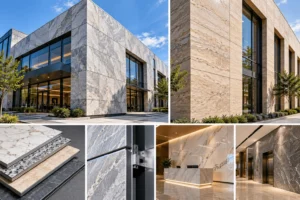
Major ACP manufacturers produce extensive ranges of stone-effect finishes using PVDF printing and sublimation transfer technologies applied to aluminum face sheets. These products reproduce the visual character of granite, marble, limestone, slate, and sandstone in flat-panel form with sufficient fidelity that at typical viewing distances — anything beyond 2 to 3 meters — most observers cannot distinguish the composite from natural stone.
Stone-effect ACP is particularly effective for large-format facade applications where the design intent is a stone-like overall visual effect rather than the close-up material authenticity required in luxury interior contexts. The PVDF coating ensures the stone-effect print is as durable and UV-resistant as standard ACP colors, delivering a consistent appearance across the full 20 to 25-year exterior service life.
9.2 Fiber Cement Stone-Texture Composite Panels
Fiber cement composite panels with stone-texture surface moulds offer a third dimension of stone replication that flat-print ACP cannot fully achieve: physical surface texture. The manufacturing process presses fiber cement slurry against stone-surface moulds, creating panels with genuine three-dimensional surface relief that replicates the tactile and visual character of stone at close range. Combined with factory-applied mineral stone-tone paint finishes, textured fiber cement panels are used extensively in external cladding applications where close-range stone-like character is required at controlled cost.
9.3 HPL Stone-Effect Composite Panels
High-pressure laminate panels with stone-effect decorative surfaces are a popular choice for interior applications where a stone aesthetic is required in high-traffic, high-durability conditions. HPL stone-effect panels reproduce marble, granite, and travertine visual characteristics at a resolution that is difficult to distinguish from natural stone at close range in interior lighting conditions, while delivering the scratch resistance, impact resistance, and easy maintenance that hospitality and commercial interior environments demand.
HPL stone-effect panels are commonly used in hotel lobby cladding, retail interior feature walls, restaurant feature surfaces, and commercial bathroom and washroom wall cladding — all contexts where natural stone specification would carry significant material and maintenance cost premiums over the composite alternative.
Frequently Asked Questions
Exactly how much cheaper is composite panel than stone cladding per m²?
On material supply cost alone, aluminum composite panels typically cost $15 to $50 per m² compared to $80 to $500 per m² for natural stone cladding depending on species. This represents a material cost saving of approximately 60 to 90% per m². When structural, installation, logistics, and lifecycle maintenance costs are added, total 25-year cost savings of 60 to 75% are typical on commercial building projects. The absolute saving per m² is larger for premium stone species — the comparison between ACP and marble or premium granite can show savings of 80% or more in material cost alone.
Can composite panels genuinely look like natural stone from the street?
Yes — at typical street-level and mid-distance viewing ranges (2 meters and beyond), high-quality stone-effect composite panels are visually indistinguishable from natural stone cladding for most observers. PVDF-printed stone-effect ACP and textured fiber cement panels both deliver convincing stone aesthetic results in exterior facade applications. The fidelity of reproduction is highest for granite and slate — which have relatively uniform visual patterns — and somewhat more challenging for highly complex veined marble, where the organic veining pattern variation of natural stone is difficult to replicate non-repetitively across large panel areas.
Does composite panel cladding reduce a building’s value compared to natural stone?
Not for most commercial property types. Commercial office, retail, and hospitality buildings are valued primarily on their income-generating capacity (yield) rather than the prestige of their cladding material. A building that performs better on operating cost — including lower facade maintenance expenditure — may actually command equal or superior returns to a stone-clad equivalent with higher operational cost. Where cladding material contributes to value positioning, it is typically in ultra-luxury residential and hospitality contexts where the target buyer or guest premium justifies the stone cost investment.
How do composite panels compare to stone cladding in terms of fire performance?
Composite panels can match or exceed natural stone’s fire safety performance. Natural stone is inherently non-combustible but can spall and fail structurally under fire conditions, particularly in thin-panel exterior cladding formats. Aluminum composite panels with A2-rated mineral-filled fire-resistant cores carry Class A fire ratings that satisfy the most stringent exterior cladding regulations, including UK Building Regulations and equivalent European standards. ACP fire performance is achieved through engineered core composition and is consistent and verifiable via third-party test certification — advantages that stone’s non-combustibility alone does not provide.
What is the lifespan of composite panels vs stone cladding?
Quality aluminum composite panels with PVDF coating are designed for a 20 to 25-year facade service life based on accelerated weathering testing, with many installations in service for 30+ years. Natural stone, when correctly specified, anchored, and maintained, can have a longer theoretical material lifespan — but the practical service life of stone cladding between major maintenance interventions (repointing, anchor remediation, panel replacement programs) is typically 10 to 15 years. The composite panel’s designed service life, combined with lower maintenance frequency, often results in a lower total lifecycle cost even where the stone material itself might theoretically outlast the composite if perfectly maintained.
Are there composite panel types that are genuinely comparable to stone in durability?
In exterior applications, aluminum composite panels with PVDF coating and fire-resistant cores are extremely durable materials in their own right — not merely durable relative to composite alternatives, but durable in absolute terms. They do not rust, rot, spall, or suffer biological degradation. Their surfaces maintain color and finish without recoating for 20+ years. Their mechanical anchoring systems are compatible with the same subframe technology used for stone, and their structural behavior under wind load is well-understood and engineered. For most commercial exterior cladding applications, ACP represents a durability specification that is fully adequate for the asset’s commercial lifecycle.
Conclusion: A Compelling Cost Case, Backed by the Numbers
The question “Is composite panel cheaper than stone cladding?” has a clear and decisive answer: yes — substantially cheaper, across every dimension of project cost. The material price gap alone — composite panels at $15 to $50 per m² against stone cladding at $80 to $500 per m² — is significant. But when structural engineering savings, faster installation, lower logistics cost, and dramatically reduced 25-year maintenance expenditure are included, total lifecycle cost savings of 60 to 75% are achievable on typical commercial building projects. For a 2,000 m² facade, that saving can fund a complete internal fit-out.
Composite panels also deliver where it matters most for today’s commercial specification environment: they are available with Class A fire ratings, are compatible with modern green building certification programs, can be installed faster than stone on a construction program critical path, and require virtually no maintenance for their designed service life. The aesthetic gap between composite and stone, meanwhile, has narrowed to the point where stone-effect composite cladding is genuinely convincing at the viewing distances that matter in commercial building environments.
There remain specific contexts where natural stone is the appropriate specification choice — heritage buildings, ultra-luxury positioning, close-range luxury retail — and this guide has acknowledged them directly. But for the large majority of commercial, corporate, hospitality, and residential development projects, composite panels deliver equivalent or superior performance, a fully competitive aesthetic, and a project cost that transforms the financial viability of the facade specification.
Get a Competitive Composite Panel Quote for Your Project
We supply aluminum composite panels, stone-effect ACP, and fiber cement cladding systems to commercial building projects worldwide. Our team provides detailed project costings, technical documentation, fire certification, and material samples — everything your team needs to make a confident, well-evidenced specification decision.
Send us your facade area, location, and aesthetic brief — we will respond with a detailed cost comparison within 24 hours.
Contact us today. Your next project deserves smarter specification.