Table of Contents
China produces more than 70% of the world’s WPC wall panels — and for good reason. Chinese WPC manufacturers combine raw material access, advanced extrusion technology, and competitive pricing in a way that no other sourcing market can currently match. But here’s the reality that catches most first-time importers off guard: finding a cheap WPC panel online is easy. Finding a reliable supplier who delivers consistent quality, ships on time, clears customs without incident, and supports you when something goes wrong — that’s an entirely different challenge. Getting it right can save your business tens of thousands of dollars per year. Getting it wrong can cost you a project, a client, and months of operational disruption. This guide walks you through every step of the import process, from identifying legitimate factories to receiving your first container.
Quick Answer
To import WPC wall panels from China, follow these 10 steps: (1) Find verified suppliers on Alibaba, Made-in-China, or through Canton Fair; (2) Verify the supplier is a real factory with ISO 9001 and relevant export certifications; (3) Request and test physical samples before ordering; (4) Confirm product specifications, HS codes, and required certifications (CE, SGS, ASTM); (5) Get FOB/CIF/DDP pricing and negotiate MOQ and payment terms; (6) Arrange third-party pre-shipment quality inspection; (7) Book sea freight (LCL for trial orders, FCL for full containers); (8) Clear customs using a licensed broker and pay applicable import duties; (9) Inspect goods on arrival; (10) Build a long-term supplier relationship for consistent quality and pricing.
1. Why China Is the World’s Leading Source for WPC Wall Panels
Before diving into the import process, it’s worth understanding why China dominates the global WPC panel market — and why that dominance is likely to continue.
1.1 Manufacturing Scale and Cost Efficiency
China’s WPC manufacturing industry has scaled massively over the past two decades. Major production clusters are concentrated in:
- Zhejiang Province (Ningbo, Hangzhou): The largest WPC manufacturing hub in China, home to hundreds of factories ranging from small workshops to large-scale export-focused operations.
- Shandong Province (Jinan, Qingdao): Strong presence of WPC decking and wall panel manufacturers with direct port access via Qingdao.
- Jiangsu Province (Suzhou, Nanjing): Mid-to-premium WPC manufacturers, particularly strong in co-extruded products for European and Australian markets.
- Guangdong Province (Guangzhou, Foshan): Significant trading hub and home to many WPC suppliers active in the Middle East and Southeast Asian markets.
This concentration of manufacturing creates intense price competition, deep supply chains, and access to the raw materials (recycled wood fibre, PP/PE/PVC polymer, pigments, stabilisers) that no other region matches in volume or cost.
1.2 Technology and Product Range
Leading Chinese WPC factories operate multi-zone twin-screw extruders, co-extrusion lines, and automated surface embossing and brushing systems. Product ranges span:
- Single-layer WPC wall panels (economical, standard residential use)
- Co-extruded WPC cladding with protective polymer shells (exterior & premium)
- 3D embossed wood-grain and stone-effect surface profiles
- Custom dimensions, profiles, and OEM colour specifications
- Fire-retardant formulations for commercial and hospitality specifications
1.3 Export Infrastructure
China’s port infrastructure — particularly Shanghai, Ningbo-Zhoushan, Qingdao, and Guangzhou — provides direct container service to virtually every major market globally. Lead times from factory order to vessel departure are typically 15–30 days for standard products, and transit times to most destinations range from 14 to 40 days by sea freight.
China’s combination of product range, production scale, price competitiveness, and export logistics makes it the most rational global sourcing market for WPC wall panels at any order volume.
2. The Complete 10-Step Import Process at a Glance
The table below provides the full import roadmap before we explore each step in detail:
- Find Suppliers Search Alibaba, Made-in-China, Canton Fair Verify factory, not trader
- Verify Credentials Request business licence, ISO cert, factory audit Use third-party audit service
- Request Samples Order 3–5 product samples from shortlisted suppliers Pay for samples — shows seriousness
- Confirm Specs Define HS code, dimensions, certifications required CE, ASTM, SGS as applicable
- Get Quotations Request FOB/CIF/DDP pricing with Incoterm clarity Compare total landed cost, not FOB only
- Negotiate Terms MOQ, payment (30% TT + 70% BL), lead time Use escrow or LC for first orders
- Pre-Shipment QC Third-party inspection before loading QIMA, Bureau Veritas, SGS
- Book Freight Sea freight (LCL or FCL), air freight, or courier LCL for <10 CBM; FCL from 15 CBM+
- Customs Clearance Classify HS code, pay import duties, arrange broker Hire licensed customs broker
- Final Inspection Check on arrival against purchase order Document any damage immediately

3. Finding Reliable WPC Suppliers in China
3.1 Online Sourcing Platforms
The primary online channels for finding Chinese WPC wall panel suppliers are:
Alibaba (alibaba.com): The world’s largest B2B sourcing platform. Search “WPC wall panel”, “WPC exterior cladding”, or “wood plastic composite wall cladding”. Filter by Trade Assurance, Gold Supplier status, and supplier verification level. Do not confuse listing quality with product quality — the best suppliers are not always the ones with the most polished Alibaba pages.
Made-in-China (made-in-china.com): Strong alternative to Alibaba, particularly for verified factory listings. Use the supplier audit filter to shortlist manufacturers with third-party factory assessments.
Global Sources (globalsources.com): Traditionally stronger for electronics, but increasingly relevant for building materials. Tends to attract slightly more established exporters.
1688.com: The domestic Chinese equivalent of Alibaba — prices are often lower than on the international platform, but navigation and communication require Chinese language capability or a local agent.
3.2 Trade Fairs
For buyers who prefer face-to-face supplier evaluation, two exhibitions are particularly relevant:
- Canton Fair (China Import and Export Fair, Guangzhou): Held twice annually (April and October). The world’s largest trade fair, with a significant building materials section. Ideal for meeting multiple WPC suppliers in a single trip and comparing product quality directly.
- Domotex Asia / China Floor (Shanghai): Focused on flooring and surface materials — includes WPC decking and wall cladding exhibitors.
- China International Hardware Show (Shanghai): Building materials and components; some WPC exhibitors present.
3.3 Professional Referrals and Industry Networks
For buyers with existing networks in the construction or interior design industry, referrals from other importers or distributors who already source WPC from China are one of the highest-reliability sourcing methods. A supplier reference from a trusted peer carries more weight than any platform verification badge.
Sourcing tip: Do not shortlist fewer than 5 suppliers at the initial stage. You need a comparison baseline across price, quality, responsiveness, and professionalism. Narrow to 2–3 after sample evaluation.
4. Verifying Supplier Credentials
The most expensive mistake in Chinese sourcing is placing a commercial order before adequately verifying a supplier’s credentials and capabilities. The verification checklist below covers the essential areas:
- Verification Item Priority How to Verify
- Business Registration / Licence Critical Request scanned copy; verify on SAMR (China company registry)
- Factory vs Trading Company Critical Request factory photos, video tour, or third-party audit
- ISO 9001 Quality Certification High Request current certificate with valid expiry date
- CE Marking (for EU imports) High Request Declaration of Conformity + test report
- Product test reports (SGS, Intertek) High Request full test reports — not just certificates
- Export licence and experience High Ask for examples of previous shipments to your region
- Production capacity & lead time Medium Request capacity sheet; cross-check with factory audit
- References from existing buyers Medium Ask for 2–3 buyer references; contact them directly
- Sample product quality Critical Order physical samples before any commercial order
- Financial stability / credit check Medium Use Alibaba Trade Assurance or third-party credit check
4.1 Factory vs Trading Company: Why It Matters
The distinction between a manufacturer (factory) and a trading company is critically important for WPC sourcing:
Direct factory: Controls production, can customise products, has direct visibility of quality, can respond to technical questions with authority, and typically offers lower base pricing.
Trading company: Acts as an intermediary between you and one or more factories. May offer broader product range and sometimes better English communication, but adds a margin, has less control over production quality, and may not disclose which factory actually produces the product.
For a long-term WPC supply relationship, a direct factory relationship is almost always preferable. Request a video factory tour and verify the factory registration against the Alibaba or company listing — if the registered address is an office building, not a factory, you are dealing with a trader.
4.2 Using Third-Party Factory Audit Services
For orders above $5,000–10,000, a third-party factory audit is a sound investment. Services such as QIMA, Bureau Veritas, Intertek, and SGS offer factory assessment reports that cover:
- Physical facility and production capacity verification
- Quality management system assessment (ISO 9001 compliance)
- Worker safety and labour practice evaluation
- Product sampling from production line
- Machinery and equipment capability review
A standard factory audit costs approximately $300–600 and typically provides significantly more reliable information than anything you can verify remotely.
Red flag: A supplier who refuses a factory audit, cannot provide verifiable business registration, or cannot answer basic technical questions about their WPC formulation should be removed from your shortlist immediately.
5. Product Sampling and Specification Confirmation
5.1 How to Request Samples Effectively
Never place a commercial order without evaluating physical product samples. When requesting samples from Chinese WPC suppliers:
- Request samples from at least 3 shortlisted suppliers simultaneously for direct comparison
- Specify the exact product: surface texture, colour, dimensions, profile type (co-extruded vs single layer)
- Pay for samples — most quality factories charge $30–150 for a sample pack including shipping. Suppliers offering free samples for all enquiries may be using the samples as marketing collateral and not from current production
- Request that samples be taken from production stock, not custom-produced for your enquiry
- Ask for the product technical data sheet (TDS) and any available test reports with the sample
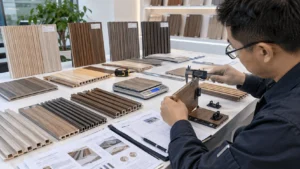
5.2 What to Evaluate in Physical WPC Samples
When your samples arrive, evaluate the following:
- Surface quality: Check for consistent grain pattern, no visible moulding marks, no colour streaking, and uniform gloss level across the panel face.
- Dimensional consistency: Measure width, thickness, and length against the specification. Tolerance should be ±0.5mm on width and thickness.
- Weight: Weigh the sample and calculate kg/m². Compare against the supplier’s stated specification — underweight panels may have lower wood fibre content or excessive foaming.
- Cut edge quality: Examine a cross-section cut. A quality WPC panel should show uniform density across the cross-section with no large voids, bubbles, or delamination.
- Fixing system compatibility: Test the groove or clip channel with the supplier’s fixing system to confirm the fit is precise and consistent.
- UV and weathering performance: Request accelerated UV test results if your application is exterior. A reputable supplier should be able to provide ISO 4892-3 or ASTM G154 test reports.
Best practice: Place samples from different suppliers side by side under identical lighting conditions. The difference in quality between manufacturers — even at similar price points — is often immediately apparent from a direct physical comparison.
6. Understanding Required Certifications and Compliance
WPC wall panels imported into different markets require different certifications. Importing without the correct documentation can result in customs detention, forced re-export, or legal liability. Verify the specific requirements for your destination market before placing any order.
6.1 Key Certifications by Market
CE Marking (European Union and UK): Required for construction products sold in the EU under the Construction Products Regulation (CPR). CE marking for WPC cladding requires classification for reaction to fire performance under EN 13501-1 and, for structural applications, declaration of performance under the relevant harmonised standard. Request a Declaration of Conformity and the supporting test reports.
ASTM Standards (United States / North America): WPC cladding for the US market should comply with relevant ASTM standards — particularly ASTM D7031 for WPC decking (sometimes referenced for wall panels) and ASTM D7032 for WPC structural performance. Some projects additionally require ICC-ES (International Code Council Evaluation Service) reports.
SGS / Intertek Test Reports: Third-party test reports from SGS, Intertek, or Bureau Veritas provide independent verification of physical and chemical properties and are widely accepted across markets as a quality assurance baseline even where specific standards are not mandatory.
FSC Chain of Custody (Sustainability): If your project has green building requirements (LEED, BREEAM) or a sustainability policy, request FSC CoC certification confirming that wood fibre content derives from responsible sources.
REACH Compliance (EU chemical safety): For EU imports, confirm that the WPC formulation complies with EU REACH regulations — particularly regarding restricted substances (Annex XVII) and SVHC (Substances of Very High Concern) in the polymer additives.
Compliance shortcut: Ask for the supplier’s current export documentation pack — most established Chinese exporters maintain CE, SGS, and FSC documents as standard and can provide them within 24–48 hours of request.
7. Pricing, MOQ, and Payment Terms
7.1 Understanding WPC Pricing from China
WPC wall panel pricing from Chinese factories is typically quoted in USD per square metre (m²) or per linear metre (LM), and varies significantly by:
- Product type: single-layer ($4–9/m² FOB) vs co-extruded ($8–18/m² FOB)
- Surface finish: plain/brushed vs deep embossed wood grain
- Profile complexity: simple plank vs tongue-and-groove or decorative profile
- Order volume: pricing breaks typically at 200m², 500m², 1,000m², and 5,000m²+
- Colour: standard colours at standard price; custom colours carry tooling and minimum run surcharges
Always request pricing in three Incoterms to allow proper comparison across suppliers:
- FOB (Free On Board): Price includes production and delivery to named Chinese port. You arrange and pay for freight, insurance, and import duties.
- CIF (Cost, Insurance, Freight): Price includes FOB cost plus ocean freight and insurance to your destination port. You handle customs clearance and inland delivery.
- DDP (Delivered Duty Paid): Price includes everything to your named destination address. Highest price, lowest complexity — the supplier handles all logistics, customs, and duty.
7.2 MOQ (Minimum Order Quantity)
Typical MOQ for WPC wall panels from Chinese factories:
- Standard products (stocked colours): 100–300m² — many factories accept trial orders of this size
- Custom colours or profiles: 500–1,000m² minimum — custom tooling and pigment batching require larger runs to be economical
- OEM/private label: Typically 1,000m²+ minimum — includes custom packaging design setup costs
7.3 Payment Terms for First Orders
For first-time orders, the standard payment structure for Chinese WPC manufacturers is:
- 30% T/T (telegraphic transfer) deposit — paid before production begins
- 70% T/T balance — paid against copy of Bill of Lading (before release of original shipping documents)
For larger orders or where risk mitigation is a priority, consider:
- Letter of Credit (LC): Bank-guaranteed payment on presentation of compliant shipping documents. Adds banking cost but provides strong payment security for both parties.
- Alibaba Trade Assurance: For orders through Alibaba, Trade Assurance provides refund protection if the supplier fails to ship on time or the product does not match the description. Useful for smaller first orders.
- Payment risk warning: Never pay 100% upfront for a first order with a new supplier, regardless of how professional their listing appears. The 30/70 payment structure exists to protect both buyer and seller — a supplier who insists on full upfront payment should be treated with significant caution.
8. Pre-Shipment Quality Control
Pre-shipment inspection is the single most important risk-management step available to WPC importers — and the one most frequently skipped by first-time buyers to save cost. Do not skip it.
8.1 What Pre-Shipment Inspection Covers
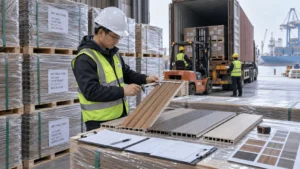
A professional pre-shipment quality inspection (PSI) performed in China before the goods are loaded typically covers:
- Quantity verification — piece count and m² calculation against the purchase order
- Dimensional check — width, length, and thickness measurements on a statistically representative sample
- Visual surface quality assessment — colour consistency, surface defects, edge quality
- Packaging integrity check — carton marking, panel protection, packing method
- Colour comparison against approved reference standard or approved sample
- Product certification document verification against goods to be shipped
8.2 How to Arrange Pre-Shipment Inspection
Third-party inspection services operating in China include:
- QIMA (formerly AsiaInspection): Most widely used by small-to-mid importers — online booking, standardised reports, fast turnaround. Cost: approximately $300–400 per inspection day.
- SGS: Premium global inspection service — higher cost but extremely well-recognised by customs authorities and end-clients worldwide.
- Bureau Veritas, Intertek, TÜV Rheinland: Comparable to SGS in credibility — suitable for large commercial orders or where client contracts require specific inspection body certification.
Arrange the inspection with the service provider at least 5 business days before the planned loading date. Provide the inspector with your purchase order, approved product specification, and approved colour/sample reference.
Cost-benefit: A $350 pre-shipment inspection on a $15,000 WPC order is less than 2.5% of the order value. Discovering a quality or quantity problem before the container leaves China is infinitely cheaper than discovering it after 30 days at sea.
9. Shipping and Freight Options
Selecting the correct freight method for your WPC panel order depends on order volume, budget, urgency, and destination. The comparison below covers the main options:
- Freight Method Transit Time Relative Cost Best For
- Sea Freight – FCL (Full Container) 20–45 days Lowest Orders ≥15 CBM / large commercial projects
- Sea Freight – LCL (Shared Container) 25–50 days Low–Medium Orders 1–14 CBM / first trial orders
- Air Freight 5–10 days High Urgent small orders; samples; high-value thin panels
- Express Courier (DHL/FedEx/UPS) 3–7 days Highest Sample shipments only; <50kg
- Rail Freight (China–Europe) 18–25 days Medium European importers; cost/speed balance
9.1 FCL vs LCL — Which Is Right for Your Order?
Full Container Load (FCL): You book an entire shipping container exclusively for your goods. Standard container sizes for WPC panels: 20ft (approximately 25–28 CBM cargo capacity) and 40ft (approximately 55–60 CBM). FCL is the most cost-effective option per m² for orders above approximately 15–20 CBM and provides the fastest transit and least handling risk, since the container is sealed from factory to destination.
Less than Container Load (LCL): Your goods share a container with other importers’ cargo. More expensive per CBM than FCL, but available for any volume from 0.1 CBM upward. LCL involves more handling (consolidation at origin; deconsolidation at destination), slightly longer transit times, and marginally higher damage risk. Best for trial orders, sample shipments, and orders below 15 CBM.
WPC wall panels are typically packaged as follows: panels wrapped in protective film, stacked in wooden crates or on pallets, with edge protection. Standard crate volumes are approximately 0.3–0.8 CBM per 50–100m² of panels, depending on profile thickness and panel length.
9.2 Working with a Freight Forwarder
Unless you have significant shipping experience, use a licensed freight forwarder to manage your WPC shipment. A good forwarder will:
- Advise on the most cost-effective routing and carrier selection
- Prepare and check all shipping documentation (Bill of Lading, Commercial Invoice, Packing List, Certificate of Origin)
- Coordinate with the Chinese factory’s export documentation team
- Track the shipment and provide proactive updates
- Arrange marine cargo insurance
- Coordinate with your customs broker at destination
10. Import Duties, HS Codes, and Customs Clearance
10.1 HS Code Classification for WPC Wall Panels
The correct HS (Harmonised System) code classification of your WPC wall panels is critical for customs clearance and duty calculation. WPC panels typically fall under:
- HS 3916.20: Monofilament of plastics (rod, stick, profile shapes) of polymers of vinyl chloride — covers PVC-based WPC profiles
- HS 3916.90: Other monofilament, sticks, rods and profile shapes of plastics — covers PE/PP-based WPC profiles
- HS 3920.10 / 3920.51: Plates, sheets, film of plastics — may apply to panel-format products depending on jurisdiction
Classification varies by jurisdiction. Engage a licensed customs broker in your destination country to confirm the correct classification before importation — misclassification can result in penalties, delayed clearance, and retrospective duty demands.
Import duty rates and key market notes:
- Import Region Typical HS Code Import Duty Notes
- United States 3916.90 / 3920.99 0–25% Section 301 tariffs may apply; verify current trade status
- European Union 3916.20 / 3920.51 3.7–6.5% Anti-dumping duties possible; CE marking required
- United Kingdom 3916.20 0–4% Post-Brexit tariff schedule; UKCA may be required
- Australia 3916.90 0–5% ACCC product safety compliance required
- Canada 3920.10 / 3916.90 0–6.5% CETA may offer preferential rates for some goods
- Middle East (GCC) 3916.90 5% Unified GCC customs tariff; halal/GSO not required
- Southeast Asia 3916.90 0–10% ASEAN FTA may reduce duties for some member states
Note: Duty rates are indicative based on standard tariff schedules. Actual rates depend on exact HS classification, origin criteria, applicable trade agreements, and any anti-dumping or countervailing measures in effect. Always verify with a customs broker before importing.
10.2 Documentation Required for Customs Clearance
Prepare and verify the following documents for every WPC panel shipment:
- Commercial Invoice — itemised with HS codes, unit prices, quantities, and declared customs value
- Packing List — detailed list of packages, weights, and dimensions
- Bill of Lading or Air Waybill — issued by the shipping carrier
- Certificate of Origin — from the Chinese Chamber of Commerce (Form A for GSP markets, CO for others)
- Product certification documents — CE Declaration of Conformity, SGS test reports as required
- Import Licence — if required in your destination country for construction materials
- Phytosanitary Certificate — for wooden packaging materials (crates, pallets) under ISPM 15
Customs broker tip: Hire a licensed customs broker who has specific experience clearing construction materials or polymer products. General freight forwarders sometimes lack the product-specific knowledge to classify WPC correctly, leading to delays.
11. Common Mistakes First-Time WPC Importers Make
The following mistakes account for the majority of problems experienced by first-time importers of WPC panels from China. Avoiding them will save you time, money, and frustration:
- Selecting a supplier based on price alone: The lowest-priced WPC panel from China is almost never the best-value option. Price differences reflect real differences in raw material quality, production control, and product performance. The cheapest product is often the most expensive when total lifecycle cost is considered.
- Skipping physical sample evaluation: Product photography on Chinese trading platforms is routinely touched up and does not represent actual product quality. There is no substitute for evaluating a physical sample under your own conditions, in your own hands.
- Ignoring the factory vs trader distinction: Ordering from a trading company without knowing which factory produces the product gives you no control over quality, production scheduling, or problem resolution if something goes wrong.
- Not specifying certifications in the purchase order: If you need CE marking, SGS test reports, or FSC certification, specify them explicitly in your purchase order before production begins. Requesting them after shipment is too late.
- Paying full payment upfront: Never. Use the standard 30/70 or 50/50 structure, or Trade Assurance / LC for first orders.
- Skipping pre-shipment inspection: Discovering quality or quantity problems after a 30-day sea voyage is expensive and legally complex. A $300 inspection before loading eliminates this risk.
- Underestimating landed cost: FOB price is not your cost. Add freight, insurance, customs duty, customs broker fees, port handling, and inland delivery to calculate your true landed cost per m².
- Ordering the wrong quantity for the project: Order 8–12% above the net project area to account for cutting waste, installation damage, and future repairs. Ordering a second batch to match the first is never guaranteed — and reorder colour matching adds cost and risk.
12. Sourcing Agent vs Direct Factory — Which Is Right for You?
One of the key strategic decisions for WPC importers is whether to source directly from a Chinese factory or to use a professional sourcing agent. The right answer depends on your order volume, language capability, and supplier management bandwidth.
12.1 When to Source Direct from Factory
Direct factory sourcing is the right approach when:
- You have sufficient order volume to justify a factory’s attention (typically $10,000+ per order)
- You have the internal capability to manage supplier communication (Mandarin language skills help significantly, but many major WPC factories have English-speaking export teams)
- You require specific customisation (profile design, colour, OEM labelling) that demands direct factory engagement
- You want to build a long-term exclusive or preferred supplier relationship
12.2 When to Use a Sourcing Agent
A professional China-based sourcing agent adds value when:
- Your order volumes are too small to attract premium factory attention
- You lack Mandarin language capability and cannot confidently manage Chinese supplier communications
- You need to source multiple products or manage multiple suppliers in a single engagement
- You want someone physically on the ground in China to conduct factory visits, sample verification, and pre-shipment inspection on your behalf
A good sourcing agent charges 5–10% of the purchase value, or a fixed monthly retainer for ongoing supply management. This cost is often more than recovered through better supplier selection, negotiated pricing, and avoided quality problems.
Long-term strategy: The most cost-effective import model for WPC panels is typically a direct relationship with a verified Chinese factory, managed through a framework supply agreement with defined quality standards, pricing tiers, and dispute resolution provisions. Start with a sourcing agent if needed — then transition to direct once you know which factory you want to work with.
Frequently Asked Questions
What is the minimum order quantity to import WPC wall panels from China?
Most Chinese WPC factories accept orders from 200–300m² for standard stocked products. For trial orders, some factories will supply 100m² or less, particularly if you are an established importer or have provided samples of a previous order. Custom colours, profiles, or OEM labelling typically require a minimum of 500–1,000m². Contact our team to discuss your specific project volume.
How long does it take to receive WPC panels from China?
Total lead time from order confirmation to delivery depends on three components: production time (typically 10–25 days for standard products, 20–35 days for custom), sea freight transit time (14–35 days depending on destination), and customs clearance (2–7 business days). Budget 6–10 weeks from order placement to delivery for a standard sea freight shipment. Express air freight can reduce total lead time to 3–4 weeks but at significantly higher cost.
How do I know if a Chinese WPC supplier is a real factory and not a trader?
Request a video factory tour showing the extrusion lines, raw material storage, and finishing area. Ask for the factory’s business licence (营业执照) and verify the registered address matches a manufacturing facility, not an office building. Commission a third-party factory audit through QIMA, Bureau Veritas, or SGS for any order over $5,000. Legitimate factories welcome this — traders who cannot provide factory evidence should be avoided.
What certifications should I require for WPC wall panels from China?
At minimum, request SGS or Intertek test reports covering the key physical properties of the product. For EU/UK markets, CE marking under the Construction Products Regulation is required. For fire performance requirements, request EN 13501-1 fire classification test reports. For green building projects, request FSC Chain of Custody certification. For US markets, request ASTM compliance documentation. Always specify the certifications required in your purchase order before production begins.
Can I visit the WPC factory in China before placing an order?
Yes, and for orders above $20,000–30,000, a factory visit is strongly recommended. Most established WPC exporters welcome buyer factory visits and can arrange hospitality including airport pickup, accommodation, and factory tours. A single sourcing trip to China — typically 5–7 days visiting 3–5 supplier factories — can save significant risk and cost on large orders. Alternatively, commission a third-party audit service to visit on your behalf.
What are the main risks of importing WPC panels from China and how do I mitigate them?
The main risks are: quality inconsistency (mitigated by sample evaluation and pre-shipment inspection), supplier fraud (mitigated by factory verification and 30/70 payment terms), customs compliance issues (mitigated by correct HS classification and licensed customs broker), shipping damage (mitigated by marine cargo insurance and proper packaging specification), and colour mismatch on reorders (mitigated by requesting retained batch samples and specifying ΔE tolerance). Each of these risks is manageable with the right processes — none of them makes China sourcing inadvisable.
Conclusion: A Reliable WPC Import Relationship Is Worth Building
Importing WPC wall panels from China is one of the most cost-effective sourcing strategies available to distributors, developers, and contractors worldwide. China’s manufacturing depth, product range, and export infrastructure are unmatched — and the total savings compared to domestic or Western European alternatives are substantial.
But the difference between a successful WPC import operation and a costly disaster comes down to process discipline: verifying your supplier before you order, evaluating physical samples, specifying certifications in your purchase order, arranging pre-shipment inspection, and working with experienced freight and customs professionals at every stage.
First-time importers who invest in these steps consistently report that their second and third orders from China are significantly smoother than the first — because they have identified the right supplier and established the quality and logistics framework that makes repeat ordering reliable. Build the foundation correctly, and Chinese WPC sourcing becomes a genuine competitive advantage.
Ready to Import WPC Wall Panels from China? Start Here.
We are a verified WPC wall panel manufacturer with 15+ years of export experience. We ship to 60+ countries and handle everything from sampling to door-to-door delivery.
✔ Free product samples with CE/SGS test reports
✔ FOB, CIF & DDP pricing available
✔ MOQ from 200m²