What separates a five-star hotel room from a very nice four-star one? Guests will give you many answers — the bed linen, the view, the service. But spend time studying what luxury hotel brands actually invest in at specification stage, and a consistent pattern emerges: the walls. Not the art hanging on them, not the color of the paint, but the physical materials that make up the wall surface itself. In a five-star environment, every sensory detail is a deliberate decision — and the wall panels you choose will determine whether guests feel the hush of genuine luxury or something that only resembles it. If you are designing, procuring, or refurbishing a five-star property, this guide will walk you through exactly how to make that decision correctly.
Quick Answer
How to Choose Wall Panels for 5-Star Hotel Rooms
To choose wall panels for 5-star hotel rooms, follow a seven-step process: (1) define your design concept and brand standard first, so materials reinforce the guest experience narrative; (2) prioritize acoustic performance — specify panels with an NRC of 0.75 or higher for the sleeping zone; (3) verify Class A fire safety compliance with certified third-party test data; (4) match material to room zone — acoustic fabric behind the bed, decorative wood veneer or stone on feature walls, waterproof panels in bathrooms; (5) evaluate durability against a minimum 10-year lifecycle target; (6) confirm sustainability credentials to meet ESG and guest expectations; and (7) partner with a supplier experienced in five-star hospitality projects who can provide samples, documentation, and dedicated technical support. The non-negotiables at the five-star level are acoustic performance, fire compliance, and material authenticity — any panel specification that cannot satisfy all three is not five-star grade, regardless of how it looks on screen.

Why Five-Star Hotel Wall Panel Specification Demands a Different Standard
Choosing wall panels for a five-star hotel is fundamentally different from specifying them for any other building type — including lower hotel categories. The difference is not purely about budget. It is about the compounding effect of performance requirements that, at the luxury level, must all be met simultaneously rather than traded off against each other.
In a budget hotel, you can prioritize cost and accept modest acoustic performance. In a four-star property, you might prioritize durability and accept a standard rather than exceptional aesthetic. At the five-star level, there is no acceptable compromise category. A guest paying $400 to $2,000 per night has a calibrated sense of quality — not necessarily a technical one, but a felt one. They will sense immediately whether a wall surface communicates genuine luxury or is performing it. They will notice the dead silence when adjacent rooms should theoretically be heard. They will run their hand along the headboard wall and register the texture. And when they write their review, those impressions will surface — either as a confirmation of the rate they paid, or as a nagging doubt about value.
This is the standard you are building to. Here is how to meet it.
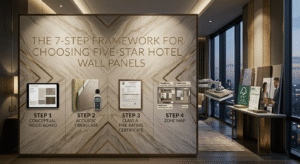
The 7-Step Framework for Choosing Five-Star Hotel Wall Panels
Step 1: Anchor Every Decision in Your Design Concept and Brand Standard
Before you look at a single sample or request a single quote, write down — in plain language — what your guest room walls need to communicate. Are you building a hyper-contemporary urban property where walls should disappear behind geometry and shadow? A heritage resort where materials need to connect to the landscape and local craft tradition? A globally branded luxury hotel where consistency and brand recognition across hundreds of rooms take priority?
The answer determines everything downstream: which material families are in consideration, which textures and tones are appropriate, what scale of panel module suits the room geometry, and how much installation complexity is justified by the design return. Wall panels that are not anchored to a clear design brief end up as expensive wallpaper — visually present but experientially meaningless.
At the five-star level, your design brief should address:
- The emotional quality the room should convey — calm, drama, warmth, modernity, heritage
- The tactile character of wall surfaces — smooth and cool, warm and textured, soft and absorbent
- The relationship between wall panels and other finishes — flooring, ceiling, millwork, soft furnishings
- Any sustainability or material-origin narrative that forms part of the brand story
- Any brand standards from the hotel group that constrain or define material selection
Step 2: Set Your Acoustic Performance Target Before Selecting Any Material
Noise is the single most common complaint in luxury hotel reviews, and the most damaging to the perceived value of a premium stay. The irony is that acoustic performance is also the specification criterion most frequently left as an afterthought — something addressed after the visual design is already locked, when the available options have been severely constrained.
The right approach is the reverse: set your acoustic performance target first, then select materials that meet both acoustic and aesthetic requirements. For five-star guest rooms, the benchmark acoustic targets are:
- NRC (Noise Reduction Coefficient) ≥ 0.75 for the headboard wall panel — this absorbs sound within the room and reduces echo and flutter that makes a space feel live and restless
- STC (Sound Transmission Class) ≥ 50 for the complete wall assembly between adjacent guest rooms — this prevents audible conversation, television, and movement from neighboring rooms
- FIIC (Field Impact Isolation Class) ≥ 50 for floors above — while not a wall panel metric, it interacts with panel specification in rooms below
When reviewing panel options, request certified acoustic test data — not claimed values, not theoretical estimates, but third-party laboratory test reports for the specific product and core assembly you are specifying. NRC values change significantly based on panel thickness, core material, mounting method, and airspace behind the panel. A panel tested mounted directly on drywall will perform differently from the same panel mounted on a 25mm airspace. Test the assembly you will actually build.
| Designer Insight: The highest acoustic return per dollar in a luxury guest room comes from a high-NRC panel on the headboard wall (where guests spend the most time) and acoustic treatment on the shared wall with the corridor or adjacent room. These two interventions alone can eliminate the majority of subjective noise complaints without requiring a full acoustic overhaul of the entire room. |
Step 3: Verify Fire Safety Compliance — Obtain Certified Documentation, Not Claims
Fire safety is not a design preference. It is a legal requirement that carries criminal liability for designers, specifiers, owners, and contractors in most jurisdictions. In the aftermath of major hotel fires globally, building codes have become significantly more stringent — and enforcement more consistent. There is no luxury aesthetic that justifies a non-compliant wall finish, and there is no supplier claim that substitutes for certified third-party test documentation.
For five-star hotel wall panels, the fire standards you need to understand are:
- United States — ASTM E84: Class A rating (flame spread index 0–25, smoke developed 0–450)
- European Union — EN 13501-1: Class B-s1,d0 minimum for most hotel interior applications
- United Kingdom — BS 476 Part 6 and 7: Class 1 surface spread of flame for public building interiors
- Middle East — Gulf Civil Defense standards, which frequently align with ASTM or BS but with local authority amendments
- Asia-Pacific — local fire codes vary significantly; always verify with the authority having jurisdiction (AHJ) for the specific project location
Request the following documentation from every panel supplier before shortlisting: the actual laboratory test report (not a summary certificate) for the product type and thickness you are specifying; confirmation that the tested product matches production specifications (some products are reformulated between testing and manufacture); and the name and contact information of the testing laboratory so you can verify report authenticity if needed.
This documentation requirement alone will eliminate a significant proportion of suppliers from consideration — which is precisely the point. At the five-star level, the acceptable supplier pool is defined by those who can meet this standard, not by those who cannot.
Step 4: Match Panel Material to Room Zone
A five-star guest room is not a single uniform space. It is a sequence of experiential zones, each with different functional requirements, different exposure to moisture and traffic, and different roles in the guest experience narrative. Specifying a single panel type across all zones is a design and performance error — the best five-star installations are zone-specific.
Here is how to approach each zone:
| Room Zone | Recommended Panel Type | Priority Attribute |
| Sleeping Area (behind bed) | Acoustic fabric or perforated wood veneer | Sound absorption — NRC ≥ 0.75 |
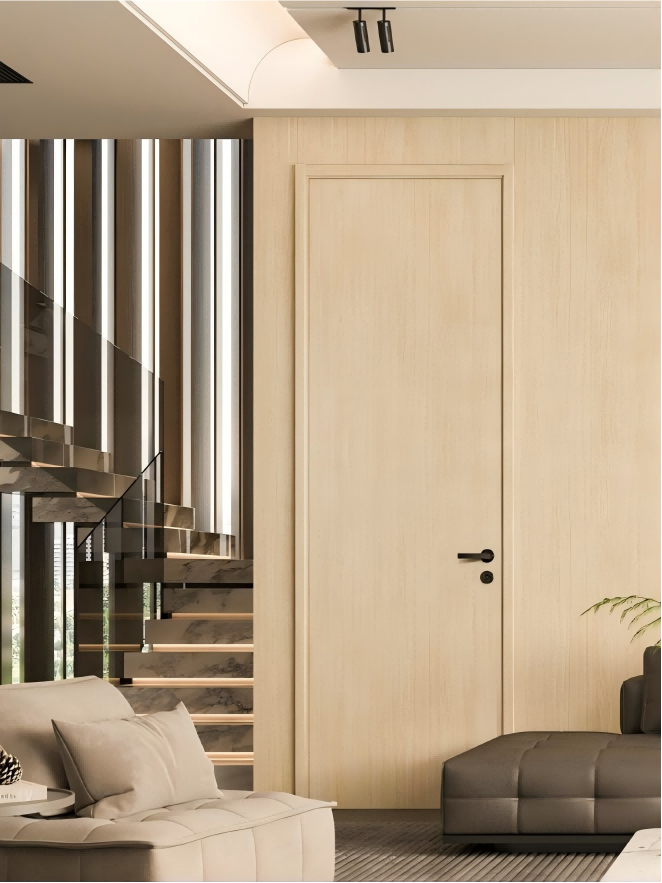
| Sitting / Lounge Zone | Decorative wood veneer or 3D textured panel | Brand identity & visual warmth |
| Entry Foyer | Stone-look panel or luxury wallcovering | First-impression impact |
| Shared Party Walls | High-density composite + acoustic inner layer | Sound isolation (STC ≥ 50) |
| Bathroom Dry Zone | Moisture-resistant MDF or stone-finish panel | Premium aesthetics + water resistance |
| Bathroom Wet Zone | Porcelain slab or waterproof stone panel | Full waterproofing + fire compliance |
Table: Zone-by-zone wall panel specification guide for 5-star hotel guest rooms.
The sleeping zone deserves particular attention. The wall behind the bed — typically incorporating the headboard feature and extending to either side — is the most acoustically critical surface in the room and the most visually dominant. At the five-star level, the most successful specification strategy is a composite approach: a high-NRC acoustic core panel as the structural layer, faced with a premium fabric or decorative veneer that delivers the design intent. This approach achieves NRC ratings of 0.80 or above while maintaining the visual quality of a purely decorative panel.
Step 5: Set a Minimum Lifecycle Target and Evaluate Durability Accordingly
Five-star hotels typically target a full guest room refurbishment cycle of ten to fifteen years. Within that cycle, wall panels must maintain their appearance, structural integrity, and performance without requiring replacement — because replacing panels mid-cycle means closing rooms, which means lost revenue. The cost of a panel that fails at year seven in a property with a fifteen-year cycle is not just the replacement cost; it includes every room night lost during the repair period.
When evaluating panel durability for a five-star project, request the following data from suppliers:
- Taber abrasion test results (surface resistance to abrasion — relevant for luggage contact zones and housekeeping cleaning cycles)
- Impact resistance testing — what force is required to dent or break the panel surface
- UV stability data — for rooms with significant natural light exposure, surface color and finish stability over ten-plus years
- Wet scrub cycle certification — how many standardized cleaning cycles the surface can withstand before finish degradation
- Joint and edge stability — how exposed edges and panel joints perform over time under thermal movement and humidity variation
Also request installation references from comparable five-star hotel projects, and wherever possible, visit an installed reference site. A panel that looks exceptional in the showroom and fails in the field is a pattern that experienced hospitality specifiers recognize — and that only site visits can reveal.
Step 6: Integrate Sustainability Credentials Into the Specification
Sustainability has moved from a marketing attribute to a guest expectation and, in a growing number of markets, a regulatory requirement. Five-star guests — particularly in the corporate, MICE, and premium leisure segments — increasingly research environmental credentials before booking. Hotel owners are under pressure from investors, brands, and lenders to demonstrate ESG performance metrics, of which material sourcing and environmental impact are a key component.
When specifying wall panels for a five-star project, evaluate sustainability across four dimensions:
- Material origin — FSC certification for wood-based panels; recycled content percentage for composite panels; extraction impact for natural stone
- Manufacturing footprint — is the manufacturer certified to ISO 14001 Environmental Management? What is the energy source for production?
- Indoor air quality — confirm VOC (Volatile Organic Compound) emissions compliance with LEED, BREEAM, or WELL Building Standard requirements as applicable. Many premium adhesives and finishes contain VOC levels that can affect indoor air quality and are increasingly restricted by green building certification programs
- End-of-life — can the panel be recycled, reclaimed, or safely disposed of at the end of its life? For 5-star brands with published sustainability commitments, this is increasingly an auditable requirement
Request Environmental Product Declarations (EPDs) from suppliers for all panels being considered for LEED or BREEAM certified projects. An EPD is a standardized, third-party verified disclosure of a product’s environmental impact across its full lifecycle — and is becoming a standard procurement requirement in premium hotel development.
Step 7: Choose a Supplier Partner, Not Just a Vendor
At the five-star level, wall panel selection is a relationship as much as a procurement decision. The supplier you choose will need to provide not just the product, but the technical support, documentation management, sample coordination, custom development capability, logistics reliability, and post-installation service that complex luxury hotel projects demand. A supplier who can deliver an excellent panel at specification stage but disappears when installation issues arise, or cannot provide a replacement panel within an acceptable lead time three years after installation, is not a viable five-star partner.
When evaluating potential suppliers for a five-star hotel project, assess the following:
- Hospitality project portfolio — specific five-star or luxury hotel references, with property names and contact persons who can be approached for references
- Sample and documentation service — can they provide full-size installation samples, fire test reports, acoustic test reports, VOC certifications, and EPDs within a standard project timeline?
- Custom capability — can they develop custom colors, textures, sizes, or acoustic configurations to meet your design brief, and what is the minimum order quantity and development lead time for custom specifications?
- Logistics and supply chain reliability — what are their standard lead times? What happens if your order is part of a larger hotel opening program where delays cascade?
- After-sales support — what is their replacement panel availability policy? Do they maintain stock for installed products beyond the warranty period?
The best five-star hotel wall panel suppliers actively participate in the specification process — visiting the project, reviewing the design brief, proposing solutions, and providing mock-up support. If a supplier is only reachable by email and sends a catalog without engaging in your project specifics, that is a signal about the level of support you will receive when you need it most.
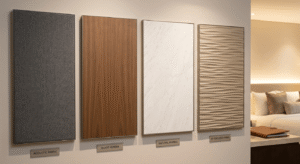
Material Comparison: Which Panels Are Truly Five-Star Grade?
Use the table below as an initial filter. It reflects performance across the criteria most relevant to luxury hotel guest room specification.
| Material | Design Impact | Acoustic NRC | Maintenance | 5-Star Suitability |
| Acoustic Fabric Panels | High | 0.75 – 1.00 | Medium | ★★★★★ |
| Wood Veneer / MDF | Very High | 0.20 – 0.55 | Low | ★★★★★ |
| Natural Marble / Stone | Premium | 0.02 – 0.10 | Low–Med | ★★★★☆ |
| 3D Textured Panels | Very High | 0.30 – 0.55 | Low | ★★★★☆ |
| Perforated Metal Panels | High | 0.40 – 0.70 | Very Low | ★★★☆☆ |
| Commercial Wallcovering | Medium | 0.05 – 0.20 | Very Low | ★★★☆☆ |
| PVC / Vinyl Panels | Medium–Low | 0.05 – 0.15 | Very Low | ★★☆☆☆ |
Note: NRC values reflect typical ranges for hotel-grade specifications. Actual performance depends on panel thickness, core material, and mounting assembly. ★★★★★ = Fully suitable at five-star level; ★★☆☆☆ = Limited suitability.
What Experienced Five-Star Hotel Designers Look For — An Insider Perspective
Having observed the specification decisions made by leading hospitality interior designers on five-star projects across multiple markets, several patterns emerge consistently among the most successful wall panel programs:
They always specify a full-scale mock-up.
The gap between how a panel looks on a 300mm sample and how it reads on a full wall can be dramatic. Grain patterns, texture depth, seam visibility, color variation, and the behavior of the panel under the room’s specific lighting all change at full scale. The cost of a mock-up is trivial relative to the cost of specifying the wrong panel across an entire hotel.
They design the lighting before finalizing the panel.
Wall panel texture and three-dimensionality are only visible when light crosses the surface at an angle. Acoustic fabric panels that appear flat and featureless under ambient downlighting can become richly textured when grazed with a wall-wash fixture. Specifying panels in isolation from the lighting design is one of the most common and costly errors in luxury hotel interiors.
They prioritize the headboard wall above all other surfaces.
The headboard wall is the single surface a guest stares at for the most hours across a stay — first when settling in, then each morning, and whenever they rest against the bed. It is also the acoustic surface with the greatest impact on perceived noise levels. Experienced designers allocate a disproportionate share of the wall panel budget to this surface, and treat other walls as supporting context.
They always test cleaning compatibility before final specification.
Every panel shortlisted for a five-star project is tested with the property’s actual cleaning protocols and chemicals before the specification is finalized. Incompatibility between cleaning agents and panel surface chemistry can cause rapid degradation that is contractually difficult to address after installation.
The Most Costly Mistakes in Five-Star Hotel Wall Panel Specification
- Treating acoustic performance as a secondary specification criterion — addressed after visual design is locked, when material options have already been severely constrained.
- Accepting supplier claims of fire compliance without requesting the actual laboratory test report for the specific product and thickness being specified.
- Specifying a single panel type across all room zones rather than taking a zone-specific approach that matches material performance to functional requirements.
- Failing to conduct a full-scale mock-up installation before committing to a specification across multiple rooms or an entire hotel.
- Selecting a supplier based on catalog quality rather than confirmed five-star hotel delivery track record, technical documentation capability, and after-sales service commitment.
- Ignoring the interaction between wall panels and lighting design — finalizing panel specifications before the lighting scheme is developed or tested.
- Underestimating the importance of panel joint management — poorly managed seams between panels can undermine even the most premium material specification, making an expensive surface look budget.
Frequently Asked Questions
How much should a five-star hotel budget for wall panels per room?
Total installed costs for wall panels in five-star guest rooms typically range from $120 to $450 per square meter, depending on material, room count, and market. For a standard 40–50 m² guest room with wall surface area of approximately 80–100 m², this translates to a total wall panel investment of $9,600 to $45,000 per room. Luxury suites and branded residences at the ultra-luxury tier can exceed these figures significantly, particularly where bespoke materials and artisan finishes are specified. Material cost typically represents 45–60% of total installed cost; installation, substrate preparation, and waste factor constitute the remainder.
Can acoustic panels look as premium as purely decorative panels?
Yes — and in many cases, high-performance acoustic fabric panels outperform purely decorative materials in visual terms at the five-star level. Modern hospitality acoustic panels are available in hundreds of fabric textures, custom colors, and bespoke graphic prints. They can be specified in large-format modules that eliminate visible seams. Some manufacturers offer curved and three-dimensional acoustic panel configurations. The key is specifying a hospitality-grade acoustic panel with a premium fabric facing and a clean-edge finish system — not a basic studio foam panel.
How do I handle wall panels in high-humidity hotel bathroom areas?
In wet zones — shower enclosures and areas subject to direct water splash — specify porcelain slab panels, natural stone with hydrophobic sealing, or engineered stone composites with fully waterproof adhesive systems and silicone-sealed joints. In dry bathroom zones outside the wet area, moisture-resistant MDF with a sealed or lacquered finish, or luxury vinyl panels with stone or concrete aesthetics, perform well and are significantly easier to install and maintain than natural stone. Avoid fabric panels, standard MDF, and wood veneer in any bathroom area regardless of the aesthetic brief.
What is the typical lead time for five-star hotel wall panels?
Lead times vary significantly by material and order size. Standard commercial acoustic panels typically have 4–8 week lead times for in-stock specifications. Custom color, fabric, or size specifications add 4–8 weeks to that baseline. Decorative wood veneer panels in custom profiles typically require 6–12 weeks from confirmed specification. Natural stone panels — particularly bespoke thin-stone configurations — can require 12–20 weeks from block selection to delivery. For any project with a fixed opening date, confirm lead times at the specification stage, not at the purchase order stage, and build a minimum 15% buffer into your project schedule.
How do I specify wall panels to meet LEED or BREEAM requirements?
For LEED v4 compliance, focus on low-emitting materials credits: specify panels with VOC emissions tested to CDPH Standard Method v1.2, and adhesives and sealants with VOC content below LEED thresholds. For materials credits, prioritize panels with EPDs, recycled content declarations, and sourcing within 500 miles of the project site where feasible. For BREEAM, the Mat 01 and Hea 09 credits are most relevant to wall panel specification — request Life Cycle Assessment data and indoor air quality test reports from suppliers. Many leading hospitality panel manufacturers have pre-tested their products against LEED and BREEAM requirements; ask explicitly during the qualification process.
Final Thoughts
Choosing wall panels for a five-star hotel room is not a procurement task — it is a design and strategic decision that will shape guest experience, operational costs, and review scores for a decade or more. The seven-step framework in this guide is built around one principle: at the five-star level, performance and aesthetics are not competing priorities. They are both requirements, and the best wall panel programs satisfy both completely.
The hotels that consistently earn and maintain five-star recognition are the ones where every element of the guest environment has been specified with precision, validated through testing, and supported by suppliers who understand what luxury hospitality actually demands. Wall panels are where that commitment either shows or it doesn’t.