Table of Contents
You approved the colour. The samples looked perfect. Then the containers arrived — and the installed panels don’t match the show-home you used to sell the project. If you have ever experienced this, you already know how damaging WPC colour inconsistency can be: from costly replacements and delayed handovers to unhappy clients and damaged business relationships. Color consistency in WPC systems isn’t just an aesthetic concern — it is a technical challenge that runs from raw material intake all the way through to finished-product dispatch. Understanding how to control it is what separates premium WPC manufacturers from the rest of the market.
Quick Answer
Achieving color consistency in WPC systems requires controlling five interconnected variables — raw material quality, pigment selection, compounding process, extrusion parameters, and post-production quality verification. Specifically: use inorganic or high-performance organic pigments in masterbatch form, standardise wood fibre moisture to below 2%, maintain tight extrusion temperature tolerances (±2°C), implement in-line spectrophotometric measurement, and define ΔE tolerance thresholds (typically ΔE ≤ 2.0) in your quality contracts. Together, these controls eliminate the most common sources of batch-to-batch and within-batch colour variation.
1. Why Color Consistency in WPC Systems Is So Hard to Achieve
WPC — Wood Plastic Composite — is an inherently complex material. Unlike a painted metal panel or a ceramic tile, which starts from a uniform substrate, WPC is produced from a blend of organic and inorganic materials that each carry their own natural variation. This complexity is the root of the colour consistency challenge.
At the most basic level, you are trying to create a visually uniform surface from:
- Wood fibres or flour — which vary in species, age, cut, and moisture content
- Thermoplastic polymers — which carry their own base colour and opacity
- Pigment or masterbatch — which must be dispersed uniformly through the matrix
- UV stabilisers, lubricants, and processing aids — which can affect colour perception
- The embossed or brushed surface texture — which affects how light interacts with the colour
Any variation in any one of these elements — across batches, across shifts, or even within a single production run — has the potential to create visible colour differences in the final product. The challenge is systematic. Solving it requires process discipline at every stage of manufacturing.
Key insight: WPC colour consistency is not solved by choosing a colour — it is maintained by controlling a manufacturing process.
2. The Five Key Factors That Control WPC Color Consistency
2.1 Raw Material Quality and Standardisation
The single most underestimated source of WPC colour variation is the raw material — specifically, the wood fibre component.
Wood fibre moisture content is the most critical variable. When wood flour enters the extruder with inconsistent moisture levels, it behaves differently during processing — affecting melt viscosity, density, and the way pigment distributes through the matrix. Even small moisture differences of 0.5–1% can produce measurable colour shifts between batches.
Best practice for wood fibre management:
- Standardise incoming wood flour to ≤2% moisture contentbefore compounding
- Use a consistent fibre species and particle size specification from approved suppliers
- Conduct intake moisture testing on every delivery — do not rely on supplier certificates alone
- Store fibre in climate-controlled silos, not open warehouse conditions
- Use FIFO (first in, first out) stock rotation to prevent moisture re-absorption in stored inventory
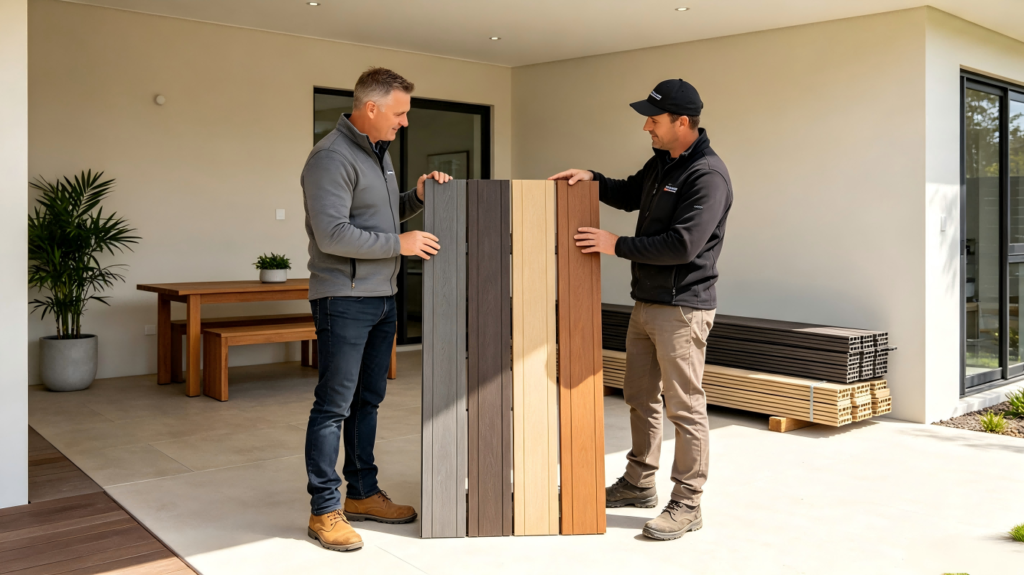
Polymer base colour is the second variable. Virgin PP and PE carry a near-white or slightly cream base. Recycled polymer can introduce grey, yellow, or brown undertones that will affect the final composite colour — particularly in lighter shades. If you use any recycled content, specify a consistent recycled grade with a defined colour range and test each batch before production.
Rule: Never change wood fibre species, supplier, or moisture specification without running a colour-matching trial first.
2.2 Pigment Selection: The Foundation of Color Performance
Not all pigments behave the same way in WPC processing. The pigment you choose determines not just the initial colour, but how stable that colour remains over years of UV exposure, thermal cycling, and weathering. This is one of the most important purchasing decisions in WPC manufacturing.
The main pigment categories and their performance in WPC:
Inorganic pigments (iron oxides, titanium dioxide, chromium oxide): Excellent heat stability (stable above 280°C), outstanding UV resistance, and strong consistency batch-to-batch. Best suited for browns, reds, blacks, greys, and greens. Recommended for exterior WPC applications.
High-performance organic pigments (perylene, phthalocyanine, quinacridone): Good heat stability (stable to 250°C+), excellent colour vibrancy for blues, yellows, and bright tones. More expensive than inorganics but necessary where strong chroma is required. Require UV stabiliser pairing.
Standard organic pigments (azo pigments, basic dyes): Typically not recommended for exterior WPC. Poor heat stability (may degrade above 200°C during extrusion), prone to fading and bleeding. Using them to cut cost is one of the most common causes of rapid colour fade and inconsistency in the field.
Practical pigment selection criteria for WPC:
- Heat stability: Minimum 240°C for standard WPC extrusion; 260°C+ recommended
- UV resistance: Minimum 7/8 on the Blue Wool Scale (ISO 105-B02)
- Migration resistance: Pigment must not bloom to the surface over time
- Dispersion: Prefer fine particle size pigments or pre-dispersed masterbatch for uniform colour distribution
- Consistency: Source pigments from consistent, documented suppliers with batch-level traceability
2.3 Masterbatch vs Dry Pigment Blending
How you introduce pigment into the WPC compound has a major impact on consistency. There are two primary approaches:
Dry powder pigment blending: Pigment is added as a raw powder and blended with wood flour and polymer in a mixer before extrusion. This is the lower-cost option, but it is highly sensitive to operator technique, weighing accuracy, and mixing time. It is the primary cause of colour streaking and within-batch colour variation in lower-tier WPC production.
Masterbatch (pre-compounded concentrate): Pigment is pre-dispersed at high concentration in a polymer carrier that matches the WPC matrix, then introduced at a controlled let-down ratio. Masterbatch delivers dramatically more consistent pigment dispersion, is less sensitive to operator variation, and simplifies dosing. It is the standard approach for any manufacturer serious about colour consistency.
Best practice: Use masterbatch over dry pigment for all production requiring consistent colour — the premium is small compared to the cost of a rejected batch or a client claim.
2.4 Extrusion Parameter Control
Even with perfect raw materials and pigment, inconsistent extrusion parameters will produce colour variation. The three most critical extrusion variables for colour consistency are:
Temperature profile: The temperature across the barrel and die zones must be tightly controlled (tolerance: ±2°C). Temperature fluctuations cause localised variations in melt flow and pigment distribution. Over-temperature conditions can cause pigment degradation or wood fibre scorching — both produce visible colour changes. Under-temperature leads to incomplete dispersion.
Screw speed and throughput rate: Screw speed affects residence time — how long the material spends in the barrel. Changes in screw speed without corresponding adjustments to temperature can change pigment dispersion quality. Maintain consistent throughput rates and document the target parameters for each colour formulation.
Die head pressure and temperature distribution: Uneven heating across the die width creates colour gradients across the panel face — boards may appear darker at edges than the centre. Regular die calibration and thermocouple maintenance are essential.
Colour-related process parameters that should be documented and locked per colour recipe:
- Barrel temperature zone profile (each zone)
- Die temperature and zone settings
- Screw RPM and feed rate
- Melt pressure range
- Cooling bath temperature
- Line speed
2.5 UV Stabilisers and Long-Term Color Stability
Achieving colour consistency at manufacture is only the first part of the challenge. Maintaining that colour consistency across years of outdoor exposure — UV radiation, moisture cycling, thermal expansion — is the long-term test of a WPC system.
The primary tools for UV colour stability in WPC are:
- HALS (Hindered Amine Light Stabilisers): The most effective class of UV stabilisers for WPC. HALS do not absorb UV but instead interrupt the photo-oxidation chain reaction that degrades pigments. High-molecular-weight HALS are preferred for longevity and resistance to extraction in wet environments.
- UV absorbers (benzotriazoles, benzophenones): Work by absorbing UV radiation and converting it to heat. Often used in combination with HALS for a synergistic protective effect — particularly important in the surface layer of co-extruded WPC products.
- Antioxidants: Protect against thermal and oxidative degradation during processing as well as long-term weathering. Particularly important when recycled polymer content is included in the formulation.
For co-extruded WPC wall and decking panels, the outer polymer shell provides an additional UV protection layer — this is one of the key reasons co-extrusion improves long-term colour retention compared to single-layer WPC.
3. Measuring Color Consistency: The ΔE Standard
To manage colour consistency objectively — rather than relying on human visual assessment, which is subjective and inconsistent — the WPC industry uses the ΔE (Delta E) metric from the CIE L*a*b* colour space.
The L*a*b* colour model describes colour using three axes:
- L* (Lightness): 0 = black, 100 = white
- a* (Red-Green axis): Positive values = red, negative = green
- b* (Yellow-Blue axis): Positive values = yellow, negative = blue
ΔE is the calculated distance between two colour points in L*a*b* space — effectively, a single number that expresses how different two colours appear to a human observer.
| Category | ΔE Value Range | Practical Implication |
| Imperceptible | ΔE < 1.0 | No visible difference — ideal for batch-to-batch production |
| Slight variation | ΔE 1.0–2.0 | Barely perceptible — acceptable for most commercial projects |
| Noticeable difference | ΔE 2.0–3.5 | Visible under controlled lighting — may be rejected by buyers |
| Significant variation | ΔE 3.5–5.0 | Clearly visible — typically unacceptable for quality projects |
| Severe mismatch | ΔE > 5.0 | Immediately obvious — warranty claims, project rejection risk |
Industry standard for WPC: Most quality-conscious WPC manufacturers and buyers specify ΔE ≤ 2.0 between batches for the same colour. Premium projects often specify ΔE ≤ 1.0.
Measurement is performed using a spectrophotometer — a device that measures reflected light across the visible spectrum and calculates L*a*b* values. For meaningful control, measurement should occur at:
- Raw material intake (wood fibre and polymer colour baseline)
- Masterbatch / pigment intake (verify against colour standard)
- Start of each production run (confirm first-off sample)
- Every 30–60 minutes during production (in-line or near-line)
- Final inspection before packing (confirm against approved standard)
Key requirement: Ask any WPC supplier for their ΔE tolerance specification and the measurement protocol they use. If they cannot provide this, colour consistency is not systematically controlled.
4. Common WPC Color Consistency Problems and How to Solve Them
The table below maps the most frequently encountered colour problems in WPC systems to their root causes and the corrective actions required:
| Problem | Root Cause | Solution |
| Batch-to-batch color shift | Wood fibre moisture variation | Standardise drying to <2% moisture |
| Surface whitening / chalking | UV pigment breakdown | Upgrade UV stabiliser loading |
| Color streaking | Poor pigment dispersion in mix | Pre-mix masterbatch; extend mixing time |
| Fading within 12 months | Low-grade organic pigments | Switch to inorganic or carbon-based pigments |
| Darker edges than faces | Uneven die temperature profile | Calibrate die heating zones |
| Color difference by run direction | Grain alignment affecting light refraction | Consistent emboss depth & die angle |
| Lot-to-lot colour mismatch | No colorimetric QC at intake | Implement spectrophotometer intake checks |
5. Production Protocol: A Step-by-Step Approach to Color Control
For WPC manufacturers who want to build a systematic colour consistency programme, the following protocol represents current best practice:
Step 1 — Establish a Colour Master Standard
Before production begins, create a physical and digital reference standard for each colour in your range. This means:
- Producing a ‘golden sample’ panel under fully controlled conditions
- Measuring the L*a*b* values of the golden sample with a calibrated spectrophotometer
- Documenting the target L*, a*, b* values and acceptable ΔE tolerance range
- Retaining the physical golden sample in controlled storage (away from UV and humidity)
Step 2 — Define and Lock the Colour Recipe
Each colour must have a locked formula that specifies:
- Masterbatch brand, grade, and lot-down ratio (e.g., 3.5% by weight)
- Wood fibre species, particle size, and target moisture (e.g., ≤2%)
- Polymer grade and supplier
- UV stabiliser type and loading level
- All extrusion process parameters (temperature profile, screw speed, line speed)
Step 3 — Intake QC on Every Raw Material Delivery
Implement mandatory acceptance criteria for each incoming material delivery:
- Wood flour: moisture measurement, particle size confirmation, visual colour check
- Polymer: colour measurement against approved standard (ΔE ≤ 1.0)
- Masterbatch: draw-down test and ΔE measurement against standard
- UV stabilisers: verify correct grade and supplier
Step 4 — Process Monitoring During Production
Continuous or frequent in-process measurement prevents colour drift accumulating undetected:
- First-off sample: measure and approve before full production begins
- Interval measurement: every 30–60 minutes minimum during production
- Shift changeover check: mandatory remeasurement when operators or settings change
- Automated temperature logging: confirm all zones within ±2°C of target throughout run
Step 5 — Batch Traceability and Retention Samples
Each production batch should carry full traceability:
- Unique batch number linking to all raw material lot numbers used
- Time-stamped process data log (temperature, speed, pressure)
- Retained panel sample from every batch — stored for minimum 12 months
- Spectrophotometer measurement record for each batch
- Clear batch segregation in packaging and despatch to prevent mixing
6. How Buyers Can Specify and Verify Color Consistency
If you are a developer, architect, contractor, or distributor purchasing WPC panels, colour consistency should be a contractual specification — not an assumption. Here is how to protect your project:
6.1 Specify ΔE Tolerance in Your Purchase Contract
Do not accept generic terms like ‘colour may vary’ or ‘natural variation expected’. Specify:
- Maximum ΔE between any two panels in the same delivery: ΔE ≤ 2.0 recommended
- Maximum ΔE between repeat orders for the same project: ΔE ≤ 2.0 recommended
- Reference standard: Approved physical sample retained by both buyer and supplier
6.2 Request Pre-Production Colour Confirmation
For large orders, request a pre-production sample from the actual production run — not from existing stock — before the full order is manufactured. Approve it against your standard before authorising production.
6.3 Order Enough Material from a Single Production Run
The most reliable way to guarantee colour consistency across a project is to order all material from a single production run. If this is not possible due to project phasing, specify the same colour code and request batch retention samples from each run to confirm the colour match before despatch.
6.4 Request UV Weathering Test Data
For exterior applications, ask for weathering test results that demonstrate colour stability over the equivalent of 2–5 years of outdoor exposure. Relevant standards include ISO 4892-3, ASTM G154 (UV fluorescent lamp), and ASTM G155 (xenon arc). Look for ΔE change of ≤ 4.0 after 2,000 hours of accelerated UV exposure as a reasonable performance benchmark.
7. How to Evaluate a WPC Supplier on Color Consistency
Not all WPC manufacturers have the same level of colour control capability. Use this checklist to evaluate potential suppliers before placing an order:
| Evaluation Criterion | Priority | What to Ask / Check |
| Spectrophotometer QC on production line | Critical | Request ΔE tolerance spec in writing |
| Retained colour samples per batch | Critical | Ask for sample from every production run |
| Pigment brand & grade documentation | High | Request pigment TDS (Technical Data Sheet) |
| ISO 9001 quality management certification | High | Ask for current certificate |
| UV weathering test reports | High | Request ISO 4892-3 or ASTM G154 results |
| Masterbatch vs dry pigment process | Medium | Masterbatch preferred for consistency |
| Colour range availability & custom colours | Medium | Confirm lead time for custom colour orders |
| Minimum ΔE guarantee in supply contract | High | Negotiate ΔE ≤ 2.0 between batches |
A supplier who cannot clearly answer questions about their ΔE tolerance, measurement method, and batch retention sample practice is almost certainly not managing colour consistency systematically. This is a significant commercial risk for any project where visual uniformity matters.
8. Color Consistency Across Co-Extruded and Single-Layer WPC
The manufacturing structure of the WPC product also affects how colour consistency is achieved and maintained over time.
Single-layer WPC: Pigment is dispersed throughout the entire cross-section of the panel. This means that surface wear or mechanical damage reveals the same colour at depth — but it also means the pigment and UV stabilisers must protect the full thickness of material. Single-layer WPC is more susceptible to colour shift over time if the UV stabiliser loading is insufficient, and it is more sensitive to raw material colour variation because there is no protective skin layer.
Co-extruded WPC: A continuous polymer-rich outer shell is bonded to the WPC core during extrusion. The shell can be independently formulated with higher concentrations of UV stabilisers, pigments, and scratch-resistant additives. This allows much tighter colour control at the visible surface — the appearance is governed by the shell formulation, not the core. Co-extruded WPC consistently shows better long-term colour retention and batch-to-batch surface colour consistency than single-layer construction.
Recommendation: For projects where colour consistency and longevity are critical — facades, hotel exteriors, high-end residential — specify co-extruded WPC rather than single-layer extrusion.
9. Special Considerations: Custom Colors and Large-Scale Projects
Large-scale projects — hotel facades, residential developments, commercial complexes — introduce additional colour consistency challenges that require specific management strategies.
9.1 Custom Color Development
If your project requires a colour not in the standard range, custom colour development adds significant complexity. Key requirements:
- Allow minimum 4–8 weeks for colour development, trial production, and approval
- Approve based on a full production trial, not a lab-scale draw-down
- Document the approved formula with locked masterbatch lot numbers
- Build in a volume buffer — custom colours are difficult to reorder to exactly the same specification
9.2 Phase Ordering for Large Projects
When a project is delivered in construction phases, material for later phases may come from different production runs. To manage this:
- Order all material for the full project in a single production run if possible
- If phased ordering is unavoidable, use retained batch samples to verify ΔE ≤ 2.0 between runs before despatch
- Store later-phase material in covered, UV-free conditions to prevent differential weathering before installation
- Plan installation sequences to ensure any marginal batch differences are distributed evenly across visible elevations, not concentrated in a single zone
9.3 Site Handling and Installation Colour Management
Even perfectly consistent WPC panels can appear colour-inconsistent on site if installation management is poor. Key installation practices:
- Mix boards from multiple packs across the installation area — never install one pack at a time
- Keep panels under UV-protected covers until immediately before installation — avoid differential pre-installation weathering
- Inspect all panels for colour variation before fixing — return suspect panels before installation, not after
- Allow consistent acclimatisation time for all panels in the installation environment
10. Frequently Asked Questions
What ΔE value is acceptable for WPC panel colour consistency?
For most commercial projects, ΔE ≤ 2.0 between panels from the same colour specification is the accepted standard. Premium applications may specify ΔE ≤ 1.0. ΔE values above 3.5 are generally visible to the naked eye under normal lighting conditions and are typically unacceptable for architectural installations.
Why do WPC panels fade to different colours over time if they started the same?
Differential fading is usually caused by insufficient or inconsistent UV stabiliser loading, low-grade pigments, or variation in the panel’s exposure conditions (shading, orientation, reflected heat). Ensuring all panels carry the same UV stabiliser specification at production, and using inorganic or high-performance pigments, significantly reduces differential long-term fading.
Is colour consistency better in co-extruded WPC than single-layer WPC?
Yes, consistently. Co-extruded WPC allows the surface appearance to be controlled independently through the outer shell formulation, with higher pigment and UV stabiliser concentrations. This delivers tighter batch-to-batch surface colour consistency and significantly better long-term colour stability under UV exposure.
How do I match WPC panels from a reorder to the original installation?
Specify the original batch number when reordering and ask the supplier to match against the retained batch sample from the original production run, with a ΔE ≤ 2.0 tolerance confirmed before despatch. Note that if the original installation has been exposed to UV for 12+ months, it will have weathered — a new batch matched to the original standard will appear lighter than the installed material. Allow for this in your project planning.
Can I test WPC colour consistency myself?
Yes. A portable spectrophotometer (such as the X-Rite or Konica Minolta handheld models) allows you to measure ΔE between panels or against a reference standard on site. This is increasingly used by quality-conscious developers and main contractors to verify incoming WPC material before acceptance on large projects.
What is the minimum order quantity to get consistent WPC colour?
This depends on the supplier’s minimum production run length, but a practical minimum for consistent colour is typically 500–1,000 square metres from a single production run. Below this threshold, it is harder to guarantee that all material comes from a continuous run with identical process conditions. Contact our team to discuss your project volume.
11. Conclusion: Color Consistency Is a System, Not a Product
Achieving and maintaining colour consistency in WPC systems is not the result of choosing a good colour — it is the outcome of a disciplined, documented manufacturing system applied at every stage from raw material intake to final despatch.
The key levers are: consistent, well-controlled raw materials (especially wood fibre moisture); the right pigment technology (inorganic or high-performance organic, in masterbatch form); tight extrusion process control (temperature tolerance ±2°C, locked parameters per colour recipe); in-process spectrophotometric measurement with defined ΔE acceptance criteria; and complete batch traceability.
For buyers, the message is clear: colour consistency should be a specification, not an assumption. Define your ΔE tolerance in the contract, request pre-production confirmation samples, and work with suppliers who can demonstrate their colour control programme with documented evidence — not just promises.
The industry benchmark is achievable. The suppliers who consistently hit ΔE ≤ 2.0 across large orders and repeat deliveries are out there — and they are the partners who will protect your project and your reputation.