Table of Contents
You have a 90-room hotel to renovate. The contractor has a six-week window. Rooms need to be back on sale before peak season. And then someone tells you the cabinet installation alone will take three weeks. Sound familiar? Renovation timelines in hospitality and commercial property are brutal—and cabinetry is consistently one of the biggest causes of schedule overruns. But here is what most project managers never discover: the type of cabinet system you specify determines the pace of your entire fit-out. Choose the right door wall cabinet system, and you can cut installation time by 40 to 60 percent. Choose the wrong one, and your schedule—and your budget—will pay the price for months.
Quick Answer
A door wall cabinet system speeds up renovations by delivering pre-fabricated, modular units that install in a fraction of the time required by traditional built-in cabinetry. Components arrive on-site ready to fit—pre-hung doors, pre-drilled fixings, integrated cable management—allowing multiple teams to work room by room simultaneously rather than sequentially. Standardized sizing eliminates on-site measurement and custom cutting. Integrated door-and-cabinet units reduce trade coordination and handoff delays. Exact-match replacement units resolve punch-list issues in hours, not days. The result: shorter project timelines, lower labor costs, less room downtime, and faster return to revenue.
What Is a Door Wall Cabinet System?
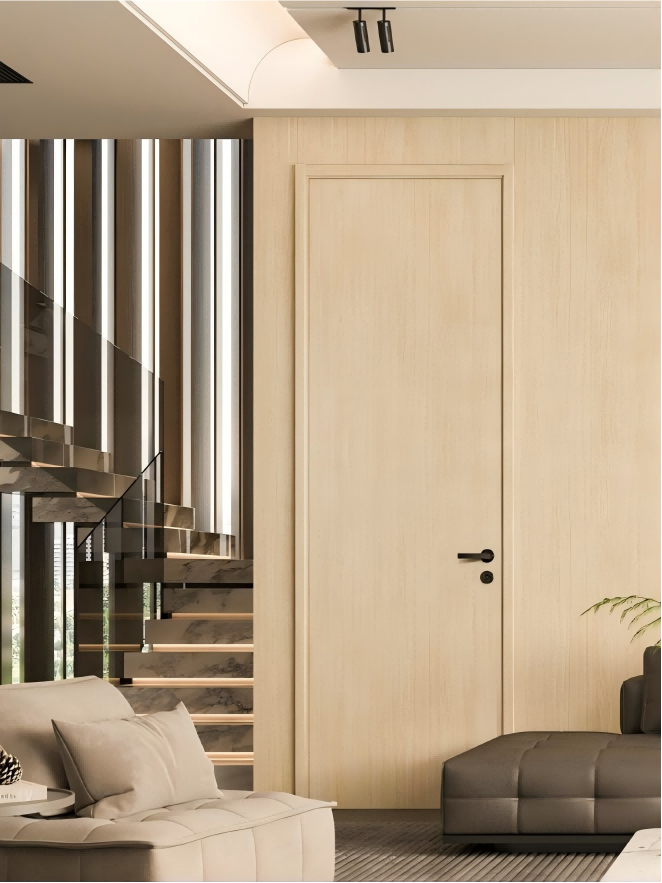
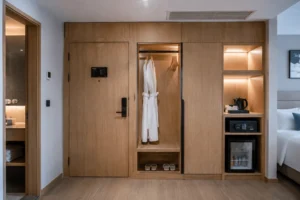
A door wall cabinet system is an integrated furniture solution where the room door, surrounding wall panel, and adjacent storage cabinetry are designed, manufactured, and delivered as a single coordinated assembly. In hotel and commercial fit-out contexts, this typically includes the entry door, a full-height wardrobe or storage unit positioned directly beside or behind the door, and often a luggage shelf, safe housing, and mini-bar enclosure—all within one unified panel system.
The key distinction from traditional cabinetry is integration. Conventional hotel fit-outs treat the door frame, wall finish, and wardrobe as three separate elements, each specified, procured, and installed by different trades at different project stages. A door wall cabinet system replaces this fragmented approach with a single engineered unit that arrives on-site ready to position and fix.
This integration is not merely aesthetic. It is the fundamental reason door wall cabinet systems dramatically accelerate renovation timelines—and precisely why their adoption in hotel renovation projects has grown significantly over the past decade.
The Renovation Timeline Problem
Before exploring how door wall cabinet systems solve the timeline problem, it is worth understanding exactly why traditional hotel renovations run so late. A conventional hotel room fit-out follows a rigid sequential process—each stage unable to begin until the previous one is complete:
- Structural work and wall preparation
- Door frame installation
- Electrical first fix
- Plastering and wall finishing
- Door hanging
- Electrical second fix
- Floor laying
- Painting and decoration
- Wardrobe and cabinetry delivery and installation
- Punch-list and snagging
In this chain, cabinetry cannot begin until painting is complete. Painting cannot begin until walls are plastered. The wardrobe cannot be fully fitted until floors are laid. Every stage is dependent on the one before it, and any single delay cascades forward through the entire schedule.
On top of this sequential dependency, traditional cabinetry typically requires on-site measuring and marking after walls are finished, custom cutting to accommodate irregularities, multiple delivery trips for made-to-measure components, coordination between separate carpentry and door installation teams, and multiple site visits for adjustment and snagging. Each step takes time, requires skilled labor, and creates fresh opportunities for error and costly rework. A door wall cabinet system is specifically engineered to eliminate as many of these variables as possible.
6 Ways a Door Wall Cabinet System Speeds Up Renovations
1. Pre-Fabricated Components Eliminate On-Site Fabrication
In a traditional renovation, a significant portion of installation time is consumed on-site: cutting panels to length, trimming doors to irregular ceiling heights, scribing units to uneven walls, and adjusting components manufactured to nominal—rather than actual—site dimensions.
A well-designed door wall cabinet system arrives pre-fabricated to room specifications. Where room dimensions are consistent—as they are in most hotel builds—standard units can be manufactured at volume, quality-checked in a controlled factory environment, and delivered as finished, ready-to-install assemblies. Installation teams spend the majority of their time actually installing, not cutting, adjusting, and improvising. Industry data from modular hotel furniture projects consistently shows on-site labor reductions of 30 to 50 percent versus traditional carpentry-based fit-outs.
2. Modular Design Enables Parallel Installation
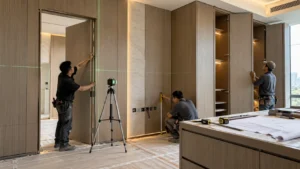
One of the most powerful advantages of a modular door wall cabinet system is that it breaks the sequential dependency entirely. Because each room’s assembly is self-contained and pre-configured, multiple two-person teams can work simultaneously across an entire floor—or across an entire property.
Consider a 100-room hotel renovation. A sequential workflow, completing one room before moving to the next, might cover five rooms per day—taking 20 working days to complete the floor. A parallel modular approach, with five simultaneous teams each working on different rooms, covers the same five rooms per day but finishes in just 4 working days—an 80 percent reduction in elapsed calendar time. That is not a marginal efficiency gain; it is a project transformation.
3. Standardized Sizing Eliminates Measurement Errors
Measurement errors are a chronic and expensive source of delay in traditional cabinet installation. A wardrobe that arrives 20mm too wide for its alcove requires a workshop return trip, a re-manufacture run, and a second delivery—adding days or weeks to the schedule and significant unplanned cost.
Door wall cabinet systems designed for commercial use are built around standardized room dimensions agreed in advance and locked in before production begins. Minor site discrepancies are accommodated with adjustable components—scribing strips, filler panels, and leveling feet—without re-manufacture of entire units. This dimensional discipline, combined with pre-delivery quality checks against approved samples, virtually eliminates measurement-error delays.
4. Integrated Door-Cabinet Units Reduce Trade Coordination
In a conventional fit-out, the door installer and the cabinet installer are separate trades, operating under different procurement contracts, working to different schedules, and communicating through an overworked site manager. The junction between the door frame and the adjacent wardrobe unit is one of the most consistently problematic areas in hotel room fit-out—prone to fit issues, finish discrepancies, and scheduling conflicts.
A door wall cabinet system resolves this by treating door and cabinet as a single coordinated unit, manufactured to the same specification, installed by the same team in a single site visit. Fewer trades, fewer handoffs, fewer opportunities for error, and a cleaner finished result—delivered faster and more predictably than any multi-trade approach can manage.
5. Simplified Supply Chain Reduces Lead Times
Traditional hotel fit-out involves managing multiple parallel supply chains: door manufacturers, frame suppliers, hardware specialists, wardrobe manufacturers, panel material suppliers, and finishing contractors. Each has its own lead time, and the longest lead time in the chain determines when installation can actually begin.
A door wall cabinet system consolidates this into a single supply relationship. One supplier provides the complete assembly—doors, frames, cabinets, hardware, finishes—to a coordinated production and delivery schedule. Lead times are predictable and contractually managed. Delivery is timed to site readiness, not to the diverging schedules of five separate manufacturers. For project managers, this supply chain simplification replaces five purchase orders, five sets of communication, and five punch-list conversations with one—dramatically reducing coordination overhead.
6. Rapid Replacement Minimizes Disruption During Phased Renovations
Hotels rarely close entirely for renovation. Most projects are phased—a floor at a time, a wing at a time—while the rest of the property continues to trade. Punch-list and replacement work must therefore be completed quickly, with minimum disruption to operating rooms.
Because a door wall cabinet system uses standardized, catalogued components, replacing a damaged or defective element is straightforward. A replacement part ordered to a known specification arrives to an exact dimension and can be fitted in hours by a two-person team—without disturbing adjacent rooms or requiring the removal of complete room sets. This rapid replacement capability directly reduces room downtime during phased renovations and accelerates the handover process at the end of each phase, improving the project’s return on investment.
How Much Time Can a Door Wall Cabinet System Actually Save?
Time savings vary with project scale and complexity, but industry experience across hotel renovation projects delivers a consistent picture. The figures below are based on fully coordinated modular installations with parallel installation teams:
Small hotel (50 rooms) | Traditional: 15–20 working days → Modular: 6–9 working days | Time saved: 35–55%
Mid-scale hotel (150 rooms) | Traditional: 30–40 working days → Modular: 12–18 working days | Time saved: 40–55%
Large hotel (300+ rooms) | Traditional: 50–70 working days → Modular: 18–28 working days | Time saved: 45–60%
Even conservative estimates consistently show savings of 35 percent or more. When converted to financial terms—reduced labor costs, earlier room reopening, and avoided revenue loss during room downtime—the business case is typically compelling. For a 200-room hotel at an average daily rate of $150, recovering 5 room-nights per room through faster renovation represents $150,000 in recovered revenue from a single project.
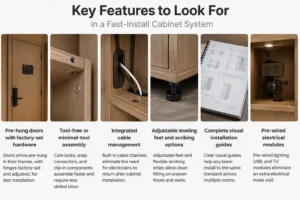
Key Features to Look For in a Fast-Install Cabinet System
Not all door wall cabinet systems deliver the same speed advantages. When evaluating options, look specifically for these features that indicate a system genuinely optimized for rapid installation:
- Pre-hung doors with factory-set hardware. Doors that arrive pre-hung in their frames, with hinges factory-set and adjusted, can be installed in a fraction of the time required for on-site hanging. The door, frame, and hardware should arrive as a single assembly.
- Tool-free or minimal-tool assembly. Systems using cam locks, snap connectors, or clip-in components rather than complex screwed joinery assemble faster, require less skilled labor, and leave less margin for error.
- Integrated cable management. Integrated cable management channels eliminate the need for electricians to return after cabinet installation to route cables—saving a full trade visit and the scheduling coordination it requires.
- Adjustable leveling feet and scribing options. Adjustable leveling feet and flexible scribing strips allow clean fitting without site modification, even when floors and walls are not perfectly level or plumb.
- Complete visual installation guides. Clear visual installation documentation enables less-experienced teams to install to the same standard as specialist fitters—critical when working across multiple rooms simultaneously with different personnel.
- Pre-wired electrical modules. Some systems include pre-wired electrical modules for in-cabinet lighting, USB points, and TV connections—eliminating a full electrical trade visit and its scheduling dependency.
Door Wall Cabinet Systems in Hotel Renovations: A Closer Look
The hotel sector is the most demanding and most developed application for door wall cabinet systems, and for good reason. Hotels face a unique combination of renovation pressures that no other property type replicates:
- Large room counts that make installation efficiency critical at scale
- Revenue pressure that makes every day of room downtime financially material
- Brand standards requiring precise, consistent color and finish across all rooms
- Phased renovation requirements demanding fast, repeatable installation by different teams
- High-traffic use requiring durable, easily replaceable individual components
Major international hotel groups have incorporated modular door wall cabinet systems into their renovation specifications precisely because they offer a credible, proven solution to all five challenges simultaneously. The decision is rarely about aesthetics—modular systems can match any visual specification. It is about project control: speed, consistency, and the financial value of getting rooms back into service faster.
For hotel owners and asset managers, the financial case for a door wall cabinet system is straightforward: calculate the daily revenue loss of a room out of service during renovation, multiply by the number of rooms and the days saved per room using a modular system, and compare with any cost premium over traditional cabinetry. In almost every case across mid-scale to large projects, the modular system more than pays for any cost difference within the renovation project itself—before accounting for the lower labor costs and reduced punch-list time.
Common Mistakes That Slow Down Cabinet Installations
Understanding how door wall cabinet systems accelerate renovations also means recognizing what goes wrong when they are poorly specified or improperly managed. These are the most common avoidable delays:
Specifying bespoke cabinetry for high-volume standard rooms: The single biggest source of unnecessary delay in hotel renovations is specifying custom-built, made-to-measure cabinetry for projects where a standardized modular system would perform identically. Bespoke requires longer lead times, more on-site time, and more trade coordination—with no functional advantage in a standard hotel room.
Inadequate site preparation: A modular cabinet system is only as fast as the site it is installed into. If walls are unfinished, floors are incomplete, or electrical positions are not confirmed, even the fastest modular system stalls. Site preparation should be audited and certified as complete before any cabinet delivery is scheduled.
Late design freeze: Last-minute changes—even minor ones like a handle specification update or an additional shelf—can delay production, push back delivery, and disrupt the installation schedule for an entire floor. Design decisions should be frozen at least 8 to 12 weeks before the installation start date.
Overlooking supplier experience: Not all suppliers of door wall cabinet systems have hotel renovation experience. Those who have not worked at hotel scale may struggle with multi-room simultaneous deliveries, rapid replacement logistics, and the color consistency standards that hotel chains require. Always verify relevant project experience before committing to a supplier.
Misaligned delivery scheduling: Delivering 200 room sets when the site can only install 10 rooms per day creates storage problems, increases damage risk, and slows installation. Work with your supplier to schedule phased deliveries that match your installation team’s actual daily capacity.
How to Prepare Your Project for Maximum Installation Speed
Achieving the maximum time benefit from a door wall cabinet system requires preparation on the client and contractor side—not just a quality system from the supplier. These steps make the difference between a fast installation and a merely adequate one:
- Complete all structural and wall preparation first. Cabinets should not arrive until walls are plastered, dried, and ready to receive fixings. Any structural irregularities should be identified and resolved before the pre-installation survey.
- Conduct a supplier pre-installation survey early. A thorough pre-installation survey—where the supplier measures actual room dimensions, identifies irregularities, and confirms electrical positions—prevents surprises during installation. Allow 4 to 6 weeks between survey and delivery for production scheduling.
- Sequence delivery to match installation capacity. Work with your supplier to schedule deliveries in batches that match your installation team’s daily room capacity. Phased delivery reduces on-site storage demands and damage risk.
- Assign a dedicated on-site coordinator. A single dedicated coordinator who can receive deliveries, direct installation teams, identify issues in real time, and communicate directly with the supplier will save more schedule time than almost any other measure.
- Plan the punch-list and replacement process in advance. Pre-agree with the supplier how snagging items will be identified, reported, and resolved. Confirm that replacement parts can be ordered and delivered within 48 hours. Establish this capability contractually before the project starts.
- Establish daily progress reporting. With five or more simultaneous installation teams working across a floor, real-time communication is essential. Agree on daily progress check-ins with your supplier’s project manager so issues are caught and resolved before they compound.
Frequently Asked Questions
What is the typical installation time per room for a door wall cabinet system?
With a well-designed modular system and an experienced two-person installation team, a complete door wall cabinet installation in a standard hotel room typically takes 2 to 4 hours. This compares with 1 to 2 full working days for a comparable traditional bespoke installation—a time saving of 70 to 85 percent per room.
Do door wall cabinet systems work for renovation projects as well as new builds?
Yes—renovation projects often benefit more from modular systems than new builds do, precisely because renovation timelines are more compressed and room downtime is more expensive. Systems designed for renovation typically include additional flexibility features—scribing options, adjustable fixings, and pre-finished surfaces—that make them easier to install cleanly in existing room shells with minor dimensional variations.
Can a door wall cabinet system be specified to match hotel brand color standards?
Yes. Leading suppliers offer extensive finish libraries covering standard wood tones, laminates, lacquers, and hardware options. For major hotel chains requiring proprietary color matches, custom color development is also available. Physical samples should always be approved and signed off before production begins to guarantee color accuracy across the full production run.
What happens if a single unit needs replacing after installation?
This is one of the key practical advantages of a standardized modular system. Individual components—a damaged panel, a door, a specific cabinet module—can be ordered to the original specification and installed by a two-person team in less than a day, without disturbing adjacent rooms or requiring the removal of entire room sets. This rapid replacement capability is particularly valuable for phased renovations where speed of rectification is commercially critical.
How far in advance do we need to order a door wall cabinet system?
Lead times vary by supplier and specification complexity, but typically range from 8 to 16 weeks from confirmed design freeze to first delivery. Projects with complex or custom specifications should plan for a minimum of 16 weeks. Always confirm lead times directly with your supplier at the earliest planning stage—late ordering is one of the most common and most avoidable causes of renovation schedule delay.
Can smaller properties benefit from a door wall cabinet system, or is it only for large hotels?
Properties of any size benefit from the installation speed, replacement simplicity, and quality consistency of a modular door wall cabinet system. The financial return on the time savings is proportionally similar regardless of room count—and the reduction in installation complexity and trade coordination overhead is valuable even for a single-site property.
Why Choosing the Right Supplier Is Part of the Speed Equation
A door wall cabinet system is only as fast as the supplier behind it. The quality of the system’s engineering, the precision of its manufacturing, the reliability of its delivery schedules, and the responsiveness of its technical support team all directly affect how fast your renovation moves. A beautifully designed system from an inexperienced or under-resourced supplier will not deliver the time savings you expect.
When evaluating suppliers, look specifically for:
- Proven hotel project references. Can they name hotel renovation projects of comparable scale? Can you speak to the project managers involved? References are the clearest indicator of real-world capability.
- In-house production capability. Suppliers who manufacture their own systems control their own lead times and quality. Those who subcontract production are exposed to third-party schedule slippage that they cannot fully control.
- Dedicated project management support. Large renovation projects require active supplier involvement throughout the project, not just product delivery. A dedicated supplier project manager who knows your schedule and responds to issues in real time is a genuine competitive advantage.
- Replacement part lead time commitment. Confirm the supplier’s maximum lead time for replacement parts in writing. For phased renovations where room downtime costs real money, a 48-hour replacement capability versus a 2-week lead time can represent a significant financial difference.
- Documented color management processes. Verify the supplier’s color management processes—spectrophotometer verification, batch records, approved sample retention. Color consistency across large production volumes is technically demanding; suppliers who cannot explain their process clearly are unlikely to deliver reliably.
The right supplier is a renovation partner, not simply a product vendor. They understand the financial stakes of your project timeline. They invest in your schedule as if it were their own. They resolve problems fast because they know what a day’s room downtime costs. This partnership dimension is as important as the technical specification of the cabinet system itself—and it is what distinguishes the best suppliers from the rest.

Conclusion
The pressure to renovate faster, at lower cost, and with less disruption to trading operations is not going away. Hospitality renovation demands will only intensify as aging hotel stock meets rising guest expectations and increasingly compressed renovation windows driven by tighter capital cycles. The door wall cabinet system is not a marginal improvement on traditional practice—it is a fundamentally different approach to hotel fit-out that changes the pace, cost, and risk profile of renovation projects.
For hotel owners, operators, developers, and project managers who are serious about cutting renovation timelines, reducing room downtime, and delivering consistent, high-quality results across large room counts, the question is no longer whether to specify a door wall cabinet system. It is which system—and which supplier—to choose. The time savings are real, the financial case is compelling, and the projects that adopt this approach consistently outperform those that rely on traditional methods.
📩 Ready to cut your renovation timeline by up to 60%? Contact our team today for a door wall cabinet system proposal tailored to your project —