Table of Contents
You’re managing dozens of vendors, juggling delivery schedules, reconciling mismatched finishes between units, and trying to hold the budget together while the handover date creeps closer. If you’ve ever been on a call at 10 PM trying to figure out why the cabinet color doesn’t match the door trim in Unit 4B — you already know the real price of a fragmented supply chain. The question isn’t just about saving money. It’s about protecting quality, reducing risk, and delivering your project on time without the kind of coordination nightmare that drains your team and quietly eats into your margin.
Quick Answer
Should developers buy doors and cabinets from one factory? In most cases, yes. Sourcing both products from a single manufacturer gives real estate developers measurable advantages: lower procurement costs through volume bundling, guaranteed material and finish consistency across all units, streamlined logistics with a single delivery schedule, and one clear point of accountability when problems arise. For large-scale residential or commercial developments, consolidating doors and cabinets under one factory typically yields cost savings of 15–30% compared to managing two separate vendors. The critical factor is selecting a factory with proven, certified capability in both product lines — and this article shows you exactly how to do that.
The Real Cost of Managing Two Separate Vendors
Most developers don’t calculate the hidden cost of splitting their door and cabinet orders. They see two line items on a spreadsheet and compare price per unit, lead time, and MOQ. What they don’t account for is the invisible overhead that compounds across every stage of a large project.
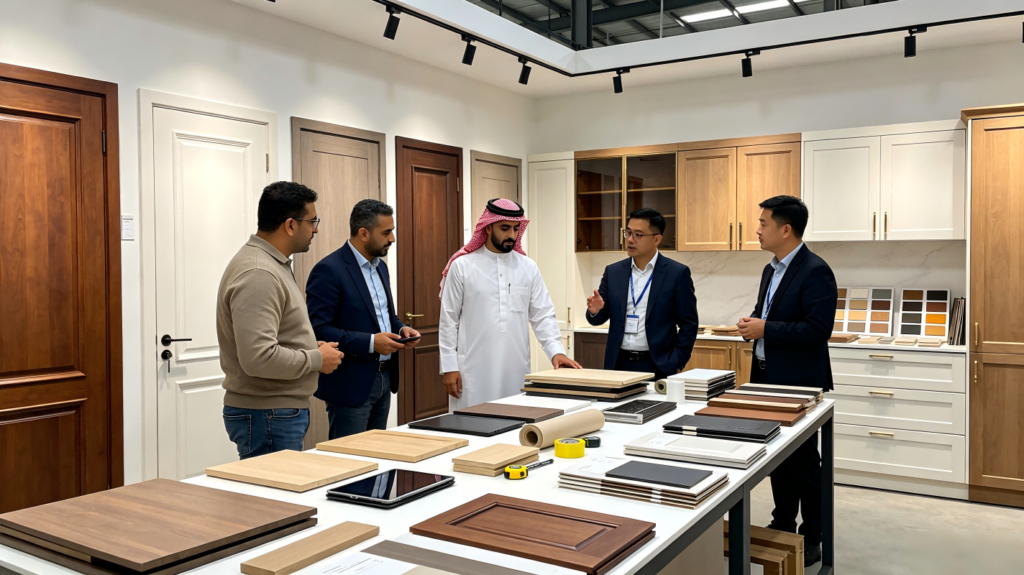
Consider a 200-unit residential development. The developer sources interior doors from Vendor A in one province and kitchen cabinets from Vendor B in another. Here’s what actually happens:
- Double the sourcing effort. Your procurement team spends twice as much time on supplier vetting, sampling, negotiating, and contracting. Two sets of technical drawings. Two sets of sample approvals. Two sets of legal agreements. Two factory audits.
- Double the communication overhead. Every design revision must be communicated to and confirmed by two separate teams with two different workflows. Misunderstandings are inevitable, and when they happen, there’s nobody who owns the relationship between the two products.
- Finish and material mismatches. This is the biggest silent quality killer. Even when you specify the same RAL color for doors and cabinet fronts, two factories using different lacquer suppliers and spray lines will almost never produce a perfect visual match. In a mid-to-luxury development, this triggers buyer complaints, developer re-sprays, and margin damage that far exceeds any cost savings from using two vendors.
- Fragmented delivery windows. Vendor A ships in week 12. Vendor B isn’t ready until week 15. Your installer is booked for week 12. Now you’re rescheduling labor, paying for storage, and watching your handover date slip.
- Divided accountability. When something goes wrong — and in large-scale construction, something always does — two vendors means two excuses and no one who owns the problem end-to-end. Without one supplier responsible for both, resolution takes longer, costs more, and lands on your team to mediate.
The total cost of managing two vendors isn’t just financial. It’s time, energy, quality risk, and the kind of project complexity that scales with every unit you add.
What It Means to Source Doors and Cabinets From One Factory
“Buying from one factory” sounds straightforward, but it’s worth being precise — because not every factory that claims to do both is built to do both well.
A genuine dual-capability factory manufactures both interior/exterior doors and cabinetry within the same or closely integrated production facility, under the same quality management system, using compatible material specifications. This is different from a trading company that sources from two sub-suppliers and consolidates the invoice. It’s also different from a factory that produces cabinets as its core business but “can also do doors” as a side offering with outsourced components.
What you’re looking for is a manufacturer where both product lines share:
- The same raw material standards — board grades, hardware suppliers, surface treatment protocols
- A unified finish control process so door and cabinet surfaces are visually matched from the same batch
- A single production scheduler who can coordinate lead times across both lines simultaneously
- Integrated quality inspection covering both products before a single shipment leaves the factory
When a factory meets these criteria, the advantages for a developer are structural — not just about convenience. They eliminate an entire category of risk from your supply chain.
5 Major Benefits of Buying Doors and Cabinets From One Factory
1. Lower Unit Costs Through Bundled Purchasing Power
When you place a combined order for doors and cabinets, you’re not just buying two products — you’re giving one supplier a significantly larger contract value. And that matters.
Factories reserve their best pricing for customers who offer volume and consistency. A developer ordering 200 sets of interior doors AND 200 kitchen cabinet sets in a single contract is a very different client than one ordering only doors. The combined order value may cross a pricing tier threshold, unlock better material specifications at no extra cost, or give you leverage to negotiate free design services, reduced sampling costs, or priority production scheduling.
In practice, developers who consolidate their door and cabinet orders frequently report 10–25% lower per-unit costs compared to splitting orders. Over 200 units, this difference is significant enough to offset the cost of a factory audit trip before signing the contract.
Beyond the purchase price, bundled orders mean lower shipping costs (one consolidation, one freight booking, one customs clearance), fewer inspection fees (one factory visit covers both products), and reduced administrative overhead (one contract, one payment schedule, one invoice).
2. Guaranteed Design Consistency Across Every Unit
This is the most underappreciated benefit of single-factory sourcing — and the one with the most direct impact on end-buyer satisfaction.
In a residential development, buyers compare units. In a hotel project, guests move between rooms. In a serviced apartment complex, tenants have eyes. Any visible inconsistency between door finishes and cabinet finishes is noticed, discussed, and remembered. When those two products come from separate factories with separate material sources and separate quality control processes, visual variation is essentially guaranteed over a large batch.
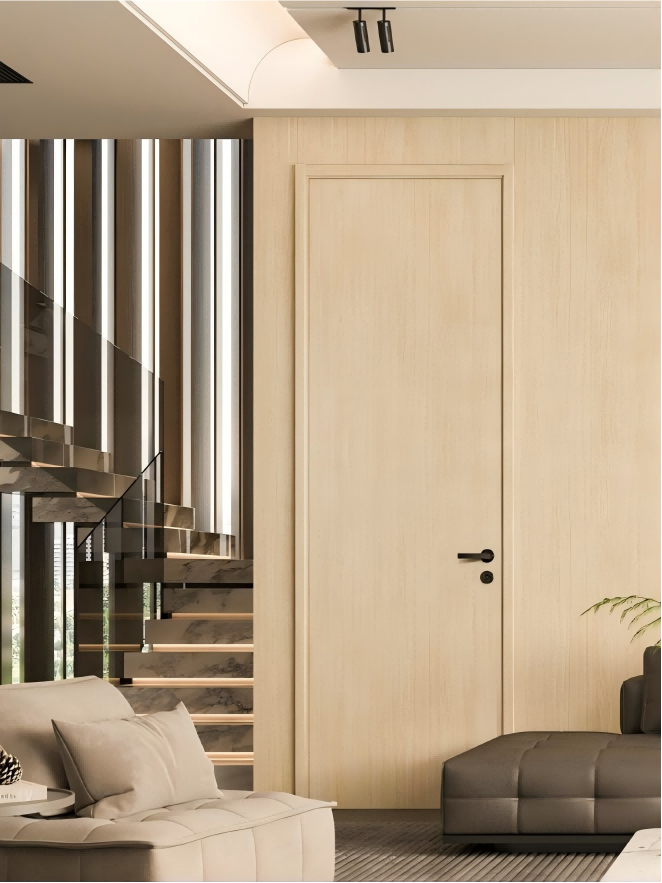
When doors and cabinets come from the same factory, the surface treatment — whether it’s lacquer spraying, melamine wrapping, veneer pressing, or PVC foiling — happens on the same equipment, with the same batch of materials, under the same quality standards. The result is a visual coherence that simply cannot be reliably achieved any other way.
For developers positioning their projects in the mid-to-luxury segment, this consistency isn’t a nice-to-have. It’s a fundamental requirement for protecting your brand and preventing after-sales complaints that cost far more to resolve than they would have cost to prevent.
3. Simplified Logistics and Fewer Coordination Headaches
A large development project has enough moving parts already. Every additional vendor in your supply chain introduces new variables: a new production calendar, a new shipping schedule, a new point of failure.
Sourcing doors and cabinets from one factory means one production plan covering both. Your factory contact can tell you, in a single conversation, exactly when both products will be ready for shipment — and can coordinate packaging and loading so that both arrive at your site simultaneously, in the correct quantities, labeled correctly for each unit.
This logistics simplification becomes even more valuable in phased developments where you’re delivering units in batches across a multi-month or multi-year timeline. Instead of coordinating two separate restocking orders every phase, you make one call and place one order. The factory already knows your specs, your labeling requirements, and your site contact.
4. Faster Project Timelines From a Single Production Schedule
Time is money in development. Every week a project overruns its handover target adds holding costs, delays revenue recognition, and creates buyer friction that can damage your reputation in the market.
When doors and cabinets come from the same factory, production schedules are inherently coordinated. The factory doesn’t ship the cabinets in week 8 and the doors in week 14 — both go out together on a schedule your project team can plan around.
This also means that if your project timeline shifts — as it almost always does in large-scale development — you have one supplier to call and one schedule to renegotiate. Instead of managing separate change requests with two production teams operating in parallel, you deal with a single point of contact who owns both timelines and can adjust both simultaneously.
For contractors and project managers who’ve lost weeks to misaligned delivery schedules, this benefit alone often makes the single-factory decision a straightforward one.
5. One Point of Contact for Quality Control and Aftersales
In a 200-unit project, the probability that something will need attention after delivery is close to 100%. A scratched door. A cabinet drawer that’s misaligned. A hinge that needs adjusting. These are normal occurrences in large-scale fit-out work, and how your supplier handles them determines whether they’re minor inconveniences or major project disruptions.
When doors and cabinets come from the same factory, there’s one account manager, one warranty policy, one claims process, and one team responsible for resolution. If a batch of doors has a surface defect that’s also visible on the cabinet fronts, the factory already knows both products and can assess and resolve the issue comprehensively — rather than deflecting responsibility onto another supplier.
This single-point accountability isn’t just convenient. It’s a risk management tool. When something goes wrong, you’re not caught between two parties pointing at each other. You have one supplier who owns the problem and is incentivized to resolve it quickly to protect the relationship.
What to Look for in a Factory That Supplies Both
Not every factory that offers doors and cabinets is equally capable of delivering both at scale. Before committing to a single-factory sourcing strategy, verify the following:
Integrated production, not outsourced sub-supply. Ask directly: “Do you manufacture both products in-house?” A factory that produces cabinets but outsources door production to a third party isn’t a single-factory solution — it’s a trading company in disguise. You should be able to tour both production lines on a factory visit.
Compatible material specifications. The board grades, hardware, and surface treatment materials for doors and cabinets should come from overlapping suppliers, with documented specifications you can review. If the cabinet team uses one lacquer supplier and the door team uses another, finish consistency is at risk.
Unified quality management system. The factory should have a single QC framework — ideally ISO 9001-certified — that covers both product lines. Ask to see inspection records and understand how they manage inter-product finish matching across large batches.
Relevant project experience. Ask for references from developers who’ve ordered both products from the factory. How did they handle multi-phase delivery? What was their defect rate? How did they manage after-sales issues? References from projects of comparable scale to yours are particularly valuable.
Dedicated project management. Large developer orders need a dedicated account manager who understands construction timelines, phased delivery requirements, and the specific needs of bulk procurement. A factory that treats your order like a standard retail sale is not equipped to support you.
Export capability and documentation. If you’re developing internationally, your factory needs proven experience with export documentation, container loading, customs requirements, and international shipping coordination.
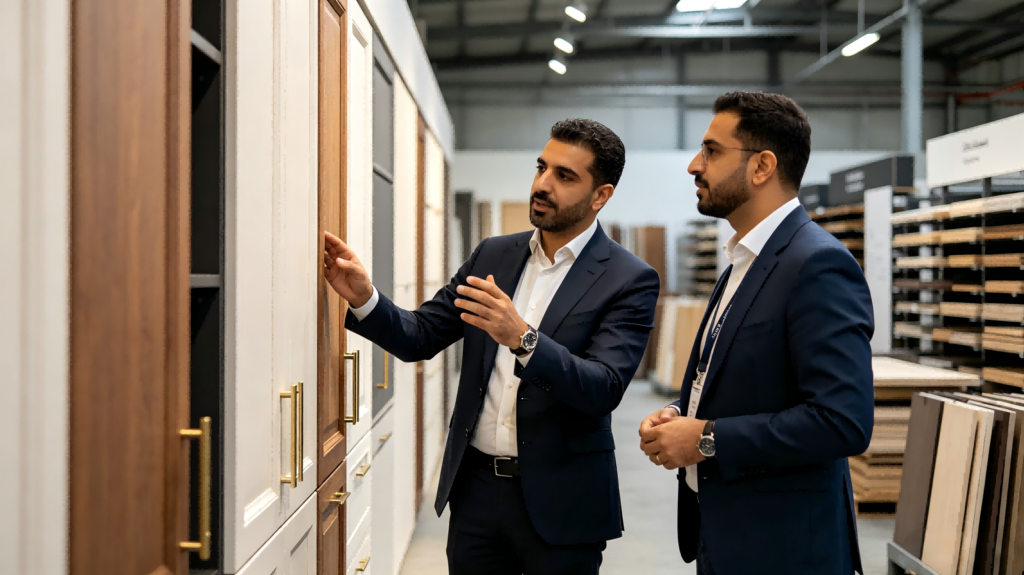
Common Questions Developers Ask Before Consolidating Suppliers
“What if the factory is stronger at cabinets than at doors?”
This is a legitimate concern, and it’s why due diligence matters. Ask to see samples of both products and have them reviewed by someone with technical knowledge of both. If the cabinet quality is exceptional but the doors feel like an afterthought, that’s the factory telling you something about where they’ve invested. Look for a manufacturer where both product lines are clearly core business — with dedicated production lines, separate QC stations, and sales staff who can speak technically about both.
“Doesn’t using one factory increase our risk concentration?”
Only if you don’t vet the factory carefully upfront. A well-qualified, financially stable factory with proven capacity is lower risk than two under-resourced vendors competing for your business. The key is doing your homework before signing: factory audit, reference checks, and a clear understanding of production capacity and contingency protocols.
“Can one factory really match two different factories on price?”
When you’re placing a combined order, the bundled value changes the negotiation. You’re not asking one factory to match two price lists separately — you’re offering one factory a significantly larger total contract, which gives them strong motivation to price aggressively. Most developers find that a well-negotiated single-factory contract is cheaper than the sum of two separate vendor contracts, especially once logistics and administrative savings are included.
“What about specialized local suppliers for one of the products?”
Sometimes a local supplier offers genuine speed advantages — faster delivery, easier communication, lower MOQs. This can be a real advantage for small developments or for replacement and repair orders. But for large-scale initial fit-outs, the benefits of consolidated sourcing almost always outweigh the advantages of a local specialist for one product line.
When It Might Not Make Sense to Use a Single Factory
Honesty serves developers better than oversimplification. There are genuine scenarios where splitting your door and cabinet orders is the right call:
- Very small projects: If you’re developing 10–20 units, the logistics and quality benefits of single-factory sourcing are less pronounced, and a local supplier for one product may offer better value and more flexibility.
- Highly specialized requirements: If your doors require specific fire ratings, acoustic performance, or security certifications that your cabinet supplier doesn’t manufacture, forcing the combination may compromise technical specification or value for money.
- Emergency replacement orders: If you need to replace damaged units mid-project and your primary factory has a 60-day lead time, local sourcing may be the pragmatic choice — even if it introduces some finish consistency risk.
- Strong existing supplier relationships: If you have a long-term relationship with a door supplier who knows your standards and has delivered reliably for years, the switching cost may not be worth it — particularly if your current cabinet supplier is also performing.
The case for single-factory sourcing is strongest in medium-to-large developments (50+ units), projects with strict design coherence requirements, and situations where procurement simplicity directly impacts project timeline and margin.
How to Evaluate a Door and Cabinet Factory for Large-Scale Projects
A factory visit is non-negotiable for procurement decisions at this scale. Here’s what to look for when you’re on-site:
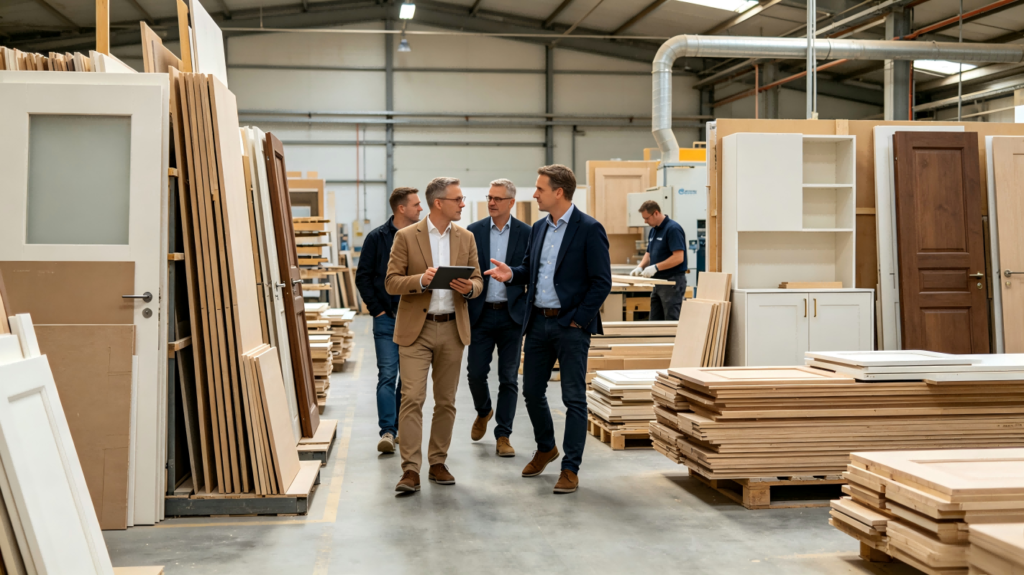
Production line capacity. How many units can they produce per month for each product? Does the capacity align with your project schedule and phase structure? Are they currently over-committed with other clients?
Material storage and handling. Are boards and panels stored properly to prevent warping or moisture damage? Is hardware organized and inventoried in a way that supports accurate bill-of-materials management for a large order?
Finish quality control. Visit the spray booth or foiling line. Look at the QC checkpoints. Ask how they manage batch-to-batch color consistency for large orders, and ask to see the current production run for another client.
Sample room and showroom. A factory serious about product quality will have a well-curated sample room showing both door and cabinet options at multiple price points and finishes. If the sample room is sparse or disorganized, it often reflects the company’s attitude toward product development and design investment.
After-sales support infrastructure. How do they handle warranty claims? Do they maintain replacement inventory for common components? Is there a dedicated after-sales team, or is it handled by the same staff who take new orders?
Management and communication. Are the people you meet technically knowledgeable about both product lines? Do they understand construction timelines and phased delivery? Can they communicate clearly in your working language, or do they have capable professional translation support?
10 Key Questions to Ask Your Factory Before Signing a Contract
Get clear, specific answers to these questions before you commit to any single-factory arrangement:
- Do you manufacture both doors and cabinets in-house, or do you sub-contract either product?
- Can you provide a unified finish specification document confirming material and color matching across both products?
- What is your current production capacity for doors and cabinets per month, and do you have confirmed capacity for our project timeline?
- Have you worked with developers on projects of similar scale? Can we speak with references?
- How do you handle phased delivery for multi-stage developments — can you manage partial shipments per building or per floor?
- What is your standard lead time from order confirmation to first shipment for a combined door and cabinet order?
- What is your warranty policy, and how do you handle defect claims and replacements after delivery?
- What QC steps do you perform before shipment for each product, and do you provide inspection reports?
- Can you handle export documentation and international shipping coordination if required?
- Who will be our dedicated project contact throughout the full order, from sampling through final delivery and aftersales?
The answers to these questions will tell you far more than any brochure or website. A factory confident in both product lines will answer them directly and with specifics. A factory that’s weak in one area will hedge, deflect, or give vague answers that should set off clear warning signals.
Conclusion: One Factory, Smarter Projects
The question of whether developers should buy doors and cabinets from one factory has a clear answer for most development scenarios: yes. The combination of lower procurement costs, guaranteed design consistency, simplified logistics, coordinated timelines, and single-point accountability creates a sourcing model that is more efficient, more manageable, and far more protective of your project’s quality and margin than the alternative.
The critical variable isn’t whether to consolidate — it’s who you consolidate with. A factory that genuinely excels in both product lines, has the capacity to support your scale, and has real experience working with developers on complex, phased projects is a strategic partner, not just another vendor on your spreadsheet.
If you’re planning a residential, commercial, or hospitality development and evaluating your door and cabinet supply chain, we’d like to understand your project requirements and show you what a single-factory partnership actually delivers in practice.
📩 Contact Us Today — Get a Tailored Proposal Within 24 Hours
Tell us your project scale, timeline, design requirements, and target specifications. We’ll come back to you with pricing, lead times, sample options, and a clear plan for how we can support your development from first sample to final delivery.
Your next development project deserves a supply chain built to match it.