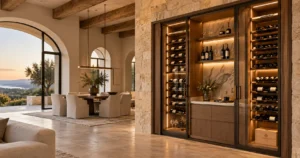
The key difference between a curio cabinet and a china cabinet is purpose. A curio cabinet is designed almost entirely for display — it has glass panels on most or all sides, a mirrored interior back, and built-in lighting to showcase collectibles, figurines, and decorative objects from every angle. A china cabinet is designed for both storage and display — it has a glass-fronted upper section for visible display and a solid lower cabinet for concealed storage of dinnerware, linens, and serving pieces. If your priority is showing off a collection, choose a curio cabinet. If your priority is organized dining room storage with a display element, choose a china cabinet.
You’ve narrowed it down to two options. Both have glass doors. Both sit in the living room or dining room. Both show off things you care about. But one is half the price of the other, and you’re not entirely sure which one actually solves your problem.
This is one of the most common friction points furniture shoppers face in this category — and it’s not helped by the fact that retailers frequently display both types side by side with minimal explanation of what makes them different or which one is right for what situation.
This guide removes the guesswork. You’ll understand the structural differences, the functional trade-offs, and exactly which type fits your collection, your room, and your daily life — before you make the purchase.
Table of Contents
1. What Is a Curio Cabinet?
The word “curio” comes from “curiosity” — and that tells you everything about the original intent of this furniture type. Curio cabinets were designed in 18th-century Europe to showcase unusual, rare, and beautiful objects: specimens from nature, porcelain figurines, small sculptures, curiosities collected on travels.
In modern furniture, a curio cabinet is defined by three specific design features that distinguish it from everything else:
Glass on Multiple Sides
Where a china cabinet has glass only on the front doors of the upper section, a curio cabinet typically features glass on the front, sides, and sometimes even the back. The glass-on-three-sides design means you can see into the cabinet from across the room, from the side, and even from an angle — the display is visible from multiple vantage points simultaneously.
Some curio cabinets go further with glass on all four sides, essentially turning the cabinet into a transparent showcase. Others use glass on the front and sides only, with a mirrored or solid back panel.
Mirrored Interior Back Panel
The interior back wall of most curio cabinets is mirrored. This serves two functions: it visually doubles the apparent depth of the cabinet (making the interior feel larger than it is), and it reflects light back through the displayed objects, enhancing their visual presence from the front.
This is the feature that makes a curio cabinet genuinely different from a glass-door china cabinet — a mirror back transforms a small decorative object into something that appears to float in space.
Built-In Interior Lighting
Almost all curio cabinets above entry level include integrated interior lighting — either LED strip lights along the top and sides, halogen puck lights on each shelf, or a combination of both. The lighting is designed to illuminate the displayed objects from above and the sides, creating the kind of showcase effect you’d see in a retail jewelry display or a museum vitrine.
This interior lighting is functional, not just decorative. Without it, a closed glass cabinet in a typical room interior becomes dark and difficult to see into, especially during evening hours when overhead room lighting creates reflection on the glass panels.
What Curio Cabinets Typically Do NOT Have
- A large solid-door lower section for concealed storage
- Deep interior shelving designed for stacked plates or bulky serving pieces
- Drawers for linens or flatware
- The proportions and weight capacity needed for full sets of heavy dinnerware
The bottom line: a curio cabinet is optimized almost entirely for the visual experience of display. Storage is secondary — and for many curio cabinet designs, storage is not a significant feature at all.
2. What Is a China Cabinet?
A china cabinet is a dual-purpose piece: equal parts storage furniture and display furniture. It was designed specifically for the dining room, with the practical goal of keeping fine dinnerware protected, organized, and accessible while also allowing it to be admired without opening the cabinet.
The Two-Section Design
A china cabinet is defined by its two distinct sections with different functions:
The upper section is the display zone — glass-paneled doors, interior shelving at heights designed for dinner plates, glassware, and serving pieces. The glass allows you to see the contents without opening the doors, keeping dust out while keeping the display visible.
The lower section is the storage zone — solid wood doors (occasionally with glass accents), drawers for flatware and linens, and deep interior shelves for bulkier items. This section is designed for concealed, organized storage of the items that don’t need to be on display: tablecloths, napkin rings, backup serving dishes, seasonal pieces.
What China Cabinets Typically Do NOT Have
- Glass on the sides — the view is front-facing only
- A mirrored interior back (some premium models include this as an accent, but it is not standard)
- Interior lighting as a standard feature (some models include it; many do not)
- The same visual “showcase” effect that curio cabinets create with their multi-angle glass and mirror interiors
China cabinets prioritize practical household function — protecting and organizing the things you use to feed your family and entertain guests — with an aesthetically pleasing display element built in.
3. Side-by-Side Comparison: Every Feature That Matters
| Feature | Curio Cabinet | China Cabinet |
|---|---|---|
| Glass panels | Front + sides, often mirrored back | Front of upper section only |
| Interior lighting | Standard (LED or halogen) | Optional, not always included |
| Mirrored back panel | Standard on most models | Rare; occasional premium feature |
| Lower storage section | Minimal or none | Full solid-door lower cabinet |
| Drawers | Rarely | Usually (for flatware and linens) |
| Shelf depth | Shallow (6–10 inches) | Deeper (12–16 inches upper, deeper lower) |
| Weight capacity per shelf | Light to medium (decorative objects) | Medium to heavy (stacked plates, glassware) |
| Best display angle | 360-degree or multi-angle | Front-facing |
| Typical height | 60–72 inches | 68–84 inches |
| Typical width | 18–36 inches | 36–72 inches |
| Primary room | Living room, hallway, dining room | Dining room |
| Primary function | Showcase display | Dining storage + display |
| Price range (mid-tier) | $200 – $1,500 | $300 – $3,000+ |
4. The Display Question: What Are You Showing Off?
Before you make any decision between these two types, answer one question honestly: What specifically are you planning to display, and how do you want it to look?
Choose a Curio Cabinet If You’re Displaying:
Small collectibles and figurines. Curio cabinets were designed for exactly this. Porcelain figurines, Lladró pieces, Hummel collectibles, crystal animals, small sculptures — items where you want to see the detail from multiple angles benefit enormously from the glass-on-three-sides design and mirrored back.
Crystal and glass objects. Crystal catches light in ways that a flat front-facing glass panel cannot fully exploit. A curio cabinet’s side glass and interior lighting allow crystal to refract light in all directions — which is precisely the visual effect that makes crystal worth displaying in the first place.
Small jewelry or gemstone collections. The shallow shelves and jewelry-case-like presentation of a curio cabinet suit small, valuable items where close-up visual detail matters.
Miniatures and models. Model ships, miniature buildings, diecast vehicles, architectural models — objects where scale and detail are the point — benefit from the 360-degree visibility and close-range display format of a curio.
Themed collections. Sports memorabilia, vintage cameras, antique watches, perfume bottles, antique dolls — any collection with a cohesive visual identity benefits from curio cabinet presentation, which is closer to a museum display than a household storage unit.
Choose a China Cabinet If You’re Displaying:
Full china sets. Dinner plates, soup bowls, salad plates, serving platters — these are bulky, heavy, and require the deeper shelves and higher weight ratings of a china cabinet’s upper display section. A curio cabinet’s shallow shelves cannot safely accommodate a full 12-piece china service.
Crystal wine glasses and stemware. Stemware needs to stand upright (or hang from a stemware rack, which some china cabinets include). The interior height of china cabinet shelves is designed with glassware proportions in mind.
Mixed display and practical storage. If you want to show off your grandmother’s china set AND have a place to store the table linens and extra serving pieces used twice a year, you need a china cabinet. A curio cabinet cannot serve this function.
Seasonal or rotating displays. If you plan to swap out what’s on display seasonally — holiday china in December, everyday pieces the rest of the year — the deep, organized shelving of a china cabinet makes this rotation practical.
5. The Storage Question: What Else Do You Need to Keep?
This is the question that most clearly separates the two types — and it’s the question that most furniture comparison articles fail to address directly.
A curio cabinet is, at its core, a display piece. It typically has no meaningful concealed storage. Some curio models include a small solid-panel base cabinet, but it is generally shallow and narrow — designed for a few items, not for the practical storage needs of a functioning dining room.
A china cabinet’s lower section is a full storage unit. Typical lower cabinet configurations include:
- Two large doors opening onto two or three interior shelves — enough for full sets of serving bowls, platters, and backup dinnerware
- One to three drawers for flatware, serving utensils, napkin rings, and linens
- Adjustable shelf configurations in higher-end models
If you need to store anything beyond the displayed objects themselves — linens, extra dishes, serving pieces, seasonal items — a china cabinet is the only type that genuinely solves this problem.
Ask yourself: Do you have dining room storage needs beyond display? If the honest answer is yes, a curio cabinet will leave you with an unresolved storage problem that ends up handled by a second piece of furniture anyway.
6. Lighting: Why It Matters More Than You Think
Interior lighting is a feature that divides these two types more clearly than almost any other specification — and it has a real impact on whether your display actually looks good in daily use.
Curio Cabinet Lighting
Most curio cabinets above the entry-level price point include built-in LED or halogen lighting. This is not a luxury add-on; it is integral to how a curio cabinet functions. Without interior lighting:
- A closed glass cabinet in an average room becomes dark and difficult to see into, especially against walls that do not receive direct window light
- The reflective mirror back cannot do its job — the mirror only creates depth and atmosphere when properly lit from within
- Crystal and glass objects lose their sparkle entirely
Halogen vs LED in curio cabinets: Halogen lights produce warmer, more flattering light for crystal and porcelain. However, they generate significant heat — enough to damage heat-sensitive items like wax figures, certain plastics, and dried natural specimens. LED lights run cool and are safe for all display items; more recent LED options have improved in color warmth and are now the standard in most quality curio cabinets.
China Cabinet Lighting
China cabinet lighting is more variable. Many mid-range china cabinets ship without any interior lighting at all — the assumption being that your dining room’s existing ambient lighting is sufficient to illuminate the display section. Premium china cabinets increasingly include LED strips along the underside of the top shelf.
If interior lighting is important to you — and it often is for showing off crystal glassware in a china cabinet — verify whether a specific model includes it, and if not, whether it can be retrofitted. Battery-powered LED puck lights or plug-in LED strip lights are a common aftermarket solution.
7. Room Placement: Where Does Each Type Work?
Curio Cabinet Placement
Because curio cabinets are designed to be viewed from multiple angles, they work best in positions where they can be approached and viewed from the side and front — not pushed into a corner where two sides of the glass are obstructed.
Best positions:
- Against a wall with clear walking space on at least one side
- In the center of a room as a standalone feature piece (for larger curio formats)
- In a hallway where it can be viewed in passing from both directions
- In a living room between two seating areas where it can be appreciated from multiple seats
Avoid: Tight corners where the side glass is blocked, or positions where a light source behind the viewer creates glare on the front glass panels.
China Cabinet Placement
China cabinets are designed to sit flat against a dining room wall — the front-facing display glass works perfectly from across the table, and the large footprint is best accommodated against a solid wall with adequate width.
Best positions:
- Along the longest unbroken wall in a dining room
- Centered on a dining room wall opposite or adjacent to the dining table
- Corner position (if using a corner china cabinet model)
- In a dining area adjacent to the kitchen for practical access during meal service
Avoid: Positions where the cabinet’s depth (typically 16–22 inches) would obstruct traffic flow or create a bottleneck between the cabinet and the dining chairs when pulled out.
8. Style and Design: Which Fits Your Interior?
Curio Cabinet Styles
Traditional curio cabinets feature dark wood frames (mahogany, walnut, cherry), carved leg details, brass or gold-tone hardware, and beveled glass panels. These are the format most associated with formal Victorian and Colonial interiors.
Contemporary curio cabinets use metal frames (chrome, brushed nickel, matte black), frameless glass panels, and minimal hardware. These suit modern apartments and minimalist interiors where a traditional wood frame would look out of place.
Corner curio cabinets are a specific format designed for 90-degree corners — they maximize display space in rooms where floor space is limited, and the corner positioning allows the glass side panels to face outward into the room.
China Cabinet Styles
China cabinets span a much wider style range than curio cabinets, largely because they serve a more central role in the dining room as a design anchor:
- Traditional / Colonial — dark hardwoods, raised panel doors, crown molding
- Farmhouse / Shaker — painted finishes, flat panel doors, simple hardware
- French Country — distressed paint, chicken-wire panels, curved legs
- Transitional — neutral finishes, clean lines, versatile hardware
- Contemporary — high-gloss lacquer, integrated LED, frameless glass
The wider style range of china cabinets reflects their role as the dominant furniture type for the dining room — a room where the cabinet is expected to match the table, chairs, and overall room aesthetic.
9. Price Comparison at Every Budget Level
| Budget Tier | Curio Cabinet | China Cabinet | Notes |
|---|---|---|---|
| Under $200 | $80 – $199 | $150 – $299 | Entry-level; basic materials, limited features |
| $200 – $500 | $200 – $499 | $300 – $599 | Improved glass, basic lighting in curios |
| $500 – $1,000 | $500 – $999 | $600 – $1,200 | Solid construction, LED lighting, soft-close |
| $1,000 – $2,500 | $1,000 – $2,000 | $1,200 – $2,500 | Solid hardwood, quality hardware, warranties |
| $2,500+ | $1,500 – $5,000+ | $2,500 – $8,000+ | Custom, semi-custom, heirloom quality |
Key pricing observation: Quality curio cabinets are available at lower price points than equivalent-quality china cabinets, largely because they require less material (no large lower storage section) and simpler construction. A well-built curio cabinet at $600–$800 represents a higher quality-to-price ratio than a china cabinet at the same price — but they are solving different problems.
Secondhand market: Both types appear regularly on the secondhand market. Quality vintage curio cabinets from the 1980s–2000s are abundant on Facebook Marketplace and Craigslist, often priced at $75–$300 for pieces that would cost $500–$1,200 new. Vintage china cabinets in traditional styles are similarly available, often in excellent structural condition even if the finish is dated — and both types respond well to repainting or refinishing as a DIY project.
10. The Decision Framework: Four Questions to End the Debate
Answer these four questions honestly and your choice becomes clear:
Question 1: Do you have a collection of small objects — figurines, crystal, collectibles — that you want showcased as the primary purpose?
- Yes → curio cabinet
- No, or my items are primarily dinnerware → china cabinet
Question 2: Do you need concealed dining room storage (for linens, flatware, extra dishes) in addition to display?
- Yes → china cabinet (curio cabinets cannot adequately serve this function)
- No, display only is sufficient → curio cabinet
Question 3: Is the cabinet going in a living room, hallway, or bedroom rather than a dining room?
- Yes, non-dining room placement → curio cabinet (better suited to non-dining settings)
- No, dining room → china cabinet is the more natural choice
Question 4: Is seeing your displayed items from multiple angles — the sides as well as the front — important to how you want to display them?
- Yes → curio cabinet (multi-angle glass is its defining feature)
- No, front-facing display is sufficient → china cabinet works
Quick Reference Summary
| Your Situation | Best Choice |
|---|---|
| Displaying figurines, crystal, or collectibles | Curio cabinet |
| Storing and displaying full china sets | China cabinet |
| Need concealed storage alongside display | China cabinet |
| Living room or hallway placement | Curio cabinet |
| Want 360-degree visibility of display items | Curio cabinet |
| Dining room, dining-focused use | China cabinet |
| Tight budget, display-only needs | Curio cabinet (more affordable at same quality) |
| Want interior lighting as standard feature | Curio cabinet |
| Need to store table linens and serving pieces | China cabinet |
| Have both a collection AND dining room storage needs | Both — one of each type |
Frequently Asked Questions
What is the difference between a curio cabinet and a china cabinet? A curio cabinet is designed primarily for display, with glass panels on multiple sides, a mirrored interior back, and built-in lighting to showcase collectibles and decorative objects from all angles. A china cabinet is designed for both storage and display — the glass-fronted upper section displays fine china and glassware, while the solid lower section provides concealed storage for linens, flatware, and extra dining pieces. Curio cabinets prioritize visual presentation; china cabinets prioritize practical dining room organization.
Can a curio cabinet be used to store china? Technically yes, but not ideally. Curio cabinet shelves are typically shallower (6–10 inches) than china cabinet shelves (12–16 inches), and have lower weight capacities — they are not designed to hold the combined weight of a full 12-piece china service stacked on multiple shelves. For occasional display of a few special pieces, a curio cabinet works. For organized storage of a full china set in regular use, a china cabinet is the appropriate choice.
Do curio cabinets always have lighting? Most curio cabinets above entry level include built-in LED or halogen interior lighting — it is considered a standard feature, not an upgrade. Some very basic entry-level models (under $150) ship without lighting. China cabinets do not universally include interior lighting — many mid-range models require an aftermarket addition if lighting is desired.
Where should a curio cabinet be placed in a room? Curio cabinets work best where they can be viewed from multiple angles — against a wall with open space on at least one side, in a hallway, or between two seating areas in a living room. Avoid tight corners where the glass side panels are fully obstructed. The glass-on-multiple-sides design only delivers its visual benefit when the cabinet is accessible from more than one direction.
Is a display cabinet the same as a curio cabinet? “Display cabinet” is a broader term that encompasses curio cabinets, china cabinets, collector’s cabinets, and any glass-fronted unit used to show objects. A curio cabinet is a specific type of display cabinet defined by its multi-side glass panels, mirrored back, and interior lighting. Not all display cabinets are curio cabinets, but all curio cabinets are display cabinets.
Which is better for crystal — a curio cabinet or a china cabinet? For showcasing crystal as a collection — crystal figurines, crystal animals, decorative crystal objects — a curio cabinet is significantly better. The mirrored back and interior lighting interact with crystal’s refractive properties in a way that a front-only glass panel cannot. For storing crystal stemware (wine glasses, champagne flutes) in a functional dining room context alongside other dinnerware, a china cabinet is more practical due to its deeper shelves and greater weight capacity.
Can a curio cabinet be used in a bedroom? Yes. Curio cabinets work well in bedrooms for displaying personal collections — jewelry, perfume bottles, small figurines, keepsakes — that you want protected behind glass but visible daily. Their typically smaller footprint (18–30 inches wide) suits bedroom placement more naturally than the larger format of a china cabinet.