Table of Contents
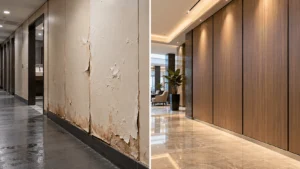
MDF has been the go-to interior wall panel material for decades — cheap, smooth, easy to paint, available from any builders’ merchant, and familiar to every joiner and fit-out contractor. But familiarity is not the same as suitability, and cheap material cost is not the same as low project cost. If you’ve specified MDF for a hotel bathroom feature wall, a restaurant interior, a commercial corridor, or any wall that will face humidity, heavy cleaning, high traffic, or fire safety scrutiny — you’ve likely encountered the moment when MDF’s limitations become expensive problems. The question isn’t whether MDF works in some applications: it does. The question is whether composite panels are better for walls in the conditions that matter most to commercial projects. This guide gives you the direct comparison you need.
Quick Answer — Composite Panel vs MDF for Walls
Yes — in the vast majority of commercial wall applications, composite panels are significantly better than MDF. MDF (Medium Density Fiberboard) is a wood-based panel with a smooth, paint-ready surface and excellent machinability, but it has fundamental weaknesses that make it a poor choice for most wall cladding in commercial environments: it absorbs moisture and swells permanently; it cannot achieve Class A fire rating because it is combustible; its surface is soft and prone to impact damage; and it requires substantial on-site finishing (priming, painting, sanding) that drives up installation cost and time. Composite panels — including aluminum composite panels (ACP), wood plastic composite (WPC), fiberglass reinforced panels (FRP), and HPL-faced systems — are pre-finished, moisture-resistant, impact-durable, available with Class A fire ratings, and require no on-site painting. They cost more per m² in material, but deliver lower total project cost over time. The exception is millwork, built-in cabinetry, complex routed profiles, and paint-finish feature walls in dry, low-traffic, non-commercial environments — where MDF’s machinability and paintability remain genuine advantages.
1. What Is MDF? Understanding the Material You Are Replacing
Medium Density Fiberboard (MDF) is an engineered wood product manufactured by breaking down softwood or hardwood residuals into wood fibers, combining them with wax and resin binders (typically urea-formaldehyde), and pressing the mixture under high temperature and pressure into flat panels. The result is a homogeneous, smooth-surfaced board with no grain direction, making it exceptionally receptive to paint, veneers, and laminates, and easy to cut, route, and shape cleanly.
MDF was developed in the 1960s as a cost-effective alternative to solid timber and plywood for furniture, cabinetry, and interior finishing applications. Its key practical advantages over solid timber are price, dimensional consistency (no knots, grain variation, or warping from natural defects), and machinability — MDF can be cut to precise dimensions, routed into complex profiles, and laminated or painted to a smooth, uniform finish.
MDF Standard Properties
- Density: 700–850 kg/m³ — MDF is a dense, heavy material compared to most composite panels
- Surface: smooth, uniform, paint-ready without primer filling of grain voids
- Machinability: excellent — clean cuts, precise router profiles, and tight tolerances achievable with standard woodworking tools
- Paint adhesion: excellent — MDF accepts primer and paint well, producing smooth, high-quality painted finishes
- Moisture sensitivity: poor — MDF absorbs moisture readily, swelling significantly and permanently on saturation
- Fire performance: Class D (combustible) in most standard formulations; fire-retardant MDF achieves Class C or B, not Class A
- VOC emissions: most standard MDF contains urea-formaldehyde binders that off-gas formaldehyde, a regulated indoor air pollutant
- Standard thicknesses: 6mm, 9mm, 12mm, 15mm, 18mm, 25mm; most wall applications use 12–18mm
MDF has genuine strengths in specific applications — which this guide acknowledges directly in Section 7. But for commercial wall cladding in most real-world environments, those strengths are outweighed by the limitations above. Understanding what MDF actually is helps explain why composite panels represent a material upgrade in commercial wall applications, not just a more expensive alternative.
2. Composite Panels for Walls — What Are the Options?
The term “composite panel” covers a family of materials; for wall applications specifically, four types are most commonly considered as alternatives to MDF. Each has a distinct performance profile, aesthetic character, and cost position.
2.1 Aluminum Composite Panels (ACP)
ACP consists of two thin aluminum face sheets bonded to a polyethylene or mineral-filled core. It is the most widely used composite wall panel in commercial construction, valued for its lightweight construction (4–8 kg/m²), PVDF or polyester factory-applied coating finish, excellent dimensional stability, and Class A fire performance availability. ACP is pre-finished to a consistently smooth, flat surface and requires no on-site painting. It is suitable for both interior wall cladding and exterior facade applications.
2.2 Wood Plastic Composite (WPC) Panels
WPC panels blend wood or bamboo fiber with thermoplastic polymers, producing panels with genuine organic woodgrain aesthetics and good moisture resistance. They are the natural choice when a warm, natural wood-like finish is required without the maintenance burden or moisture vulnerability of real timber. WPC panels are pre-finished with surface textures and tones derived from actual wood fiber content, requiring no painting on site. They are primarily suited to interior and covered semi-exterior wall applications.
2.3 Fiberglass Reinforced Panels (FRP)
FRP panels are manufactured from glass fiber embedded in a thermoset resin matrix. Their smooth, nonporous surface is extremely impact-resistant, moisture-proof, and easily cleaned with commercial cleaning agents including disinfectants. FRP is the dominant composite wall panel choice in hygiene-critical commercial environments: commercial kitchen walls, hospital corridors, washroom cladding, food processing facility offices, and any wall surface that will be regularly subjected to high-pressure washing or chemical cleaning.
2.4 HPL-Faced Composite Panels
High-pressure laminate composite panels use an HPL layer — manufactured under high temperature and pressure from phenolic resin-impregnated papers — as the face of a composite panel system. The decorative HPL surface provides an exceptionally hard, scratch-resistant finish with a very wide range of visual options: solid colors, woodgrain reproductions, stone-effect patterns, and metallic finishes, all at very high visual resolution. HPL-faced composite panels are the specification choice for premium interior wall applications where both visual quality and surface durability are critical requirements.
3. The 8 Critical Performance Differences: Composite vs MDF
3.1 Moisture and Humidity Resistance — The Most Important Difference
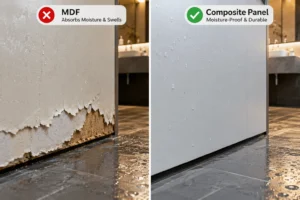
| ❌ MDF — Fails in Moisture MDF is highly hygroscopic: it absorbs atmospheric moisture and liquid water readily and expands significantly when it does — swelling by 10 to 30% in thickness on saturation. This expansion is largely irreversible. Even standard interior humidity cycling can cause surface blistering and edge swelling in MDF over time. In kitchens, bathrooms, laundries, humid climates, or any space with regular cleaning involving water, MDF wall panels will fail — edges swell, painted surfaces crack and peel, and the structural integrity of the panel deteriorates. Moisture damage to MDF is not repairable; affected panels must be replaced. | ✅ Composite — Moisture-Proof Composite wall panels are designed for moisture environments. ACP’s aluminum face sheets and polymer core are completely impervious to water. FRP’s glass-fiber/resin composition is inherently moisture-proof and is regularly used in commercial kitchen and washroom applications precisely because of this property. WPC panels resist humidity cycling without swelling or warping — they do not absorb water in the way natural wood fibers do when embedded in a thermoplastic matrix. Composite panels do not fail, swell, delaminate, or require replacement as a result of moisture exposure in properly specified interior applications. |
Project Cost Reality: Moisture Damage to MDF
A hotel fit-out using MDF cladding in bathrooms and humid corridors will typically begin experiencing swelling, paint blistering, and delamination within 2 to 5 years in tropical or humid climates, or within 5 to 10 years in temperate conditions. Replacement costs — mobilization, panel removal, disposal, new MDF supply, repainting, disruption to hotel operations — far exceed the initial material cost saving over composite. Many commercial property managers have learned this lesson on one project and never specify MDF for humid-environment walls again.
3.2 Fire Performance — A Compliance-Critical Difference
| ❌ MDF — Combustible Standard MDF is a Class D combustible material. It burns readily, contributes to fire load, and generates dense smoke. Fire-retardant MDF formulations are available — achieving Class C or Class B in some testing standards — but Class A (A2) non-combustibility is not achievable in MDF because the material is fundamentally wood-fiber based and therefore combustible. For wall applications in commercial buildings, hotels, high-rise residential, or any building where fire regulations mandate Class A or Class B fire performance for interior wall finishes, standard MDF is non-compliant. Using it without fire engineering approval creates liability. | ✅ Composite — Class A Available ACP with mineral-filled fire-resistant core achieves Class A (A2) fire performance — the highest fire classification for building materials under EN 13501-1 and equivalent standards. This means ACP wall cladding can be specified in commercial buildings with the most stringent fire safety requirements: escape routes, stairwells, high-rise interior walls, hospitality public areas, and any application where building regulations or fire engineers mandate non-combustible or limited-combustibility wall finishes. FRP panels also achieve Class A ratings in appropriate formulations. This compliance capability is simply not available in MDF. |
3.3 Surface Durability — Daily Wear and Impact Resistance
| ❌ MDF — Soft and Vulnerable MDF has a relatively soft surface that is easily damaged by the impacts, abrasion, and contact loads of commercial environments. Trolleys, luggage, cleaning equipment, and casual contact all create visible dents, chips, and edge damage in MDF wall panels over time. Painted MDF surfaces are particularly vulnerable because the paint film sits on top of a relatively soft substrate — once the paint is chipped, the exposed MDF immediately begins to absorb moisture and expand at the damage point. Repainting requires matching existing paint colors, which is notoriously difficult once the original finish has aged. | ✅ Composite — Engineered for Durability Composite wall panels are engineered for the durability demands of commercial environments. ACP aluminum face sheets resist deformation and surface damage from impacts that would dent or chip MDF. FRP panels have impact resistance rated at 3 to 5 times that of standard drywall and are specifically used in high-traffic commercial corridors for this reason. HPL-faced composite panels have surface hardness ratings that resist scratching, scuffing, and cleaning abrasion. WPC’s thermoplastic-polymer matrix is more resistant to impact damage than MDF’s wood fiber structure. All composite types maintain their surface appearance without repainting for the duration of their specified service life. |
3.4 Weight — Structural and Installation Implications
MDF is a dense material: standard 18mm MDF used for wall panels weighs approximately 14 to 16 kg/m² — similar to some lightweight stone tiles and significantly heavier than most composite panel types. In renovation projects where additional wall cladding is being added to an existing structure, or in high-rise buildings where total fit-out dead load is managed to structural limits, MDF’s weight per m² is a real constraint.
ACP at 4 to 8 kg/m² weighs 50 to 70% less than equivalent MDF. WPC at 10 to 20 kg/m² is still lighter than 18mm MDF in most cases, and HPL-faced composite panels typically weigh 8 to 14 kg/m². For renovations where dead load limits are a concern, or for large-scale fit-outs where cumulative wall cladding weight affects the structural assessment, composite panels offer a weight advantage that translates directly into engineering simplicity and cost.
3.5 Installation Speed — The Hidden Labor Cost Difference
| ❌ MDF — Multi-Stage On-Site Finishing Installing MDF wall panels to a finished standard involves multiple sequential trades and stages: cutting to size, fixing to substrate, filling joints and fixings, sanding filled areas smooth, applying primer coat, sanding primer, applying first paint coat, sanding, applying final coat, and touching up. In a commercial fit-out where the wall finish must be perfect, this process is labor-intensive and cannot be rushed between coats without risking finish quality. It also requires the painting trade to complete its work before other trades can use the space. | ✅ Composite — Pre-Finished, One-Trade Installation Composite wall panels arrive on site pre-finished to their final specification: the color, texture, and surface quality are factory-applied and consistent. Installation involves fixing the subframe (if required), cutting panels to size, and fixing them to the substrate — no priming, painting, or sanding. A composite panel installation is complete when the last panel is fixed. This single-trade, single-stage approach is typically 30 to 50% faster than equivalent MDF wall installation and eliminates painting trade dependency, which often sits on the critical path of commercial fit-out programs. |
3.6 Paintability and Machinability — Where MDF Retains Genuine Advantages
This is the dimension where MDF’s genuine advantages over most composite panels are most pronounced — and it is important to acknowledge them clearly rather than present a one-sided comparison.
| ✅ MDF Advantages: Paint and Profile MDF has an exceptional surface for painted finishes. Its smooth, uniform, grain-free surface accepts primer and paint without telegraphing grain structure or knots, and can be sanded to a level of smoothness that painted solid timber or plywood cannot match. Complex router profiles — ogee edges, rebates, shadow reveals, decorative mouldings — can be machined cleanly and precisely in MDF using standard router tooling, making it the preferred substrate for painted millwork, paneling with decorative profiles, and built-in furniture with complex edge detailing. | ◑ Composite Panel Limitations: Finishing and Profiles Most composite panels are pre-finished and cannot be repainted on site to a different color without specialist preparation. While ACP can be router-cut and bent to profiles, the design vocabulary of composite panels is generally that of flat or gently curved panels in factory finishes rather than complex architectural mouldings. For applications where a traditional painted panel aesthetic with visible architectural moulding profiles is the design intent — traditional hotel corridors, heritage-style residential interiors, high-specification millwork — MDF remains the more appropriate substrate. |
3.7 Indoor Air Quality and VOC Emissions
Standard MDF is manufactured with urea-formaldehyde (UF) resin binders that off-gas formaldehyde — a regulated indoor air pollutant classified as a probable human carcinogen at elevated concentrations by WHO. In enclosed commercial spaces with limited ventilation, new MDF installations can contribute to elevated formaldehyde levels, particularly in the weeks following installation. Low-formaldehyde (E1 or E0) and formaldehyde-free MDF alternatives are available at cost premium, but they are not universal in the supply chain.
Composite wall panels — ACP, WPC, FRP, and HPL systems — generally emit lower VOC levels than standard MDF, particularly in the post-installation period. For projects targeting LEED, WELL, or BREEAM certification, or for occupiers with explicit indoor air quality commitments, composite panels offer a meaningful advantage in the material chemistry dimension of the specification. This is particularly relevant in healthcare, educational, and early years childcare environments where indoor air quality standards are most rigorously applied.
3.8 Lifecycle Cost — The Number That Changes the Decision
Material cost per m² is where MDF appears most competitive against composite panels. At $8 to $18 per m², MDF is cheaper than ACP ($15–$50/m²), WPC ($20–$50/m²), or HPL composite ($35–$70/m²) in material supply cost. But this comparison is misleading when considered alongside total project and lifecycle cost.
Adding the cost of on-site priming, painting, and finishing to MDF — typically $10 to $25/m² in additional labor and materials — narrows the total installed cost gap significantly. Adding the cost of periodic repainting (every 3 to 7 years in commercial use), moisture damage repair and replacement, and the operational disruption of maintenance programs in occupied commercial spaces, the long-term cost picture for MDF walls is materially worse than the material price alone suggests. Composite panels that require no repainting, resist moisture damage, and require only cleaning maintenance will typically deliver lower total cost over a 15 to 25-year commercial buildings lifecycle despite their higher initial material cost.
4. At-a-Glance Scorecard: Composite Panel vs MDF for Walls
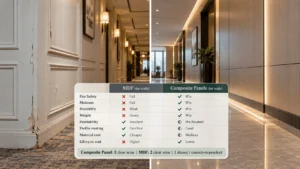
A rapid comparison of the eight key dimensions covered in Section 3, evaluated for commercial wall cladding applications:
| Category | MDF | Composite Panel |
| 🔥 Fire Safety | MDF: ✗ Fail | Composite: ✓ Win |
| 💧 Moisture | MDF: ✗ Fail | Composite: ✓ Win |
| 🏗 Durability | MDF: ✗ Weak | Composite: ✓ Win |
| ⚖ Weight | MDF: ✗ Heavy | Composite: ✓ Win |
| 🎨 Paintability | MDF: ✓ Excellent | Composite: ◑ Pre-finished |
| 🔧 Profile routing | MDF: ✓ Excellent | Composite: ◑ Good |
| 💰 Material cost | MDF: ✓ Cheaper | Composite: ◑ Medium |
| 📅 Lifecycle cost | MDF: ✗ Higher | Composite: ✓ Lower |
Composite Panel: 5 clear wins MDF: 2 clear wins 1 shared / context-dependent
5. Full Specification Comparison: Composite Panel vs MDF
The table below provides the detailed specification comparison across all major performance and practical dimensions for commercial wall applications:
| Performance Factor | MDF | Composite Panel (ACP / WPC / HPL) |
| Moisture resistance | Poor — swells, warps, delaminates on contact with moisture | Excellent — ACP / WPC / FRP are moisture-impervious or highly resistant |
| Fire performance | Class D (combustible) — MDF burns readily | Class A available (ACP with FR core) — meets high-rise fire regulations |
| Surface durability | Soft surface — chips, dents, and edge-peels easily under impact | Hard-wearing — resists daily impact, abrasion, and cleaning chemicals |
| Weight (typical) | 700 – 850 kg/m³ (heavy per unit area at standard thickness) | ACP: 4–8 kg/m² | WPC: 10–20 kg/m² — significantly lighter than MDF |
| Moisture / humid climate | Unsuitable without full sealing — swells and fails permanently | Fully suitable — composite panels designed for humid commercial environments |
| Installation speed | Slow — requires cutting, filling, sanding, priming, and painting | Fast — panels arrive pre-finished, cut to size, ready for direct fixing |
| Paint / finish options | Excellent for painted finishes — takes primer and paint very well | Pre-finished — no on-site painting; very wide range of factory finishes |
| Edge finishing / routing | Excellent — MDF edges can be routed, shaped, and moulded cleanly | Good — ACP can be routed and bent; edges require trim profiles or fold |
| Replaceable panels | Difficult — matching existing paint finish is challenging on repairs | Easy — individual panels replaceable from original manufacturer specification |
| Exterior use | Unsuitable — MDF disintegrates under exterior weather conditions | Fully suitable (ACP) — designed for 20–25 year exterior exposure |
| Material cost ($/m²) | $8 – $18 (low material cost) | ACP $15–$50 | WPC $20–$50 | HPL $35–$70 (medium) |
| 25-year lifecycle cost | High — repainting, swelling repairs, and replacement cycles | Low — minimal maintenance, no repainting, individual panel replacement only |
| Best application | Millwork, furniture, paint-finish feature walls, complex profiles | Commercial wall cladding, hygiene walls, feature walls, exterior facades |
Note: MDF columns are shaded in coral-red; composite panel columns in blue. Prices are indicative USD/m² for material supply only. Fire ratings and performance characteristics reflect standard commercial-grade product variants.
6. When MDF Still Makes Sense for Walls — Honest Exceptions
A credible comparison acknowledges where MDF remains the right material choice. There are specific wall applications where MDF’s properties genuinely make it the better specification, and experienced specifiers recognize these contexts rather than applying a blanket preference for composite panels.
6.1 Painted Millwork and Built-In Cabinetry
When the wall application involves integrated built-in furniture — wardrobes, entertainment units, study nooks, reception desk structures — MDF’s machinability and paint-finish quality are decisive advantages. The ability to rout complex profiles, create tight-tolerance joints, and achieve a flawless painted finish on three-dimensional structures is where MDF genuinely outperforms flat composite panel systems. Composite panels are designed as planar cladding products; they are not optimized for the joinery construction techniques used in cabinetry and millwork.
6.2 Traditional Architectural Paneling with Decorative Profiles
Traditional interior paneling styles — Georgian, Victorian, Art Deco, classical hotel corridors — are characterized by architectural moulding profiles: chamfers, ogees, rebates, and shadow reveals that give panel systems their period character. These profiles are most economically and accurately produced by routing MDF, then painting to the specified finish. Replicating these profiles in composite panel systems is technically possible but typically more expensive and less authentic. For heritage-sensitive interiors, listed building refurbishments, or clients who specifically require traditional paneling aesthetics, MDF remains the appropriate substrate.
6.3 Dry Interior Feature Walls in Low-Traffic Spaces
In dry, climate-controlled residential or low-use commercial interiors — a private office, a home library, a formal dining room feature wall — where moisture, heavy traffic, and fire compliance requirements are minimal, MDF’s lower material cost and excellent painted finish may make it the most practical specification. The performance limitations that make MDF problematic in commercial applications are less relevant when the environment is genuinely stable and the usage intensity is low.
6.4 Very Tight Budget Constraints with Short Specification Horizons
Where a project has an extremely tight material budget and a short intended specification life — a temporary retail activation, a pop-up event space, a commercial fitout expected to be completely refurbished within three to five years — MDF’s low material cost may make it the pragmatic choice. If the expectation is that the wall finish will be replaced within the timeline before MDF’s moisture and durability limitations become problems, the lifecycle cost argument for composite panels is less compelling than in a long-term permanent installation.
7. Which Composite Panel for Which Wall? A Practical Selector
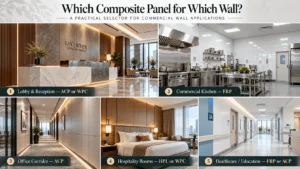
Once the decision to specify composite panels over MDF is made, the next question is which composite panel type is right for the specific wall application. The following guidance maps the most common commercial wall scenarios to the appropriate composite panel specification.
7.1 Commercial Lobby and Reception Feature Walls
Specification: ACP (PVDF-coated, metallic or stone-effect finish) or WPC (for natural woodgrain warmth)
Reception and lobby feature walls are brand statements — they need to make a strong visual impression, maintain their appearance over years of use, and be easy to keep clean. ACP delivers precision flatness, unlimited color and finish options (including dramatic metallic and brushed finishes), and Class A fire performance in a lightweight, low-maintenance package. WPC is the choice when the design brief calls for genuine natural wood warmth that communicates a biophilic, premium aesthetic. Both significantly outperform MDF in longevity, surface quality, and maintenance demand in this application.
7.2 Commercial Kitchen and Food Preparation Walls
Specification: FRP (fiberglass reinforced panel)
Commercial kitchen walls must withstand daily high-pressure washing, grease, steam, food splatter, and impact from kitchen equipment. FRP is the definitive specification: its nonporous surface does not harbor bacteria, resists steam and cleaning chemicals, and tolerates high-pressure washing without damage. MDF in a commercial kitchen environment will fail rapidly under these conditions. No other composite panel type is as well-suited as FRP for this specific demanding application.
7.3 Office Corridor and Public Area Walls
Specification: ACP (pre-finished, color-matched to corporate palette)
Office corridors require wall finishes that resist scuffing from luggage, cleaning equipment, and daily pedestrian traffic; maintain their appearance without periodic repainting; and comply with fire safety requirements for commercial escape routes and public areas. ACP fulfils all three requirements. Its aluminum face sheet resists impact damage that would chip MDF; its factory finish requires no repainting; and its Class A fire-rated variant complies with commercial corridor fire requirements that standard MDF cannot meet.
7.4 Hospitality Room Cladding — Hotels, Serviced Apartments
Specification: HPL-faced composite panels or WPC
Hotel and serviced apartment room walls need to look premium across a 10 to 15-year room refurbishment cycle, resist daily housekeeping cleaning, and withstand guest contact and occasional impact without visible surface damage. HPL-faced composite panels deliver premium visual quality in woodgrain, stone-effect, and solid-color options, with surface hardness that resists the scratching and scuffing that accumulates on MDF surfaces over years of hotel use. WPC adds genuine natural warmth in high-specification boutique hotel contexts. Both significantly outlast MDF in this application without requiring intermediate refinishing.
7.5 Healthcare and Educational Wall Cladding
Specification: FRP (hygiene environments) or ACP (general clinical and teaching spaces)
Healthcare walls must meet stringent hygiene standards — nonporous, easily cleanable surfaces that resist bacterial colonization and tolerate disinfectant chemicals. Educational walls must withstand high-impact use, graffiti cleaning, and heavy traffic over many years. FRP excels in both contexts for direct-contact wall areas. ACP is the appropriate specification for higher-level wall areas, corridors, and external-facing interior cladding in healthcare and educational buildings. MDF’s moisture vulnerability, formaldehyde emissions, and combustibility make it a poor fit for both healthcare and educational environments under current specification standards.
8. Frequently Asked Questions
Can composite panels be used to replace existing MDF wall panels?
Yes — composite panels can be installed over or in replacement of existing MDF wall panels in most commercial renovation and refurbishment projects. ACP and HPL composite panels can be fixed directly to existing wall substrates using appropriate adhesive or mechanical fixing systems, and WPC and FRP systems are similarly adaptable to existing wall constructions. In many cases, composite panel systems can be installed with minimal removal of existing substrate, reducing renovation disruption and waste. Confirm the fixing method and substrate compatibility with the supplier before specifying for a renovation context.
Is composite panel harder to cut and install than MDF?
Composite panels are cut using different tools than MDF but are not significantly more difficult to work with for a competent installation team. ACP is best cut using a circular saw with a fine-tooth metal-cutting blade or a router with a straight-cut bit. WPC and FRP are cut with standard fine-tooth woodworking blades. All composite panel types require less on-site finishing than MDF — there is no priming, painting, or sanding — which makes the total installation workflow simpler and faster despite any additional care required in cutting. Most facade contractors and commercial fit-out teams are entirely familiar with composite panel installation.
Can composite panels be painted if I want to change the color later?
Most composite panels are pre-finished to their factory specification and are not routinely repainted on site. ACP with PVDF coating can be re-coated with specialist coatings systems, but this is not standard practice and requires specialist application. HPL surfaces can accept paint in some circumstances but surface preparation is critical and the result is not equivalent to a factory finish. For applications where ongoing color flexibility is a specific requirement, MDF retains a genuine advantage. For most commercial applications, the wide range of available factory color and finish options in composite panels eliminates the need for on-site color change during the panel’s service life.
How do composite panels compare to MDF in terms of sustainability?
The sustainability comparison between MDF and composite panels is nuanced. MDF uses wood fiber — often from managed forestry by-products — but also contains formaldehyde-based resin binders that are a regulated pollutant and complicates end-of-life material recovery. ACP uses aluminum — with a high recycling rate globally — but has significant embodied energy in primary aluminum production. WPC contains natural wood fiber and is recyclable. FRP is more challenging to recycle at end of life. For green building certifications (LEED, BREEAM), composite panels with EPD documentation, low-VOC credentials, and recycled content can accumulate certification credits that MDF with formaldehyde binders cannot. The most sustainable choice depends on the specific product, the manufacturing source, and the project’s certification priorities.
What is the fire rating difference between fire-retardant MDF and composite panels?
Fire-retardant MDF (FR MDF) can typically achieve Class B fire performance under EN 13501-1 testing, compared to Class D for standard MDF. This is a meaningful improvement for interior applications where Class B is required. However, Class A (A2) non-combustibility — required for exterior cladding on high-rise buildings and mandated for interior wall finishes in specific high-risk commercial applications — is not achievable in any MDF formulation because the material is inherently wood-fiber based and therefore combustible. ACP with mineral-filled FR core achieves A2-rated Class A performance, providing a level of fire safety that FR MDF cannot match. When Class A fire compliance is a project requirement, composite panel is the only viable option regardless of other specification factors.
Can composite panels be used for curved walls?
ACP can be cold-bent to relatively tight radii using standard panel bending equipment, making it suitable for gently curved wall surfaces. WPC and FRP panels have limited flexibility but can be installed on faceted curved surfaces using closely spaced fixing points. HPL composite panels are generally flat only. MDF, by contrast, can be bent around tighter curves using kerfing (cutting parallel grooves in the back of the panel) or using flexible MDF variants specifically manufactured for curved applications. For tightly curved wall surfaces with complex profiles — particularly decorative curved features in high-end hospitality interiors — MDF or curved-form timber veneer may be more practical than composite panels.
Conclusion: Better Performance, Longer Life, and Lower True Cost
The direct answer is yes — composite panels are better than MDF for walls in the conditions that define most commercial projects: humidity, high traffic, fire compliance requirements, and the need for a finish that maintains itself without periodic painting. MDF is a genuinely useful material in specific contexts — millwork, built-in furniture, complex architectural profiles, and dry residential applications — and those contexts are worth acknowledging rather than dismissing. But for commercial wall cladding in offices, hotels, hospitality venues, healthcare facilities, retail environments, and any project where performance over a 10 to 25-year lifecycle matters, composite panels outperform MDF on the metrics that count: moisture resistance, fire safety, surface durability, installation efficiency, and total cost of ownership.
The common objection — that composite panels cost more per m² — is true in material supply cost and partially true or false in total installed cost once painting labor is included. It is almost always false when maintenance, repainting cycles, moisture damage remediation, and operational disruption are calculated across the building’s commercial lifecycle. The accountants who evaluated both options on a 20-year basis almost always recommend composite panels. The specifiers who have experienced MDF failure in a commercial project almost always specify composite on the next one.
If your next project involves commercial wall cladding — whether in hospitality, corporate offices, healthcare, retail, or any other high-performance commercial environment — the right starting point is selecting the right composite panel type for your specific application, then specifying it correctly with complete technical documentation. Our team is here to help with exactly that process.
Ready to Upgrade From MDF to High-Performance Composite Panels?
We supply ACP, WPC, FRP, and HPL-faced composite panels for commercial wall cladding projects worldwide. Our team provides project-specific product recommendations, fire certification documentation, VOC test reports, and physical samples dispatched within 48 hours. We have helped architects, fit-out contractors, and developers across hospitality, corporate, healthcare, and retail sectors make the switch from MDF to composite — and never look back.
Send us your wall application, floor area, and environment brief — we will recommend the right composite panel and provide a competitive quotation within 24 hours.
Composite panels: better walls, lower lifetime cost, zero maintenance repainting.