Table of Contents
They are both sold as low-maintenance wall panels. They are both available in wood-effect finishes. They are both priced far below natural timber. So when you are specifying a wall cladding product for a hotel refurbishment, a villa development, or a commercial fitout, why does the choice between WPC and PVC wall panels matter at all? It matters enormously — and not just because one looks better than the other. The differences between wood plastic composite and PVC wall panels run through structural performance, fire safety, environmental impact, long-term durability, and the fundamental question of whether a product will still look premium in five years or start showing its synthetic origins within months. If you are about to specify or purchase wall panels for any project where quality, longevity, or client expectations matter, this comparison will change how you think about the decision.
WPC (Wood Plastic Composite) wall panels are superior to PVC wall panels in seven critical performance areas: (1) Aesthetics — WPC replicates natural wood grain with genuine depth and warmth that PVC prints cannot match; (2) Structural strength — WPC solid core panels achieve 40–60 MPa vs 15–25 MPa for hollow PVC; (3) Sound insulation — WPC’s dense mass attenuates sound; PVC hollow profiles transmit vibration; (4) Fire safety — PVC releases hydrochloric acid and dioxins when burned; WPC does not; (5) Environmental credentials — WPC uses recycled wood fibre and is recyclable; PVC requires chlorine chemistry and is difficult to recycle; (6) Thermal stability — WPC expands and contracts less than pure PVC in temperature cycles; (7) Exterior suitability — solid co-extruded WPC is rated for outdoor exposure; PVC yellows and embrittles outdoors. PVC costs less upfront ($10–35/m² FOB) but WPC ($18–55/m²) delivers consistently lower total lifecycle cost.
1. What Are WPC and PVC Wall Panels? A Clear Starting Point
1.1 WPC Wall Panels: Wood Meets Polymer
WPC — Wood Plastic Composite — is manufactured by blending wood fibre or flour (typically 50–70% by weight) with thermoplastic polymer (polyethylene, polypropylene, or PVC as a minor binder) along with coupling agents, UV stabilisers, lubricants, and pigments. The blended compound is extruded through a die that forms the panel profile, creating a material that combines the visual warmth of wood with the durability and moisture resistance of plastic.
The critical characteristic of quality WPC wall panels is the wood fibre content itself — this is what gives WPC its natural appearance, thermal stability, and the dense, substantive feel that distinguishes it from fully synthetic alternatives. Premium WPC uses co-extrusion technology to add a polymer-rich outer shell that protects the wood-composite core and dramatically enhances UV resistance and colour stability.
1.2 PVC Wall Panels: Fully Synthetic Polymer
PVC wall panels are manufactured entirely from polyvinyl chloride — a chlorine-based synthetic polymer — typically with plasticisers, stabilisers, and pigments added to modify its properties. The majority of PVC wall panel products are hollow-profile extrusions: the panel face is a thin PVC skin, typically 1–3mm thick, over a series of internal channels created during extrusion.
PVC is inherently rigid and durable in dry indoor conditions. It is inherently non-absorbent and easy to clean. However, it lacks the structural mass of WPC, produces a synthetic appearance that experienced buyers immediately recognise as plastic, and carries material properties — particularly around fire performance and outdoor UV resistance — that significantly limit its appropriate application range.
The fundamental distinction: WPC is a hybrid material that captures the best properties of wood and polymer. PVC is a synthetic polymer that mimics the appearance of wood without the underlying material properties that create genuine warmth, density, and structural performance.
2. The Complete Comparison: WPC vs PVC Wall Panels
The table below provides a structured head-to-head assessment across the dimensions that matter most for professional specification:
| Comparison Factor | WPC Wall Panels | PVC Wall Panels | Verdict |
| Natural Aesthetics | Wood grain / stone textures, warm feel | Plastic look; wood-effect varies in quality | WPC |
| Surface Texture Quality | Deep emboss, multi-tonal, realistic grain | Shallow print; often looks synthetic up close | WPC |
| Core Strength (MPa) | Solid core 40–60 MPa; dense composite | 15–25 MPa; hollow PVC profile | WPC |
| Impact Resistance | High — resists denting and cracking | Moderate — hollow profiles can crack or dent | WPC |
| Screw / Fixing Hold | Superior — deep thread engagement | Moderate — risk of strip in hollow section | WPC |
| UV Colour Stability | Co-extruded options: excellent UV resistance | Good; UV stabilisers in most products | Tie |
| Thermal Expansion | Lower — wood fibre stabilises the matrix | Higher — pure PVC expands/contracts more | WPC |
| Thermal Insulation | Moderate (solid core); good (hollow core) | Good (hollow channels trap air) | Tie |
| Sound Insulation | Better — dense mass attenuates sound | Moderate — hollow PVC transmits vibration | WPC |
| Fire Performance | B or C rating; retardant options available | PVC releases HCl & dioxins when burned | WPC |
| Chemical Off-Gassing | Low — wood-based composite | PVC contains plasticisers; odour on install | WPC |
| Environmental Impact | Recycled wood + polymer; lower carbon | Virgin PVC from chlorine chemistry; high energy | WPC |
| Recyclability | Fully recyclable; some take-back programmes | Difficult — chlorinated polymer waste | WPC |
| Maintenance Required | Near-zero — rinse clean | Near-zero — wipe clean | Tie |
| Material Cost (per m²) | $18–55 FOB China | $10–35 FOB China | PVC |
| Lifecycle Cost (10yr) | Lower — premium durability reduces replacement | Moderate — lower cost but quality variance | WPC |
| Suitable for Exterior | Yes — solid core co-extruded WPC | Limited — UV exposure can yellow & embrittle | WPC |
| Design Range | Wide — dozens of textures, colours, profiles | Moderate — fewer premium finish options | WPC |
| Premium Project Fit | Hotels, villas, commercial — ideal | Budget residential, utility — adequate | WPC |
3. Aesthetics: Why WPC Looks Better — and Why It Matters
3.1 The Natural Wood Appearance Gap
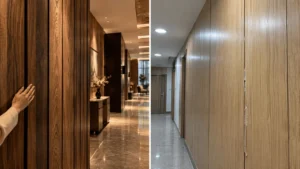
In any application where design quality is part of the brief — hotels, luxury residential, high-end commercial, hospitality — the visual difference between WPC and PVC wall panels is immediately apparent to trained eyes, and increasingly apparent to everyday users as design literacy improves.
The visual quality difference comes from the manufacturing process:
WPC surface texture: Deep embossed grain patterns created by heavy steel rollers produce genuine three-dimensional texture that catches and responds to light the way real timber does — producing highlight and shadow that shift as the viewing angle changes. Multi-tonal colour variation within the grain mimics the natural variation of wood species. At arm’s length, premium co-extruded WPC panels are visually indistinguishable from the real wood species they reference.
PVC surface print: The wood-effect appearance of PVC panels is created by a printed film or a shallow emboss on a plastic substrate. The result lacks depth — the grain pattern is visually flat, the colour is uniform rather than varied, and direct lighting reveals the plastic sheen beneath. Experienced interior designers and discerning hotel guests recognise PVC panels immediately, and this recognition undermines the perceived quality of the entire installation.
3.2 The Touch and Feel Dimension
In close-contact interior applications — hotel corridors, villa living rooms, restaurant feature walls — guests interact physically with wall panels. WPC’s wood fibre content gives it a warmth and density on touch that PVC lacks. PVC feels cold and synthetic to the touch, particularly in air-conditioned environments. This tactile quality gap between WPC and PVC is impossible to specification-document but instantly recognisable to any guest who runs a hand along the wall.
3.3 Colour Depth and Long-Term Appearance
WPC colour is distributed through the composite matrix and protected by the co-extrusion shell — meaning that even if the surface is lightly scratched or worn, the colour and texture transition gradually rather than dramatically. PVC panels with printed surface films can show wear through the film to a uniform white or grey substrate beneath — particularly at edges, corners, and areas of repeated contact.
Design conclusion: For any project where visual quality is expected to remain convincing over years — hotels, premium residential, high-end commercial — WPC’s aesthetic performance is meaningfully superior to PVC. This is not a matter of subjective preference; it is a measurable difference in material and manufacturing quality.
4. Structural Performance: Density, Strength, and Fixing
4.1 Core Density and Compressive Strength
The structural performance difference between solid core WPC and hollow profile PVC is significant and measurable:
- Solid core WPC: Density 950–1,200 kg/m³; compressive strength 40–60 MPa; flexural modulus 3,000–5,000 MPa
- Hollow PVC panel: Effective density 400–700 kg/m³; compressive strength 15–25 MPa; flexural modulus 1,500–2,500 MPa
This density difference has practical consequences across every aspect of panel performance — from how well the panel absorbs an impact to how reliably it holds a fixing under load. WPC’s denser structure is the direct result of the wood fibre content that defines the material — and it cannot be replicated by any hollow plastic extrusion.
4.2 Impact Resistance
Point impacts — from luggage, trolleys, maintenance equipment, or deliberate force — produce predictably different results on WPC and PVC panels:
WPC impact response: The dense composite matrix distributes impact energy across the cross-section. Minor impacts produce no visible damage. Significant impacts may produce a surface mark that requires replacement — but the panel structure does not collapse or shatter.
PVC impact response: Hollow PVC profiles are vulnerable to concentrated impact above the hollow channels — the thin face wall (1–3mm) can crack, depress, or shatter without significant force. This failure mode is irreversible without panel replacement, and it appears with regularity in hotel corridors, stairwells, and any area subject to equipment movement.
4.3 Screw and Fixing Retention
For any application requiring panel attachment via screws, toggle anchors, or surface-mounted fixtures (TV brackets, picture rails, bathroom accessories), fixing retention is a critical performance requirement:
- WPC screw pull-out: 800–1,500 N with standard 4.5mm self-tapping screws — across the full panel thickness
- PVC screw pull-out: 200–500 N — limited by thin face wall engagement; fixing in hollow channels risks pull-through
In hotel rooms where TV brackets, headboard rails, and artwork fixings are routinely installed directly into wall panels, WPC’s superior screw retention is the difference between a safe installation and a liability risk.
Structural verdict: WPC’s solid core construction makes it the appropriate specification for any application involving mechanical loads, impact exposure, or fixed attachments. PVC hollow profiles are not engineered for these requirements.
5. Fire Safety: The Critical Difference
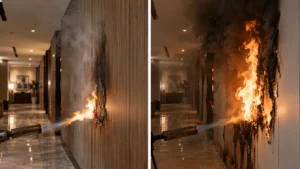
This is arguably the most important reason to choose WPC over PVC in any commercial, hospitality, or multi-occupancy residential specification — and the least discussed in typical material comparisons.
5.1 PVC Combustion Chemistry
When PVC burns, it produces a distinctive and toxic combustion chemistry:
- Hydrochloric acid (HCl): PVC contains approximately 57% chlorine by weight. During combustion, this chlorine combines with hydrogen to produce hydrochloric acid gas — highly corrosive to respiratory tissue and equipment, and a significant toxic hazard in enclosed building spaces.
- Dioxins and furans: PVC combustion at sub-optimal temperatures produces chlorinated dioxins and furans — among the most toxic substances known. These persistent organic pollutants accumulate in the environment and the human body, and are classified as carcinogenic by the WHO.
- Dense black smoke: PVC fires produce exceptionally dense black smoke that rapidly reduces visibility and makes evacuation and fire-fighting significantly more dangerous than fires involving other building materials.
5.2 WPC Fire Performance
WPC wall panels produce significantly less toxic combustion products than PVC:
- No chlorine-based combustion products — no HCl, no dioxin formation
- Combustion products are primarily CO₂, water vapour, and carbon particulates — the same as wood
- Fire-retardant WPC formulations available achieving Class B (EN 13501-1) classification
- Slower flame spread rate due to wood fibre char formation during burning
For hotel, resort, healthcare, government, and multi-storey residential projects — where building codes mandate specific fire performance requirements — the choice of WPC over PVC is often not a preference but a regulatory necessity. Local fire codes in many jurisdictions explicitly prohibit PVC cladding in certain building types and locations.
Fire safety warning: Specifying PVC wall panels in commercial hospitality or multi-occupancy residential projects without verifying local fire code compliance and specific product fire classifications carries genuine legal and safety risk. WPC’s cleaner combustion chemistry makes it the professionally responsible choice in these applications.
6. Environmental and Health Credentials
6.1 PVC’s Environmental Challenges
PVC is one of the most environmentally controversial polymer materials in use — a fact that is increasingly relevant to sustainability-conscious developers, clients, and regulatory frameworks:
- Production energy and chlorine chemistry: PVC manufacturing requires chlorine, produced via energy-intensive electrolysis. The chlorine supply chain generates toxic by-products including mercury compounds at some facilities.
- Plasticisers: Many PVC formulations contain phthalate plasticisers — a category of chemicals associated with endocrine disruption, which have been subject to increasing regulatory restriction under EU REACH regulations. While PVC wall panel formulations are typically rigid (unplasticised PVC or uPVC), the broader product category creates specification risk.
- End-of-life recyclability: Chlorinated polymers are significantly more difficult to recycle than polyolefins (PE, PP). PVC waste in construction demolition typically ends up in landfill or incineration, with the latter producing the same toxic combustion products described above.
- Indoor air quality: Freshly installed PVC panels can off-gas plasticiser-related compounds, producing a characteristic ‘plastic smell’ during the initial period after installation. In sealed interior environments like hotel rooms, this can be noticeable and potentially objectionable to guests.
6.2 WPC’s Environmental Position
WPC wall panels carry a more favourable environmental profile across most lifecycle assessment dimensions:
- Recycled content: Quality WPC uses recycled wood fibre (sawmill waste, agricultural residue) and recycled polymer content — diverting both material streams from landfill. Some manufacturers achieve 80%+ recycled content by weight.
- No chlorine chemistry: PE and PP-based WPC formulations are chlorine-free throughout the product lifecycle — production, installation, use, and end-of-life disposal.
- Lower carbon intensity: Wood fibre sequesters carbon during its growth phase. While this carbon is eventually released, WPC’s wood content gives it a more favourable embodied carbon profile than virgin PVC.
- Green building certification: WPC with certified recycled content can contribute to LEED Materials & Resources credits, BREEAM Responsible Sourcing credits, and other green building certification requirements that PVC typically cannot fulfil.
ESG alignment: For developers with sustainability targets, ESG reporting requirements, or green building certification goals, WPC is the materially and demonstrably more sustainable wall panel specification. PVC creates compliance risk that WPC eliminates.
7. Thermal Stability and Outdoor Performance
7.1 Thermal Expansion: A Practical Problem with PVC
PVC has one of the highest thermal expansion coefficients of any common building material — approximately 50–80 × 10⁻⁶ /°C. This means that a 3-metre PVC panel can expand or contract by 4.5–7.2mm across a 30°C temperature swing — a common range in many climates between summer and winter, or even between day and night in some regions.
For interior installations in climate-controlled environments, this movement is manageable. For any semi-exposed position — covered exterior corridors, rooftop terraces, balconied facades — this level of thermal movement can cause:
- Joint gaps opening in cold conditions
- Panel buckling or bowing in hot direct sunlight
- Clip and fixing system stress leading to cracking around fixing points
- Visible waviness across large panel installations
WPC thermal expansion: Approximately 20–40 × 10⁻⁶ /°C — 40–60% lower than PVC, due to the constraining effect of the wood fibre matrix. WPC panels are significantly more dimensionally stable across temperature cycles, reducing movement-related installation and performance problems.
7.2 UV Performance Outdoors
PVC in direct UV exposure progressively degrades — a process known as UV embrittlement. Unprotected PVC yellows, loses flexibility, and eventually becomes prone to cracking, particularly in hot climates with intense solar radiation. Most PVC wall panel products are formulated for interior use and carry no UV performance warranty for exterior applications.
Co-extruded WPC panels, with UV stabiliser-rich outer shells, are specifically engineered and tested for exterior UV exposure. Leading manufacturers test to ISO 4892-3 (UV fluorescent lamp) or ASTM G155 (xenon arc) and warrant exterior colour performance for 10–15 years. This is the primary reason solid-core co-extruded WPC is the standard specification for exterior wall cladding while PVC is not.
Outdoor specification rule: Never specify PVC wall panels for exterior, semi-exposed, or direct UV-exposure positions. Co-extruded solid core WPC is the correct material for these applications — the product is engineered, tested, and warranted for them.
8. Acoustic Performance
Sound management is an increasingly important specification requirement across hospitality, residential, and commercial projects — and it is an area where WPC and PVC diverge meaningfully.
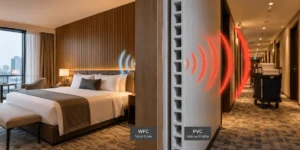
WPC acoustic performance: Solid core WPC panels add meaningful acoustic mass to wall systems. A 100m² solid core WPC cladding installation can contribute 3–5 dB of additional sound attenuation compared to a bare substrate — relevant for hotel room-to-corridor sound privacy, restaurant ambient noise control, and office acoustic management.
PVC acoustic performance: Hollow PVC panels add minimal acoustic mass and can act as resonance chambers that amplify certain frequencies. In hotel corridors panelled with hollow PVC, the ‘hollow knock’ sound when panels are touched or impacted is audible and undermines the perception of build quality. Hollow panels can also transmit impact sound more effectively than solid wall constructions, reducing acoustic privacy between spaces.
For hotels where guest satisfaction scores are influenced by room acoustic privacy, and for restaurants where ambient noise management affects the dining experience, WPC’s superior acoustic mass is a tangible performance advantage that justifies its premium over PVC.
9. When to Choose WPC vs PVC: Project-by-Project Guide
Different projects have different priorities. Use the guide below to determine which material is the more appropriate specification for your specific situation:
| Project Scenario | Choose | Key Reason |
| 5-star hotel guest rooms | WPC | Fire rating, acoustic mass, screw holding for fixtures & artwork |
| Hotel exterior facade | WPC | Weatherproof solid core; no UV yellowing or embrittlement |
| Luxury villa interior walls | WPC | Natural wood-grain aesthetics essential at close inspection |
| Villa exterior cladding | WPC | Only co-extruded WPC suitable; PVC degrades outdoors |
| Budget apartment renovation | PVC | Cost-driven spec; low traffic; dry indoor only |
| Office interior feature wall | WPC | Premium visual standard required; client-facing spaces |
| Restaurant interior cladding | WPC | Fire safety; high-traffic durability; brand aesthetics |
| Retail utility back-of-house | PVC | Low-visibility area; cost reduction acceptable |
| Airport or government building | WPC | Fire performance & structural integrity mandatory |
| Pool surround / wet area wall | WPC | Solid core WPC is waterproof; PVC risks long-term UV damage |
| Bathroom interior (budget spec) | PVC | Moisture resistance adequate; low traffic; cost priority |
| Exterior pergola / deck feature | WPC | Co-extruded WPC handles outdoor exposure; PVC cannot |
10. Cost Comparison: The True Picture
WPC wall panels cost more than PVC wall panels — but the full cost comparison is more nuanced than the material price per square metre suggests:
| Cost Element (per 100m²) | WPC Wall Panels | PVC Wall Panels |
| Material cost (FOB China) | $2,000–5,000 | $1,000–3,000 |
| Installation labour | $1,500–3,000 | $1,200–2,500 |
| Fixing & sub-frame system | $400–700 | $350–600 |
| Annual maintenance | Near zero | Near zero |
| UV / colour degradation risk | Low (co-ext.) | Moderate–High outdoors |
| 5-year replacement likelihood | Very low | Low (indoor) / High (outdoor) |
| 10-year total cost (100m²) | $4,000–9,000 | $3,000–7,500 |
| Lifecycle cost advantage | Lower long-term | Lower upfront only |
Key finding: WPC costs 40–80% more than PVC on a material basis. On a 10-year total installed and maintained cost basis for interior applications, the gap narrows to 20–30%. For exterior applications, PVC is not an appropriate substitute for WPC at any price — so the cost comparison is meaningless in those contexts.
Financial advice for specifiers: Present the WPC vs PVC comparison to clients on a 10-year lifecycle basis, not a material price basis. The additional $5–20/m² of WPC material cost, spread across a 10-year building lifecycle, amounts to $0.50–2.00/m²/year — a trivial premium for the quality and performance improvement it delivers.
11. Is There Any Scenario Where PVC Is the Right Choice?
A thorough comparison requires intellectual honesty about when PVC wall panels represent a legitimate specification choice rather than a compromise:
Budget residential renovation (dry interior, low traffic): In a dry, climate-controlled residential interior with low impact exposure, PVC wall panels perform adequately as a decorative surface treatment. If the budget does not permit WPC and the client understands the quality trade-off, PVC is a serviceable choice for non-demanding interior applications.
Utility and service areas: Non-guest-facing areas of commercial buildings — back-of-house corridors, plant rooms, utility spaces — where appearance and premium performance are not requirements, PVC may represent the appropriate cost-optimised choice.
Temporary installations: Exhibition stands, temporary retail fitouts, pop-up installations, and other applications with a defined short life expectancy where capital cost minimisation is the primary driver.
Bathroom cladding (budget residential, dry system): PVC bathroom cladding panels have an established track record in budget residential applications. While WPC is the superior long-term specification, PVC bathroom panels installed in a properly waterproofed system can perform adequately for 10+ years in dry domestic environments.
The common thread in all appropriate PVC applications is: dry, interior, low-traffic, non-premium, non-fire-critical, and typically short-to-medium life expectancy. As soon as any of those qualifiers changes — the specification should change to WPC.
12. Specifying WPC: What to Look for in a Quality Product
Not all WPC wall panels are equivalent. The performance advantages described throughout this article apply to quality-manufactured WPC products. When specifying WPC, confirm:
- Core type: Specify solid core WPC for exterior and high-performance interior applications (minimum density 950 kg/m³). Hollow core WPC is acceptable only for dry, low-traffic interior accent walls.
- Co-extrusion: For exterior applications, specify co-extruded WPC with a polymer-rich outer shell — this is what delivers UV stability and moisture resistance that single-layer WPC cannot match.
- Pigment quality: Specify inorganic or high-performance organic pigments with heat stability above 240°C and a minimum Blue Wool Scale UV rating of 7/8. Cheap organic pigments in WPC fade within 1–3 years of outdoor exposure.
- Certification documentation: Request CE Declaration of Conformity, fire classification test reports (EN 13501-1 or ASTM E84), SGS product test reports, and UV weathering test results. A manufacturer who cannot provide these documents is not managing quality systematically.
- Colour consistency: Specify a ΔE ≤ 2.0 batch-to-batch colour tolerance for large projects. Confirm that the manufacturer retains batch samples and measures production output with a spectrophotometer.
- Warranty: Quality WPC wall panels carry 10–25 year manufacturer warranties. A supplier offering a 1–2 year warranty on an exterior WPC product is signalling limited confidence in long-term performance.
Frequently Asked Questions
Is WPC more expensive than PVC wall panels?
Yes — WPC wall panels typically cost 40–80% more per square metre than PVC equivalents on a material basis. However, when installation, maintenance, and lifecycle replacement costs are included over 10 years, the total cost difference is typically 20–30%. For exterior applications, PVC is not a viable alternative to WPC, making cost comparison irrelevant in those contexts. For interior applications, the additional WPC material cost amounts to approximately $0.50–2.00/m²/year over a building’s life — a small premium for significantly better performance and aesthetics.
Can WPC wall panels be used outdoors where PVC cannot?
Yes. Co-extruded solid core WPC wall panels are specifically engineered, tested, and warranted for exterior applications — including facades, exterior corridors, pool surrounds, and coastal environments. Most PVC wall panel products are designed for interior use only: UV exposure causes PVC to yellow and embrittle over time, making it unsuitable for any position with direct sunlight or significant temperature cycling. For outdoor applications, co-extruded WPC is the correct specification.
Are WPC panels safer than PVC panels in a fire?
Yes, significantly. When WPC burns, it produces combustion products similar to natural wood — primarily CO₂, water vapour, and carbon particulates. When PVC burns, it releases hydrochloric acid gas and, under certain conditions, chlorinated dioxins and furans — highly toxic substances with serious health implications for building occupants and emergency responders. For commercial, hospitality, and multi-occupancy residential projects, WPC’s cleaner fire chemistry is a genuine safety advantage, and many building codes explicitly restrict PVC in these applications.
Does WPC look more realistic than PVC for wood grain effects?
In the experience of most interior designers and discerning buyers, yes. WPC’s wood fibre content allows deep embossed grain textures with genuine three-dimensional depth and multi-tonal colour variation that closely replicates real timber. PVC wood-effect panels rely on a printed film or shallow surface emboss — the result is visually flatter and more recognisably synthetic, particularly in direct lighting or at close viewing distances. For premium hospitality, luxury residential, and high-specification commercial projects, WPC’s aesthetic quality is meaningfully superior.
Is WPC wall panel more environmentally friendly than PVC?
In most lifecycle assessment dimensions, yes. WPC uses recycled wood fibre and can incorporate recycled polymer content. It does not require chlorine chemistry in production, does not contain phthalate plasticisers, and is recyclable at end of life. PVC requires energy-intensive chlorine production, may contain plasticisers under regulatory scrutiny, and is difficult to recycle. For LEED, BREEAM, and other green building certifications, WPC with recycled content typically earns credits that PVC cannot.
What is the minimum order quantity for WPC wall panels from China?
Most quality WPC manufacturers accept orders from 200–300m² for standard stocked colours and profiles. Custom colours, profiles, or OEM specifications typically require 500–1,000m² minimum. For project-based procurement, requesting all material from a single production run ensures colour consistency. Contact our team with your project specifications to receive a tailored MOQ recommendation and competitive pricing.
Conclusion: WPC Is the Professional’s Choice
The comparison between WPC and PVC wall panels is not genuinely close for most professional applications. WPC outperforms PVC on aesthetics, structural strength, acoustic performance, fire safety, environmental credentials, outdoor durability, and thermal stability. The only dimension where PVC consistently wins is initial material cost — and even that advantage narrows significantly when the total lifecycle cost of the installation is properly calculated.
The choice of PVC over WPC in a professional specification is typically driven by one of three factors: a budget constraint that genuinely cannot accommodate WPC’s premium; a misunderstanding of the performance differences between the two materials; or a specification process that evaluates material cost in isolation from lifecycle cost, installation performance, and project quality expectations.
For architects, interior designers, hotel developers, and property managers who want to make a specification decision they will not regret in three years: WPC is the answer. The additional cost is real, and so is the performance it buys. In any application where quality, longevity, safety, or client satisfaction matters — WPC is the only professional choice.
Ready to Upgrade from PVC to Premium WPC Wall Panels?
Melinco’s solid-core WPC wall panels deliver the natural aesthetics, structural performance, and lifetime durability that PVC simply cannot match — for hotels, villas, and landmark commercial projects worldwide.
✔ Free WPC sample pack with test reports
✔ CE / SGS certified products
✔ OEM & custom colours available