Table of Contents
There is something about natural wood that no other material has ever quite replicated — the warmth, the depth of grain, the way light catches a knot or shifts across a quarter-sawn surface. For decades, designers faced an uncomfortable binary: use real timber and accept its maintenance demands, moisture sensitivity, fire hazards, and escalating sustainable sourcing costs — or settle for synthetic alternatives and sacrifice the aesthetic warmth they were trying to achieve. Today, that choice looks very different. Advanced composite panel technology has reached the point where asking “can composite panels mimic natural wood grain?” is almost the wrong question. The real question is: how close do they get, which technology is right for your project, and what should you know before you specify?
Quick Answer — The Short Version for Busy Specifiers
Yes — modern composite panels can realistically mimic natural wood grain to a high degree of visual fidelity. Wood grain aluminum composite panels (ACP), wood plastic composite (WPC) panels, and high-pressure laminate (HPL)-faced composite systems are the three leading technologies for achieving authentic timber aesthetics in composite form. Using digital scanning, PVDF printing, sublimation transfer, precision embossing, and natural wood fiber integration, today’s composite panels can replicate the color gradation, grain direction, knot patterns, and surface texture of specific species — including oak, teak, walnut, cedar, ash, pine, and many others — with sufficient accuracy that most observers cannot distinguish the composite from real timber at normal viewing distances. The critical advantage: these panels deliver the wood aesthetic without natural timber’s vulnerability to moisture, UV degradation, warping, fire risk, or high maintenance cost.
1. Why the Wood Aesthetic Matters in Modern Construction
Natural wood has been central to the human built environment for millennia. Its warmth communicates comfort and belonging. Its grain pattern is inherently varied and organic, resisting the clinical uniformity that makes many modern buildings feel cold or institutional. In commercial interiors — offices, hotels, retail spaces, hospitals, and schools — the presence of wood-like surfaces has been consistently shown in environmental psychology research to reduce perceived stress, increase perceived quality of space, and support longer, more comfortable occupancy.
But natural timber in large-scale commercial applications comes with a substantial set of operational and regulatory challenges. The cost of premium solid timber — or even quality timber veneer — has risen significantly as sustainable sourcing requirements constrain the availability of premium species. Natural wood is inherently variable in color and grain, making precise tonal matching across a large installation difficult to achieve and maintain. It swells and shrinks with seasonal humidity changes, creating dimensional movement that conflicts with the tight tolerances of contemporary precision interiors. It requires periodic maintenance intervention — oiling, staining, repainting — that disrupts building operations and generates recurring lifecycle costs. And in external applications, timber faces the compounding degradation of UV, rain, frost, thermal cycling, and biological activity that, without maintenance, causes greying, checking, warping, and ultimately structural failure of the cladding.
These pressures have driven enormous innovation in the development of composite panel systems that replicate the wood aesthetic — and today’s highest-quality products deliver results that were simply not achievable a decade ago. Understanding what is now possible, and how to specify it correctly, is what this guide is for.
2. How Composite Panels Replicate Wood Grain — The Technologies
The wood grain effect in composite panels is achieved through several distinct technologies, each with its own characteristic visual output, tactile quality, durability profile, and suitable application range. Understanding these technologies is the foundation of making an informed specification decision.
2.1 PVDF Wood Grain Printing on Aluminum Composite Panels
The most sophisticated wood grain reproduction currently applied to composite panels is PVDF (polyvinylidene fluoride) printing on aluminum composite panel face sheets. The production process begins with high-resolution digital scanning of actual timber samples — typically multiple panels from within the same species batch to capture authentic grain variation, tonal shifts between heartwood and sapwood, and the subtle imperfections that give natural wood its visual richness. These scans are used to create printing masters from which the wood grain pattern is transferred to the aluminum face sheet using precision roller coating or digital inkjet printing.
The printed pattern is then permanently sealed beneath a clear PVDF topcoat — the same fluoropolymer coating technology used on standard architectural ACP that delivers 20 to 25-year exterior color retention. This topcoat protects the wood grain print from UV degradation, rain erosion, cleaning chemical contact, and surface abrasion with the same proven longevity as standard PVDF ACP colors. The result is a wood grain composite panel that can be exposed to full exterior weathering for decades without the print fading, lifting, or losing grain definition — a performance characteristic that no natural timber cladding system can match.
2.2 Sublimation Transfer Printing
Sublimation transfer is a printing process in which the wood grain pattern is first printed in reverse on a transfer medium using sublimation dye inks, then transferred to the panel surface under controlled heat and pressure. During the sublimation process, the inks change from solid to gas phase and migrate into the molecular structure of the receiving surface rather than sitting on top of it — creating a print that is bonded at depth to the substrate and is significantly more resistant to surface abrasion and wear than conventional surface-applied prints.
Sublimation transfer is used on both aluminum face sheets and solid PVC composite panels. It is particularly effective for replicating the tonal depth and multi-layered color complexity of fine wood species — the overlapping warm and cool tones that give walnut and teak their distinctive visual richness, or the subtle grey-pink warmth of cedar — where simple single-pass printing cannot capture adequate visual complexity.
2.3 Embossing and Physical Surface Texture
Visual wood grain reproduction is only part of the replication equation. Natural timber has a tactile surface: the grain is physically raised and depressed in ways that hands recognize instinctively, even before eyes confirm the material identity. The most convincing wood grain composite panels combine the printed grain pattern with a physically embossed surface texture whose raised and recessed grain lines are precisely aligned with the visual grain direction in the print.
This embossed grain texture is applied during panel manufacturing using textured roller pressing at the lamination stage, or through embossed overlay sheets applied before the PVDF topcoat. The result is a panel surface that has both the color variation and the tactile character of timber — and at the viewing and touching distances at which people actually experience building interiors, the composite surface is genuinely difficult to distinguish from natural wood by most observers.
2.4 Natural Wood Fiber Integration — Wood Plastic Composite (WPC)
WPC panels take a fundamentally different approach to wood grain replication: rather than printing a timber pattern onto a non-wood substrate, they incorporate actual wood fiber into the material itself. WPC panels are manufactured by blending finely milled wood or bamboo fiber — typically 40 to 70% by weight — with thermoplastic polymers, most commonly HDPE or polypropylene, and then extruding or pressing the mixture into panel form.
The wood grain and color variation visible in WPC panels is generated by the actual wood fiber content rather than a printed simulation. This gives WPC an inherently organic visual quality — the grain variation is genuinely random and non-repeating, because it is produced by real fiber distribution rather than a digital print master. At close range, WPC is arguably the most convincing wood grain composite, precisely because what you are seeing is not a simulation of wood but a material that genuinely contains it.
2.5 High-Pressure Laminate (HPL) Wood Grain Facing
High-pressure laminate panels use an HPL layer — manufactured by impregnating multiple layers of kraft paper with phenolic resin and pressing them at high temperature and pressure — as the face of a composite panel system. The outermost decorative layer is printed with a high-resolution wood grain pattern, protected by a clear melamine or acrylic overlay that provides scratch and impact resistance.
The resolution of modern decorative paper printing enables extremely faithful reproduction of complex grain structures and subtle tonal variations — arguably the finest wood grain visual reproduction of any composite panel technology. HPL-faced composite panels are a fixture in premium interior design: hotel room cladding, executive office environments, luxury retail fit-outs, and high-specification residential projects where visual quality is the primary specification criterion.
3. Types of Wood Grain Composite Panels — A Full Overview
3.1 Wood Grain Aluminum Composite Panels (ACP)
Wood grain ACP is the most versatile of all wood grain composite options, combining the structural and performance advantages of standard aluminum composite with PVDF-printed or sublimation-transferred timber aesthetics. The aluminum face sheet carries the wood grain pattern; the composite core provides rigidity, dimensional stability, and thermal performance.
The primary advantages of wood grain ACP for commercial projects:
- Full exterior weathering capability — PVDF wood grain coatings maintain their appearance under UV, rain, and temperature cycling for 20 to 25 years without maintenance
- Compatible with all standard ACP fixing systems — rainscreen, cassette, curtain wall infill — making integration into building facades technically straightforward
- Available in a comprehensive species library — typically including light oak, dark oak, walnut, teak, cherry, cedar, pine, ash, mahogany, and custom grain development on request
- Lightweight at 4 to 8 kg/m², reducing structural load compared to stone or masonry cladding alternatives
- Fire-resistant core (A2-rated mineral fill) available for high-rise compliance, making a timber aesthetic achievable on buildings where natural wood would be prohibited by fire codes
- Paintable cut edges and matching trim profiles available from most manufacturers for professional joinery at panel terminations
Wood grain ACP is ideal for exterior building facades, entrance feature panels, canopy soffits, interior lobby cladding, column covers, reception feature walls, and signage backing. It is best suited to commercial office buildings, hospitality developments, retail anchors, and any project requiring a timber aesthetic in fully exposed conditions.
3.2 Wood Plastic Composite (WPC) Panels
WPC panels offer the most structurally authentic wood grain experience of any composite panel type, because they contain real wood fiber in their material composition. Their appearance — in terms of organic grain variation, surface texture, and tonal depth — is particularly convincing at close range, making them ideal for applications where occupants will have direct visual and tactile interaction with the panel surface.
WPC specification advantages for interior and semi-exterior applications:
- Genuinely organic grain variation — the non-repeating natural distribution of wood fiber content means adjacent panels look different from one another, as real timber does
- Moisture-resistant composition — panels do not swell, warp, or support mold growth under the humidity cycles of commercial HVAC environments
- No painting, staining, or recoating required for the life of the installation in covered conditions — maintenance is limited to periodic cleaning
- Dimensionally stable — no seasonal movement, eliminating the joint gaps and surface distortion that afflict natural timber panel systems over time
- Suitable for covered exterior applications — terraces, entrance canopies, sheltered walkways — where a natural timber aesthetic is desired without the maintenance obligation
- Available in a range of woodgrain tones from pale Scandinavian oak to rich tropical mahogany
WPC is ideal for interior feature walls, reception surfaces, executive office cladding, conference room accent walls, restaurant and hotel lobby environments, and semi-exterior covered terrace cladding. Best suited for environments where premium natural aesthetics are integral to brand identity or occupant wellbeing strategy.
3.3 HPL-Faced Composite Panels
High-pressure laminate composite panels are the specification choice for interior environments demanding the highest level of wood grain visual fidelity combined with demanding durability performance. The quality of wood grain reproduction in premium HPL is the finest achievable in any composite panel format — with grain pattern resolution, tonal complexity, and depth of visual texture that rivals quality timber veneer at normal interior viewing distances.
HPL composite panel specification advantages for premium interiors:
- Exceptional wood grain resolution — modern decorative paper printing technologies capture grain complexity and tonal variation at a level that other composite technologies cannot match
- Superior surface hardness and scratch resistance — the cured melamine overlay resists daily wear from cleaning, contact, and impact more effectively than painted or PVDF-coated surfaces
- Consistent batch-to-batch color and grain matching — important for large-area installations where visual uniformity across many panels is required
- Easily cleaned with standard commercial cleaning agents including mild disinfectants — suitable for hospitality, healthcare-adjacent, and food service office environments
- Available in large-format sheets reducing the joint frequency in interior feature wall applications
HPL-faced composite panels are ideal for hotel room cladding, executive office environments, luxury retail and showroom interiors, premium restaurant fit-outs, residential high-specification applications, and any commercial interior where the quality of the timber aesthetic is the primary specification driver.
3.4 Fiber Cement Wood Grain Panels
Fiber cement composite panels with wood grain texture and factory-applied paint represent a durable, fire-resistant, and cost-competitive option for exterior applications where a timber aesthetic is desired at a lower price point. The fiber cement substrate is produced by pressing a mixture of Portland cement, cellulose fiber, and silica to create a dense, dimensionally stable board that is highly resistant to moisture, biological growth, and fire.
The wood grain surface is typically achieved through embossed moulds applied during panel pressing — producing a physical surface relief that authentically replicates the raised and recessed grain character of timber — combined with factory-applied acrylic or silicone polymer paint in species-referenced tones. The result is a panel with genuine tactile wood grain character and a durable painted finish that, in protected locations, can provide 10 to 15 years of service before requiring repainting.
Fiber cement wood grain panels are suited to residential external cladding, low-rise commercial buildings, retail shopfronts, and any project requiring a wood aesthetic on exterior surfaces at controlled material cost. They are less suited to high-rise applications where wind pressure resistance requirements may exceed the panel’s structural performance capability.
3.5 PVC Wood Grain Composite Panels
PVC composite panels with sublimation-printed wood grain finishes are the most accessible price point in the wood grain composite category. The thermoplastic PVC substrate is lightweight, moisture-resistant, and easy to fabricate; the sublimation-printed wood grain surface delivers a reasonable visual approximation of timber at very competitive cost.
PVC wood grain panels are best suited to interior applications in cost-controlled fit-outs where the wood aesthetic adds value but the specification level does not justify the investment in ACP, WPC, or HPL systems. They should not be specified for exterior use or applications involving sustained UV exposure, as the PVC substrate degrades in sunlight conditions and the sublimation print may show UV-induced discoloration over time.
PVC wood grain composite is well suited to internal partitioning, retail back-of-house, budget hospitality interiors, amenity cladding in commercial buildings, and any application where the visual wood grain effect is desired at minimum material cost.
4. Wood Grain Composite Panels — Side-by-Side Comparison
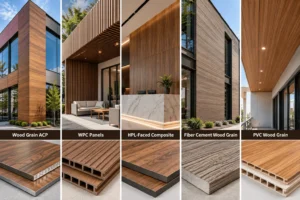
The table below provides a concise specification-level comparison of the five main wood grain composite panel technologies, enabling rapid evaluation for project-specific selection.
| Panel Type | Wood Grain Method | Interior Use | Exterior Use | Fire Rating | Cost Level |
| Wood Grain ACP | PVDF print / sublimation | ✓ Excellent | ✓ Excellent | A2 / Class A | Medium |
| WPC Panels | Natural wood fiber | ✓ Excellent | ◑ Covered only | Class B–A | Medium |
| HPL-Faced Composite | Decorative paper print | ✓ Excellent | ✗ Not suitable | Class A (INT) | Medium+ |
| Fiber Cement Wood Grain | Embossed mould + paint | ✓ Good | ✓ Good | Class A | Low–Med |
| PVC Wood Grain | Sublimation print | ✓ Basic | ✗ Not suitable | Class B | Low |
Key: ✓ = Fully suitable ◑ = Suitable with product-specific confirmation ✗ = Not recommended for this application. Fire ratings reflect best-available product variants; confirm specific certificates with supplier.
5. How Close Can Composite Panels Really Get to Natural Wood?
This is the question that matters most to anyone specifying wood grain composite panels for the first time — and the honest, evidence-based answer is: closer than most expect, and in many practical contexts, indistinguishable from natural timber.
5.1 Visual Fidelity
Wood grain reproduction in high-quality composite panels has transformed over the past decade. PVDF-printed ACP panels from leading manufacturers now incorporate scanned digital masters derived from multiple actual timber specimens of the same species, combining them to replicate the non-repeating natural variation — grain direction shifts, medullary rays, knot formations, sapwood-to-heartwood transitions — that give natural wood its visual richness.
At normal interior viewing distances of 1.5 to 5 meters, premium wood grain ACP, WPC, and HPL panels are genuinely difficult to distinguish from natural timber veneer by most observers. The most significant variable determining visual realism is the management of grain pattern repetition across adjacent panels: natural wood has truly random grain, while composite panels produced from the same print master carry a repeating grain cycle. Experienced installers manage this through deliberate panel rotation, flipping, and offset installation that simulates the non-repeating randomness of a real timber installation — and when done correctly, the composite result is essentially indistinguishable.
5.2 Tactile Experience
The tactile dimension of wood grain replication has improved substantially. Embossed grain surfaces on premium ACP panels and the inherent surface texture of WPC materials provide a physical response to touch that closely approximates actual timber. For interior applications where occupants interact directly with the surface — reception desks, wall cladding within arm’s reach, feature wall surfaces adjacent to seating — tactile realism is an important element of the overall perceptual quality of the material, and the best composite products address this seriously.
5.3 Durability — Where Composite Panels Clearly Win
On durability, wood grain composite panels do not merely match natural timber — they outperform it comprehensively. Natural timber in exterior applications requires maintenance cycling every 3 to 7 years — oiling, staining, or repainting — to preserve both appearance and structural integrity against UV degradation, moisture, biological growth, and temperature cycling. Without maintenance, natural timber exterior cladding greys, checks, warps, and eventually fails.
Wood grain ACP, WPC, and HPL-faced composite panels maintain their appearance under equivalent exposure conditions for 20 to 30 years with maintenance limited to routine cleaning. The wood grain is permanently integrated into the panel surface construction and is not subject to the biological and moisture-driven degradation mechanisms that compromise natural timber over time. For building owners with long-term cost of ownership perspectives, this durability differential is a decisive specification argument.
5.4 Fire Performance
Natural timber is combustible. In fire situations, it burns — contributing fuel load to the developing fire and potentially failing structurally. This is a significant constraint in commercial and multi-occupancy building applications, where fire codes impose strict limits on the combustibility of interior and exterior finish materials, particularly above regulatory height thresholds.
Wood grain composite panels — specifically ACP with A2-rated mineral-filled fire-resistant core — can achieve Class A fire ratings that natural timber fundamentally cannot. This makes a timber aesthetic achievable in high-rise commercial applications — office towers, hotels, residential apartments — where natural wood cladding would be prohibited by fire code. This compliance advantage alone makes wood grain ACP the specification of choice for exterior applications on buildings above regulated height thresholds.
5.5 Cost
Premium natural timber veneer has become increasingly expensive as sustainable sourcing requirements reduce the supply of premium species. Installed natural timber cladding at commercial scale — with the cost of the timber itself, installation complexity, waste rates due to natural defect, and the lifecycle maintenance program — often significantly exceeds the cost of equivalent-area wood grain composite panel installation. For large commercial projects, this cost differential can represent a material budget saving that funds other project priorities.
6. Best Applications for Wood Grain Composite Panels
6.1 Exterior Building Facades
Wood grain composite facades — primarily wood grain ACP systems — allow architects to specify building envelopes with the warmth and organic character of timber at a fraction of the maintenance cost, with far superior fire performance, and without the sustainable sourcing constraints that make large-scale natural timber cladding increasingly difficult to specify in good conscience. The aesthetic is particularly popular in corporate office buildings, boutique hotels, mixed-use developments, educational campus buildings, and premium residential developments where a timber aesthetic is central to the design concept but natural wood cannot meet regulatory or commercial requirements.
Modern wood grain ACP facade systems are fully compatible with standard rainscreen, cassette, and curtain wall engineering. Their lightweight construction reduces structural demand and construction cost compared to heavier facade materials. Custom panel fabrication — routing, bending, and corner forming — allows complex facade geometries to be executed in wood grain composite without the specialist joinery skills and site waste that characterize natural timber at scale.
6.2 Interior Feature Walls and Reception Areas
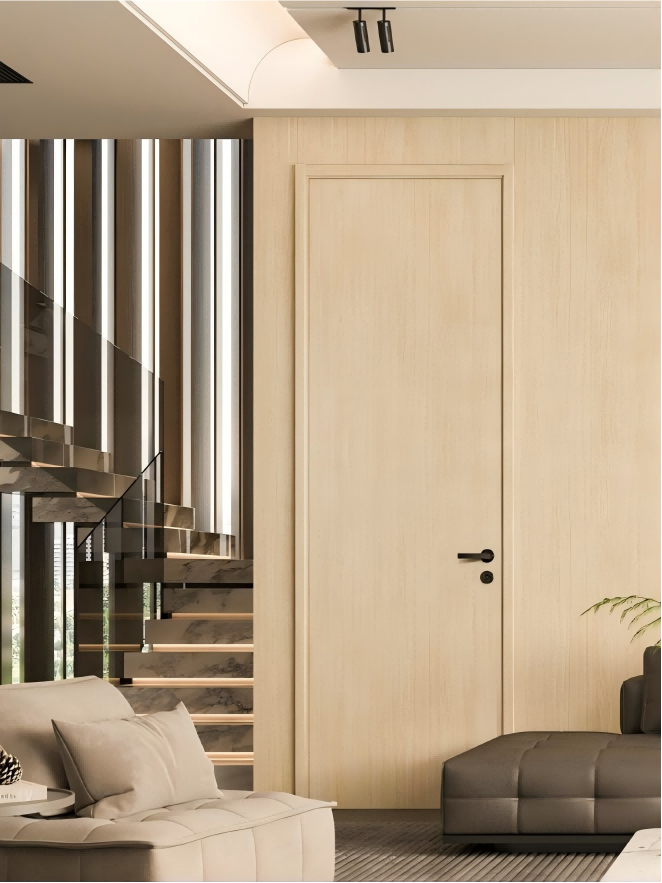
Interior wood grain composite panel feature walls are among the most popular applications in contemporary hospitality, retail, and corporate design. The ability to create large, continuous wood grain surfaces — using composite panels in formats up to 1220 x 4050mm or larger — without the jointing difficulties, tonal variation control challenges, and moisture sensitivity of timber veneer makes wood grain composite an extremely practical alternative for ambitious feature wall projects.
In reception areas specifically, a wood grain composite feature wall creates an immediate impression of quality, warmth, and design intentionality. The surface requires no periodic refinishing, tolerates cleaning, and remains visually consistent throughout the installation’s service life without the patina development that divides opinion in natural timber installations.
6.3 Hospitality, Retail, and Food & Beverage Environments
Hotels, restaurants, bars, retail stores, and showrooms place intense and simultaneous demands on interior finish materials: premium visual quality, high-traffic durability, resistance to spills and cleaning chemicals, and compliance with fire regulations. HPL-faced wood grain composite panels are particularly successful in these environments, delivering the aesthetic premium demanded by hospitality brand standards alongside the durability performance that high-turnover commercial use requires.
In hotel room fit-outs, wood grain composite cladding — typically HPL-faced panels on wardrobes, headboard walls, and bathroom vanities — provides guests with a premium timber aesthetic that remains visually consistent across the 10 to 15-year hotel room refurbishment cycle without requiring intermediate maintenance.
6.4 Office and Corporate Workplace Environments
Corporate offices are increasingly using wood grain composite panels as a deliberate evidence-based design intervention to support occupant wellbeing. Research in environmental psychology consistently demonstrates that organic, biophilic materials — including wood-grain surfaces — reduce cortisol levels, increase perceived spatial quality, and extend the duration of voluntary occupancy. WPC feature walls, wood grain ACP reception surfaces, and HPL-faced collaborative zone cladding are now standard elements in the design vocabulary of forward-thinking workplace developers and corporate occupiers.
6.5 Educational and Healthcare Facilities
Schools, universities, hospitals, and medical centres are increasing specifications of wood grain composite panels as a deliberate environmental design response to published research showing that natural and nature-referencing materials positively impact patient recovery times, reduce anxiety in clinical settings, and improve student engagement and learning outcomes. The fire performance, hygiene, durability, and low maintenance of composite panels address the specific operational requirements of healthcare and educational environments far more effectively than natural timber alternatives, while delivering the biophilic aesthetic benefits the research evidence supports.
7. How to Choose the Right Wood Grain Composite Panel
7.1 Match the Wood Species to Design Intent
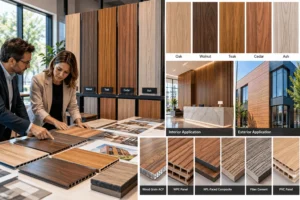
Different timber species communicate distinctly different aesthetic and emotional qualities. Light oak communicates Scandinavian minimalism, contemporary freshness, and casual premium. Dark walnut conveys executive gravitas, heritage, and considered luxury. Teak references tropical premium tradition and durability. Cedar suggests natural warmth and relaxed informality. Pale ash reads as modern and light-filled. Match the wood species effect you specify to the emotional register and brand message the space needs to convey — and always evaluate actual physical material samples in the project’s lighting conditions before committing to a final specification.
7.2 Interior vs. Exterior: Confirm Performance Requirements
Not all wood grain composite panels are appropriate for all applications. Confirm the intended use environment — interior, semi-exterior covered, or fully exterior exposed — before shortlisting products. PVC wood grain composite should not be specified in any exterior or UV-exposed condition. WPC requires product-specific UV treatment confirmation for fully exposed exterior conditions. Wood grain ACP with PVDF coating is the appropriate specification for fully exterior-exposed applications, including high-rise facades, where long-term performance under weathering conditions is required.
7.3 Fire Rating Compliance
Confirm the applicable fire rating requirement for the intended application — both the regulatory standard and the specific classification — before specifying. For exterior cladding on buildings above regulated height thresholds (18 meters in the UK, with similar thresholds in many other jurisdictions), specify ACP with A2-rated mineral fire-resistant core. For interior applications, confirm the relevant fire classification for the specific room type and escape route relationship. A compliance-capable supplier will provide specific third-party fire test certificate documentation referenced to the applicable standard for every product they propose.
7.4 Manage Grain Pattern Repetition at Scale
For large-area installations of 50 square meters or more, request multiple sample panels from the same product batch and evaluate how the grain pattern repeats across adjacent panels. Premium products are designed with extended print repeat lengths — typically 3 to 5 meters or more — that minimize visible pattern repetition. Request specific installation guidance from the supplier on panel rotation, flip, and offset practices that maximize visual randomness across the finished installation. This single installation detail is the most significant factor determining whether a large wood grain composite installation reads as a convincing natural material or reveals its composite nature.
7.5 Request Physical Samples Before Final Specification
Wood grain composite panels must be evaluated in physical sample form — not from digital images or manufacturer catalog photography, which can be manipulated to present idealized appearance — and must be viewed in the actual lighting conditions of the intended installation. Request minimum 600 x 600mm samples from your shortlisted suppliers. Evaluate color rendering under both the project’s natural daylight exposure and the planned artificial lighting specification. Evaluate grain depth and texture under raking light conditions. Request a minimum of two or three adjacent panels from the same batch to assess pattern repetition.
Frequently Asked Questions
What wood species can composite panels realistically replicate?
Modern wood grain composite panels can replicate an extensive range of timber species, including oak (light and dark), walnut, teak, cedar, pine, ash, cherry, maple, mahogany, bamboo, and many others. Leading ACP and HPL manufacturers maintain comprehensive wood grain libraries and can also offer custom wood grain development based on specific species samples provided by the design team. Request a full physical sample catalogue from prospective suppliers to evaluate the visual quality of individual species reproductions rather than relying on digital images.
Will wood grain composite panels fade on exterior building facades?
Wood grain ACP panels with PVDF coating systems are engineered specifically for exterior color and grain stability under weathering conditions. Manufacturer warranties of 15 to 20 years against significant color change or print degradation are standard from reputable suppliers. The PVDF topcoat that protects the wood grain print is the same fluoropolymer coating technology used on standard architectural ACP colors, with a proven track record across a wide range of global climatic conditions. Always request specific PVDF warranty documentation from your supplier before specifying for exterior applications.
Can wood grain composite panels be fabricated and cut to custom sizes on site?
Yes — wood grain ACP and most other wood grain composite types can be cut and fabricated using standard workshop and site tools. Circular saws, jig saws, and CNC routing equipment are all suitable. When planning cuts, the direction and orientation should be considered relative to the grain pattern — cutting across the visible grain direction at panel edges creates a clean termination, while cuts parallel to grain direction benefit from matching edge trim profiles. Request detailed fabrication guidelines and edge treatment specifications from your supplier before commencing cut operations.
How do I maintain and clean wood grain composite panels?
Wood grain composite panels require only periodic cleaning with mild detergent and water to maintain their appearance — no oiling, staining, repainting, or specialist treatment. For exterior applications, an annual wash-down using a soft brush or low-pressure hose is typically sufficient. For interior applications, standard commercial cleaning agents and microfibre cloths are appropriate. Avoid abrasive cleaning agents or mechanical scrubbing pads on printed surfaces. Specific cleaning guidelines vary by panel type and coating system — always confirm cleaning protocol with your supplier to protect the warranty.
Is there a significant cost premium for wood grain vs. standard composite panels?
Wood grain composite panels typically carry a modest price premium over equivalent standard color panels — generally 10 to 30% depending on panel type, grain complexity, and print quality tier. However, this premium is substantially lower than the installed cost of equivalent natural timber veneer or solid timber cladding systems in most commercial applications, particularly when lifecycle maintenance costs are factored into the comparison. On a total cost of ownership basis over a 20 to 25-year building lifecycle, wood grain composite is typically significantly more economical than natural timber in large-scale commercial applications.
Can wood grain composite panels be used in buildings where fire codes restrict combustible materials?
Yes — wood grain ACP with an A2-rated mineral-filled fire-resistant core can be specified for exterior cladding on buildings subject to the most stringent non-combustibility requirements, including high-rise commercial buildings subject to post-Grenfell fire safety legislation in the UK and similar regulatory frameworks in other jurisdictions. This is a significant specification advantage over natural timber, which is combustible and cannot meet Class A fire rating requirements. Always confirm the specific fire classification requirement applicable to your project and request the third-party fire test certificate documenting the panel’s compliance before specifying.
Conclusion: The Wood Aesthetic, Without the Compromises
The question of whether composite panels can mimic natural wood grain has a clear answer: yes, convincingly, and in many practical applications, indistinguishably. The visual quality, tactile realism, species range, and installation flexibility of today’s best wood grain composite panels have reached a level that makes them a genuine design alternative to natural timber — not a compromise, but a choice that often delivers better results across the full set of performance, regulatory, cost, and maintenance criteria that govern commercial construction decisions.
Wood grain aluminum composite panels lead the category for exterior and mixed-use applications, combining authentic timber aesthetics with PVDF coating durability, fire-resistant core options, and lightweight construction. WPC panels deliver the most organically convincing grain variation for premium interior environments. HPL-faced composite panels provide the highest interior visual quality for prestige fit-out contexts. Fiber cement and PVC wood grain panels round out the range for applications where cost is the governing specification criterion.
The wood aesthetic is one of the most emotionally resonant choices an architect or designer can make in a commercial space. It communicates warmth, quality, human scale, and connection to the natural world. Modern composite panel technology means these values are now accessible in any application — exterior or interior, high-rise or low-rise, premium or budget — without accepting any of the traditional compromises of natural timber.
Specify Wood Grain Composite Panels for Your Next Project
Our team specializes in wood grain composite panel supply for commercial, hospitality, and residential projects worldwide. We offer comprehensive species libraries, custom grain development, fire certification documentation, large-format sample dispatch, and full project technical support.
Contact us to request physical samples, technical specifications, or a competitive project quotation.
Our technical sales team responds within 24 hours.