Table of Contents
Here is a question that decides the outcome of every door wall cabinet system project before a single panel is cut: which materials are you building it from? Get the material selection right and you have a wall that looks magnificent on day one and continues looking magnificent on day five thousand. Get it wrong — use the wrong substrate in a humidity-variable environment, specify the wrong finish for a commercial application, pair incompatible materials at a critical joint — and you have a wall that begins announcing its compromises within months. The most beautifully designed door wall cabinet system in the world is only as good as the materials it is made from. That is not a caveat. It is the foundational truth of every project in this category.
If you are specifying, designing, or commissioning a door wall cabinet system — for a luxury residence, a hotel guestroom, a commercial office, or any space where the standard of finish matters — this guide will give you a precise, practical, and complete answer to the material question
Quick Answer
Which Materials Work Best in a Door Wall Cabinet System?
The materials that work best in a door wall cabinet system depend on the application, but the most effective combinations across most projects are: moisture-resistant MDF (MR MDF) for door and panel substrates; aluminum extrusion profiles for the structural frame; two-pack polyurethane lacquer or high-pressure laminate (HPL) for exterior surface finishes; and commercial-grade steel or zinc alloy concealed hinges and hardware. For premium residential and luxury hospitality projects, real wood veneer over MR MDF substrate adds warmth and natural depth while maintaining dimensional stability. The critical principle is that every material in the system must be selected not for how it looks in isolation, but for how it performs alongside every other material in the wall — in the specific environment where the project will live and be used.
Why Material Selection Is the Foundation of Every Design Decision
A door wall cabinet system is many things simultaneously: an architectural statement, a space optimization strategy, a brand expression for a hotel or developer. But before it is any of those things, it is a collection of materials — substrates, frames, finishes, and hardware — that must work together with engineering discipline in a real occupied environment, across many years of daily use.
Material selection determines the answers to every question that matters after the installation team leaves:
- Will the system remain flat and gap-consistent over time, or will it warp and distort?
- Will the surface finish hold its cooler and surface integrity, or fade, chip, and stain?
- Will the hardware operate with consistent performance, or degrade progressively with use?
- Will the joints between adjacent elements remain tight and controlled, or open and reveal their construction?
- Will the system demand attention in year four, or remain pristine through year fourteen?
The visual design of a door wall cabinet system is what attracts clients, wins projects, and fills portfolios. Material specification is what makes that visual design a durable reality — or exposes it as an aspiration the underlying construction cannot sustain.
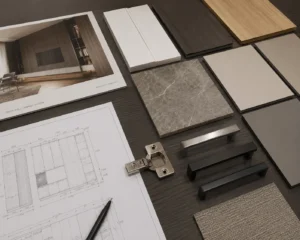
The Four Material Layers in Every Door Wall Cabinet System
Every door wall cabinet system contains four distinct material categories, each with its own performance requirements and selection logic. Understanding these layers is the prerequisite for any coherent material specification.
Layer 1 — The Structural Frame
The frame is the backbone. It holds every other component in position, and its material must deliver the rigidity, dimensional stability, and installation precision necessary to anchor a flat, plumb wall surface across the full room span. Frame material failure — flex, twist, or movement over time — makes perfect alignment impossible to achieve and impossible to maintain.
Layer 2 — Panel and Door Substrates
The substrate is the foundation of every panel face and door leaf. It determines the surface quality of the finished face, the component’s dimensional stability in response to environmental conditions, and its response to moisture and humidity variation. The substrate is invisible in the finished wall — but it determines everything about how the finished surface performs over its working life.
Layer 3 — Surface Finishes
The surface finish is what the eye sees and the hand contacts. It must read visually consistent across all elements in the system, perform durably in the specific application environment, and remain compatible with the substrate beneath it across cycles of temperature and humidity change. In the simplest terms: the finish is the system’s face, and faces are judged constantly and compared mercilessly.
Layer 4 — Hardware
Hardware is the mechanical layer — the hinges, latches, drawer runners, push-to-open mechanisms, and door closers that allow every element to function as designed. Hardware material and specification grade determine whether the system operates beautifully and consistently for ten years or begins to show failure within eighteen months of heavy use.
Deep Dive: Substrate Materials
Moisture-Resistant MDF (MR MDF) — The First-Choice Substrate
Moisture-resistant MDF is the most widely specified and most reliably performing substrate for door and panel faces in a door wall cabinet system. It is the material against which all alternatives are measured.
- What it is: Medium-density fiberboard manufactured with a moisture-resistant resin binder. Identifiable by a green-closured core when cross-cut. Available in thicknesses from 9mm to 30mm; 18mm is standard for door leaves.
- Why it works: Extremely smooth and consistent surface for painted or veneered finishes. Dimensionally stable in normal humidity ranges. CNC-machinable to precise dimensional tolerances. Compatible with all surface finish types: lacquer, laminate, and veneer.
- Where it is specified: Panel faces, door blanks, fill panels, and all exterior-facing surfaces in standard residential, commercial, and hospitality door wall cabinet systems.
- Its limitation: Not suitable for sustained high-humidity environments (bathrooms without ventilation, pool enclosures, coastal properties without climate control). Heavy at full height — hinge selection must account for door leaf mass.
HDF (High-Density Fiberboard) — For Fine Detail and Slim Profiles
High-density fiberboard is manufactured to a greater density than MDF (typically 800–1,000 kg/m³ vs. MDF at 600–800 kg/m³), producing a harder panel with superior edge quality in thin cross-sections.
- Why it is used: Specified for applications requiring fine edge profiling — rebated grooves, slim shaker-style routing, or thin back panels where precise detail at the edge is architecturally important. HDF’s harder surface also performs well for drawer bases and cabinet shelf faces in high-contact applications.
- Its limitation: More expensive than MDF. Less common in large format sheets. Not typically used for full-height door leaves where the cost premium over MR MDF is not justified by performance requirement.
Standard Particleboard (Chipboard) — Used With Discipline
Particleboard is manufactured from wood chips bonded with resin, producing a panel that is less dense and less dimensionally stable than MDF, with a coarser surface that requires additional priming and preparation for painted finishes.
- Its correct role: Cabinet carcass construction (internal box structures that will not be directly finished) where it is faced with a melamine foil. In this application it is cost-effective and entirely appropriate.
- Where it must not be used: Particleboard must never be specified as the substrate for exterior door or panel faces in a door wall cabinet system. Its surface inconsistency, poor moisture response, and inferior CNC edge quality will produce visible quality failure in the finished installation. If a supplier specifies particleboard for door faces, treat it as a significant quality signal.
Plywood — The Structural Alternative
Plywood is engineered from multiple bonded veneer plies in alternating grain directions, producing a panel with high structural strength and excellent screw-holding compared to MDF or particleboard.
- Its role in integrated systems: Heavy-duty structural shelf decks and base structures within cabinet carcasses. Applications where fixings must be inserted and removed repeatedly. Projects where an exposed birch ply edge or face is a deliberate design element.
- Its limitation for face applications: Plywood surface is less consistent than MDF. Grain and void patterns in the face veneer can telegraph through painted finishes, particularly in satin and higher sheens. Rarely the first choice for finished door or panel faces except where the exposed ply aesthetic is intentional.
Deep Dive: Frame Materials
Aluminum Extrusion Profiles — The Default Frame Specification
Aluminum extrusion is the dominant structural frame material for high-quality door wall cabinet systems. Its combination of dimensional precision, structural rigidity, corrosion resistance, and modular profile availability makes it the correct specification for the vast majority of integrated wall projects.
- Dimensional precision: Extruded aluminum profiles are manufactured to tolerances of ±0.1mm on section dimensions — providing a consistently accurate datum for panel and door installation.
- Rigidity-to-weight ratio: Aluminum delivers the structural rigidity needed to hold a flat wall surface across a full room span without adding the mass associated with steel alternatives.
- Corrosion resistance: Aluminum does not corrode in normal interior environments, making it suitable for bathroom-adjacent or humid applications without additional treatment.
- Modular profile design: Specialist aluminum profiles for integrated wall systems incorporate concealed fixing channels, panel retention clips, and integrated shadow-gap reveal geometry — eliminating the need for separate visible fixing hardware.
Structural Steel Profiles — For Large-Format and Heavy-Door Applications
Structural steel (typically hollow section, welded and ground flat) is specified where the span or door weight exceeds what aluminum profiles can reliably support.
- Typical applications: Multi-wall hospitality installations spanning more than 4 meters without intermediate structural support. Heavy pivot door installations where a single door leaf weighs 80–120 kg. Two-story or double-height integrated wall systems.
- Its limitation: Heavier and more complex to work with on site than aluminum. Requires a painted or powder-coated finish to prevent corrosion. Specified only where structural performance demands it.
Deep Dive: Surface Finish Materials
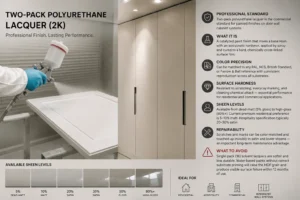
Two-Pack Polyurethane Lacquer (2K) — The Painted Finish Standard
Two-pack polyurethane lacquer is the professional and commercial standard for all painted finishes on door wall cabinet systems. It is the only painted finish type that delivers the color consistency, surface hardness, and long-term durability that integrated wall systems require.
- What it is: A catalyzed paint finish that mixes a base resin with an isocyanate hardener, applied by spray in a controlled factory environment and cured to a hard, chemically cross-linked surface film.
- Cooler precision: Can be matched to any RAL, NCS, British Standard, or Farrow & Ball reference with consistent reproduction across all substrates when correctly applied and batch-controlled.
- Surface hardness: Resistant to scratching, everyday marking, and cleaning chemical attack — essential performance for residential and commercial applications alike.
- Sheen levels: Available from dead-matt (5% gloss) to high-gloss (80%+). Current premium residential preference is 5–10% matt. Hospitality specification typically 20–30% satin for better cleanability.
- Repairability: Scratches and marks can be color-matched and touched up invisibly in satin and lower sheens — an important long-term maintenance advantage.
- What to avoid: Single-pack (1K) solvent lacquers are softer and less durable. Water-based paints without correct substrate priming will raise the MDF grain and produce visible surface failure within 12 months of use.
High-Pressure Laminate (HPL) — The Durable All-Rounder
High-pressure laminate is manufactured by bonding multiple resin-impregnated kraft paper layers under high pressure (typically 70–100 bar), producing a surface panel of exceptional hardness, chemical resistance, and consistency.
- Surface durability: HPL resists impact, abrasion, heat to 180°C, and most professional cleaning chemicals — significantly more durable in surface terms than 2K lacquer in high-traffic environments.
- Cross-substrate consistency: Because HPL is a uniform manufactured material, it reads identically across all substrate types without the cross-testing and batch control that lacquer requires.
- Palette range: Available from manufacturers including Formica, Abet Laminate, Egger, and Pflieger in hundreds of solid colors, wood effects, stone effects, and tactile textures.
- Cost efficiency at scale: For hospitality projects with high room counts, HPL is typically more cost-effective per square meter of panel face than 2K lacquer without sacrificing durability.
- Its limitation: Rigid material — cannot follow curved or tight-radius profiled edges. Large format sheets (over approximately 2,800mm) may require joins. Post-formed or bonded edge treatment required to conceal the visible black core at panel edges.
Real Wood Veneer — Natural Character Over Engineered Stability
Wood veneer is the surface finish of choice when natural material warmth is a design priority and the project specification supports its requirements. No manufactured surface replicates the depth, variation, and living quality of a real timber face.
- What it is: A thin slice of real timber (typically 0.5–0.6mm in natural-face veneers) bonded to a stable MR MDF substrate and sealed with compatible lacquer or UV-cured oil finish.
- Its design value: In a door wall cabinet system finished in a premium veneer — European oak, American walnut, smoked oak, wenge — the wall becomes a material statement that no catalogue finish can replicate.
- Matching requirement: All veneer panels in the system must be produced from consecutive leaves of the same bundle, laid out in sequence and photographed for approval before installation, to ensure consistent grain and figure across the full wall.
- Common species: European Oak (versatile — suits residential, hospitality, and commercial). American Walnut (dark, rich — premium residential). Smoked Oak (contemporary hotel specification). Ash (Nordic aesthetic). Wenge (dramatic, used as accent rather than full-wall specification).
- Key technical requirement: The MDF substrate must be absolutely smooth and defect-free — any surface imperfection telegraphs through the veneer face after sealing. Veneer grain direction must be consistent (vertical) across all panels, doors, and cabinet faces.
Melamine Foil — The Interior Surface Standard
Melamine foil is a resin-impregnated paper finish applied during the panel manufacturing process, producing a cleanable, consistent surface. In a door wall cabinet system, it is the standard specification for all internal cabinet surfaces — wardrobe carcass interiors, shelf decks, and drawer interiors — where it is functional, hygienic, and cost-appropriate.
Melamine foil is not a suitable exterior face finish for a premium integrated system. Its surface read is visibly less refined than lacquer or HPL, its edge is difficult to finish invisibly at the panel perimeter, and its color palette cannot match the design range of manufactured finish alternatives. Its correct role is interior-facing only.
Material Performance Comparison at a Glance
The table below summarizes the key performance attributes of the primary materials used in door wall cabinet systems. Green ratings indicate superior performance; amber indicates moderate; use this as a specification cross-check, not a replacement for project-specific advice.
| Material | Durability | Moisture Res. | Surface Quality | Cost Level | Best Application |
| MR MDF (substrate) | High | Good | Excellent | Medium | All door & panel faces |
| Standard MDF | Medium | Poor | Excellent | Low | Dry interiors only |
| HDF | Very High | Good | Excellent | Medium-High | Fine profiles & edges |
| Plywood | Very High | Medium | Good | Medium-High | Structural carcass |
| Aluminum frame | Very High | Excellent | — | Medium | All frame applications |
| 2K Polyurethane Lacquer | High | Good | Exceptional | Med-High | Residential & hotel |
| High-Pressure Laminate | Very High | Excellent | Excellent | Medium | Commercial & hotel |
| Real Wood Veneer | Medium | Good(sld) | Exceptional | High | Premium & luxury |
| Melamine Foil | Medium | Good | Good | Low | Internal cab surfaces |
Matching Materials to Project Type
The correct material specification is not universal — it is specific to the project environment, performance requirements, and quality standard. Here is how material selection maps to the most common project types.
Premium Residential — specification priority: surface refinement and natural warmth
MR MDF substrates for all door and panel faces. Aluminum frame profiles. Surface finish: real wood veneer in European oak, American walnut, or smoked oak — or 2K polyurethane lacquer in a precisely matched matt color. Hardware: Blum, Hettich, or equivalent named-brand commercial grade with documented cycle ratings. Internal cabinet surfaces in white melamine foil. Result: a wall of architectural distinction that performs across a 12-15 year ownership cycle without requiring significant maintenance.
Mid-Range Residential — specification priority: quality appearance at controlled cost
MR MDF substrates. Aluminum frame profiles. Surface finish: HPL in a coordinated wood-effect or solid color from a recognized manufacturer. Quality European concealed hinges (Blum Clip-top or equivalent). Internal melamine foil on carcass interiors. This specification delivers excellent visual quality and durability at a cost point appropriate for mid-range residential projects, and will not require surface replacement within the normal residential ownership cycle.
Hotel & Hospitality (Mid-scale to Upper Upscale) — specification priority: durability and brand consistency
MR MDF for door substrates. Particleboard carcass interiors faced with melamine. Aluminum frame profiles. Surface finish: HPL in brand-standard color and texture, batch-controlled across all rooms. Concealed hinges rated to 100,000+ opening cycles — non-negotiable for a door opened multiple times per day, 365 days per year. Hardware from Hettich, Grass, or equivalent commercial supplier with documented performance data. Internal melamine in a complementary neutral.
Luxury Hotel & High-End Hospitality — specification priority: brand distinction and material excellence
MR MDF substrates throughout. Aluminum or structural steel frame depending on door weight. Surface finish: real wood veneer in a specified species, or custom 2K lacquer in a proprietary color. Hardware: premium European pivot hinges (FritsJurgens, Simonswerk Tectus) or equivalent, in a specified metal finish (brushed brass, anodized black, brushed nickel). Every material selection is a brand statement at this level — specification must be documented and controlled to ensure consistency across all rooms and all properties.
Commercial Office — specification priority: durability, cleanliness, consistency
MR MDF or aluminum composite substrates for door faces. Aluminum frame. HPL surface finish in a neutral corporate palette — simple, timeless, and low-maintenance. Office-grade concealed hardware with soft-close specification. Internal melamine foil. This combination delivers consistent appearance across multiple installations in a portfolio, easy cleaning, and a long maintenance-free period appropriate for commercial lease terms.
High-Humidity Environments (Bathroom-Adjacent, Coastal, Pool Areas) — specification priority: moisture performance throughout
HMR (high moisture resistant) MDF for all substrate applications. Aluminum frame only — no steel without marine-grade coating. HPL or 2K lacquer surface finish with all cut edges sealed with waterproof edge banding or edge lacquer. Hardware: grade 316 stainless steel or marine-grade zinc alloy — standard steel hardware will corrode and seize in a sustained moisture environment. Internal carcass: moisture-resistant particleboard faced with moisture-resistant melamine foil.
The Five Most Common Material Mistakes — And How to Avoid Them
Mistake 1: Standard MDF in a Humidity-Variable Environment
Standard MDF is not moisture-resistant. In a bathroom-adjacent wardrobe, a coastal property without consistent climate control, or any room with regular humidity swings, standard MDF absorbs moisture, swells, and causes door and panel faces to bow, distort, and develop cracking in the surface finish. The correction is simple but must be made at the specification stage: always specify MR MDF as the minimum substrate grade, and HMR (high moisture resistant) for any application within two metros of a water source or in an environment with regularly elevated humidity.
Mistake 2: Mismatching Sheen Level to Surface Preparation Quality
A high-gloss or even mid-gloss 2K lacquer finish applied to a substrate with even minor surface preparation deficiencies will magnify every imperfection — sanding scratches, filler marks, grain raise — in a way that the same deficiency at a lower sheen would conceal entirely. The correct sequence for a gloss finish on MDF is: prime, sand to 180 grit minimum, seal, sand, then apply topcoat. Every stage is mandatory. Skipping any stage is the single most common cause of a beautifully specified finish delivering an immediately disappointing result on installation.
Mistake 3: Furniture-Grade Hardware on Commercial-Weight Door Leaves
A full-height door leaf in 18mm MR MDF at 2,400mm × 900mm weighs approximately 35–40 kg before any additional mass from acoustic or fire-rated cores. Kitchen furniture hinges are typically rated for 15–25 kg. Specifying furniture-grade hardware on a door of this weight will produce hinge sag and door misalignment within months of regular use — and the progressive misalignment will widen every gap in the system incrementally. The correct approach: calculate door leaf weight precisely, specify hinges with a rated load exceeding the calculated weight by at least 20%, and confirm the cycle rating matches the frequency of use.
Mistake 4: Inconsistent Finish Sources for Adjacent Elements
When the room door is lacquered by one finishing contractor and the adjacent cabinet doors by another — even when both quote the same RAL reference — the risk of visible color variance between them is significant. Formulation, application conditions, substrate preparation, and batch variation all contribute to color shift. In a truly integrated system, all exterior surface finishing must be carried out by a single finishing operation using the same batch of materials, applied in the same conditions. This requirement must be written into the specification and confirmed with the supplier before manufacturing begins.
Mistake 5: Specifying HPL on Curved or Tightly Profiled Edges
HPL is a rigid material. Attempting to post-form it around a tight-radius edge profile will produce cracking or delamination at the bend — and because the failure is at the most visible part of the panel (its edge), the effect is immediately obvious. If the system design includes curved panel edges, rebated reveal profiles, or any feature requiring the surface material to follow a compound form, specify 2K lacquer — which follows any substrate profile without constraint — rather than HPL. If HPL is required for durability reasons, design the edge detail to accommodate its rigidity, not the other way around.
Sustainability and Material Certification
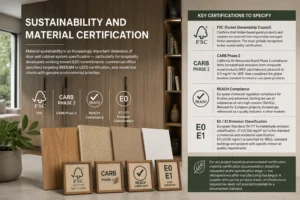
Material sustainability is an increasingly important dimension of door wall cabinet system specification — particularly for hospitality developers working toward ESG commitments, commercial office specifiers targeting BREEAM or LEED certification, and residential clients with genuine environmental priorities.
Key Certifications to Specify
- FSC (Forest Stewardship Council): Confirms that timber-based panel products and veneers are sourced from responsibly managed forest operations. The most globally recognized timber sustainability certification. Specify FSC-certified MDF, veneer, and plywood as the standard for any project with environmental credentials.
- CARB Phase 2: California Air Resources Board Phase 2 compliance limits formaldehyde emissions from composite wood products (MDF, particleboard, plywood) to 0.11 mg/m³ for MDF. Now considered the global baseline standard for interior-use panel products regardless of project location.
- REACH Compliance: European chemicals regulation compliance for finishes and adhesives, limiting the use of substances of very high concern (SVHCs). Relevant for European projects; increasingly referenced as a quality indicator in other markets.
- E0 / E1 Emission Classification: European Standard EN 717 formaldehyde emission classification. E1 (≤0.124 mg/m³ air) is the standard commercial and residential specification. E0 (≤0.05 mg/m³) is specified for WELL-standard buildings and projects with specific indoor air quality requirements.
For any project targeting environmental certification, material certification documentation should be requested at the specification stage — not retrospectively after manufacturing has begun. A supplier who cannot produce these certifications on request has likely not sourced materials to a documented standard.
Questions to Ask Your Supplier About Material Specification
Before committing to a supplier for a door wall cabinet system project, these material-specific questions will reveal the depth — or absence — of their specification knowledge. Experienced suppliers will answer every one without hesitation and with supporting documentation.
What grade of MDF do you use for door and panel faces — standard, MR, or HMR?
The answer should be MR as a minimum for any occupied building. If the answer is ‘standard MDF’ without specific justification for a dry, climate-controlled environment, treat it as a quality signal. HMR should be specified for any application near moisture sources.
What is the cycle rating of the hinges you are specifying for this specific door weight?
A supplier who cannot state the door leaf weight and quote the hinge cycle rating against it has not completed the hardware specification. The cycle rating must match or exceed the use frequency: 50,000+ for residential, 100,000+ for hospitality.
Do your panel materials carry CARB Phase 2 and FSC certification?
A supplier routinely working on commercial or hospitality projects should answer immediately and provide documentation. Inability to answer confidently indicates materials are not being sourced to a documented environmental standard.
Are all exterior surfaces finished by the same finishing operation, using batch-controlled materials?
The answer should confirm a single finishing source. If room doors and cabinet doors are being finished by different contractors or at different times without batch control, colour variance between adjacent elements is likely.
Can I see a sample of the specified finish on the actual substrate — not a manufacturer’s laminate card?
Manufacturer sample cards show the finish in ideal conditions on a standard substrate. A sample of the actual finish on the actual substrate reveals the real result, including colour, sheen level, and surface quality. Any supplier confident in their specification will produce this sample readily.
Frequently Asked Questions
Is MDF suitable for full floor-to-ceiling door panels?
Yes — MR MDF in 18mm thickness is the standard substrate for full-height door panels to 2,700mm. For panels above this height, the substrate thickness should increase to 22–25mm to maintain rigidity, and the hinge specification must be reviewed against the increased door leaf weight. Any door leaf exceeding 40 kg should be assessed for pivot door hardware as an alternative to conventional hung hinges.
Can veneer be applied to every element of a door wall cabinet system?
Yes. Veneer can be applied to every visible exterior surface — door faces, fill panels, frame reveals, and cabinet fronts. The critical requirement is that all veneer panels are produced from consecutive leaves of the same bundle, sequenced for consistent grain and figure matching across the full wall installation. This matching is carried out in the factory, with panels laid out in installation order and photographed for client approval before shipping.
Which is more durable over time — HPL or 2K lacquer?
HPL has superior surface hardness and resistance to abrasion, impact, heat, and cleaning chemicals compared to 2K lacquer in any sheen. It is the more durable surface in terms of physical resilience. However, 2K lacquer offers greater design flexibility (it can follow any edge profile, is available in any mixed color, and can be repaired invisibly in satin and lower sheens), and achieves a surface refinement in very low-sheen matt finishes that current HPL products cannot replicate. The specification choice is determined by the project’s durability requirements and aesthetic priorities — not a binary ‘better or worse’ judgement.
How do I specify hardware for a heavy room entry door in an integrated system?
Calculate the door leaf weight precisely: width (m) × height (m) × thickness (m) × material density (kg/m³). For 18mm MR MDF, density is approximately 750 kg/m³. From this weight, specify a concealed hinge with a documented maximum load rating exceeding the calculated weight by at least 20% safety margin. For very heavy doors (over 50 kg), evaluate pivot door systems (FritsJurgens, Simonswerk) which distribute the door weight across floor and ceiling pivot points rather than the door frame.
Can the same material specification be used in a humid or tropical climate?
Standard MR MDF must be upgraded to HMR (high moisture resistant) grade for tropical or coastal environments with consistently elevated humidity. Steel frame elements must be replaced with aluminum or confirmed marine-grade coated steel. Hardware must be specified as marine-grade or grade 316 stainless steel — standard zinc alloy hardware will corrode within months in a sustained humid environment. HPL and 2K lacquer surface finishes remain appropriate but require careful attention to edge sealing on all cut panel edges.
What is the correct thickness for door panels in a high-quality integrated system?
The standard specification is 18mm MR MDF for door leaves up to 2,400mm height. For doors between 2,400mm and 2,800mm, 22mm is the recommended specification. Above 2,800mm, 25mm or a composite core (MDF with a solid timber stiffening batten at the hinge and latch positions) should be considered. Panel thickness directly affects the weight calculation for hardware specification and the rigidity of the door leaf in operation — specifying too thin a substrate for a tall door will produce visible flex in the panel when operated.
How long should a correctly specified door wall cabinet system last before requiring material replacement?
A system specified to the standards described in this article — MR MDF substrates, aluminum frame, 2K lacquer or HPL surface finish, and commercial-grade hardware — should require no significant material replacement for 12 to 15 years under normal residential use, and 8 to 12 years in a high-occupancy commercial or hospitality environment. Individual hardware components (soft-close dampers, push-to-open mechanisms) may require replacement after 7 to 10 years of heavy daily use; all other elements should remain fully functional and visually correct for the full period.
Specify the Right Materials for Your Project — Talk to Our Team
Material selection in a door wall cabinet system is not a secondary specification decision — it is the decision that determines whether the system performs as designed through its full working life, or begins to reveal its compromises within the first few years. Every substrate, every finish, every hardware choice is a commitment that the project will live with long after the installation team has left.
Getting it right requires a supplier who understands material performance, not just material appearance — one who can recommend the correct specification for the specific environment, advise on compatibility between adjacent materials, quantify hardware requirements against actual door weights, and provide the certification documentation that confirms every material meets the required standard.
We manufacture door wall cabinet systems specified to the exact material requirements of each project — residential, commercial, or hospitality, at any scale. Our specification team works directly with architects, interior designers, and developers to select the right substrate, the right finish, and the right hardware for each application. Every recommendation is backed by technical data, not just preference.
🌿 Request a Material Specification Consultation & Project Quote
Share your project environment, design brief, or reference images — we will respond within 24 hours with a tailored material recommendation and indicative project pricing.