Table of Contents
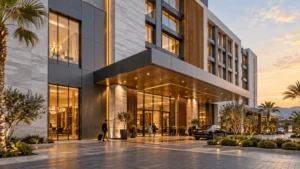
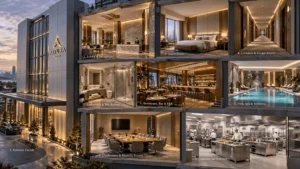
A hotel is not one building — it is nine or ten different environments stacked inside one structure, each with its own performance demands, aesthetic standards, and regulatory requirements. The facade must project brand identity under full weather exposure for 20-plus years. The lobby must make a statement that justifies room rates, resist 24/7 foot traffic, and meet fire safety codes. Guest room walls must look premium across a decade of constant occupancy. Corridor cladding must survive housekeeping trolleys, luggage impacts, and repeated chemical cleaning without showing wear. Bathrooms need moisture-proof surfaces. Kitchens need food-safe hygienic walls. Get any one of these specifications wrong and you either face costly remediation, a compliance failure, or a guest experience that doesn’t deliver what the brand promises. Composite panels can solve all of these challenges — but only if you specify the right type for each zone. This guide tells you exactly which panels work where, and why.
Quick Answer — Best Composite Panels by Hotel Zone
The best composite panel for a hotel depends entirely on where it is being used. Aluminum Composite Panels (ACP) with PVDF coating and fire-resistant mineral core are the definitive choice for hotel exterior facades: lightweight, Class A fire-rated, weather-resistant for 20 to 25 years, and available in any brand color. For hotel lobbies and reception areas, ACP (metallic or stone-effect), HPL-faced composite (premium scratch-resistant surfaces), and WPC (genuine wood warmth for luxury boutique properties) are all strong choices depending on the aesthetic brief. Guest room feature walls and furniture surrounds are best served by HPL-faced composite panels, which provide the surface durability needed to withstand years of daily housekeeping cleaning. Hotel corridors require high-impact, fire-rated panels — ACP with FR core or HPL composite are the top choices. Bathrooms and wet areas require moisture-proof FRP panels. Commercial kitchens require FRP panels exclusively for food safety compliance. Restaurant, bar, and wellness areas call for WPC (natural warmth) or HPL composite (premium surface). The single most important principle for hotel panel specification is matching the right composite technology to each specific zone rather than applying one material throughout.
1. Why Hotels Demand More From Composite Panels Than Any Other Building Type
Commercial offices close at 7pm. Retail stores shut on Sunday. But hotels never stop. Every surface in a hotel — from the entrance canopy to the kitchen wall — is in continuous use, cleaned multiple times daily, and expected to present perfectly to guests arriving at any hour. This intensity of use places demands on wall and facade materials that most other building types never generate.
Hotels also operate under a more complex regulatory framework than most commercial buildings. Fire safety regulations for hotels are among the most stringent in the built environment — because hotels house sleeping occupants who may be unfamiliar with the building layout and have limited time to evacuate in an emergency. Material specifications in hotel escape routes, corridors, stairwells, and public areas must meet strict fire performance classifications, and these requirements apply to cladding panels just as much as to structural elements.
Beyond performance and compliance, hotels have brand standards. International hotel operators — Marriott, Hilton, IHG, Accor, Hyatt, and their many sub-brands — maintain detailed interior design and material specification standards that govern every customer-facing surface. These standards define color palettes, finish types, quality thresholds, and approved material categories. A hotel developer or designer working with these brands cannot simply specify the cheapest available panel and expect brand approval — they must specify materials that meet the brand’s performance and aesthetic standards while also meeting local building regulations.
Finally, hotels operate in refurbishment cycles that directly affect specification decisions. Guest rooms are typically refurbished every 8 to 12 years; public areas every 10 to 15 years; exteriors every 20 to 25 years. A panel specification that requires repainting every 5 years generates cost and operational disruption within a single refurbishment cycle — an unacceptable lifecycle performance for a professionally managed hotel asset. Composite panels’ low-maintenance, long-lifespan characteristics make them inherently well-suited to hotel economics.
2. The Composite Panel Types Used in Hotel Projects
Five composite panel types are regularly specified in hotel construction and refurbishment projects. Understanding each one’s strengths is the foundation of zone-by-zone specification.
2.1 Aluminum Composite Panels (ACP)
Two thin aluminum face sheets permanently bonded to a polyethylene or mineral-filled fire-resistant core. Typically 3 to 6mm total thickness, weighing 4 to 8 kg/m². Available in virtually unlimited colors and finishes including solid colors, metallic effects, brushed aluminum, stone-effect, and woodgrain prints. PVDF coating provides 20 to 25-year exterior color retention. Fire-resistant mineral core achieves Class A (A2) fire performance for exterior cladding compliance on mid- and high-rise hotels. The dominant composite panel type in hotel exterior and interior commercial applications worldwide.
2.2 Wood Plastic Composite (WPC)
Genuine wood or bamboo fiber (40 to 70% by weight) blended with thermoplastic polymers. Provides an organic, natural woodgrain appearance and tactile warmth that no other composite type can replicate because it contains real wood fiber. Moisture-resistant and dimensionally stable — superior to natural timber in humidity environments. No painting or recoating required. Suitable for interior feature walls, restaurant and bar cladding, lobby warmth elements, and covered exterior terrace applications. Cannot achieve Class A fire rating; primarily an interior and sheltered specification.
2.3 HPL-Faced Composite Panels
High-pressure laminate face sheet — manufactured by pressing resin-impregnated papers under high temperature and pressure — applied to a structural composite core. Delivers an extremely hard, scratch-resistant surface with outstanding visual resolution for woodgrain, stone-effect, solid-color, and metallic finishes. The interior designer’s composite of choice for guest room wall cladding, wardrobe surrounds, headboard feature panels, and any surface subject to repeated daily contact and cleaning. Available in large-format sheets with excellent batch-to-batch color consistency.
2.4 Fiberglass Reinforced Panels (FRP)
Glass fiber strands embedded in thermoset polyester or vinyl ester resin. Creates a smooth, nonporous surface with exceptional impact, moisture, and chemical resistance. FRP is the mandatory specification for hotel commercial kitchen walls (food safety compliance) and the optimal choice for bathroom and wet area cladding (moisture impermeability) and pool and spa environments (chemical resistance). Its surface is completely nonporous, resists bacterial colonization, and tolerates high-pressure washing and aggressive cleaning chemicals without degradation.
2.5 Aluminum Honeycomb Panels
Hexagonal aluminum honeycomb core bonded between aluminum face sheets, creating panels with extraordinary rigidity-to-weight ratios and perfect large-format flatness. Used in premium hotel lobby ceiling systems, prestige feature wall installations, and high-specification exterior curtain wall panels where zero oil-canning (surface deformation) and maximum visual precision are required. The specification choice for five-star and luxury properties where the highest standards of panel flatness and visual quality are expected, and where the project economics justify the premium cost of honeycomb construction.
3. Best Composite Panel by Hotel Zone — A Complete Specification Guide
The following zone-by-zone guide maps the specific performance requirements of each hotel area to the optimal composite panel specification, with reasoning for each recommendation.
| Zone 1: Exterior Facade → Recommended: ACP (FR mineral core, PVDF coating) The hotel facade is the brand’s most public physical statement, visible from the street before a guest arrives. ACP with PVDF coating delivers brand-accurate color matching, weather resistance for 20–25 years, and Class A (A2) fire performance through a mineral-filled fire-resistant core — a regulatory requirement for exterior cladding on mid- and high-rise hotels in most jurisdictions. ACP’s lightweight construction at 4–8 kg/m² simplifies structural engineering and enables large panel formats that give facades a clean, unjointed appearance. Aluminum honeycomb panels are the premium alternative for five-star hotels where large-format perfect flatness is the design priority. |
| Zone 2: Lobby & Reception → Recommended: ACP (metallic/stone-effect) + WPC or HPL (luxury tier) The lobby is the first interior experience — and the moment the guest forms their quality perception. For standard four-star hotels, ACP in premium metallic or stone-effect finishes creates impressive feature walls and column covers with Class A fire compliance, easy maintenance, and design flexibility. For luxury boutique and five-star properties, WPC delivers the genuine natural warmth and organic depth that guests at that price point recognize as authentic luxury. HPL composite panels provide the highest visual resolution for woodgrain and stone-effect surfaces in the premium tier, with superior scratch resistance for high-traffic lobby environments. |
| Zone 3: Guest Room Feature Walls & Headboards → Recommended: HPL-faced Composite Panels Guest rooms require wall finishes that look premium on check-in and maintain that appearance across thousands of housekeeping cleanings over 8 to 12 years. HPL-faced composite panels are the specification of choice for guest room feature walls, headboard surrounds, wardrobe cladding, and bedhead panels. The HPL surface is hard, scratch-resistant, and easily cleaned with standard housekeeping agents without losing its finish quality. Consistent batch-to-batch color means replacement panels for damaged areas match the existing installation without visible color deviation. WPC is the choice for boutique luxury rooms where natural wood warmth is integral to the room’s character at the premium rate. |
| Zone 4: Corridors & Escape Routes → Recommended: ACP (FR core) or HPL Composite Hotel corridors are simultaneously the highest-traffic areas in the building and the most fire-safety-critical spaces — as primary escape routes, they must be lined with materials that meet the most stringent fire classifications mandated by building regulations. ACP with mineral-filled FR core achieves Class A (A2) fire performance, making it the compliant choice for corridor wall cladding in mid- and high-rise hotels where regulations mandate non-combustible or limited-combustibility materials in escape routes. HPL composite panels meet Class A requirements in appropriate formulations and add the scratch resistance and easy cleaning performance that corridor traffic demands. Both require no repainting throughout the refurbishment cycle. |
| Zone 5: Bathrooms, Wet Rooms & Shower Areas → Recommended: FRP Panels Hotel bathrooms combine sustained moisture exposure, frequent cleaning with aggressive agents, and the guest expectation of hygienic cleanliness that is foundational to hotel quality perception. FRP is the definitive specification for wet area walls: completely moisture-impervious, nonporous, resistant to mold and bacterial growth, and tolerant of all standard cleaning agents including bleach-based disinfectants. FRP panels can be installed directly to bathroom wall substrates without a tile bed, significantly simplifying the bathroom construction program and eliminating the grout lines that trap moisture and bacteria in traditional tiled bathrooms. Specialist moisture-resistant WPC can be considered for dry bathroom feature walls adjacent to shower enclosures in luxury suites. |
| Zone 6: Restaurant, Bar & F&B Areas → Recommended: WPC (warmth) or HPL Composite (premium) Hotel restaurants and bars must create an environment that attracts both hotel guests and external diners — the commercial success of the F&B operation directly impacts hotel revenue and guest satisfaction scores. WPC panel feature walls deliver the natural warmth and organic depth that defines premium casual dining and boutique bar environments, communicating quality without formality. HPL composite panels provide the premium visual resolution and surface durability required for fine dining environments where brand standards demand perfection. ACP with stone-effect or metallic finishes is appropriate for contemporary or design-led F&B concepts where the aesthetic is more architectural than organic. |
| Zone 7: Pool, Spa & Wellness Areas → Recommended: FRP Panels (primary) or Marine-Grade ACP Pool and spa environments are the most chemically aggressive spaces in a hotel building. Chlorinated pool water, humidity levels that cycle between saturation and dry conditions, and cleaning programs involving specialist pool chemicals all degrade conventional wall materials rapidly. FRP is the primary specification for pool hall wall cladding: completely moisture-proof, resistant to chlorine and pool chemicals, easily cleaned, and available in smooth-surface formats that resist biological growth in humid conditions. Marine-grade ACP with additional protective coatings can be specified for feature wall panels above the waterline in premium pool areas where a more architectural visual statement is required. Standard ACP or WPC without specialist chemical-resistance treatment should not be specified for primary pool environment surfaces. |
| Zone 8: Conference & Meeting Rooms → Recommended: HPL Composite or ACP Conference and meeting rooms host both hotel guests and external corporate events — they are revenue-generating spaces that must project professionalism, flexibility, and quality. HPL composite panels deliver the premium surface quality and acoustic contribution (through appropriate panel-and-substrate specification) that meeting room environments require. ACP with brushed metallic or solid-color finishes creates a contemporary corporate aesthetic appropriate for business hotels and MICE-focused properties. Both materials tolerate the full range of AV mounting, fixings, and cabling penetrations that modern meeting room technology requires, and both maintain their appearance across the 10 to 15-year public area refurbishment cycle without repainting. |
| Zone 9: Commercial Kitchen & Food Preparation Areas → Recommended: FRP Panels — Mandatory Hotel commercial kitchens are subject to food safety regulations that govern the materials permitted on wall surfaces in food preparation and cooking areas. These regulations typically require walls to be smooth, nonporous, impervious to moisture and grease, resistant to cleaning chemicals, and free from materials that could harbor bacteria or contaminate food. FRP is the composite panel that fulfills all of these requirements: its glass fiber and resin matrix is completely nonporous, its surface is smooth and easily washed down with commercial kitchen cleaning agents, and it tolerates the steam, grease, and temperature cycling of a busy hotel kitchen without degradation. No other composite panel type is appropriate for direct food preparation area wall application. |
4. Hotel Zone Composite Panel Suitability — At a Glance
The suitability table below summarizes the recommended composite panel type for each hotel zone, enabling rapid cross-reference during the specification process. Ratings reflect suitability for the zone’s primary performance requirements.
| Hotel Zone | ACP | WPC | HPL Composite | FRP |
| Exterior Facade | ★★★★★ Best | ★★ Limited | ★ Not suited | ★ Not suited |
| Lobby / Reception | ★★★★ Excellent | ★★★★★ Best (luxury) | ★★★★★ Best (premium) | ★★ Hygiene wall only |
| Guestroom Feature Wall | ★★★ Good | ★★★★ Excellent | ★★★★★ Best | ★ Not suited |
| Corridors / Escape | ★★★★★ Best (FR core) | ★★ Limited (fire) | ★★★★ Excellent | ★★★ Good |
| Bathrooms / Wet Areas | ★★★ Good | ★★★ Good (covered) | ★★ Limited | ★★★★★ Best |
| Restaurant / Bar | ★★★★ Excellent | ★★★★★ Best | ★★★★★ Best | ★★ Hygiene only |
| Pool / Spa / Wellness | ★★★ Good | ★★★ Good (covered) | ★★ Limited | ★★★★★ Best |
| Conference / Meeting | ★★★★ Excellent | ★★★★ Excellent | ★★★★★ Best | ★★ Hygiene only |
| Commercial Kitchen | ★★ Limited | ★ Not suited | ★ Not suited | ★★★★★ Best |
Rating key: ★★★★★ Best choice ★★★★ Excellent ★★★ Good ★★ Limited suitability ★ Not recommended for primary use in this zone. Always confirm fire rating compliance for the specific jurisdiction before finalizing specification.
5. Fire Safety Requirements for Hotel Composite Panel Specification
Fire safety is not a secondary consideration in hotel panel specification — it is the governing requirement that shapes every other decision. Hotels house sleeping occupants who may be disoriented in an emergency, unfamiliar with the building layout, and dependent on the building’s passive fire protection systems to give them the time to evacuate safely. Building regulations in most jurisdictions reflect this elevated risk with fire performance requirements for hotel materials that are among the most stringent in the built environment.
5.1 The Key Fire Classifications for Hotel Panels
- Class A (A2-rated) non-combustibility — Required for exterior cladding on hotels above regulated height thresholds (18 meters in the UK and equivalent thresholds in European, Middle Eastern, and increasingly North American jurisdictions). ACP with mineral-filled FR core is the only standard composite panel type that achieves this classification. Essential for exterior facades and recommended for all escape route cladding.
- Class B — s2, d0 or better — Required for interior wall finishes in many hotel escape routes and high-occupancy public areas. ACP with FR core and Class B-rated HPL composite panels typically meet this threshold. Verify specific product test certification for the exact application condition.
- Class C — May be acceptable for some hotel interior spaces in non-escape-route locations depending on jurisdiction. Standard PE-core ACP, some WPC formulations with FR additives, and standard FRP typically achieve Class C or better.
- Class D (standard WPC and standard PE-core ACP) — Not acceptable for escape routes, public areas, or exterior cladding on regulated-height buildings. Confirm fire classification for every product before specifying in any hotel application.
5.2 Practical Fire Specification Rules for Hotel Projects
Non-Negotiable Fire Specification Rules for Hotels
- Exterior cladding on hotels above 11 meters (or local equivalent threshold): specify ACP with A2-rated mineral FR core only. No exceptions.
- Escape routes, corridors, and stairwells: specify ACP with FR core or certified Class B-rated HPL composite. Confirm third-party EN 13501-1 test certificate for the exact product, thickness, and substrate combination.
- Guest rooms: Class B or C typically acceptable in non-escape-route areas depending on jurisdiction — confirm with the fire engineer.
- Wet areas (bathrooms, kitchens): FRP fire classification is typically acceptable for non-escape-route applications — confirm with the fire engineer.
- Always obtain project-specific fire engineering confirmation before finalizing any specification.

6. How Hotel Brand Standards Influence Composite Panel Specification
For managed hotels operating under international brand flags, composite panel specification is not a fully open choice — it is constrained by the brand’s design and technical standards, which define acceptable materials, minimum quality thresholds, approved finish categories, and sometimes approved supplier lists.
6.1 What Brand Standards Typically Govern
- Color palette alignment — Many hotel brands define specific color references for lobby, corridor, and facade finishes. ACP’s PVDF color-matching capability — including custom RAL, NCS, and Pantone matching — is a critical advantage in brand-standard contexts, as it allows precise color reproduction across large panel areas with guaranteed consistency.
- Finish quality thresholds — Premium brands typically specify minimum surface quality parameters: gloss levels, color tolerance under specified lighting conditions, and consistency across multiple panels in the same installation. Specifying from a manufacturer whose production quality control processes can meet these tolerances consistently is as important as the material selection itself.
- Fire performance documentation requirements — Brand technical standards typically require specific fire test certification documentation to be submitted for approval before materials are ordered. Ensure your panel supplier can provide test certificates in the exact format required by the brand’s technical team.
- Material durability expectations — Premium brands specify minimum service life expectations before refinishing is required. Confirming that your composite panel specification meets these longevity thresholds — with supporting accelerated weathering or wear test data — is an important step in the brand approval process.
6.2 Working With Brand Technical Teams
Engage the brand’s technical or design services team early in the specification process — ideally at concept design stage rather than at the pre-construction technical review. Brands can often advise on previously approved composite panel products and suppliers within their portfolio, which reduces specification risk and approval timelines. Where a new product or supplier is being proposed for the first time, allow adequate time for the brand’s review and approval process — typically 4 to 8 weeks — before committing to procurement.
7. How to Evaluate a Composite Panel Supplier for Hotel Projects
Hotel projects are long-term investments with complex multi-stakeholder approval processes, brand standards to satisfy, and fire safety documentation requirements that cannot be navigated with generic supplier relationships. Selecting the right composite panel supplier for a hotel project requires a structured evaluation against criteria that go well beyond price per m².
| Evaluation Criterion | What to Confirm from the Supplier |
| Fire certification documentation | Third-party EN 13501-1 or equivalent fire test certificates covering the exact product specification you require, not a similar product |
| Brand-standard color matching | Confirmed ability to match RAL, NCS, or custom Pantone references with PVDF coating consistency across all panels in the order |
| Hotel-specific project references | Documented experience on comparable hotel projects — exterior cladding, room refurbishments, lobby features — with contact references available |
| Large-format sample dispatch | Ability to dispatch minimum 600×600mm physical samples of all specified finishes within 5 business days for board approval |
| BIM/CAD documentation | Full BIM object library and CAD product profiles available for integration into project documentation |
| Lead time and phased delivery | Confirmed production lead times and ability to support phased delivery schedules aligned to hotel construction or refurbishment programs |
| Warranty documentation | Written product and coating warranty — minimum 10 years for interior, 20 years for exterior PVDF-coated ACP — issued by the manufacturer |
| After-sales support | Named technical contact and confirmed process for warranty claims, replacement panel supply, and color-match for future repairs |
The most significant supplier risk in hotel projects is color consistency across multiple order batches — particularly for corridor cladding systems where panels from different production runs must match precisely. Always specify the same production batch for panels that will be installed in adjacent visual fields, and retain a proportion of the original batch as a reference standard for future repair and replacement work within the refurbishment cycle.
8. Frequently Asked Questions
What composite panel is best for hotel exterior facades?
Aluminum Composite Panel (ACP) with a mineral-filled fire-resistant core and PVDF coating system is the definitive choice for hotel exterior facades. The FR mineral core provides Class A (A2-rated) fire performance that meets exterior cladding regulations for mid- and high-rise hotels in most jurisdictions. PVDF coating delivers 20 to 25-year color retention without repainting. ACP’s lightweight construction (4 to 8 kg/m²) simplifies structural engineering and enables the large-format clean-panel-line facade aesthetics that characterize contemporary hotel architecture. For landmark five-star hotels requiring perfect large-format flatness, aluminum honeycomb panels are the premium alternative.
Can composite panels be used in hotel bathrooms?
Yes — with the right panel type, composite panels are an excellent choice for hotel bathrooms and significantly outperform MDF and other wood-based panels in wet area conditions. FRP (Fiberglass Reinforced Panel) is the primary recommendation: its completely nonporous, moisture-proof surface tolerates sustained wet conditions, cleaning chemicals, and high-humidity cycling without swelling, delaminating, or supporting bacterial growth. FRP eliminates grout lines, reducing the bacterial contamination risk associated with traditionally tiled bathroom walls, and simplifies the bathroom construction program by eliminating the tile-bed requirement. Moisture-resistant WPC can be considered for dry decorative elements in luxury suite bathrooms.
What panels comply with hotel fire safety regulations for corridors?
Hotel corridors, as primary escape routes, typically require the highest fire performance classification specified for interior wall finishes in any hotel application. ACP with A2-rated mineral-filled fire-resistant core achieves Class A fire performance and is the appropriate specification for escape route corridor cladding on mid- and high-rise hotels where regulations mandate non-combustibility. HPL-faced composite panels in fire-rated formulations can achieve Class B-s2,d0 or better in specific product configurations. Always confirm the specific fire performance classification required by the local authority having jurisdiction and the fire engineer, and obtain the relevant EN 13501-1 or equivalent third-party test certificate for the exact product before specifying.
How do I match composite panel colors to hotel brand standards?
Matching composite panel colors to hotel brand standards requires a supplier with the PVDF color-matching capability to produce panels in custom Pantone, RAL, or NCS references with consistency across multiple production batches. Request confirmed color tolerance specifications — typically measured against the Delta E (dE) color difference standard — from prospective suppliers, and specify a maximum acceptable dE value in your procurement documentation. Order a production sample batch for brand technical team approval before committing to full production. Retain reference panels from the approved production batch for use as color-matching standards on future repair and replacement orders.
Are composite panels suitable for five-star luxury hotel projects?
Absolutely — many of the world’s leading luxury hotels specify composite panels for both exterior and interior applications. At the five-star level, the key is selecting the highest-specification product within each composite type: aluminum honeycomb panels for exterior facades and lobby ceiling systems where perfect flatness is mandatory; premium HPL-faced composite with fine woodgrain or natural stone reproductions for guest room feature walls; full-custom PVDF color-matched ACP for facade brand expression; and WPC panels for interior feature walls where genuine natural material authenticity is part of the design language. The composite panel category spans from budget commercial to ultra-luxury — selecting at the appropriate quality tier for a five-star project is a supplier and product selection decision as much as a material category decision.
How long do composite panels last in hotel applications?
Composite panel service life in hotel applications is among the best of any building finish material. PVDF-coated ACP on exterior facades is designed for 20 to 25-year service without repainting, aligning with typical hotel exterior refurbishment cycles. Interior ACP and HPL composite panels in corridors and public areas typically exceed the 10 to 15-year public area refurbishment cycle without requiring surface treatment. FRP panels in kitchen and bathroom applications are designed for service lives exceeding 15 years under demanding commercial use conditions. WPC panels in interior applications last the full refurbishment cycle without maintenance beyond cleaning. The low-maintenance lifecycle of composite panels is a significant advantage for hotel operators who need to control operational costs between major capital refurbishment events.
Conclusion: Right Panel, Right Zone, Right Brand
The question “what composite panels are best for hotels?” has no single answer — because a hotel is not a single environment. It is nine or ten distinct zones, each with its own performance demands, regulatory requirements, and aesthetic standards. ACP is best for facades and corridors. WPC is best for natural warmth in restaurants, bars, and boutique lobby features. HPL composite is best for guest room walls, conference rooms, and premium interior surfaces. FRP is mandatory for kitchens and the optimal choice for bathrooms and pool environments. Honeycomb panels serve the premium tier where large-format flatness is non-negotiable.
The most expensive mistake in hotel composite panel specification is applying one panel type everywhere — or selecting panels based on material price alone without evaluating the lifecycle cost implications of fire compliance, maintenance requirements, and durability under the specific occupancy conditions of each zone. The least expensive approach, measured over a 10 to 25-year building lifecycle, is matching the right composite panel to each zone, specifying from a supplier with proven hotel project experience, and treating composite panels not as a cost input but as a performance investment in the guest experience, brand reputation, and asset value the hotel is designed to deliver.
Whether you are developing a new hotel, refurbishing an existing one, or specifying for a branded property with complex approval requirements, our team has the technical knowledge and hotel project experience to guide your composite panel specification from zone mapping through fire certification, brand color approval, and project delivery.
Specify Composite Panels for Your Hotel Project with Confidence
We supply ACP, WPC, HPL composite, FRP, and aluminum honeycomb panels specifically to hotel construction and refurbishment projects worldwide. Our team provides zone-by-zone specification advice, fire certification documentation for every product, brand standard color matching, physical samples dispatched within 48 hours, and full project logistics support from factory to site.
The right composite panel for every zone. Every time.