You’ve found two WPC wall panels that look almost identical — same colour, same grain, same dimensions. But one is meaningfully heavier. You tap on them both: one sounds solid and substantial; the other rings slightly hollow. Which do you buy? This isn’t a trivial question. The difference between solid core and hollow core WPC is the difference between a panel that performs flawlessly in a high-traffic hotel corridor for 25 years and one that develops surface cracks, fails to hold a fixing, or deteriorates in a moisture-exposed environment within a decade. It is one of the most important structural decisions in a WPC specification — and most buyers have no idea it even exists until something goes wrong.
Direct Answer: Solid core WPC panels are manufactured with a fully dense composite material throughout the entire cross-section, with no internal voids or air chambers. Hollow core WPC panels contain internal channels or cavities that reduce material use and weight. Solid core WPC is stronger, heavier (6–12 kg/m²), more impact-resistant, and better at holding fixings — making it the correct choice for exterior facades, high-traffic interiors, hotels, and wet areas. Hollow core WPC is lighter (3–6 kg/m²), less expensive, and suitable for dry, low-impact interior applications such as decorative partitions and accent walls. The density difference is typically 950–1,200 kg/m³ for solid core vs 600–800 kg/m³ for hollow core.
1. Understanding WPC Core Structure: The Basics
WPC — Wood Plastic Composite — is produced by blending wood fibre, thermoplastic polymer, and processing additives, then extruding the mixture through a die that shapes the final profile. The die design determines everything about the panel’s cross-sectional structure — and it is precisely here that the critical difference between solid and hollow core WPC is created.
1.1 The Extrusion Process and Core Formation
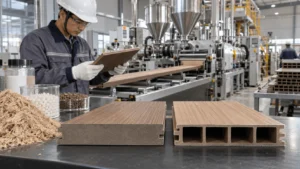
During WPC extrusion, the blended compound is pushed at high pressure through a shaped die. A solid core die produces a panel where the composite material fills the entire cross-section uniformly — there are no gaps, channels, or cavities. The finished product is a dense, homogeneous slab of WPC from face to face.
A hollow core die contains metal pins or mandrels within the die profile that displace material during extrusion, creating continuous longitudinal channels through the panel. These channels run the full length of the board and represent voids where no composite material exists — effectively, air tubes within the panel structure.
1.2 Why the Choice of Core Structure Matters
The internal structure of a WPC panel determines its performance across every dimension that matters in a real-world application:
- How much load the panel can bear without deformation or failure
- How well the panel holds screws, anchors, and mechanical fixings
- How the panel responds to impact — from tools, furniture, luggage, or vandalism
- Whether moisture can penetrate and accumulate within the panel over time
- How the panel performs under fire exposure
- What the panel weighs per square metre — with implications for structural loading and installation
- How long the panel will last before replacement is required
The core structure is invisible from the surface — but it determines everything about performance. Never specify WPC without confirming whether the product is solid or hollow core.
2. What Is Solid Core WPC?
A solid core WPC panel contains composite material across its entire cross-section with no internal voids. The wood fibre and polymer matrix is uniformly distributed from the front face to the back face, and from edge to edge. When you cut a solid core WPC board, the cross-section reveals a consistent, homogeneous material — the same density throughout.
2.1 Physical Characteristics of Solid Core WPC
- Density: 950–1,200 kg/m³ — noticeably heavier than hollow core equivalents. This density is the direct result of the fully compacted composite matrix with no air inclusion.
- Weight: Typically 6–12 kg/m² depending on panel thickness (common range: 14mm–25mm). For a standard 2.9m × 0.15m panel, this equates to approximately 2.6–5.2 kg per board.
- Compressive strength: 40–60 MPa — significantly higher than hollow core equivalents. This strength allows solid core WPC to function as a structural skin in facade systems where panels may be subject to wind loads, impact, and point loads from fixings.
- Cross-section appearance: A cut edge reveals uniform colour and texture throughout the entire thickness. There are no visible channels, walls, or voids. The composite grain structure is consistent from face to face.
- Tactile and acoustic quality: Solid core panels produce a dull, dense sound when tapped — similar to hardwood. This acoustic mass is valued in premium architectural applications where the ‘feel’ of quality matters.
2.2 Performance Advantages of Solid Core WPC
- Superior fixing retention: Screws, mechanical anchors, and hidden clips engage with the full depth of the panel without risk of stripping or deformation. This is critical for facade systems where fixing failure can result in panel loss.
- Impact and dent resistance: The continuous dense matrix absorbs and distributes impact energy across the full cross-section. Hollow panels, by contrast, can produce localised fracture or ‘caving’ of the outer wall above a hollow channel when struck.
- No moisture trapping: Solid core panels have no internal void space where moisture can accumulate, freeze, and cause internal delamination. This makes solid core WPC the only appropriate specification for exterior cladding, wet rooms, pool surrounds, and marine environments.
- Sound attenuation: Dense mass blocks airborne sound transmission more effectively than hollow panels, which can act as resonance chambers. Solid core WPC contributes meaningfully to room-to-room sound insulation in hotel and apartment applications.
- Fire resistance advantage: While WPC is a combustible material, solid core panels have a significantly higher mass per unit area. This slows the rate of thermal penetration and reduces the risk of rapid structural collapse compared to thin-walled hollow profiles.
Solid core WPC is the correct specification for: exterior facades, hotel corridors and guest rooms, bathrooms and wet areas, high-traffic commercial spaces, and any application where mechanical fixing performance or long-term structural integrity is critical.
3. What Is Hollow Core WPC?
Hollow core WPC panels contain longitudinal internal channels created during extrusion by die pins that displace material during the forming process. The panel profile comprises outer and inner walls of composite material connected by vertical web ribs, enclosing continuous air-filled cavities that run the full length of the board.
3.1 Physical Characteristics of Hollow Core WPC
- Density: 600–800 kg/m³ — significantly lighter than solid core equivalents due to the reduced material volume. A hollow core board of the same external dimensions as a solid core board may contain 30–50% less composite material by volume.
- Weight: Typically 3–6 kg/m² — noticeably lighter than solid core for the same external dimensions. This reduced weight is a meaningful advantage in applications where panel handling or installation weight is constrained.
- Cross-section appearance: A cut end reveals the internal channel structure — outer face walls, inner bottom wall, and a series of vertical web ribs connecting them, with air cavities between. This structure is visually similar to the cross-section of a hollow extrusion in aluminium or PVC.
- Thermal insulation: The air cavities within hollow core panels provide a degree of thermal insulation that solid core panels do not. Still air is a poor conductor of heat, so hollow panels can marginally improve the thermal performance of interior partition walls in dry indoor environments.
3.2 Limitations of Hollow Core WPC
- Reduced fixing strength: Screws and anchors in hollow core panels engage only with the face wall and web ribs — not a continuous dense matrix. Under load, fixings can pull through the face wall, particularly in thin-walled products where the face thickness is 3–5mm.
- Vulnerability to impact: Point impacts — from corners of furniture, dropped tools, or deliberate force — can crack or depress the face wall above a hollow channel. This type of damage is nearly impossible to reverse without panel replacement.
- Moisture risk at cut ends: Where hollow core panels are cut on site, the open channels exposed at cut ends must be sealed. If left open in any environment with humidity or condensation, moisture can enter the channels, accumulate, and — in cold climates — freeze and expand, causing delamination of the face wall.
- Not suitable for exterior use: Hollow core WPC should not be specified for exterior applications, exposed facades, or wet areas. The combination of open-channel moisture risk, reduced impact resistance, and lower structural performance makes hollow core WPC inappropriate for any application with outdoor exposure.
- Hollow core WPC is appropriate for: dry interior accent walls, residential feature walls, temporary installations, budget apartment panels, and low-traffic decorative applications where fixing load and impact resistance are not primary concerns.
4. Head-to-Head Comparison: Solid Core vs Hollow Core WPC
The following table provides a structured comparison across the most critical performance and commercial dimensions:
| Comparison Factor | Solid Core WPC | Hollow Core WPC |
| Internal structure | 100% dense composite fill | Air chambers / hollow channels |
| Density (typical) | 950–1,200 kg/m³ | 600–800 kg/m³ |
| Weight per m² | Heavier — 6–12 kg/m² | Lighter — 3–6 kg/m² |
| Compressive strength | Excellent — 40–60 MPa | Moderate — 15–30 MPa |
| Impact resistance | High — resists denting & cracking | Moderate — hollow walls can crack |
| Screw / fixing holding | Superior — deep thread engagement | Moderate — risk of stripping |
| Thermal insulation | Moderate (mass-based insulation) | Better (air cavities trap heat) |
| Sound insulation | Better — dense mass blocks sound | Moderate — hollow transmits vibration |
| Moisture resistance | Excellent (no internal voids) | Good — but hollow channels risk moisture trap |
| Fire performance | Slower burn due to density | Can collapse faster in fire |
| Typical applications | High-traffic, exterior, premium | Interior accent walls, partitions |
| Material cost | Higher — more raw material | Lower — less material used |
| Installation weight | Heavier — consider scaffolding | Lighter — easier handling |
| Lifespan | 25–30+ years | 10–20 years (indoor use) |
| Warranty (typical) | 15–25 year manufacturer warranty | 5–10 year manufacturer warranty |
5. Which WPC Core Is Right for Your Application?
Use the application guide below to match your project type to the correct core specification:
| Application | Recommended Core | Why |
| Hotel exterior facade cladding | Solid Core | Weather, impact, and vandal resistance essential |
| Hotel room interior accent wall | Solid Core | Fire rating, sound insulation, screw holding for TV mounts |
| Luxury villa exterior cladding | Solid Core | Lifetime performance and premium visual weight |
| Villa bedroom interior feature wall | Hollow Core | Lightweight, rapid installation, cost efficiency |
| Restaurant interior wall panelling | Solid Core | Durability in high-traffic dining environment |
| Office internal partition cladding | Hollow Core | Budget-conscious; low mechanical load |
| Airport and government building | Solid Core | Public safety, fire rating, structural integrity |
| Retail display wall (low traffic) | Hollow Core | Cost reduction acceptable; low impact exposure |
| Outdoor pergola / deck surround | Solid Core | Weatherproofing; no moisture trapping in cavities |
| Temporary exhibition stand wall | Hollow Core | Light weight; ease of assembly and disassembly |
| Bathroom feature wall (interior) | Solid Core | Zero moisture penetration risk in wet areas |
| Budget apartment wall panel | Hollow Core | Cost-driven specification; dry indoor use only |
Decision rule: If the project involves outdoor exposure, moisture, high traffic, mechanical fixing loads, fire performance requirements, or premium client expectations — specify solid core WPC. If the application is a dry, low-traffic interior decorative feature with a budget constraint — hollow core may be considered.
6. Strength and Structural Performance: A Detailed Analysis
6.1 Compressive and Flexural Strength
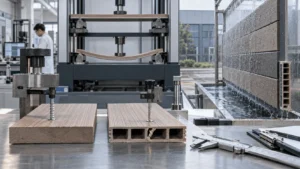
The structural performance difference between solid and hollow core WPC panels is substantial and measurable. In standardised testing to EN 15534 or ASTM D7031, solid core WPC panels typically demonstrate:
- Compressive strength: 40–60 MPa (solid core) vs 15–30 MPa (hollow core) — a factor of 2–3x difference
- Flexural modulus: 3,000–5,000 MPa (solid core) vs 1,500–2,500 MPa (hollow core)
- Tensile strength: 15–25 MPa (solid core) vs 8–15 MPa (hollow core)
For facade applications, the flexural performance of solid core WPC is particularly important. Panels fixed at intervals across a subframe span must resist wind pressure without deflecting beyond acceptable limits. Hollow core panels with the same external dimensions as solid core will deflect more under the same wind load — requiring closer fixing intervals, additional subframe members, or simply being unacceptable in exposed positions.
6.2 Screw Pull-Out Strength
Perhaps the most practically important structural difference between solid and hollow core WPC is screw pull-out resistance — the force required to pull a fixed screw out of the panel under load. Published test data from leading WPC manufacturers shows:
- Solid core WPC: Screw pull-out strength of 800–1,500 N using a standard 4.5mm × 40mm self-tapping screw
- Hollow core WPC: Screw pull-out strength of 250–600 N with the same screw specification, depending on web rib engagement
The practical implication: in a facade system where fixing clips must retain panels against wind uplift forces, hollow core panels carry a significantly higher risk of fixing failure under extreme conditions. Most reputable facade engineers will not approve hollow core WPC for external cladding applications, regardless of nominal product thickness.
7. Moisture, Weathering, and Long-Term Durability
7.1 Solid Core — Sealed Against Moisture
The homogeneous structure of solid core WPC provides inherent moisture resistance. There are no internal voids for water to enter, no hollow channels where ice can form and expand, and no delamination risk from freeze-thaw cycling. This is why solid core WPC panels are specified for:
- Exterior building facades in all climate zones
- Coastal and marine environments where salt spray is a concern
- Wet rooms, bathrooms, and pool surrounds
- Regions with severe freeze-thaw cycling (Nordic climates, alpine environments)
- Tropical climates with high humidity and intense rainfall
Quality solid core WPC panels with co-extrusion polymer shells can achieve water absorption rates of less than 0.5% after 24-hour immersion testing — equivalent to many polymer products and dramatically better than any natural timber specification.
7.2 Hollow Core — Moisture Management Challenges
Hollow core WPC presents specific moisture management challenges that must be understood and managed:
- Cut-end sealing: Wherever hollow core panels are cut on site — at corners, window reveals, or panel length adjustments — the open channel ends must be sealed with an appropriate end cap or sealant. Unsealed ends in any humid environment create a path for moisture ingress into the panel cavity.
- Joint integrity: If the face wall of a hollow core panel is penetrated by a fixing (rather than using a groove/clip system), the penetration creates a moisture entry point directly into the hollow chamber. This risk is eliminated in properly installed clip systems, but poorly installed hollow core panels can suffer progressive moisture damage.
- Condensation in cold climates: In below-zero environments, moisture that enters hollow channels can freeze, expand, and cause the face wall to delaminate. This failure mode is irreversible without panel replacement.
Important: Never use hollow core WPC in any application with outdoor exposure, direct water contact, or significant temperature cycling. The moisture risk is not manageable in such environments regardless of installation quality.
8. Cost Comparison: Upfront vs Lifecycle
The cost relationship between solid and hollow core WPC is nuanced and depends entirely on the project type and timeframe of evaluation:
| Cost Element | Solid Core WPC (per 100m²) | Hollow Core WPC (per 100m²) |
| Material cost (FOB China) | $1,200–2,800 | $800–1,500 |
| Installation labour | $2,200–3,500 | $1,500–2,500 |
| Fixing & sub-frame system | $400–700 | $300–500 |
| 5-year maintenance | $100–300 | $300–800 |
| Replacement likelihood 10yr | Very low | Moderate (indoor degradation) |
| 10-year total cost (100m²) | $3,900–7,300 | $2,900–5,300 |
| Cost advantage | Higher upfront; lower lifecycle | Lower upfront; higher lifecycle |
The fundamental cost principle: Hollow core WPC is less expensive to purchase. Solid core WPC is less expensive to own over a 10-year project lifecycle. For commercial and hospitality projects with long operational lives and high maintenance costs, the upfront premium of solid core WPC is consistently recovered through lower maintenance, fewer replacements, and avoided structural failure costs.
For hotel, resort, and commercial developers: the additional $3–8/m² material cost of solid core over hollow core WPC is recovered within 3–5 years of avoided maintenance in most climates. Over a 20-year asset life, solid core is almost invariably the lower total cost option.

9. How to Identify Solid vs Hollow Core WPC
In practice, buyers often receive product samples or tender submissions without clear structural specification. Here is how to confirm whether a WPC panel is solid or hollow core:
9.1 Physical Tests You Can Do Yourself
- The weight test: Weigh the panel and calculate kg/m². Solid core panels will typically weigh 8–12 kg/m² at 20mm thickness. Hollow core panels of the same external dimensions will weigh 4–7 kg/m². A significant weight difference compared to your expected specification should prompt investigation.
- The tap test: Tap the face of the panel firmly with a knuckle or small hammer across different positions. A solid core panel produces a consistent, dull thud across its entire surface. A hollow core panel produces a slightly hollow or resonant ring, particularly over the channel voids — the tone may vary noticeably between the web rib positions and the cavity positions.
- The cut end test: Request that the supplier cut a short cross-section sample from the end of a board. The cut face will immediately reveal whether the interior is solid composite material or contains channels and voids. This is the definitive identification method and should be requested for any specification above 200m².
- The drill test: Drill a 5mm hole perpendicular to the face at a representative position. In a solid core panel, the drill will meet consistent resistance throughout its depth. In a hollow panel, resistance will drop sharply as the drill enters a channel, then return when it hits the inner wall or opposite face.
9.2 Documentation and Certification
Any reputable WPC manufacturer should be able to provide:
- Product datasheet specifying the core type (solid or hollow) and nominal density (kg/m³)
- Cross-section drawing or photograph showing the internal profile
- Test reports confirming density, compressive strength, and screw pull-out performance
- Weight per linear metre or per square metre for the specified thickness
Specification tip: Always include the words ‘solid core, minimum density 950 kg/m³’ in your WPC product specification for any exterior or high-performance interior application. This single requirement eliminates hollow core products from the supply chain at the procurement stage.
10. The Melinco Golden Formula: Why Solid Core Is the Only Specification
Melinco Group has manufactured WPC wall panels exclusively with solid core construction since the company’s founding. This is not a premium option within the range — it is the fundamental design principle of the entire product line, embedded in what Melinco calls the Golden Formula substrate.
10.1 What the Golden Formula Means in Practice
The Golden Formula refers to Melinco’s proprietary WPC compound formulation — the precise ratio of wood fibre species, particle size distribution, polymer grade, coupling agent, UV stabiliser system, lubricant package, and processing parameters that produces a consistently dense, high-performance solid core board across every production run.
Key performance characteristics of the Golden Formula solid core substrate:
- Density: Consistently above 1,000 kg/m³ across all production batches
- Screw pull-out: Tested to exceed 1,000 N with standard 4.5mm self-tapping screws
- Water absorption: Less than 0.8% after 24-hour immersion — suitable for exterior and wet area applications
- Colour consistency: Above 95% ΔE consistency between production batches — critical for large-scale hotel and development projects
- Service life: Warranted for 15 years; design life exceeds 25 years in correctly installed exterior applications
10.2 Why This Matters for Your Project
When you specify Melinco WPC wall panels for a hotel, villa, or commercial project, you are not choosing between solid and hollow core — solid core is the baseline. This means:
- Every fixing will hold as specified — no pull-through risk under facade loads
- Every panel will perform identically to the approved sample — no batch-to-batch density variation
- The installation will look the same in year 20 as it did in year 1 — no hollow panel surface collapse or moisture delamination
- The project can be specified with confidence to end clients and main contractors — because the structural performance is documented, tested, and consistent
Melinco’s 20+ years of manufacturing, combined with landmark projects including Singapore Changi Airport and the Congolese Government Building, demonstrates what solid core WPC specification delivers in the most demanding real-world environments.
11. Common Mistakes When Specifying WPC Core Type
The following errors appear repeatedly in project specifications and procurement processes — often with expensive consequences:
- Specifying ‘WPC board’ without defining core type: Without an explicit solid core requirement, a supplier is free to offer the lowest-cost product — which is almost always hollow core. Specify ‘solid core WPC, minimum density 950 kg/m³’ in every tender and purchase order.
- Selecting hollow core for exterior applications to save cost: This is the most common and most costly specification error. Hollow core WPC on an exterior facade will typically fail within 3–7 years in any climate with rain, frost, or UV exposure. The replacement cost invariably exceeds the original material saving many times over.
- Approving samples without confirming core specification: A product sample from a hollow core board looks identical to a solid core sample on the face. Without the cut-end test, weight check, or specification document review, there is no way to know which you are evaluating. Always request a cross-section sample alongside the surface sample.
- Assuming all WPC board from one supplier is consistent: Some manufacturers offer both solid and hollow core products under the same brand or similar product names. Confirm the exact product code and core specification in writing before placing an order.
- Not specifying core type in hotel refurbishment tenders: Hotel operators who renovate using unspecified ‘WPC cladding’ often discover hollow core products installed in guest corridors, where luggage trolleys and housekeeping carts quickly produce visible impact damage within months of installation.
Frequently Asked Questions
Is solid core WPC always better than hollow core?
For performance-critical applications — exterior facades, high-traffic interiors, wet areas, and premium commercial projects — solid core WPC is definitively the better specification. For dry, low-traffic interior decorative applications with a budget constraint, hollow core WPC can be an appropriate and cost-effective choice. The decision should always be driven by the application requirements, not by initial material cost alone.
Can I use hollow core WPC for an exterior hotel facade?
No. Hollow core WPC should never be specified for exterior applications. The combination of moisture ingress risk through cut ends, reduced structural performance under wind and impact loads, and accelerated surface degradation in UV-exposed positions makes hollow core WPC genuinely unsuitable for facade use. Any manufacturer who recommends hollow core WPC for exterior facades is not acting in the buyer’s best interest.
How do I tell if a WPC board is solid or hollow core?
The three most reliable methods are: (1) the weight test — solid core panels weigh significantly more per m² than hollow core equivalents; (2) the cut-end test — request a cross-section cut from the supplier and inspect the interior; (3) documentation review — request the product datasheet and verify the stated density (solid core: 950–1,200 kg/m³; hollow core: 600–800 kg/m³). The tap test (dull thud vs resonant ring) is a useful field indicator but not a substitute for documentation.
Does solid core WPC cost significantly more than hollow core?
Yes — solid core WPC typically costs 30–70% more per square metre than hollow core equivalents, reflecting the additional raw material content. However, on a total lifecycle cost basis over 10 years, solid core is almost always less expensive — because hollow core panels require more maintenance, have shorter service lives, and are more likely to require partial or full replacement in demanding environments.
What thickness should I specify for solid core WPC wall panels?
For exterior facade applications, 18–25mm solid core WPC is the typical specification range. For high-traffic interior applications (hotel corridors, commercial spaces), 14–18mm solid core is appropriate. For lower-traffic interior applications, 12–14mm solid core provides a good balance of performance and cost. Always confirm thickness requirements with the facade engineer or interior designer based on fixing centres and design loads.
What is Melinco’s Golden Formula solid core WPC panel?
Melinco’s Golden Formula is a proprietary solid core WPC substrate formulation that delivers consistent density above 1,000 kg/m³, screw pull-out strength exceeding 1,000 N, water absorption below 0.8%, and colour consistency above 95% between batches. All Melinco wall panels are manufactured exclusively with solid core construction. Contact us to request a technical datasheet and product samples.
Conclusion: The Core Decision That Defines Your Project
The choice between solid core and hollow core WPC is one of the most consequential decisions in any WPC specification — and the one most often made without adequate information. The surface appearance of the two products is identical. The performance over time is not.
Solid core WPC provides the structural integrity, moisture resistance, fixing strength, acoustic mass, and long-term durability that demanding applications require. Its higher upfront cost is consistently recovered through lower maintenance, longer service life, and the absence of the premature failure modes that hollow core panels introduce in high-performance environments.
Hollow core WPC has a legitimate role in dry, low-traffic interior decorative applications where its cost advantage is real and its limitations are acceptable. But it should never find its way into exterior facades, high-traffic commercial spaces, wet areas, or any application where performance over time is a requirement — not merely a hope.
The specification rule is simple: when in doubt, specify solid core. The cost difference is smaller than the risk of getting it wrong.
Need a Solid Core WPC Panel Built to Last? Let’s Talk.
Melinco’s exclusive Golden Formula solid-core WPC board is engineered for 20+ years of premium performance — in hotels, villas, and landmark commercial projects worldwide.
✔ Free solid core WPC samples with test reports
✔ 95%+ colour consistency guaranteed
✔ OEM & custom specification available
📩 Share your project scope — receive a technical datasheet and competitive quote within 24 hours.