Table of Contents
Stone cladding looks expensive because it is expensive — not just to buy, but to deliver, install, maintain, and eventually repair. Yet every year, developers and project managers lock themselves into stone specifications based on an upfront material comparison that ignores the four or five other budget lines that stone cladding generates throughout a building’s lifetime. WPC wall cladding, by contrast, is routinely underestimated: buyers see a modest material price and assume they are trading quality for cost. The reality is almost the opposite. Once you run the numbers across the full project lifecycle — materials, labour, structure, maintenance, logistics, and replacement — WPC doesn’t just compete with stone. It wins, often by a margin of 3 to 5 times the total cost.
Quick Answer
WPC is more cost-effective than stone cladding across six key cost dimensions: (1) WPC material costs $18–55/m² vs $60–280/m² for stone; (2) WPC installation runs $15–30/m² vs $40–120/m² for stone, which requires skilled masons and mechanical lifting; (3) WPC weighs just 4–8 kg/m² vs 80–150 kg/m² for stone, eliminating costly structural reinforcement; (4) WPC requires near-zero maintenance vs $5–20/m²/year for stone sealing, repointing, and treatment; (5) WPC ships as standard freight vs specialist heavy haulage for stone; (6) Over a 10-year lifecycle on a 100m² facade, WPC typically costs $6,700 vs $35,000 for stone — a saving of over 80%.
1. Why the Upfront Price Tag Tells You Almost Nothing
The single biggest mistake buyers make when comparing WPC and stone cladding is stopping at the material price per square metre. This approach — common in early-stage budget estimates and quantity surveyor schedules — captures only one slice of the true cost of a cladding system.
The complete cost of a cladding installation includes:
- Material procurement cost (per m²)
- Freight and logistics to site
- Structural reinforcement or substrate modification to carry the cladding weight
- Installation labour (days on site, skill level required, equipment hire)
- Annual and periodic maintenance over the building’s operational life
- Repair and replacement of failed or damaged sections
- Potential thermal performance implications (insulation add-ons)
- End-of-life disposal or recycling costs
When all eight cost categories are considered, the comparison between WPC and stone cladding shifts dramatically — and consistently in WPC’s favour. The sections below walk through each category in detail.
Key principle: A cladding decision made on material price alone is an incomplete decision. Total installed cost over the building lifecycle is the only valid basis for comparison.
2. Cost Comparison Overview: WPC vs Stone Cladding
The table below provides a structured side-by-side comparison of the primary cost categories across a typical mid-range specification for each material:
| Cost Category | WPC Cladding | Stone Cladding | Key Driver |
| Material (per m²) | $18–55 | $60–280 | Stone quarrying, cutting & transport |
| Installation (per m²) | $15–30 | $40–120 | Stone requires skilled masons & heavy lifting |
| Structural reinforcement | Rarely needed | Often required | Stone weight: 80–150 kg/m² vs WPC 4–8 kg/m² |
| Annual maintenance | Near zero | $5–20/m² | Stone needs sealing, repointing, algae treatment |
| Replacement/repair | Panel swap | Full section replacement | Stone removal risks surrounding material |
| Transportation | Standard freight | Specialist heavy haulage | Stone bulk density: 2.4–3.0 t/m³ |
| 10-year total cost (m²) | $60–120 | $200–600 | WPC up to 5× cheaper over a decade |
| 30-year total cost (m²) | $80–160 | $350–900 | Stone maintenance compounds significantly |
Note: Prices are indicative ranges based on mid-range product specifications in international markets. Actual costs vary by region, project scale, product grade, and site conditions. The directional relationship between WPC and stone costs is consistent across markets.
3. Material Cost: Where the Gap Starts
3.1 The WPC Material Price Range
WPC wall cladding panels are available in a wide price range that reflects genuine quality differences — surface technology (co-extruded vs single layer), profile design, colour range, and manufacturing precision:
- Entry-level single-layer WPC: $18–30/m² — suitable for budget residential and interior applications
- Mid-range co-extruded WPC: $30–45/m² — the standard specification for commercial and exterior applications
- Premium co-extruded WPC (wood-grain or 3D embossed): $45–55/m² — for high-specification facades and hospitality projects
3.2 The Stone Cladding Price Range
Natural and engineered stone cladding spans an even wider cost range:
- Reconstituted / cultured stone: $60–100/m² — concrete-based manufactured panels
- Natural sandstone / limestone: $80–150/m² — widely used for commercial facades
- Natural granite / quartzite: $120–200/m² — premium facade specification
- Marble / exotic natural stone: $180–280/m² — ultra-premium interior and feature wall use
Even at the entry level, stone cladding material costs are typically 2 to 3 times higher than equivalent WPC specifications. At the premium end of the stone range, the material cost gap reaches 5 to 10 times.
3.3 Hidden Material Cost: Waste and Cutting Losses
Stone cladding generates significant on-site cutting waste — typically 10–20% above net area, compared to 3–7% for WPC panels (which arrive factory-cut to length). For a 500m² facade project:
- WPC: Order approximately 515–535 m² — waste cost: $200–800
- Natural stone: Order approximately 550–600 m² — waste cost: $3,000–12,000
Cost insight: On material alone, a 500m² stone facade typically costs $30,000–100,000 more than the equivalent WPC specification — before a single hour of labour is spent.
4. Installation Labour: The Cost Nobody Budgets Correctly
Installation is where the cost gap between WPC and stone cladding widens most dramatically — and where project managers most frequently underestimate the true expense.
- Installation Factor WPC Cladding Stone Cladding
- Skill level required General carpentry / DIY-capable Qualified stonemason required
- Tools required Standard power tools Diamond saws, angle grinders, wet cutters
- Panel weight 4–8 kg/m² — handheld 80–150 kg/m² — mechanical lifting required
- Fixing system Hidden clip & aluminium rail Mechanical anchors + mortar bed
- Typical install speed 25–40 m²/day per operative 4–8 m²/day per mason
- Scaffolding requirement Standard light scaffolding Heavy-duty rated scaffolding for weight
- Site waste Low — precision factory cut High — on-site cutting and breakage
- Lead time on site 1–3 days for material delivery 2–4 weeks for bespoke cut stone
- Facade substrate prep Minimal — rail system adapts Substrate must be perfectly level and load-rated
4.1 Why Stone Installation Is So Much More Expensive
Weight and lifting: Natural stone panels for exterior facades typically weigh 80–150 kg/m². Large format stone slabs can exceed 200 kg per panel. This requires mechanical lifting equipment, additional scaffolding rated for the imposed load, and working methods that add significantly to programme time and labour cost.
Skill level and labour rates: Stone installation is a specialist trade. Qualified stonemasons command significantly higher day rates than the general building operatives who can install WPC systems. In many markets, skilled stone masons are also in short supply, adding programme risk.
Installation speed: A two-person WPC installation team can typically install 25–40 m² per day using a hidden clip and aluminium rail system. A two-person stone masonry team typically achieves 4–8 m² per day. For a 500m² project, this difference alone accounts for 40–80 extra operative days.
Substrate preparation: Stone cladding requires a perfectly level, load-rated substrate — often necessitating specialist render, concrete blocking, or steel frame work before the stone can be fixed. WPC rail systems are designed to accommodate substrate irregularity and are far more tolerant of typical facade conditions.
Labour calculation example: A 500m² stone facade at $80/m² labour cost = $40,000 in installation. The same area in WPC at $22/m² = $11,000. Labour saving alone: $29,000.
5. Structural Cost: The Bill That Stone Always Generates
This is the most frequently overlooked line item in stone cladding budget comparisons, and it can be the most expensive single additional cost — particularly for retrofits and upper-floor facades.
5.1 The Weight Problem with Stone Cladding
Natural stone cladding is heavy. Depending on species and thickness, typical facade stone weighs:
- 30mm sandstone/limestone: 72–90 kg/m²
- 30mm granite: 81–96 kg/m²
- Stacked stone (full depth): 120–200 kg/m²
Applied across a 500m² facade, this means 36,000–100,000 kg of additional load imposed on the building structure. For many structures — particularly those not originally designed for stone cladding, or older buildings undergoing refurbishment — this requires:
- Structural engineering assessment and calculations
- Steel frame or sub-frame installation to distribute the load
- Foundation or slab strengthening in severe cases
- Additional mechanical anchoring systems rated for the stone weight
These structural works typically add $15,000–80,000+ to a 500m² stone cladding project, depending on the existing structure and the engineering solution required.
5.2 WPC: Structural-Grade Weight Savings
WPC wall panels weigh approximately 4–8 kg/m² — a fraction of natural stone. A 500m² WPC installation adds just 2,000–4,000 kg of facade load. In the vast majority of projects, this is within the existing structural envelope with no additional engineering required. Even on sensitive heritage structures or lightweight steel-frame buildings where stone would be structurally impossible, WPC can typically be specified without structural intervention.
Structural saving: For a 500m² facade refurbishment, avoiding stone’s structural reinforcement requirement alone can save $20,000–60,000 compared to a stone specification.
6. Freight and Logistics: Stone’s Hidden Supply Chain Cost
6.1 The Cost of Moving Heavy Stone
Natural stone is quarried, processed, and shipped — often internationally. Its combination of high density, fragility, and bulk creates a supply chain that is significantly more expensive than standard building materials:
- Bulk density: Natural stone has a bulk density of 2,400–3,000 kg/m³. A 20-foot shipping container can carry approximately 6–8 tonnes of stone panels — far less than lighter cladding materials.
- Specialist handling: Stone must be crated, padded, and loaded with mechanical handling equipment. On-site unloading requires crane lifts or forklifts capable of handling stone crates. These requirements add cost at every transfer point.
- Fragility risk: Stone breakage during transit is a genuine risk, particularly for thin-cut panels. Damaged stone is expensive to replace and can cause significant programme delays if replacement material must be re-cut from the quarry.
6.2 WPC Logistics Advantages
WPC cladding ships as standard building materials freight. Panels are bundled and wrapped, can be stacked efficiently, and are handled without specialist equipment. A single container load carries far more coverage area than the equivalent stone shipment — typically 3–5 times more m² per container. At destination, WPC panels can be unloaded manually or with a standard pallet truck.
For international projects, the freight cost differential between WPC and stone can represent $5–20/m² of additional cost for stone — a significant additional line item on top of the material price difference.
7. Maintenance Costs: Where Stone’s Lifetime Cost Compounds
The long-term maintenance requirement is one of the most compelling financial arguments for WPC over stone cladding — and the one most dramatically underweighted in initial project budget comparisons.
| Maintenance Task | WPC Cladding | Natural Stone Cladding |
| Annual sealing / impregnation | Not required | Required – $3–8/m² annually |
| Repointing mortar joints | Not applicable | Every 7–10 years – $8–20/m² |
| Algae / moss / staining | Occasional rinse | Professional chemical treatment annually |
| Efflorescence treatment | Not applicable | Common – requires specialist treatment |
| Frost / freeze-thaw damage | No risk | Cracking / spalling – costly to repair |
| Surface crack repair | Panel replacement | Section rebuilding – skilled labour |
| Re-fixing loose panels | Simple clip re-engagement | Requires re-mortaring or new anchors |
| Colour restoration | Not required | Periodic pressure cleaning + re-sealing |
7.1 The Annual Stone Maintenance Budget
Natural stone facades in exposed exterior positions require consistent, skilled maintenance to preserve both their appearance and structural integrity. Key recurring costs include:
- Impregnating sealer application: Most natural stones (limestone, sandstone, granite) require annual or biennial application of a penetrating sealer to prevent water ingress, freeze-thaw damage, and staining. Professional application cost: $3–8/m².
- Mortar repointing: Jointed stone installations require mortar repointing typically every 7–10 years. This is skilled, labour-intensive work — cost: $8–20/m² per cycle.
- Algae, moss and biological growth treatment: Stone’s natural porosity and surface texture make it highly susceptible to biological colonisation. Professional biocide treatment is typically required annually in temperate climates — cost: $2–6/m².
- Efflorescence removal: The migration of soluble salts to the stone surface (efflorescence) is a common problem, particularly in the first few years after installation and after wet weather periods. Treatment requires specialist chemical cleaners and can cause surface damage if done incorrectly.
7.2 WPC Maintenance: What It Actually Involves
A quality co-extruded WPC cladding installation requires the following maintenance regime:
- Annual rinse with water (or mild detergent for heavy soiling)
- Periodic inspection of fixing clips and trims (every 2–3 years)
- No sealing, staining, painting, or chemical treatment required
- No specialist trade required — standard building maintenance staff
The total annual maintenance cost of a WPC cladding installation is effectively zero for labour and materials, compared to $5–20/m² per year for stone. On a 500m² facade, this represents an annual saving of $2,500–10,000 — compounding every year for the life of the building.
Maintenance saving: Over 10 years on a 500m² facade, WPC avoids approximately $25,000–100,000 in maintenance costs that stone cladding would require.
8. Repair and Replacement: The Risk You Don’t See Coming
No cladding is completely immune to damage — accidental impact, extreme weather events, or material failure will eventually require some level of repair on any facade. The critical difference between WPC and stone lies in how straightforward and affordable that repair process is.
8.1 Repairing Stone Cladding
When natural stone panels crack, spall, or become structurally compromised, repair is genuinely difficult:
- Matching replacement stone to an aged installation is extremely difficult — stone from the same quarry will not match weathered installed stone without specialist treatment
- Removing damaged stone panels risks disturbing surrounding panels and mortar, potentially causing progressive failure
- If the original stone specification is discontinued or the quarry exhausted, finding a match can be impossible — requiring full facade replacement
- Repair work requires specialist stone masons and typically involves significant disruption to the surrounding area
- For high-rise facades, abseiling access or crane-mounted platforms add further cost to repair operations
8.2 Repairing WPC Cladding
WPC panel replacement is straightforward: hidden clip systems allow individual panels to be disengaged and replaced without disturbing adjacent panels. Replacement panels from the same colour specification are reliably available from the manufacturer. The repair can be completed by a competent carpenter without specialist trade qualifications. For most WPC damage scenarios, repair time is measured in hours, not days, and costs in hundreds rather than thousands.
Risk insight: Stone cladding’s repair complexity creates budget risk that is almost impossible to quantify at project inception. WPC’s simple panel-swap repair system eliminates this uncertainty entirely.
9. The 10-Year Lifecycle Cost Analysis
The following projection models the total cost of ownership for WPC and stone cladding across a standard 100m² exterior facade application over 10 years. Figures represent mid-range specifications and typical market costs:
| Cost Element (per 100m²) | WPC — 5 yr | WPC — 10 yr | Stone — 5 yr | Stone — 10 yr |
| Materials | $3,500 | $3,500 | $12,000 | $12,000 |
| Installation labour | $2,500 | $2,500 | $9,000 | $9,000 |
| Structural works | $0 | $0 | $3,000 | $3,000 |
| Maintenance | $200 | $400 | $3,500 | $7,500 |
| Repairs / replacement | $0 | $300 | $1,500 | $3,500 |
| TOTAL (100m²) | $6,200 | $6,700 | $29,000 | $35,000 |
| Cost per m² (total) | $62 | $67 | $290 | $350 |
Key finding: Over 10 years, WPC cladding on a 100m² facade costs approximately $6,700 in total compared to $35,000 for stone cladding — a saving of $28,300 (81%). Even in best-case stone scenarios (low maintenance, no repairs), WPC is typically 3–4× cheaper on a total lifecycle basis.
This calculation does not include the structural reinforcement often required for stone (add $15,000–60,000 per project), specialist freight costs (add $5–20/m²), or the programme delays associated with stone installation (indirect cost: contractor overhead, site preliminaries). Including these factors, the real-world cost differential is often even wider.
10. Environmental Costs and Regulatory Considerations
10.1 Carbon and Embodied Energy
Natural stone extraction and processing carries a significant embodied energy cost — particularly for imported stone that has been quarried, cut, finished, and transported internationally. Quarrying operations consume significant energy and generate landscape disruption that has increasing regulatory and ESG implications for developers.
WPC panels made from recycled wood fibre and recycled polymer content carry a lower embodied carbon footprint than virgin stone in most lifecycle assessments, particularly when the product is manufactured regionally. For developers targeting green building ratings (LEED, BREEAM, WELL), WPC with certified recycled content can contribute directly to materials credits that stone cannot match.
10.2 Weight and Building Regulations
In many jurisdictions, high-rise facade cladding is subject to increasing regulatory scrutiny around fire performance, wind load resistance, and fixing system integrity. Stone cladding’s weight creates complex wind uplift calculations, requires certified mechanical anchoring systems, and demands regular inspection regimes that carry their own professional services cost. WPC’s lightweight profile simplifies facade engineering calculations and is typically less burdensome to specify within current building codes.
10.3 End-of-Life Considerations
When a facade reaches the end of its life — typically after 25–50 years — the demolition and disposal cost of stone cladding is significant. Stone rubble requires landfill or specialist processing. WPC panels, by contrast, are 100% recyclable — the wood fibre and polymer content can be reprocessed. Some manufacturers operate take-back schemes. This end-of-life advantage adds a further dimension to WPC’s total cost-of-ownership advantage.
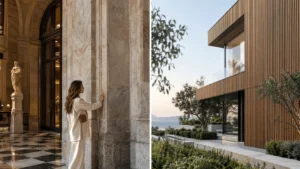
11. What WPC Cannot Deliver vs Stone — Being Honest
A credible cost comparison requires honesty about what WPC does not offer compared to natural stone, so buyers can make fully informed decisions:
Authentic natural material prestige: Natural stone carries a cultural and material status that WPC, however well-designed, cannot fully replicate at close inspection. For museum facades, heritage buildings, ultra-luxury retail, or applications where the stone’s geological identity is part of the design statement, WPC is not the appropriate substitute.
Touch, smell, and temperature feel: In interior applications where people handle the surface — tactile wall features, reception counters, luxury retail — the thermal mass and texture of natural stone create a sensory experience that WPC does not match.
Ultimate load-bearing mass: For applications where the cladding’s own mass contributes to acoustic performance (e.g., heavy stone party walls), or where the thermal mass of stone is exploited for passive heating/cooling, WPC does not offer the same physical properties.
The conclusion: for the vast majority of facade cladding applications — commercial buildings, hospitality, residential developments, landscaping features, interior feature walls — WPC delivers comparable aesthetics at dramatically lower total cost. Stone retains its place in a defined set of prestige and heritage applications where its specific material properties are non-negotiable.
12. Project Types Where WPC Delivers the Greatest Cost Saving vs Stone
Based on the cost analysis above, the following project types represent the strongest economic case for choosing WPC cladding over stone:
- Large-scale residential developments: Volume procurement, consistent specification across many units, and the need for low-maintenance materials in rental and owner-occupied blocks all favour WPC.
- Hotel and resort exteriors: The combination of large facade areas, harsh external environments, and the operational priority of minimising maintenance disruption makes WPC the cost-rational choice for hospitality assets.
- Commercial office and retail buildings: Where facade aesthetics must be maintained without ongoing specialist maintenance programmes, WPC provides a reliable, cost-efficient solution.
- Facade refurbishment projects: Retrofitting a facade with stone is structurally complex and expensive. WPC’s lightweight profile often makes it the only viable option for adding cladding to existing buildings without structural engineering intervention.
- Tropical and coastal developments: Stone’s susceptibility to salt ingress, biological growth, and moisture damage in coastal environments escalates maintenance costs beyond the figures quoted in temperate climates. WPC’s waterproof composition eliminates these risks entirely.
- Build-to-rent and property investment portfolios: For investors managing multiple assets, WPC’s near-zero maintenance requirement and predictable lifecycle cost profile is a significant financial advantage in long-term asset management planning.
Frequently Asked Questions
Is WPC cladding as durable as stone cladding?
For most exterior applications, yes — and in some environments, WPC outperforms stone. Quality co-extruded WPC panels carry a 25–30 year lifespan with near-zero maintenance. Natural stone can last centuries in the right conditions, but in wet, coastal, or frost-prone environments, stone requires consistent maintenance to achieve comparable longevity. WPC’s immunity to moisture damage, freeze-thaw cycling, and biological growth gives it a practical durability advantage in most real-world exterior conditions.
Can WPC cladding realistically replicate the look of stone?
Modern WPC manufacturing has narrowed the visual gap significantly. WPC panels with stone-effect embossing, textured surfaces, and multi-tonal colour variations are visually convincing at normal viewing distances on exterior facades. For interior applications where people are close to the surface and handle it, the difference is more apparent. For most exterior facade applications, the aesthetic difference is not perceptible — and buyers consistently rate WPC stone-effect products highly once installed.
How much can I realistically save by choosing WPC over stone?
On a typical 500m² commercial facade, the total saving from choosing WPC over mid-range natural stone cladding typically ranges from $100,000 to $250,000 when all cost elements are included — materials, installation labour, structural works, freight, and 10-year maintenance. The exact saving depends on the stone specification displaced, the site conditions, and the local labour market, but the directional saving is consistent across markets and project types.
Does WPC cladding require planning permission where stone would not?
Planning requirements for cladding materials vary significantly by jurisdiction, conservation area status, and building type. In most situations, WPC and stone cladding are treated equivalently by planning authorities for external appearance assessment. If you are working on a listed building or within a conservation area, specialist planning advice is required regardless of the cladding material. Our team can provide technical documentation to support planning submissions.
What fire rating does WPC cladding carry compared to stone?
Natural stone is inherently non-combustible and achieves A1 or A2 fire classification. WPC is a combustible material and typically achieves Class B or Class C fire classification (European standard) depending on the formulation. For high-rise buildings or projects subject to enhanced fire performance requirements, fire-rated WPC formulations are available that meet Class B standards. Specification of WPC on high-rise facades should always be verified against local building regulations with a fire engineer.
What is the minimum order for WPC cladding and how quickly can I receive it?
Standard colour WPC cladding panels are typically available from stock for orders of 50m² and above, with lead times of 3–10 business days for standard freight delivery. For large projects (500m²+), production scheduling ensures material is manufactured in a single batch for colour consistency, with lead times of 3–6 weeks. Custom profiles and colours require additional lead time. Contact our team with your project timeline and we will provide a confirmed delivery programme.
Conclusion: WPC Wins on Total Cost — Every Time
The numbers are clear. When you compare WPC and stone cladding across the complete cost of ownership — not just the material price per square metre, but installation, structure, freight, maintenance, repair, and end-of-life — WPC is the more cost-effective solution for the vast majority of facade applications. The saving is not marginal. It is substantial, measurable, and consistent across markets and project types.
Stone cladding remains the right choice where the specific properties of natural stone are non-negotiable — prestige heritage projects, ultra-luxury interiors, applications where stone’s thermal mass or material identity is part of the design intent. For every other application — which is the majority of the market — WPC delivers comparable aesthetics, superior maintenance performance, and total lifecycle costs that are typically 3–5 times lower than natural stone.
For developers, quantity surveyors, and project managers who want to make a financially defensible cladding specification, WPC is the answer. The data supports it. The projects prove it.
Want to Cut Your Cladding Budget Without Cutting Corners?
Our WPC wall cladding delivers stone-quality aesthetics at a fraction of the total project cost — with the data to prove it.
✔ Free project cost comparison report
✔ Free physical samples with spec sheet
✔ Response within 24 hours