Table of Contents
Picture this: your hotel corridors look flawless on opening day. The wall panels are pristine, the finish is sharp, the brand feel is exactly right. Fast-forward 18 months. The panels along the fire exit corridor are scuffed at luggage height. The textured finish near the elevator bank has collected grease and is impossible to wipe clean. The painted section by the housekeeping trolley bay has started to chip. None of this was in anyone’s renovation budget. And all of it was entirely predictable—if only someone had asked the right question before specifying the finish: what does a high-traffic hotel corridor actually demand from a wall panel?
Quick Answer
For high-traffic hotel corridors, the most suitable wall panel finishes are high-pressure laminate (HPL), compact laminate, and quality PVC wall panels — all combining impact resistance, easy cleaning, moisture tolerance, and long-term color stability that standard paint or fabric finishes cannot match under daily luggage, trolley, and housekeeping wear. Mid-to-upper-scale hotels requiring design sophistication should consider engineered wood veneer with protective lacquer coating, or HPL in realistic wood and stone effects, for a compelling balance of durability and visual quality. The right choice depends on your hotel’s traffic volume, brand tier, maintenance philosophy, and renovation cycle — and the wrong choice will cost significantly more to correct than it would have to specify correctly the first time.
Why Hotel Corridor Wall Panels Are a Different Challenge
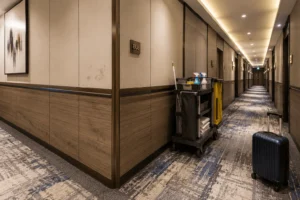
Hotel corridors are not like hotel rooms. Rooms are occupied by one or two guests who generally treat surfaces with care. Corridors are occupied by everyone—guests with rolling luggage, housekeeping teams with chemical-laden trolleys, maintenance staff with heavy equipment, room service with laden carts, and delivery teams with flatbed dollies. The wall surfaces in a hotel corridor absorb the mechanical impact, abrasion, and cleaning chemical exposure of every one of these interactions, every hour of every day, for the full 10 to 15 year life of the fit-out.
At the same time, corridors are brand-critical spaces. They form the first and last impression of every hotel stay. A guest stepping from a pristine room into a tired, marked-up corridor immediately revises their opinion of the property. The visual quality of corridor wall panels must hold not just on opening day, but through years of intensive use—making finish selection one of the most consequential material decisions in any hotel renovation.
Hotel corridors present three compounding challenges that no other space in a property replicates:
- Limited natural light — finish texture and sheen level significantly affect how the space reads under artificial lighting, making surface quality more visible, not less.
- Acoustic sensitivity — hard wall surfaces amplify corridor noise, directly affecting guest satisfaction scores on review platforms.
- Visual repetition — the length of a corridor means any wear, marking, or inconsistency in the panel finish is immediately apparent to anyone walking its length.
These three factors—extreme mechanical demand, brand-critical appearance, and acoustically and visually unforgiving environment—define the unique specification challenge of hotel corridor wall panels.
The 5 Performance Criteria That Matter Most
Before comparing specific finish types, it is essential to understand the five performance dimensions that separate a good corridor wall panel finish from a problematic one. A finish that excels on three but fails on two will still create operational and financial problems.
1. Impact and Abrasion Resistance
The most common cause of wall panel damage in hotel corridors is mechanical impact—from luggage corners, trolley edges, and door handles swinging back. A finish that marks, chips, dents, or scratches under moderate impact will look tired within months in a high-traffic environment. Look for finishes rated to EN 438 (for laminates) or equivalent commercial-use standards, with surface hardness ratings verified for heavy-duty applications.
2. Cleanability and Chemical Resistance
Hotel corridors are cleaned multiple times daily with commercial cleaning products. The panel finish must tolerate repeated contact with alkaline cleaners, disinfectant solutions, and stain removers without discoloring, dulling, or surface degradation. Finishes that trap dirt in surface textures—or that react chemically to housekeeping products—require increasingly intensive and costly maintenance over time.
3. Moisture and Humidity Tolerance
Corridors adjacent to laundry facilities, pool areas, or exterior-facing walls can experience elevated humidity. Even in standard corridors, cleaning operations introduce moisture regularly. Panel systems must tolerate this without substrate swelling, delamination, or mold development—all of which cause irreversible visual and structural damage.
4. Fire Safety Compliance
In most markets, hotel corridor wall panels must meet minimum reaction-to-fire standards. In the EU, this typically means Class B-s2,d0 or better under EN 13501-1. In the US, ASTM E84 flame spread and smoke indices apply. Finish type, substrate material, adhesive, and installation method all affect overall fire performance—and non-compliant materials create serious liability regardless of their other performance qualities.
5. Long-Term Color and Texture Stability
A finish that looks visibly different after three years of cleaning and exposure than it did on day one creates costly visual inconsistency across a property and accelerates renovation pressure. High color stability under both UV exposure and chemical contact is essential for maintaining a consistent, on-brand corridor appearance over the full renovation cycle.
The Main Wall Panel Finish Types: A Complete Comparison
Finish Type 1: High-Pressure Laminate (HPL) | Best Overall for Hotel Corridors
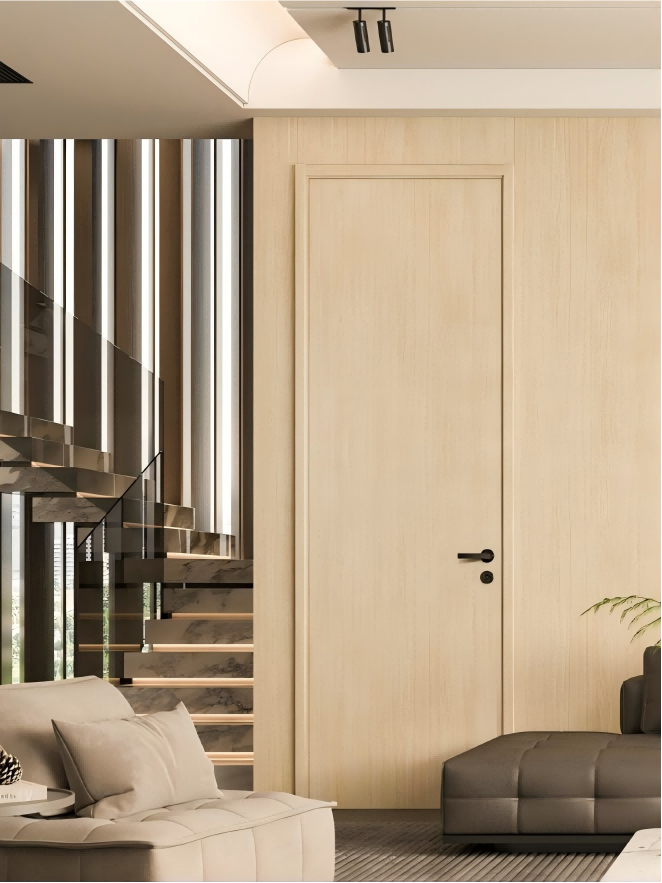
High-pressure laminate is the benchmark finish for commercial and hospitality wall panels in high-traffic environments. HPL is manufactured by bonding multiple layers of resin-impregnated paper under extreme heat and pressure, creating an exceptionally dense, hard, non-porous surface that resists impact, abrasion, moisture, and most chemical cleaning agents in ways no painted or fabric finish can approach.
For hotel corridors specifically, HPL panels offer:
- Impact and scratch resistance rated to EN 438 Grade Standard — suitable for heavy commercial use
- Seamless design versatility — available in realistic wood, stone, metal, solid color, and custom pattern effects
- Easy cleaning with commercial-grade products including disinfectants and alkaline cleaners
- Good fire classification options, including Class B-s2,d0 versions widely specified in hotel projects
- Consistent color and texture across large quantities, enabling visual uniformity along full corridor runs
- Excellent total cost of ownership — higher upfront cost than alternatives, but significantly lower lifetime cost when maintenance and replacement frequency are factored in
The main constraint of HPL is unit cost, which is higher than PVC or painted alternatives. However, when cleaning costs, maintenance frequency, and replacement timeline are compared across a full 12-year renovation cycle, HPL consistently delivers a lower total cost than any cheaper alternative in a genuinely high-traffic corridor.
Verdict: Excellent. HPL is the specification of choice for mid-scale to luxury hotel corridors across nearly all market segments.
Finish Type 2: Compact Laminate | Premium High-Durability Option
Compact laminate is a premium variant of HPL in which the entire panel thickness is laminate material—not a surface layer bonded to a separate substrate. This produces an extraordinarily dense, dimensionally stable, moisture-resistant panel that can be used unsupported in highly humid or wet environments.
In hotel corridors, compact laminate is particularly valuable adjacent to laundry, spa, or pool facilities where moisture intrusion risk is elevated. Unlike HPL-faced MDF, a damaged compact laminate panel does not reveal a vulnerable substrate beneath—making it more resilient under aggressive trolley or luggage impact. The cost premium over standard HPL is significant, however, and for most standard corridor applications HPL on a moisture-resistant substrate provides equivalent performance at lower cost.
Verdict: Excellent for extreme moisture or impact environments. Well-specified for most standard hotel corridors, but cost premium is rarely justified outside highest-risk zones.
Finish Type 3: PVC Wall Panels | Best for Budget and Economy Segments
PVC wall panels offer cost-effective practical performance in commercial environments. They are impermeable to moisture, easy to clean, and resistant to most commercial cleaning chemicals. In budget and economy hotel segments where cost control is the primary driver, PVC panels can deliver acceptable corridor performance at a meaningfully lower material cost than HPL.
For mid-scale and above applications, however, PVC has meaningful limitations:
- Visual quality does not match HPL or real veneer finishes under close or repeated inspection
- Surface scratch resistance is lower than HPL, with marks showing more readily under heavy traffic
- UV stability — PVC panels can warp or discolor with prolonged light exposure in corridor end-walls or near windows
- Environmental profile — increasingly scrutinized by hotel brands with sustainability or ESG commitments
- Acoustic characteristics — hard PVC can increase corridor noise reflection, worsening guest experience
Verdict: Good for budget and economy segments where cost is the primary constraint. Not recommended for mid-scale, upscale, or luxury hotel corridors.
Finish Type 4: Vinyl-Wrapped MDF Panels | For Lower-Traffic Secondary Areas Only
Vinyl-wrapped MDF panels—where a printed vinyl film is applied to an MDF substrate—offer excellent design flexibility and good aesthetic quality at moderate cost. They are widely and appropriately used in hotel room interiors, where lower traffic demands make their limited durability acceptable.
In primary corridor applications, however, vinyl-wrapped panels have significant vulnerabilities that make them a poor choice:
- Edge delamination risk — the vinyl film is prone to lifting and delamination, particularly in humid conditions or where cleaning chemicals penetrate near panel edges
- Substrate moisture sensitivity — the MDF core will swell and deteriorate if moisture reaches it through joint gaps or fixing points
- Limited impact resistance — luggage corners and trolley edges mark and dent vinyl-wrapped panels substantially faster than HPL
Verdict: Not recommended for primary high-traffic hotel corridors. Acceptable for lower-traffic secondary corridors or back-of-house areas only.
Finish Type 5: Real Wood Veneer Panels with Protective Coating | For Luxury Properties
Real wood veneer panels—where a thin slice of natural wood is bonded to a stable engineered substrate and finished with a protective lacquer or UV-cured coating—represent the premium aesthetic option for hotel corridor paneling. They deliver the authentic visual depth and warmth of natural wood that no laminate or printed alternative can fully replicate, making them the natural specification for upper-upscale and luxury hotel projects.
The critical variable is the protective coating applied over the veneer. Panels with inadequate surface coating will mark, stain, and deteriorate quickly in a high-traffic corridor. Properly specified veneer panels—with a hard-wearing UV-cured or catalyzed lacquer at sufficient film build—achieve surprisingly strong practical durability.
For luxury and upper-upscale hotel corridors, real veneer panels are the right choice when:
- The lacquer specification is calibrated for heavy commercial use — not residential furniture
- The supplier can guarantee exact replacement panels with matching grain and color matching
- The property maintenance philosophy and budget are appropriate for a premium material
Verdict: Excellent for luxury and upper-upscale hotel corridors with the correct lacquer specification. Not suitable for mid-scale or economy segments.
Finish Type 6: Fabric-Wrapped Acoustic Panels | Accent Use Only
Fabric-wrapped acoustic panels are specified in hotel corridors primarily for their acoustic performance, not surface durability. In hotels where corridor noise is a significant guest satisfaction issue—older high-rise properties with hard floors and reflective surfaces—fabric panels can dramatically reduce ambient noise levels and improve the perceived quality of the guest experience.
The durability limitation in primary corridor use is significant: fabric accumulates dirt, is difficult to clean without specialist treatment, and is highly vulnerable to damage from luggage and trolleys. For this reason, fabric panels in hotel corridors are best used as acoustic accent elements integrated with durable HPL or veneer as the primary wall surface—not as a standalone wall finish.
Verdict: Use as acoustic accent panels in combination with a durable primary finish. Not suitable as a standalone wall finish in any high-traffic corridor zone.
Finish Type 7: Large-Format Ceramic and Porcelain | For Lobby Corridors and Luxury Approach Areas
Large-format ceramic and porcelain wall tiles offer outstanding durability, cleanability, and moisture resistance. In premium hotel projects, large-format porcelain tiles in marble effect or engineered stone aesthetic create corridor environments of exceptional visual quality that age very well under heavy use.
Practical considerations for tiled corridors:
- Higher installation cost and longer programmer than panel systems
- Grout joints require ongoing maintenance and are vulnerable to discoloration — mitigated significantly by large-format tile reducing joint frequency
- Impact resistance of the tiles themselves is excellent, but grout and substrate fixings can be vulnerable to repeated heavy trolley impact at skirting level
- Excellent cleanability — the tile surface is fully non-porous and tolerates all commercial cleaning products
Verdict: Excellent for lobby approach corridors and luxury public areas. High cost and installation programmer limit practicality for large-scale bedroom corridor applications.
The Hidden Cost of Getting the Finish Wrong
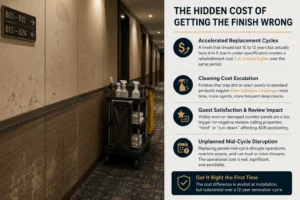
Choosing an inappropriate wall panel finish for a hotel corridor is not just an aesthetic problem—it is a compounding financial one. The costs accumulate over time in ways that are consistently underestimated at the specification stage:
- Accelerated replacement cycles. A finish that should last 10 to 12 years but actually lasts 4 to 5 due to under-specification creates a refurbishment cost 2 to 3 times higher than a correctly specified finish over the same period.
- Cleaning cost escalation. Finishes that trap dirt or react poorly to standard products require more intensive cleaning routines—more time, more specialized cleaning agents, and more frequent deep cleans. Across a 200-room hotel, these incremental costs can represent tens of thousands of dollars over a renovation cycle.
- Guest satisfaction and review impact. Visibly worn, marked, or damaged corridor panels are among the most frequently cited triggers for negative hotel reviews mentioning properties as “tired” or “run-down.” Even a single deteriorating floor can affect overall review scores and ADR positioning.
- Unplanned mid-cycle renovation disruption. Replacing corridor panels mid-cycle requires restricting corridor access, disrupting housekeeping operations, and potentially closing adjacent rooms. The operational cost of unplanned mid-cycle replacement is rarely captured in original specification comparisons—but it is real, significant, and avoidable.
Getting the finish right at the outset is invariably less expensive than getting it wrong. The cost difference between correctly and incorrectly specified corridor panels is modest at installation; the cost difference over a 12-year renovation cycle is substantial.
How to Specify Wall Panel Finishes for Hotel Corridors
The specification process for hotel corridor wall panels should follow a systematic sequence to ensure durability requirements, design intent, fire compliance, and operational realities are all addressed coherently.
- Define the traffic intensity and risk profile. Categorize your corridor by traffic intensity — low (boutique/leisure), medium (standard business hotel), or high (large conference hotel, airport hotel, resort). This categorization directly determines the minimum durability standard required and immediately narrows the appropriate finish options.
- Confirm fire classification requirements. Obtain written confirmation of fire classification requirements from your local building authority or fire safety consultant before specifying any materials. Fire compliance is a non-negotiable constraint that may eliminate certain finish options regardless of their other performance qualities.
- Define the design brief and brand alignment. Align the visual specification with your hotel’s brand tier and design language. Identify who is responsible for design decisions—a brand standards team, interior designer, or asset manager—and ensure they are involved in the specification process from the outset.
- Test physical samples under real conditions. Request large-format physical samples (minimum 40cm × 40cm), evaluate under actual corridor lighting conditions, and—critically—test with the specific cleaning products your housekeeping team uses. Some finishes that perform excellently under standard cleaners deteriorate visibly under bleach-based or alkaline degreasers common in hotel housekeeping.
- Confirm supply continuity for the full renovation cycle. Request written confirmation that the specified finish will remain in production for a minimum of 7 to 10 years. This is essential for replacement purchases during phased renovations and maintenance replacements throughout the property’s renovation cycle.
Installation Details That Protect Your Investment
The best wall panel finish will underperform if installed incorrectly. For hotel corridor applications specifically, these installation details significantly affect both durability and long-term appearance:
Mechanical Fixing Versus Adhesive Bonding
In hotel corridors where panels may need to be removed and replaced during a property’s life, mechanical fixing systems—clip systems or concealed screw fixing—are preferable to full-adhesive bonding. Mechanically fixed panels can be removed cleanly without damaging the wall substrate, while adhesive-bonded panels typically require substrate remediation work after removal, adding time and cost to replacement operations.
Panel Joint Design
The junction between adjacent panels is both a visual and practical consideration. Tight butt joints show any panel movement or substrate settlement. Shadow gap details disguise movement while adding contemporary design quality. Aluminum or stainless steel section joints provide a durable, wipeable detail that resists moisture penetration at the joint—an important specification in corridors where cleaning water tracks along wall surfaces.
Kickplate and Base-Zone Protection
The lower 200 to 400mm of a hotel corridor wall is the zone most exposed to luggage wheels, trolley bases, and cleaning equipment. A dedicated kickplate or wall protection system—in stainless steel, brushed aluminum, or high-impact-resistant HPL—installed in this zone significantly extends the life of the primary panel finish above it. This detail is standard in well-specified hotel corridor designs but frequently omitted in budget fit-outs, with predictable long-term consequences.
Corner Protection Profiles
External corridor corners are consistently high-damage zones. Metal corner protection profiles—in aluminum or stainless steel—fitted at all external corners are inexpensive to install during fit-out and virtually eliminate a significant source of post-opening maintenance cost. The cost difference between corridors with and without corner protection, measured over a 10-year period, is consistently favorable toward protection in every project analysis.
Frequently Asked Questions
What is the single most durable wall panel finish for hotel corridors?
For overall durability in high-traffic hotel corridors, high-pressure laminate (HPL) is consistently the top-performing finish across the combination of impact resistance, abrasion resistance, chemical resistance, and color stability. Compact laminate offers superior performance in extreme moisture or impact environments, but at a meaningful cost premium that is rarely justified in standard corridor applications.
How long should hotel corridor wall panels last before replacement?
With a correctly specified finish—typically HPL or equivalent—hotel corridor wall panels should achieve a service life of 10 to 15 years in standard high-traffic applications. Incorrectly specified finishes such as vinyl-wrapped MDF or standard architectural paint in the same environment typically require replacement after 3 to 5 years—creating a total cost of ownership two to three times higher over the same property lifecycle.
Do hotel corridor wall panels need to meet fire safety regulations?
Yes, and this is non-negotiable. HPL, compact laminate, and most commercial PVC panel systems are available with fire classification ratings suitable for hotel corridor use under both European (EN 13501-1 Class B-s2,d0) and US (ASTM E84) standards. Always confirm specific product fire certifications with your supplier and verify acceptance with the local building authority before finalizing any specification.
How do I maintain and clean HPL corridor wall panels?
HPL surfaces tolerate most commercial cleaning products, including mild alkaline cleaners, disinfectants, and degreasers. Always follow the manufacturer’s specific cleaning protocol—some aggressive solvent-based products can cause surface dulling over time. Avoid abrasive cleaning pads on gloss or satin HPL surfaces. Routine cleaning with appropriate products is straightforward, and this is one of HPL’s most commercially valuable attributes in hotel housekeeping operations.
Should we use the same finish throughout the full corridor or vary by zone?
A zoned specification is consistently the better approach. A well-considered corridor specification typically uses durable HPL or metal kickplate protection at luggage height, the primary decorative panel finish above, and acoustic treatment panels at intervals if noise is a concern. Zoning allows the specification budget to be concentrated where durability pressure is greatest—and allows acoustic and design quality to be optimized independently of the primary durability requirement.
Can hotel corridor wall panel finishes be customized to match our brand colors?
Yes. Leading HPL manufacturers offer extensive standard finish libraries, and most can produce custom colors and textures to proprietary specifications for hotel chains requiring visual uniqueness that standard ranges cannot provide. Custom color development typically requires minimum order quantities and longer lead times, so this requirement should be identified and communicated to the supplier at the earliest planning stage.
Why Working With a Specialist Panel Supplier Makes the Difference
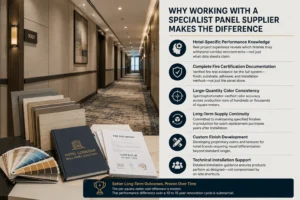
Specifying the right wall panel finish is only the first part of a successful corridor fit-out. Execution—the precision of manufacture, reliability of delivery, color accuracy across thousands of square meters, and speed of replacement supply—determines whether a sound specification delivers a sound result in practice.
Specialist hotel wall panel suppliers bring several capabilities that general building materials suppliers do not:
- Hotel-specific performance knowledge: Understanding from real project experience which finishes hold up in corridor environments — not just what product data sheets claim
- Complete fire certification documentation: Providing verified fire test evidence for the specific combination of finish, substrate, adhesive, and installation method specified — not just for the panel in isolation
- Large-quantity color consistency: Maintaining spectrophotometer-verified color accuracy across production runs covering hundreds or thousands of square meters
- Long-term supply continuity: Committing to maintain specified finishes in production throughout the renovation cycle, enabling exact replacement purchases years after initial installation
- Custom finish development: Developing proprietary color and texture specifications for hotel brands requiring visual differentiation that standard ranges cannot achieve
- Technical installation support: Providing detailed installation guidance that ensures the product’s performance potential is fully realized on-site rather than compromised by installation shortcuts
The investment in a specialist supplier relationship—rather than sourcing corridor wall panels from a general merchant or lowest-tender approach—consistently produces better long-term outcomes. The per-square-meter cost difference is typically modest. The performance difference over a 10 to 15 year renovation cycle is substantial.
Conclusion
Hotel corridor wall panels work harder than almost any other surface in a property. They endure thousands of daily interactions with luggage, equipment, cleaning chemicals, and human contact—while simultaneously forming the visual backdrop of every guest’s arrival and departure. Choosing the wrong finish means paying for that decision twice: once at installation, and again when the surface fails ahead of its planned replacement date.
For most hotel corridors, high-pressure laminate—correctly specified, properly detailed, and supplied by a manufacturer with verifiable hotel project experience—represents the optimal balance of durability, design versatility, cost efficiency, and long-term performance. Luxury properties have compelling alternatives in real veneer and large-format porcelain. Budget segments can consider PVC where cost constraints are genuinely binding. But the governing principle across every segment is this:
⭐ Specify for the full life of the fit-out — not for the opening day photographs. The finish that looks most impressive on day one is rarely the one that looks most impressive in year five. The finish that performs reliably through year twelve is the one that protects your renovation investment.
📩 Looking for hotel corridor wall panel solutions built for high-traffic performance? Contact our team today — we supply HPL, veneer, and custom panel systems to hotel projects worldwide.