Table of Contents
Walk into a Marriott in New York, then check into one in Tokyo. Something feels instantly familiar—and it’s not just the logo above the front desk. Look carefully at the room: the wardrobe panel, the wall-mounted cabinet beside the bed, the TV console. The tones, the finish, the texture—they match. Is that a coincidence? Absolutely not. The decision behind those uniform cabinet colors is one of the most deliberate moves in hotel operations, and understanding why chains invest so heavily in this consistency could change the way you think about hotel furniture design—and hotel furniture supply—entirely.
Quick Answer
Hotel chains standardize door wall cabinet colors to maintain brand consistency across all properties, reduce procurement and manufacturing costs, simplify quality control, and deliver a predictable, trustworthy guest experience. By committing to a fixed color palette—warm walnuts, neutral beiges, or cool contemporary grays—chains can replace damaged units with exact-match products, negotiate volume pricing with suppliers, and ensure every room looks on-brand regardless of location. Standardization is not a creative limitation; it is a strategic business decision that directly influences guest loyalty, operational efficiency, and long-term profitability.
Brand Identity: The Foundation of Color Standardization
In the hospitality industry, brand identity is everything. When a guest books a room at a well-known chain, they are not simply purchasing a bed for the night—they are buying a predictable experience. From the scent in the lobby to the thread count of the sheets, every sensory detail is engineered to communicate brand values.
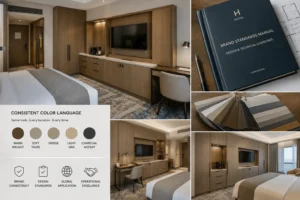
Cabinet colors play a more significant role in this than most people realize. As one of the largest visual surfaces in a hotel room, wall cabinets, wardrobes, and TV units occupy a disproportionate share of the guest’s visual field. When these surfaces share a consistent color language across every property in a chain, they function almost like a second logo—a visual shorthand that says you are in the right place.
Hilton, Marriott, IHG, and other major chains maintain strict design standards governing not just cabinet colors, but specific finishes, textures, hardware, and material specifications. These standards are compiled into Brand Standards Manuals—detailed documents that suppliers and interior designers must follow during every new-build or renovation project. For a chain operating 300, 500, or even 8,000 properties worldwide, visual consistency is not optional. It is a legal and contractual obligation built into every franchise or management agreement.
Why Does Color Specifically Matter?
Color is processed by the human brain in milliseconds—faster than we can consciously interpret a logo or read a sign. Research in environmental psychology confirms that color influences mood, perceived value, and spending behavior in hospitality environments. A budget motel chain standardizes on cool, neutral grays to signal cleanliness and efficiency; a luxury boutique brand chooses deep warm walnuts and bronze accents to communicate indulgence and refinement.
When the wrong cabinet color appears in a room, it disrupts this subliminal language. Guests may not consciously notice—but the result is a vague sense of inconsistency, a feeling that something is off. Over time, even small deviations erode the brand trust that hotel chains spend millions building.
Guest Psychology: How Color Uniformity Builds Loyalty
Understanding why guests respond so powerfully to visual consistency requires a brief look at consumer psychology. Humans are pattern-seeking creatures. When we stay at a hotel chain for the second or third time, our brains form expectations based on previous experiences. This expectation-matching is the neurological foundation of brand loyalty.
Familiarity Creates Comfort
For the frequent business traveler checking into their fortieth hotel room of the year, familiarity is a genuine comfort. The moment they enter the room and see the same warm-toned oak cabinet they remember from three cities ago, their brain registers a signal: safe, known, reliable. This emotional shortcut—built and reinforced through repeated exposure—is worth millions in repeat bookings and loyalty program membership.
Color is one of the fastest ways the brain builds this familiarity. Research from hospitality design studies consistently shows that travelers associate specific color palettes with specific brands, even without seeing a logo. This association only forms if the color is standardized and consistently reproduced across all properties.
Perceived Quality and Value
Standardized cabinet colors also shape how guests perceive the quality of their accommodation. When cabinetry tones, wall colors, and soft furnishings are deliberately coordinated, the room feels intentional and well-designed. Guests intuitively associate this cohesion with quality. Conversely, a room where the wardrobe is a slightly different tone than the bedside cabinet—perhaps because a unit was replaced with a non-standard part—signals a lack of attention to detail that undermines perceived value and, ultimately, willingness to rebook.
Operational Efficiency: The Business Case for Standardization
Beyond brand and psychology, there is a deeply practical reason hotel chains standardize their cabinet colors: it makes operations dramatically more efficient across every stage of the hotel lifecycle.
Replacement and Maintenance
Hotel furniture takes a beating. Over an average 10-year furniture cycle, cabinets and wardrobes will sustain scratches, water damage, broken hinges, and general wear. When a single unit needs replacing, the maintenance team faces a critical choice: find an exact match, or replace the entire room set.
If the chain has standardized a specific color and finish, finding a replacement is simple. The hotel contacts its approved supplier, specifies the standard SKU, and a matching unit ships within days. No color-matching exercises, no visual discrepancies, no guest complaints. Without standardization, a single damaged cabinet can trigger a costly and time-consuming process—sourcing discontinued finishes, refinishing existing units, or replacing entire room sets because a single piece is irreplaceable. That is a significant and entirely avoidable expense.
Streamlined Renovation Cycles
Major hotel chains operate on planned renovation cycles of 7 to 12 years. Standardized cabinet colors dramatically simplify planning and execution at scale. Design teams can update specifications across thousands of rooms with a single document revision. Procurement teams can negotiate volume contracts with approved suppliers. Logistics teams can coordinate multi-property deliveries simultaneously. This operational coordination would be impossible if every property had independently chosen its own cabinet colors.
Procurement and Supply Chain Advantages
One of the most financially significant reasons hotel chains standardize cabinet colors is the procurement leverage it creates—and the supply chain simplicity that follows.
Volume Purchasing Power
When a chain standardizes on a specific cabinet color and finish, it aggregates purchasing across its entire portfolio. Instead of 500 hotels each buying cabinetry from different local suppliers in different colors, the chain negotiates a single global contract with one or two approved manufacturers.
The purchasing volumes involved are extraordinary. A hotel group with 1,000 properties, each containing 200 rooms, represents a potential market of 200,000 cabinet units for a single renovation cycle. This volume gives the chain enormous leverage: lower unit prices, priority production scheduling, and contractually guaranteed quality standards—advantages that only exist because of color standardization.
For furniture manufacturers and cabinet suppliers, becoming an approved vendor for a major hotel chain is genuinely transformative. The contract provides predictable revenue, long-term production planning, and a prestigious reference customer that opens doors to other opportunities in the hospitality sector.
Simplified Logistics
Standardization also simplifies logistics. When every property in a region orders the same cabinet model in the same color, the supplier can produce large batches, warehouse stock efficiently, and deliver on demand. Lead times are shorter, freight costs are lower, and the risk of receiving incorrect items is minimized. For hotels under construction or mid-renovation, this reliability is critical—delays caused by mismatched or incorrect furniture can push back opening dates, increase labor costs, and directly delay revenue generation.
Quality Control and Color Accuracy in Manufacturing
Maintaining consistent color across thousands of cabinet units produced over many years is a genuine technical challenge—one that hotel chains and their manufacturing partners take very seriously.
Color Specification Standards
Hotel chain design teams do not describe their standard cabinet colors in vague terms. They specify colors using precise industry standards: RAL codes for painted finishes, specific veneer species and stain formulations for wood finishes, or Pantone references for laminates. These specifications are written into supplier contracts and are subject to quality control inspection both at the point of manufacture and upon delivery. Hotel properties may also conduct incoming inspections, comparing new units against approved reference samples—often called “golden samples” or “limit samples”.
Consistency Across Production Runs
Even with precise specifications, maintaining color consistency across multiple production runs spanning several years is technically demanding. Wood grain varies naturally; lacquer colors can shift with changes in ambient humidity or temperature during application; laminate batches from different material suppliers can differ in subtle but visible ways.
To manage this, hotel chains require approved cabinet suppliers to maintain batch records, provide test certificates for each production run, and submit new samples for approval when switching material batches. This rigorous quality management process ensures that a cabinet manufactured in 2026 matches one made in 2019—an essential capability for replacement and refurbishment purchasing.
Common Color Palettes Used by Major Hotel Chains
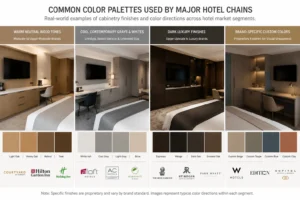
While specific brand standards are proprietary, hotel design professionals recognize several broad color trends that dominate chain hotel cabinetry across market segments.
Warm Neutral Wood Tones. The most widely used category. Medium-to-light oak, walnut, and teak veneers or laminates communicate warmth, natural quality, and timeless style. These finishes work across a wide range of room sizes and lighting conditions and are strongly associated with mid-market to upper-midscale brands. Chains in this segment typically specify finishes ranging from light honey oak to mid-brown walnut.
Cool Contemporary Grays and Whites. Increasingly popular with modern, design-forward brands targeting millennial and Gen Z travelers. Cool gray lacquers, white ash laminates, and bone-toned panels project a clean, minimalist aesthetic that photographs well on social media—a consideration that has become meaningfully important in hotel brand strategy. These finishes are common in lifestyle hotel brands, select-service chains, and extended-stay properties.
Dark Luxury Finishes. Premium and luxury hotel brands often specify darker cabinet finishes—deep espresso, near-black wenge, or dark smoked oak—combined with brushed brass or matte black hardware. These choices signal exclusivity and craftsmanship and are typically reserved for upper-upscale and luxury segments where guests expect a more dramatic, enveloping room environment.
Brand-Specific Custom Colors. Many major chains have developed proprietary color formulations not available off the shelf. These custom colors are mixed exclusively for the brand and provide an additional layer of visual uniqueness that cannot be replicated by competitors or copied by independent hotels attempting to approximate the chain aesthetic. Custom color development is often a differentiator in supplier selection.
What Furniture Suppliers Need to Know to Win Hotel Contracts
For manufacturers and suppliers looking to enter or expand within the hotel furniture market, understanding color standardization is essential to winning—and retaining—contracts with major chains.
Become Familiar With Brand Standards
Every major hotel chain publishes design and brand standards through its procurement teams or development portals. These documents contain detailed specifications for cabinet finishes, including approved materials, color references, texture grades, and finish types. Suppliers who invest time in understanding these documents—and who can demonstrate documented compliance processes—are substantially more likely to achieve preferred vendor status.
Invest in Color Management Capability
Hotel chains expect their approved suppliers to demonstrate robust color management processes. This means maintaining approved color samples for each active contract, using spectrophotometers to verify color accuracy at each production stage, keeping detailed batch records, and providing color measurement reports with each delivery. Suppliers who cannot provide this level of documentation risk disqualification—even if their products are otherwise high quality.
Offer Custom Color Development
Some hotel chains actively seek suppliers who can develop custom color formulations. If your manufacturing facility has in-house lacquering, painting, or laminate sourcing capabilities, offering to develop a proprietary hotel-specific color can be a powerful differentiator. Chains that commission custom colors often offer longer contract terms and higher volumes in exchange for this exclusivity—making it a commercially attractive proposition for both parties.
Understand Lead Time and Reliability Expectations
Hotel chains operating on renovation schedules have strict timelines. Suppliers need to demonstrate both the production capacity to deliver large volumes within defined windows and the logistical capability to hold stock for emergency replacement orders. In supplier selection, flexibility and delivery reliability are often weighted as heavily as unit price—sometimes more so.
How to Choose the Right Cabinet Color for Your Hotel Property
For hotel developers, operators, and interior designers working on new-build or renovation projects, selecting cabinet colors is a decision that deserves careful, systematic thought—not just aesthetic preference.
Align With Your Brand Tier
The most important starting point is your brand standard. If you are developing a franchised property, your choices are constrained by your franchise agreement. Review your brand standards manual carefully and order physical samples of all approved finishes before specifying anything. For independent hotels or soft-brand collections, the choice is broader—but the same principles apply. Consider where your property sits in the market: budget, midscale, upscale, luxury. Choose finishes that align with the visual language of that tier and the expectations of your target guest segment.
Consider the Room Environment
Cabinet colors must work in context. Consider room dimensions, ceiling height, natural light levels, and the colors of adjacent surfaces. As a general principle:
- Lighter tones (white, ash, light oak) make small rooms feel more spacious.
- Warm medium tones (honey oak, medium walnut) create a welcoming, residential feel.
- Dark finishes (espresso, wenge, dark walnut) add drama but can make compact rooms feel heavier.
- Cool grays and whites suit high-light rooms and contemporary design schemes targeting design-savvy travelers.
Always Test With Physical Samples
Never make final color decisions from digital renderings or computer screens alone. Colors render differently under different light sources—a warm walnut tone that looks perfect in a design software preview may read as orange under the warm LED lighting of a real hotel room. Always obtain large-format physical samples (at least 30cm × 30cm) and evaluate them in the actual room environment under the planned lighting scheme before committing to a specification.
Plan for Long-Term Consistency
If you are equipping multiple properties or planning a long renovation cycle, ensure your chosen supplier can contractually guarantee color consistency over time. Request a commitment to maintain the same color formulation for the full duration of your supply agreement, and retain signed-off reference samples against which future deliveries can be compared. This single step eliminates the most common cause of cabinet replacement complications.
Frequently Asked Questions
Do all hotel chains use exactly the same cabinet color in every room?
Most major chains standardize colors within defined ranges or collections, which may vary slightly between room categories (standard, deluxe, suite) or between property tiers within the same brand family. However, within each category, color consistency is tightly controlled and contractually mandated.
Can independent hotels benefit from color standardization too?
Absolutely. Even independent hotels with a single property benefit significantly from standardizing their cabinet colors. Replacement purchases become far simpler, maintenance operations are smoother, and the property develops a more coherent visual identity that guests associate with intentional quality. Many independent luxury hotels apply the same disciplined approach to color specification as major chains—and achieve comparable guest satisfaction results.
How often do hotel chains update their standard cabinet colors?
Major chains typically review their design standards as part of planned renovation cycles, usually every 7 to 12 years. Minor updates—such as transitioning from a gloss to a matte finish—may occur more frequently, while major color scheme changes are rare and are typically tied to broader brand repositioning strategies.
What happens if a replacement cabinet is needed after the standard color is discontinued?
This is one of the most common operational challenges in hotel furniture management. Hotels typically either source the closest available alternative, replace the entire room set to restore visual consistency, or contact their original supplier to request a special production run using retained batch records. This is precisely why maintaining a long-term relationship with a supplier who keeps detailed color and material records is so commercially valuable.
How can I find a supplier capable of matching hotel chain color standards?
Look for furniture manufacturers with demonstrable hotel project experience who can provide references from major chain projects and who have documented color management processes. Ask specifically about their ability to maintain color consistency across multiple production runs over extended periods, and their track record with emergency replacement orders. These capabilities—not just price and aesthetics—are the true differentiators in hotel-grade cabinet supply.
Why Partner With a Specialized Hotel Cabinet Supplier?
For hotel chains, developers, and purchasing managers, choosing the right cabinet supplier is one of the most consequential decisions in any renovation or new-build project. The wrong supplier can deliver products that fail color standards, miss delivery windows, and create costly operational problems for years after installation.
Specialized hotel furniture suppliers bring several advantages that general furniture manufacturers simply cannot match:
- Deep familiarity with brand standards: Experienced hotel suppliers know the documentation, approval processes, and quality expectations of major chains—and can navigate them efficiently.
- Proven color management: Established processes for maintaining color accuracy across large production runs and over extended multi-year supply relationships.
- Scale and delivery reliability: The production capacity to fulfill large orders on schedule, including holding inventory for emergency replacement needs.
- Long-term partnership approach: Understanding that a hotel renovation is the beginning of a multi-decade supply relationship, not a one-off transaction—and behaving accordingly.
Whether you are sourcing hotel cabinetry for a new build, a planned renovation, or emergency replacement orders, working with a supplier who specializes in the hotel sector will save time, reduce procurement risk, and deliver measurably better color and quality consistency across your portfolio.

Conclusion
The color uniformity you notice in hotel room cabinetry is no accident. It is the visible result of careful brand strategy, operational planning, supply chain engineering, and a sophisticated understanding of guest psychology. Hotel chains standardize door wall cabinet colors because doing so builds brand equity, reduces costs, streamlines operations, and creates the sense of trustworthy familiarity that keeps guests coming back—year after year, property after property.
For furniture suppliers, this standardization creates remarkable commercial opportunities—provided you can meet the exacting color management, quality, and reliability standards that chain hotel procurement teams demand. For hotel developers and operators, understanding the strategic logic behind color standardization is the first step toward making better specification decisions that serve your brand, your guests, and your bottom line for the full lifecycle of your property.
📩 Ready to discuss hotel-grade cabinet solutions that meet brand standards? Contact our team today — we supply precision-color hotel cabinetry for major chain projects and independent properties worldwide.