Table of Contents
When your guests check into a hotel room or a luxury villa, they trust that every surface, every panel, and every fitted interior element around them has been selected with their safety in mind. That trust is rarely articulated — but it is always present. And as the person making the specification decisions for those interiors, you carry it. So when WPC substrate appears on a material schedule — as a core board for cabinet doors, a wall panel backing, a flooring underlayer, or a bathroom vanity carcass — the question of safety is not academic. It is the question that determines whether you specify it with confidence or add it to a list of materials requiring further investigation.
Quick Answer
Is WPC Substrate Safe for Hotel and Villa Interiors?
Yes — WPC (Wood Plastic Composite) substrate is safe for hotel and villa interiors when it meets the appropriate emission, fire, and chemical safety standards for the market and application. Quality WPC substrates are formaldehyde-free or E0-rated, produce very low VOC emissions, resist moisture and mold without chemical treatments, and can achieve fire reaction classifications suitable for commercial hospitality environments. The critical distinction is between certified, tested WPC from reputable manufacturers and uncertified product where safety parameters are unknown. This guide covers exactly what to look for, which certifications matter, and how to evaluate a WPC substrate supplier for hospitality-grade specification.
1. What Is WPC Substrate? A Clear Definition for Specifiers
WPC stands for Wood Plastic Composite — a material manufactured from a blend of wood fiber or wood flour and thermoplastic polymers, typically PVC, polyethylene (PE), or polypropylene (PP). The two components are combined under heat and pressure to produce a board or profile that shares properties of both: the workability and aesthetic warmth of wood, combined with the dimensional stability, moisture resistance, and durability of plastic.
In interior applications, WPC substrate functions most commonly as a core material — the structural foundation beneath a surface finish such as veneer, high-pressure laminate (HPL), lacquer, PET film, or decorative paper. It is specified for cabinet carcasses and door cores, wall and ceiling panel backings, bathroom and kitchen vanity units, flooring underlayers, and furniture components in both residential and commercial environments.
What distinguishes WPC substrate from traditional panel products such as MDF, plywood, and particleboard is its fundamental relationship with moisture. Because the wood fiber within WPC is encapsulated by thermoplastic polymer, the composite does not swell, warp, or delaminate in the presence of water in the way that fiber-based substrates do. This property makes it particularly valuable in the humid, high-use environments characteristic of hotel bathrooms, pool areas, spa facilities, and beachfront villa interiors.
| 📐 Technical Note: WPC substrate should not be confused with WPC decking or exterior cladding profiles, which are different product forms of the same composite category. Interior WPC substrate boards are specifically engineered for enclosed environments, with different density, surface preparation, and emission profiles from outdoor WPC products. |
2. Why Material Safety Standards Are More Critical in Hotels and Villas
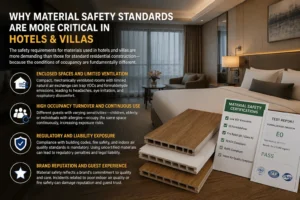
The safety requirements for materials used in hotels and villas are more demanding than those for standard residential construction — not because the people who occupy them are more vulnerable, but because the conditions of occupancy are fundamentally different.
Enclosed spaces and limited ventilation
Hotel rooms are typically compact, mechanically ventilated spaces with limited natural air exchange. Guests spend eight or more hours sleeping in them — breathing whatever the room’s surfaces are emitting. Any substrate or finish that produces elevated VOC or formaldehyde emissions in an enclosed space creates an indoor air quality problem that guests will experience directly, even if they cannot identify its source. Headaches, eye irritation, and respiratory discomfort in hotel rooms are frequently attributable to off-gassing from interior materials.
High occupancy turnover and continuous use
Unlike a private residence where occupants are consistent and materials stabilize over time, a hotel room is continuously occupied by different guests with different sensitivities, including children, elderly guests, and individuals with respiratory conditions such as asthma or allergies. Materials that would not cause concern for a healthy adult in a well-ventilated home may present risks in a hotel context where sensitive occupants cycle through continuously.
Regulatory and liability exposure
Hotels and villa developments are subject to building regulations, fire safety legislation, and increasingly, indoor air quality standards that specify the permissible emission levels for interior materials. In many markets, commercial hospitality developments are required to demonstrate compliance with specific environmental and safety standards as a condition of operating licensing. A specification that uses uncertified or below-standard materials exposes the developer, operator, and specifier to regulatory non-compliance and the associated liability.
Brand reputation and guest experience
For luxury hotel brands and high-end villa developments, material safety is not only a regulatory concern — it is a brand statement. Guests at premium properties expect to inhabit spaces where every design decision, including material selection, reflects the operator’s commitment to quality and care. A material-related incident — a VOC-triggered health complaint, a fire involving low-rated interior panels — carries reputational consequences that extend far beyond the individual event.
3. The Five Safety Dimensions of WPC Substrate
When evaluating the safety of WPC substrate for a hotel or villa specification, there are five distinct dimensions to assess. Each addresses a different type of risk, and each requires a different type of evidence from the manufacturer.
Dimension 1 — Formaldehyde Emission
Formaldehyde is the primary indoor air quality concern associated with wood-based panel products. In traditional MDF, particleboard, and lower-grade plywood, urea-formaldehyde adhesive resins are used in the manufacturing process and continue to off-gas after installation — sometimes for years. Formaldehyde at elevated concentrations is a respiratory irritant, a sensitizer, and at sustained high exposures, a classified human carcinogen.
Quality WPC substrate is manufactured without urea-formaldehyde binders. The thermoplastic polymer matrix holds the composite together without adhesive resins — meaning formaldehyde emission is either zero or negligibly low, achievable at E0 (≤0.05 mg/m³) or better. This is one of WPC substrate’s most significant safety advantages over traditional fiber-based panels, particularly for enclosed hospitality environments.
r specification purposes, require the manufacturer to provide documentary evidence of formaldehyde emission testing to a recognized standard: GB 18580 (China), EN 717-1 (Europe), ASTM E1333 (USA/CARB), or JIS A 1460 (Japan). The test result must specify the emission class — E0, E1, F★★★★, or CARB Phase 2 — and be issued by an accredited third-party laboratory.
Dimension 2 — Volatile Organic Compound (VOC) Emissions
VOCs are a broad category of chemical compounds that evaporate at room temperature and contribute to indoor air quality degradation. In interior construction, VOC sources include surface finishes, adhesives, sealants, and core materials. While the thermoplastic component of WPC substrate is generally a low-VOC material, the surface finish applied over it — lacquer, adhesive-backed film, laminate adhesive — may contribute additional VOC loading.
For hospitality-grade specification, the entire assembly — substrate plus finish — should be evaluated for VOC emissions. The most robust independent certification for indoor VOC safety is GREENGUARD Gold (previously GREENGUARD Children & Schools), which tests against over 360 individual chemical compounds and certifies products to concentration limits appropriate for sensitive environments. For hotel projects, GREENGUARD Gold certification on the finished panel assembly provides a credible, independently verified safety assurance.
Dimension 3 — Fire Safety and Reaction Classification
Fire safety in hotels is governed by some of the most stringent regulatory frameworks in the built environment, for obvious reasons: high overnight occupancy, unfamiliar environments, and the potential for rapid smoke and toxic gas accumulation in enclosed corridors and rooms. Interior materials are classified by their reaction to fire — specifically their contribution to ignition, flame spread, heat release, and smoke production.
The relevant classification systems are EN 13501-1 (Europe), GB 8624 (China), BS 476 (UK), and ASTM E84 (USA). For wall linings and ceiling panels in hotel corridors, public areas, and guestrooms, most fire codes require Class B or better under EN 13501-1, or Class B1 under GB 8624. Standard WPC substrate typically achieves B2 (normally flammable) under GB 8624 and Class D or E under EN 13501-1 without flame-retardant treatment.
For hospitality applications where fire class B1 or Class C (EN 13501-1) is required, specify flame-retardant WPC substrate — a product where fire-retardant additives have been compounded into the polymer matrix during manufacturing, rather than applied as a surface coating. Confirm the fire classification with a test report from a certified fire laboratory, not from the manufacturer’s own testing.
Dimension 4 — Moisture and Mold Resistance
In hotel bathrooms, wet rooms, spa areas, pool surrounds, and coastal villa environments, substrate materials are exposed to consistent humidity, condensation, and periodic water contact. Traditional substrates — particularly MDF and standard particleboard — absorb moisture, swell at the edges, delaminate from surface finishes, and create conditions that support mold growth behind the panel face.
WPC substrate’s moisture resistance is a direct consequence of its thermoplastic polymer content. The polymer encapsulates the wood fiber particles, significantly reducing the substrate’s water absorption rate. Quality WPC boards achieve water absorption rates of less than 2% after 24-hour immersion — compared to 10–30% for standard MDF — and dimensional expansion of less than 0.5%. This performance makes WPC substrate genuinely suitable for wet and humid hotel environments without the need for waterproofing additives or special installation precautions.
Mold resistance follows from moisture resistance: a substrate that does not absorb water does not support mold growth. For hotel specifications where indoor air quality standards include mold prevention as a criterion — particularly relevant in tropical climates and coastal destinations — WPC substrate offers a structural advantage that traditional panels cannot match.
Dimension 5 — Chemical Safety and Hazardous Substance Compliance
Beyond formaldehyde and VOCs, WPC substrate must be evaluated for the presence of restricted hazardous substances — heavy metals (lead, cadmium, mercury, chromium), plasticizers (phthalates), and other compounds regulated under frameworks such as REACH (EU), RoHS, and the China GB/T standards. These substances may be present in low-grade thermoplastic raw materials, recycled polymer inputs, or pigment systems used in the composite.
For hotel and villa specifications in regulated markets, require the manufacturer to provide a REACH compliance statement, a heavy metals test report, and a declaration of the polymer raw materials used. Reputable manufacturers of hospitality-grade WPC substrate use virgin or certified-recycled polymer inputs with traceable supply chains and can provide material safety data sheets (MSDS) for their products.
4. WPC Substrate vs Traditional Panel Materials — Safety and Performance
The following comparison positions WPC substrate against the three most commonly specified panel products in hotel and villa interiors: MDF, plywood, and particleboard. Green highlights indicate where WPC outperforms; neutral cells indicate comparable performance.
| Safety / PerformanceCriteria | WPC Substrate | MDF | Plywood | Particleboard |
| Formaldehyde emission | E0 / F★★★★ | E1 / CARB P2 | E1 | E1 / E2 (varies) |
| Moisture resistance | ★★★★★ Excellent | ★★★ Moderate | ★★★★ Good | ★★ Poor |
| Mold & mildew resistance | ★★★★★ Excellent | ★★ Poor | ★★★ Moderate | ★★ Poor |
| VOC emission level | Very Low | Low–Medium | Medium | Medium–High |
| Fire resistance | B1 achievable | B2 standard | B2 standard | B2 standard |
| Dimensional stability | ★★★★★ Excellent | ★★★ Moderate | ★★★★ Good | ★★★ Moderate |
| Screw/fix holding strength | ★★★★ Good | ★★★★ Good | ★★★★★ Excellent | ★★★ Moderate |
| Weight (relative) | Light–Medium | Medium–Heavy | Medium–Heavy | Medium |
| Hotel/villa suitability | ✓ Highly suitable | ✓ Suitable | ✓ Suitable | ⚠ Use with care |
The comparison confirms that WPC substrate leads across the safety and performance criteria most relevant to hospitality interiors — particularly moisture resistance, mold resistance, and formaldehyde emission. MDF and plywood remain competitive on screw-holding and structural applications, but carry higher inherent risk in humid environments and — for lower grades — on emission performance.
5. Certifications and Standards — What to Specify and Why
The following table maps the certifications and standards most relevant to WPC substrate specification for hotel and villa projects across different markets. Not all certifications are required for every project — the right combination depends on the project’s location, the regulatory environment, and the sustainability credentials the developer wishes to demonstrate.
| Certification / Standard | What It Covers | Key Threshold | Why It Matters for Hotels & Villas |
| E0 / F★★★★ (China GB / Japan JIS) | Formaldehyde emission | ≤0.05 mg/m³ air | Mandatory for hotel grade |
| E1 (EU EN 717-1) | Formaldehyde emission | ≤0.1 mg/m³ air | Minimum EU residential standard |
| CARB Phase 2 (California) | Formaldehyde emission | ≤0.05–0.09 ppm | Required for US export market |
| GREENGUARD Gold | VOC & chemical safety | Multi-chemical | Highest indoor air quality mark |
| ISO 14001 | Environmental management | Process standard | Supplier-level certification |
| FSC / PEFC | Timber sourcing chain | Responsible forestry | Sustainability credential |
| EN 13501 / GB 8624 Class B1 | Fire reaction | Limited combustibility | Hotel compliance in most markets |
| REACH (EU Regulation) | Hazardous substances | SVHC restricted | Required for EU projects |
| EN 14041 / CE Marking | Flooring safety | Slip, fire, hygiene | EU flooring projects |
| SGS / Intertek Third-party Test | Independent verification | Multiple | Confirms manufacturer claims |
| 💡 Specification Principle: Always request the original third-party test certificate — not a manufacturer’s self-declaration or a marketing claim. For hotel projects, a minimum specification of E0 formaldehyde emission, GB 8624 Class B1 (or equivalent) fire reaction, and REACH compliance is recommended regardless of local minimum requirements. |
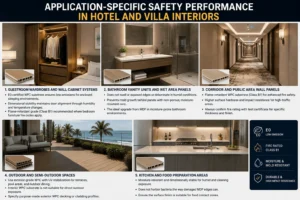
6. Application-Specific Safety Performance in Hotel and Villa Interiors
Guestroom Wardrobes and Wall Cabinet Systems
Guestroom wardrobes represent one of the highest-volume WPC substrate applications in hotel fit-outs. Cabinet door cores and carcass panels in E0-certified WPC substrate deliver the emission performance required for enclosed sleeping environments, combined with the dimensional stability needed to maintain door alignment through seasonal humidity changes and the temperature variations caused by air conditioning cycling. Flame-retardant grade WPC is recommended for guestroom wardrobes in markets where fire safety codes require Class B1 performance for bedroom furniture components.
Bathroom Vanity Units and Wet Area Panels
This is the application where WPC substrate’s moisture resistance most directly differentiates it from traditional materials. Hotel bathroom vanity carcasses built from WPC substrate do not swell at exposed edges, do not delaminate from surface finishes in humid conditions, and do not provide the porous substrate conditions that allow mold to establish behind panels. For renovations replacing MDF vanity units that have been damaged by moisture ingress, WPC substrate is the like-for-like upgrade that eliminates the failure mode.
Corridor and Public Area Wall Panels
In hotel corridors and public areas — the spaces most critical from a fire safety perspective — WPC substrate specified to flame-retardant Class B1 performance provides a safe, durable, and easily maintainable wall panel substrate. The surface hardness of WPC substrate is higher than MDF, providing better impact resistance for high-traffic areas where wall panels are subject to trolley and luggage contact. Confirm fire rating with a test certificate specific to the board thickness and surface finish combination to be used on the project.
Outdoor and Semi-Outdoor Spaces
For villa terraces, hotel pool areas, and covered outdoor dining spaces, standard interior-grade WPC substrate is not appropriate — UV stability and long-term exterior durability require a different product specification. Purpose-made exterior WPC decking and cladding profiles with UV-stabilized polymer and added weathering protection are the correct specification for these applications. Do not use interior WPC substrate board in direct outdoor exposure without confirming the manufacturer’s specific outdoor suitability rating.
Kitchen and Food Preparation Areas
In villa kitchens, hotel back-of-house cabinetry, and minibar unit construction, WPC substrate offers the moisture resistance and dimensional stability required for areas exposed to food preparation humidity and cleaning products. Confirm that the surface finish applied over the substrate is appropriate for food contact zones — the substrate itself does not carry food-contact certification, but its resistance to moisture ingress means it will not harbor bacteria in the way that damaged MDF edges can.
7. Red Flags — When WPC Substrate May Not Be Safe
Not all products marketed as WPC substrate meet the safety requirements appropriate for hotel and villa specification. The following red flags indicate product or supplier situations that require additional investigation before proceeding.
⛔ Red Flag 1: No third-party emission test certificate available
A manufacturer who cannot provide a current, third-party formaldehyde emission test certificate from an accredited laboratory is either untested or unwilling to share results. In either case, the product should not be specified for enclosed hotel or villa environments. Self-declared emission claims without independent verification are not a sufficient basis for specification in any hospitality context.
⛔ Red Flag 2: Pricing significantly below market level for the claimed specification
High-quality, certified WPC substrate manufactured with virgin polymer, tested to E0 emission standards, and certified to fire Class B1 has a production cost that is reflected in its price. Products offered at prices significantly below market comparable for the claimed specification almost invariably achieve that price by compromising on one or more quality inputs — polymer grade, wood fibre content, additives, or quality control. In a hotel or villa context, the consequences of specifying an inferior substrate — moisture failure, emission concerns, fire performance shortfall — are disproportionate to any procurement saving.
⛔ Red Flag 3: Fire classification based on the substrate alone, not the finished assembly
Fire performance is a property of the complete wall or furniture assembly — substrate, adhesive, surface finish, fixings, and air gaps behind panels. A fire test certificate for the substrate in isolation does not confirm that the finished installed assembly will achieve the same classification. For hotel projects where fire compliance is a regulatory requirement, confirm the fire rating of the complete specified assembly with the manufacturer, and verify that it matches the tested condition.
⛔ Red Flag 4: Recycled polymer content without traceable supply chain
Recycled thermoplastic can be a responsible and safe material input — but only when it comes from a traceable, tested source that confirms the absence of restricted substances. Unverified recycled polymer from mixed waste streams may contain residual heavy metals, restricted plasticizers, or other hazardous compounds from previous product lifecycles. If the manufacturer uses recycled polymer, ask for the material specification and supply chain documentation for that input.
⛔ Red Flag 5: Certificates issued under a different product name or specification
WPC substrate is sometimes supplied under multiple product names or marketed in variants that differ from the certified version. Verify that the test certificate and product specification on file precisely match the product being ordered — including board thickness, density, polymer type, and surface preparation. A certificate for a 9 mm WPC board does not automatically apply to a 12 mm or 18 mm version of the same product.
8. How to Evaluate a WPC Substrate Supplier for Hospitality Projects
For projects at hotel or villa specification level, supplier evaluation is as important as product evaluation. The following criteria define a supplier capable of supporting hospitality-grade specification requirements.
Documentation completeness
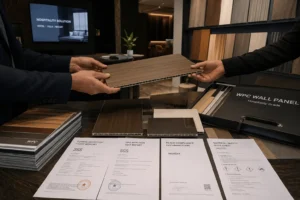
A qualified supplier provides, without being asked: current formaldehyde emission test certificates (third-party, within the last two years), fire reaction test certificates matching the product and thickness specified, REACH compliance documentation, MSDS for the product, and dimensional and mechanical property specifications. If a supplier requires significant prompting to produce this documentation, or cannot produce any of it, treat this as a qualification failure.
Product consistency and quality control
For hotel and villa projects with multiple identical units, product consistency across batches is critical. Ask the supplier about their quality control process: what parameters are tested on each production batch, what the tolerance ranges are for density, thickness, and emission levels, and what the procedure is if a delivered batch falls outside specification. A supplier with a robust QC process can answer these questions directly and in detail.
Technical support capability
Hospitality specifications often involve non-standard board dimensions, specific surface preparation requirements for particular finishes, or integration with MEP systems (acoustic panels, wall-mounted fixtures). A technically capable supplier provides application guidance, works with your fabricator to optimize the specification for the surface finish being applied, and can advise on installation methods for wet area applications. Technical depth in the sales and support team is a reliable indicator of product quality.
Supply chain transparency
For sustainability-sensitive hotel brands and villa developers who need to report on material provenance as part of LEED, BREEAM, or WELL certification programmers, supplier transparency about raw material sourcing — polymer origin, wood fiber certification (FSC/PEFC), and manufacturing location — is a specification requirement. A supplier who cannot provide this information is not aligned with the transparency standards of premium hospitality development.
Reference projects in comparable contexts
The most direct evidence of a WPC substrate supplier’s suitability for hotel and villa work is a portfolio of completed projects in comparable environments. Ask for references in hospitality or high-specification residential applications — not just commercial or residential volume projects. If possible, request to visit or inspect a completed installation using the same product you are considering specifying.
9. Frequently Asked Questions
Can WPC substrate be used in hotel rooms with LEED or WELL certification targets?
Yes, with the right product selection. LEED v4 credits for indoor air quality (EQ Credit: Low-Emitting Materials) require products to meet specified VOC and formaldehyde emission limits. WPC substrate certified to E0 or GREENGUARD Gold typically satisfies these requirements. WELL Building Standard targets for air quality similarly reward low-emission materials. Confirm with your LEED or WELL consultant which specific emission thresholds apply to the product category being specified, and obtain manufacturer documentation confirming compliance before submitting for credit.
Is WPC substrate suitable for use in hotel rooms targeting a five-star rating?
Yes, and it is increasingly specified in five-star hotel projects — particularly for bathroom vanity carcasses, wardrobe systems, and wall panel substrates in humid environments. Five-star hotel specification typically requires E0 formaldehyde emission, Class B1 fire performance, third-party certification, and a surface finish quality appropriate for premium interior design. WPC substrate from a quality manufacturer meets all of these requirements and delivers durability advantages that traditional substrates do not.
How does WPC substrate perform in tropical hotel environments?
WPC substrate performs exceptionally well in tropical environments — this is one of its strongest application contexts. The combination of high heat, high humidity, and seasonal rainfall that characterises tropical hotel locations accelerates the failure of moisture-sensitive substrates. WPC substrate’s low water absorption and dimensional stability under humid conditions means it maintains its shape, surface adhesion, and structural integrity in conditions that would cause significant degradation in MDF or particleboard over one to three years.
What is the expected lifespan of WPC substrate in a hotel application?
When correctly specified and installed, quality WPC substrate should last the full design life of the interior fit-out — typically 10 to 15 years in a hotel environment before a full refurbishment cycle. In wet area applications where traditional substrates would typically fail within three to five years, the lifespan advantage of WPC substrate is particularly significant. Longevity is directly affected by product quality, surface finish selection, installation method, and the intensity of use — a high-occupancy hotel will place more demand on materials than a private villa.
Can WPC substrate be painted or finished in the same way as MDF?
WPC substrate can be finished with lacquer, veneer, HPL, PET film, and decorative paper — but it behaves differently from MDF in some finishing processes. It has lower surface porosity than MDF, which means it accepts paint and primer differently; some primers specifically formulated for low-porosity surfaces or plastic substrates may be required for best adhesion. The surface of WPC substrate is also harder than MDF, which affects sanding and routing behaviour. Confirm the finishing method with both the substrate manufacturer and the finish supplier before finalizing the specification.
Does WPC substrate off-gas more at higher temperatures, such as in rooms with underfloor heating?
The thermoplastic component of WPC substrate has a higher thermal stability than the urea-formaldehyde adhesives used in traditional substrates, so elevated temperatures have a less significant impact on formaldehyde emission from WPC (which is already very low) than from MDF or particleboard. For applications involving underfloor heating, confirm with the manufacturer the product’s thermal stability range and any maximum temperature limits for sustained contact. Ensure that the surface finish applied over the substrate also complies with the thermal requirements of the application.
Conclusion: Safe by Specification, Not by Assumption
WPC substrate is one of the safest interior substrate options available for hotel and villa interiors — but only when it is sourced from a manufacturer who can demonstrate that safety through certified, independently verified testing. The material’s inherent characteristics — low or zero formaldehyde emission, moisture and mold resistance, dimensional stability, and compatibility with flame-retardant treatment — make it well-suited to the demanding performance requirements of hospitality environments. But those characteristics are only reliable when the product has been made to the specification that achieves them.
The practical implication is straightforward: do not specify WPC substrate based on a product name or a marketing description. Specify it based on a test certificate, a fire rating, a compliance declaration, and a supplier who can support your project with the technical documentation required to stand behind every element of the material safety case.
If you are currently specifying a hotel or villa project and want to understand whether a specific WPC substrate product meets your safety and performance requirements — or if you are looking for a supplier who can provide certified, hospitality-grade WPC substrate with full documentation — the right next step is a direct conversation with a specialist.
| 📩 Request a Certified Product Sample and Technical Documentation Our WPC substrate products are supplied with full third-party certification — E0 formaldehyde emission certificates, fire reaction test reports, REACH compliance documentation, and MSDS sheets — as standard. We work with architects, interior designers, hotel developers, and procurement teams on projects across the hospitality and luxury residential sectors. If you are specifying WPC substrate for a current project and need certified product data, application guidance, or a competitive quotation for your volumes, contact our technical team today. We respond to project enquiries within one working day. |