Table of Contents
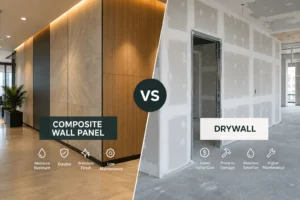
Picture this: you’re planning a commercial fitout or renovation, the spec sheet lands on your desk, and there it is again — the same old default: drywall. It’s what your grandfather’s contractor used. It’s what every budget estimate includes by default. But is it actually the best choice for your walls — or just the most familiar one? Because here’s what too few project managers and designers ask upfront: what happens to that drywall in three years when a trolley clips the corner, when a pipe leaks behind it, or when a client demands a premium finish that paint simply can’t deliver? The materials world has moved on. Composite wall panels have entered the conversation — and they’re winning contracts that drywall used to own by default. This article gives you the no-spin answer to whether composite wall panel is genuinely better than drywall, and exactly when each material earns its place.
The Direct Answer: Composite Wall Panel vs Drywall
Yes — for most commercial, hospitality, healthcare, and high-traffic residential applications, composite wall panels are the superior choice over standard drywall. Composite wall panels outperform drywall on moisture resistance, impact durability, long-term maintenance cost, and surface finish quality. Drywall remains the cost-effective default for standard residential construction and low-traffic interiors where budget efficiency takes priority over long-term performance. The decision ultimately hinges on three variables: the intensity of use, the presence of moisture, and the total cost of ownership model over the building’s occupied life.
Understanding the Two Materials
What Is a Composite Wall Panel?
A composite wall panel is an engineered interior or exterior wall surfacing product made by combining two or more distinct materials to achieve a performance profile that no single component could deliver alone. Unlike traditional single-material wall claddings, composite panels are deliberately engineered for specific performance targets.
The main composite wall panel families used in commercial and residential construction today include:
- High-Pressure Laminate (HPL) panels: dense, thermosetting panels made from resin-impregnated paper compressed under extreme heat and pressure — the premium choice for hygienic wall cladding in healthcare, hospitality, and commercial interiors.
- Aluminium Composite Material (ACM) wall panels: two thin aluminium skins bonded to a polyethylene or mineral core — widely used for both interior feature walls and external facade applications.
- Wood-Plastic Composite (WPC) wall panels: cellulose fibre and thermoplastic polymer panels offering a natural aesthetic with significantly improved moisture tolerance compared to solid timber.
- Fibre Cement Composite panels: cement-based boards reinforced with cellulose fibres — durable, moisture-resistant, and appropriate for both wet area and external applications.
- PVC Composite wall panels: lightweight, fully waterproof, and cost-effective — often specified for wet rooms, commercial washrooms, and budget fitouts.
What all composite wall panels share is a designed, engineered performance logic. They are manufactured to specific tolerances, tested to recognised standards, and supplied with technical data sheets. That predictability is their commercial advantage.
What Is Drywall (Gypsum Board)?
Drywall — also known as gypsum board, plasterboard, or Sheetrock (a US brand name) — is a sheet material made from a gypsum plaster core sandwiched between two sheets of paper facing. It has been the dominant interior wall material in residential and light commercial construction since the mid-20th century, largely because of its low cost, ease of installation, and ready availability.
Standard drywall is produced in several variants:
- Standard (white board): the workhorse residential product — appropriate for low-humidity, low-impact interior walls and ceilings.
- Moisture-resistant (green board): modified with water-resistant facing paper and core additives — suitable for kitchen and bathroom areas with indirect moisture exposure.
- Fire-rated (Type X): a thicker, denser board with glass fibre additives providing improved fire resistance — used in fire-rated wall and ceiling assemblies.
- Impact-resistant drywall: reinforced with fibreglass mesh or denser gypsum for improved durability — used in hallways, stairwells, and commercial corridors.
Drywall’s core advantage is economies of scale: it is mass-produced, universally stocked, and installed by most framing contractors without specialist training. Its core limitation is that gypsum, by its nature, is vulnerable to moisture, impact damage, and heavy surface loads — and when damaged, drywall does not self-recover.
7 Critical Factors: Composite Wall Panel vs Drywall
1. Moisture & Water Resistance
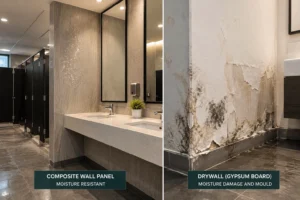
Moisture management is the single most consequential performance difference between composite wall panels and drywall — and the factor that drives the most expensive remediation failures when the wrong material is specified.
Drywall’s Moisture Vulnerability
Standard gypsum board has near-zero moisture tolerance. Even moisture-resistant (green board) drywall is vulnerable to prolonged or direct water contact — the gypsum core will absorb moisture, lose structural integrity, and support mould growth. Mould remediation behind drywall in commercial properties is one of the most costly and disruptive building failures. Walls that seem dry at the surface often conceal saturated gypsum behind tile or paint finishes after pipe leaks, steam exposure, or flooding events.
Even in areas not directly wet — commercial kitchens, gym changing rooms, hotel bathrooms, school washrooms — elevated ambient humidity causes progressive damage to standard drywall systems over time.
Composite Panel Performance
Most composite wall panel products are engineered specifically to address moisture. PVC composite panels are fully waterproof — they will not absorb water under any condition. HPL panels have water absorption rates of less than 3% under EN 438 testing — a negligible figure in any practical application. Fibre cement and ACM composite panels are also designed to perform in wet and humid environments without structural degradation, mould growth, or surface delamination.
In wet areas — commercial washrooms, hotel bathrooms, swimming pool surrounds, catering facilities, and healthcare environments — composite wall panels are not simply the better choice. They are the professionally responsible choice.
Verdict: Composite wall panels win decisively on moisture resistance. In any environment with sustained humidity, condensation, steam, or splash risk, drywall is the wrong specification. This single factor alone eliminates drywall from consideration in a significant proportion of commercial applications.
2. Durability & Impact Resistance
Commercial and high-traffic environments punish walls in ways that residential construction rarely anticipates. Trolleys in hospital corridors. Chairs pushed back against restaurant walls. Luggage trolleys in hotel lobbies. Cleaning carts in school hallways. Standard drywall is not designed for this environment.
Drywall Durability Limitations
Standard drywall at 12.5mm thickness has an inherent brittleness that makes it vulnerable to puncture, denting, and corner damage. Even impact-resistant drywall (with embedded fibreglass) has a Vickers hardness of around 10–20 HV — soft by any engineered material standard. A significant corner impact will chip or crack drywall, creating a damage pathway that is difficult to repair invisibly and, if unrepaired, allows progressive moisture ingress. Screw fixings in drywall have limited pull-out strength, restricting the weight of items that can be surface-mounted.
Composite Panel Durability
HPL composite wall panels, for example, have a surface hardness of 85–100+ on the Rockwell hardness scale — substantially harder than any drywall variant. They resist scratching, abrasion, and impact at levels that are measurably appropriate for heavy-use commercial environments. ACM panels resist denting and deformation well due to the composite skin-and-core structure. WPC panels resist both impact and moisture simultaneously. Damaged sections of composite panel systems can typically be individually replaced without affecting surrounding panels — unlike drywall repairs that require feathering, skim-coating, and full-wall repainting for an invisible result.
Verdict: Composite panels win on impact and abrasion resistance. For commercial corridors, hospitality fitouts, healthcare facilities, and any environment with regular physical wear, composite panels significantly outperform drywall in durability and damage recovery.
3. Aesthetics & Design Flexibility
The aesthetic argument for composite wall panels has grown dramatically stronger as digital printing and surface technology have advanced. The design possibilities now extend well beyond what a painted drywall surface can achieve.
Drywall Aesthetics
Drywall’s finished surface is, ultimately, a painted or tiled substrate. The quality of the final appearance depends on the skill of the plasterer and painter, the number of skim coats applied, the paint system selected, and the maintenance history of the wall. Fresh, well-finished painted drywall looks clean and professional. But it shows scuffs, marks, and touch-up patches over time — especially in commercial environments. High-gloss finishes are unforgiving of surface imperfections. Achieving a flat, seamless appearance on large wall areas requires highly skilled tradespeople and significant preparation time.
Composite Panel Aesthetics
Composite wall panels are available in an enormous and growing range of surface finishes: solid colours across the full Pantone spectrum, digital-print wood-grain, marble, terrazzo, concrete, and stone simulations, brushed and polished metallic finishes, anti-fingerprint matte surfaces, anti-graffiti coatings, and bespoke printed patterns. Crucially, the panel surface is manufactured to a consistent finish standard across the entire batch — there are no painter-skill variables, no patchy repainting zones, and no visible repair patches. The panel arrives at site ready to install with its final surface finish already applied and protected.
For design-led commercial fitouts — hospitality environments, premium retail, branded office interiors, and healthcare spaces — the aesthetic breadth and consistency of composite wall panels provide a material advantage that painted drywall cannot match.
Verdict: Composite panels offer far greater design range and finish consistency. Drywall remains perfectly adequate for standard commercial offices and residential interiors where painted finish is the design intent. For premium fitouts, composite panels deliver a quality level that painted drywall cannot reliably reach.
4. Installation Speed & Cost
Cost is always a primary project variable, and the composite vs drywall comparison requires separating installation cost from total cost of ownership — because the numbers look very different depending on the time horizon.
Drywall: Lower Upfront Installation Cost
Drywall is almost always less expensive per square metre to supply and install than composite wall panels. Standard 12.5mm gypsum board typically costs $8–$18/m² supply-only in most markets. Full installation including framing, boarding, taping, jointing, and painting commonly ranges from $40–$90/m² depending on finish quality and market. This low initial cost is the central reason drywall has dominated residential and light commercial construction for decades — it is a fast, scalable, and cost-efficient system when priced on day-one economics alone.
Composite Panels: Higher Upfront, Lower Lifecycle Cost
Composite wall panels carry a higher supply cost: HPL panels range from $35–$120/m², ACM panels from $25–$80/m², and premium architectural composite panels can exceed $150/m². Installed costs including subframe, adhesive or mechanical fixings, and silicone detailing typically range from $80–$200/m². However, composite panels arrive with their final finished surface — eliminating the skim, tape, primer, and paint stages of the drywall process. On large commercial fitouts, this finish-trade saving can partially offset the material cost premium.
The more significant financial comparison is lifecycle cost. Composite panels require no repainting, have minimal maintenance requirements, and sustain their appearance under normal commercial conditions for 15–25 years. Drywall walls in commercial environments typically require repainting every 3–5 years (more frequently in high-traffic zones), and damaged sections require skilled repair and full-wall repainting to achieve a seamless result. Over a 15–20 year building lifecycle, composite panels frequently deliver 25–40% lower total cost than repaint-maintained drywall in commercial settings.
Verdict: Drywall wins on upfront installation cost. Composite panels win on 15–20 year lifecycle cost in commercial applications. For budget-constrained residential projects, drywall is the economically rational choice. For commercial projects evaluated on lifecycle economics, the composite panel case is compelling.
5. Fire Safety & Acoustic Performance
Both material families have relevant fire and acoustic performance characteristics, though with meaningful nuances that affect specification decisions in regulated building types.
Fire Performance
Type X fire-rated gypsum drywall is a well-established and code-compliant system for achieving fire-resistance-rated wall and ceiling assemblies. 15.9mm Type X drywall in a steel-stud partition assembly can achieve one-hour fire ratings (2-hour with double layers). This is a mature, tested, and widely accepted fire engineering approach that forms the backbone of commercial building fire compartmentation in most markets.
Composite wall panels vary significantly in fire classification. Standard HPL panels with a combustible core achieve Euroclass B or C classifications. Mineral-core ACM panels and fibre cement composite panels can achieve Euroclass A2 — effectively non-combustible — and are appropriate for use in high-rise buildings and fire-regulated public interiors. When composite panels are used over drywall substrates (a common hybrid approach), the fire performance of the drywall substrate can be leveraged for the assembly rating while the composite provides the finished surface.
Acoustic Performance
Standard gypsum drywall is surprisingly effective at sound attenuation, particularly in double-layer or resilient-channel configurations. Acoustic drywall products (such as laminated damping-layer boards) can achieve Rw values of 50–65dB in tested partition assemblies — a strong acoustic performance profile that composite panels on their own cannot match. For open-plan offices, apartment party walls, and meeting room partitions requiring acoustic performance, drywall or drywall-based assemblies remain the specification standard.
Verdict: Type X drywall maintains a strong position in fire-rated assemblies and acoustic partitions. For non-combustible surface cladding requirements, mineral-core composite panels provide the appropriate fire rating. Many commercial projects use composite panels as a surface finish over fire-rated drywall — capturing the performance benefits of both systems.
6. Maintenance & Long-Term Performance
For commercial property owners and facility managers, maintenance is not a secondary concern — it is a direct operating cost that compounds over the building’s life.
Drywall Maintenance Reality
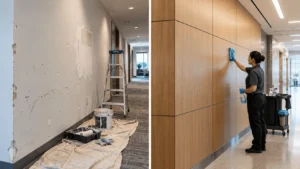
In commercial environments, painted drywall walls require a proactive maintenance programme to remain presentable. High-traffic areas — corridors, lift lobbies, stairwells, reception areas — typically require touch-up painting within 6–12 months of occupancy and full repaints within 3–5 years. Invisible repairs of significant damage (scuffs, indentations, punctures) require skimming, sanding, priming, and full-width painting to avoid visible patch marks. In healthcare and food service environments, drywall surfaces cannot be cleaned with the chemical disinfectants required for infection control without progressive surface degradation.
Composite Panel Maintenance Advantages
Quality composite wall panels are designed for minimal-intervention maintenance. HPL panels can be cleaned with strong disinfectants, making them standard in hospital wards, commercial kitchens, and food preparation areas. Minor scuffs on most composite surfaces can be cleaned without visible marking. Panels that are significantly damaged can typically be individually replaced without affecting adjacent panels — a single-panel swap rather than a full-wall repaint. Surface finishes on quality composite panels are manufactured to resist UV yellowing, chemical attack, and abrasion under normal commercial use for 15–20 years or more.
Verdict: Composite wall panels win decisively on long-term maintenance cost and operational simplicity. For commercial and institutional building owners evaluating total cost of occupancy, the maintenance differential is one of the strongest arguments for specifying composite panels in high-use areas.
7. Sustainability & Environmental Impact
Sustainability considerations increasingly influence material specification decisions, particularly for projects targeting green building certifications such as LEED, BREEAM, or WELL.
Gypsum Drywall Sustainability Profile
Gypsum is an abundant mineral with a relatively low embodied energy — standard drywall has a modest embodied carbon footprint compared to many engineered materials. Many manufacturers now use synthetic gypsum recovered from industrial processes (particularly from power station flue gas desulphurisation), improving the recycled content story. Drywall is recyclable at end of life and accepted at specialist recycling facilities in most markets. However, landfill contamination from mixed-waste drywall disposal remains a challenge on many demolition projects.
Composite Panel Sustainability Profile
The sustainability profile of composite wall panels varies significantly by product type. HPL panels have a higher manufacturing energy intensity than gypsum board, though their extended service life (15–20+ years without replacement) improves their lifecycle carbon impact considerably. ACM panels with high recycled aluminium content offer strong recyclability credentials — aluminium is infinitely recyclable with significant energy savings versus primary production. WPC panels made from recycled wood fibre and recycled thermoplastics present a compelling recycled-content and circular-economy narrative.
Durability is itself a sustainability virtue: a composite panel that does not require replacement or maintenance repainting for 20 years generates significantly less carbon and material waste than a drywall system repainted three times and replaced once over the same period.
Verdict: Standard drywall has lower embodied carbon upfront. Composite panels with recycled content can score well on certification credits, and their extended service life improves lifecycle environmental performance. For LEED or BREEAM materials credits, both can contribute — the specific product and credit pathway determine the better choice.
Side-by-Side Comparison: Composite Panel vs Drywall
| Factor | Composite Wall Panel | Drywall (Gypsum) | Winner |
| Moisture Resistance | Fully waterproof to water-resistant | Vulnerable; requires moisture-rated variant | Composite |
| Impact Durability | High; scratch & dent resistant | Low to moderate; brittle; dents & cracks | Composite |
| Aesthetics | 1000s of finishes; consistent quality | Paint finish; skill-dependent; shows wear | Composite |
| Upfront Cost | Higher ($35–$200/m² installed) | Lower ($40–$90/m² installed) | Drywall |
| Lifecycle Cost | Low; no repainting; 20+ yr performance | Ongoing repaints every 3–5 yr; patch repairs | Composite |
| Maintenance | Wipe-clean; chemical-resistant; easy swap | Requires professional repair; repainting | Composite |
| Fire Performance | A2 rated options available (mineral core) | Type X assembly-rated; proven system | Even |
| Acoustic Performance | Limited on its own; pairs with substrate | Strong in tested assemblies; industry standard | Drywall |
| Installation Speed | Panels ready-finished; fewer trades | Multiple trades: frame, board, tape, paint | Composite |
| Sustainability | Recycled content; durable lifecycle | Low embodied C; recyclable at EOL | Even |
| Wet Area Suitability | Excellent; specified standard for wet zones | Poor to moderate; not recommended in wet areas | Composite |
| Repair & Replacement | Individual panel swap; finish matched | Skim, sand, prime, paint; patch visible | Composite |
Which Is Better for Your Project Type?
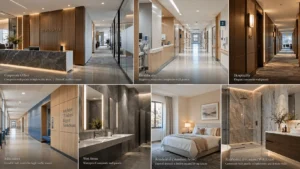
The composite vs drywall decision often resolves itself once you know exactly where and how the walls will be used. Here is how the specification decision maps across the most common project types.
Commercial Offices & Corporate Interiors
Standard painted drywall remains a practical and cost-effective choice for low-traffic office partitioning — meeting room walls, private offices, and general open-plan divisions where physical wear is limited. For high-traffic commercial zones — reception desks, lift lobbies, break room walls, and main circulation corridors — composite panels offer a significantly better durability and presentation outcome. Premium corporate fitouts increasingly specify composite wall panels as feature elements in reception areas and boardrooms, combining the finish quality of composite with the acoustic performance of drywall partitioning behind it.
Healthcare Facilities & Hospitals
Drywall has no place on clinical walls where hygiene standards demand regular chemical disinfection. Healthcare environments require wall surfaces that can be cleaned with industrial disinfectants without surface breakdown, that resist impact from hospital beds, trolleys, and equipment, and that do not support mould or bacterial growth behind the surface. HPL composite wall panels — particularly those with antibacterial surface treatments — are the specification standard for ward walls, treatment rooms, corridors, and procedure areas. Moisture-resilient, impact-resistant, and hygienic: composite panels check every clinical box that drywall cannot.
Hospitality: Hotels, Restaurants & Bars
Hospitality environments demand finishes that maintain their premium appearance under constant guest contact, cleaning regimes, and furniture impact. Painted drywall in a hotel corridor shows damage and wear within a single operating year. For guest room bathrooms, wet areas, and splash zones, standard drywall is simply the wrong substrate. Composite wall panels — in the wide range of timber, stone, and textile-simulated finishes now available — deliver the design quality that hospitality brands require and the durability that operational teams need. Many leading hotel chains now mandate composite wall panels in wet zones, and strongly recommend them for high-traffic circulation areas.
Education: Schools & Universities
Educational environments are among the most physically punishing for wall surfaces — students are not gentle. Drywall in a school corridor will need repainting within 12–18 months and shows damage within weeks of occupancy. Impact-resistant composite wall panels on corridor walls, common areas, and stairwells dramatically reduce the maintenance burden for facilities teams, while delivering a cleaner, more presentable environment for students. For science laboratories, commercial kitchens (food technology), and art rooms with chemical and moisture exposure, composite panels are the safe and practical specification.
Wet Areas: Bathrooms, Showers & Commercial Kitchens
This is the clearest specification scenario of all. In any environment with sustained moisture, direct water contact, or steam exposure, composite wall panels are the correct material and drywall is the incorrect one. Commercial kitchen walls require panels that can withstand high-pressure washing, heat, steam, and grease. Bathroom and shower surrounds require fully waterproof surfaces without grout lines that harbour mould. Swimming pool changing rooms require surfaces that perform in permanently humid, chlorine-rich environments. Composite panels — particularly PVC, HPL, and fibre cement variants — are engineered for exactly these conditions. Drywall in these environments is a liability.
Residential Applications
For standard residential construction — bedrooms, living rooms, hallways, and standard bathrooms tiled to code — drywall remains the dominant and largely appropriate choice. The combination of low cost, speed of installation, and the residential expectation of periodic repainting makes drywall the logical specification for most homes. Where composite panels earn their place in residential applications is in high-specification bathrooms and wet rooms, in feature walls where the design intent is a specific surface quality (timber effect, concrete look, high-gloss finish), and in rental or investment properties where low-maintenance durability over a long tenancy period justifies the upfront cost premium.
The Smart Approach: Using Both Materials Strategically
The most experienced architects and fitout contractors do not frame this as a binary choice. The most cost-effective and performance-optimised commercial interiors use both materials in the zones where each excels.
A typical hybrid strategy works as follows:
- Drywall stud partition for the core structural wall — providing acoustic separation, fire compartmentation (Type X where required), and thermal mass at the lowest material cost.
- Composite wall panel as the surface finish in wet areas, high-traffic zones, and design-feature locations — providing the performance and aesthetic where it is genuinely needed.
- Painted drywall as the finish in low-traffic back-of-house areas, storage rooms, and standard office spaces — where the performance of composite panels is not required and cost optimisation is appropriate.
This targeted specification approach allows project teams to allocate the composite panel budget where it delivers the highest performance return and visible impact, while maintaining overall project cost discipline with drywall in areas where it performs adequately.
Frequently Asked Questions
Can composite wall panels be installed over existing drywall?
Yes — and this is a common retrofit strategy. Composite panels can be bonded directly to sound, flat drywall using specialist construction adhesives or mechanically fixed to a new subframe over the existing wall. Direct bonding eliminates the cost of demolition and wall rebuilding, making composite panel upgrades economically attractive in refurbishment projects. The drywall substrate provides fire performance and acoustic mass, while the composite panel delivers the new surface finish and performance layer.
Are composite wall panels suitable for external walls?
Specific composite wall panel products — particularly ACM panels, fibre cement composite boards, and exterior-grade HPL panels — are designed and tested for external facade applications. Interior-specified composite panels (such as standard WPC or interior PVC panels) are not appropriate for external use without confirming the manufacturer’s weather and UV ratings. Always verify the product’s intended application scope and request relevant test certifications before specifying composite panels externally.
How do you repair a damaged composite wall panel?
The repair process depends on the extent of damage. Minor surface scuffs on most HPL and coated composite panels can be cleaned without visible marking. More significant damage — deep scratches or panel cracking — typically requires individual panel replacement. In click-fit or mechanically fixed panel systems, this is a relatively straightforward single-panel swap. In full-adhesive applications, panel removal requires more care but is still significantly less disruptive than the skim, sand, prime, and paint cycle required for a seamless drywall repair.
Is drywall still required under building codes even when composite panels are specified?
In most jurisdictions, building codes specify fire-resistance and acoustic performance requirements for wall assemblies — not the specific surface materials used. Drywall is the dominant substrate used to achieve tested assembly fire ratings, but other structural and fire-rated substrates are available. In some applications, composite panels with appropriate fire ratings can form the complete wall system. The specific code requirements, assembly test data, and fire engineering strategy for your project should be confirmed with a qualified building certifier.
How to Make the Right Decision for Your Project
Use these four questions to navigate the specification decision efficiently:
Question 1: Is there moisture or humidity exposure?
If yes — any sustained moisture, steam, condensation, or splash risk — specify composite wall panels for those surfaces. Drywall is the wrong material for these zones regardless of variant.
Question 2: What is the traffic intensity and maintenance model?
High-traffic commercial environments with quarterly or annual maintenance budgets benefit significantly from composite panels. Low-traffic residential and office environments where periodic repainting is acceptable can be appropriately served by drywall.
Question 3: What is the budget evaluation horizon?
If the project is evaluated on day-one capital cost, drywall wins. If it is evaluated on 15–20 year total cost of ownership, composite panels win in most commercial applications. Ensure the correct financial model is being applied to the specification decision.
Question 4: Does the design intent demand a specific surface quality?
If the design requires a premium or distinctive surface finish — timber effect, stone simulation, metallic, high-gloss, or bespoke printed — composite panels can deliver this directly. Achieving comparable results with painted drywall requires skilled plasterers, multiple coat systems, and ongoing maintenance to preserve the appearance.
Get Expert Guidance on Your Next Wall Specification
The composite panel vs drywall question has a clear answer once the project context is understood. What takes the decision from good to excellent is the right product selection, the right system detail, and the right supplier behind the specification.
Whether you are fitting out a commercial office, designing a healthcare facility, delivering a hotel refurbishment, or upgrading a residential bathroom, the wall panel decision you make now determines the maintenance budget, the guest experience, and the building’s presentation for the next 15–20 years.
Request Your Free Sample Pack & Project Consultation
Our wall panel specialists will review your project brief, recommend the right composite panel system, and provide full technical documentation, fire certifications, and physical samples — all at no cost.
Send an enquiry today. Our team responds within one business day.
The bottom line: composite wall panels are the better-performing specification in most commercial environments. Drywall remains the rational cost-choice for low-traffic, low-moisture residential and back-of-house applications. The professionals who specify most effectively are those who understand both materials well enough to deploy each where it genuinely excels — and who partner with a supplier capable of delivering product, system, and technical support in a single relationship.