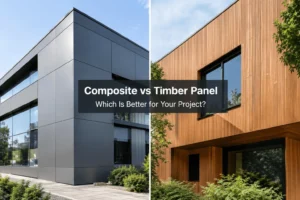
You’re standing in front of a building elevation, scrolling through a material supplier’s catalogue, and the same question keeps surfacing: composite or timber panel? Both look striking in the renders. Both have vocal supporters across the architecture and construction world. But when you’re making a decision that will define how a building looks, performs, and costs over the next two to three decades, “both look great” is nowhere near good enough. Choose wisely, and you earn lower maintenance bills, smoother contractor relationships, and clients who keep coming back. Choose poorly, and the problems start showing — sometimes within a single winter season. This article is the honest, no-spin comparison that most suppliers won’t give you.
The Direct Answer: Composite vs Timber Panel
For most modern commercial and residential projects, composite panels are the stronger overall choice. They deliver superior dimensional stability, longer service life with minimal upkeep, and consistent design performance across climates. Timber panels, however, hold a clear edge in natural aesthetic authenticity, biophilic design applications, and certain carbon-sequestration arguments. The definitive answer depends on four project-specific factors: climate exposure, budget model (upfront capital vs. lifecycle cost), design intent, and your sustainability certification target. Read on — every factor is broken down below.
Understanding the Two Materials
What Is a Composite Panel?
A composite panel is an engineered building material made by bonding two or more distinct materials to achieve performance properties that neither component could deliver alone. The most common architecturally specified variants include:
- Aluminium Composite Material (ACM/ACP): thin aluminium skins bonded to a polyethylene or mineral core — the industry workhorse for commercial facades.
- Wood-Plastic Composite (WPC): recycled wood fibre combined with thermoplastic polymers — widely used for decking and exterior cladding.
- Fibre Cement Composite Panels: cement reinforced with cellulose fibres for a mineral-look finish that resists moisture and fire.
- High-Pressure Laminate (HPL) Panels: resin-impregnated paper layers compressed under extreme heat and pressure — exceptional for feature facades and interior applications.
What unites all composite panels is the engineering principle: components are selected and combined specifically to control weight, strength, thermal movement, fire performance, and surface quality. The result is a material that is highly predictable — which is precisely what large-scale construction projects demand.
What Is a Timber Panel?
Timber panels are solid wood or engineered wood products used as cladding, feature walls, or structural panels. Key categories include:
- Solid timber cladding: planks or boards of species such as cedar, larch, Accoya, or thermally modified pine — prized for their natural grain and warmth.
- Cross-Laminated Timber (CLT): structural solid-wood panels made from layers glued at right angles — relevant for structural wall and floor applications.
- Glulam & LVL panels: laminated veneer products offering improved stability over solid timber.
- Thermo-treated timber panels: timber modified at high temperature to reduce moisture uptake and biological degradation — extending service life considerably.
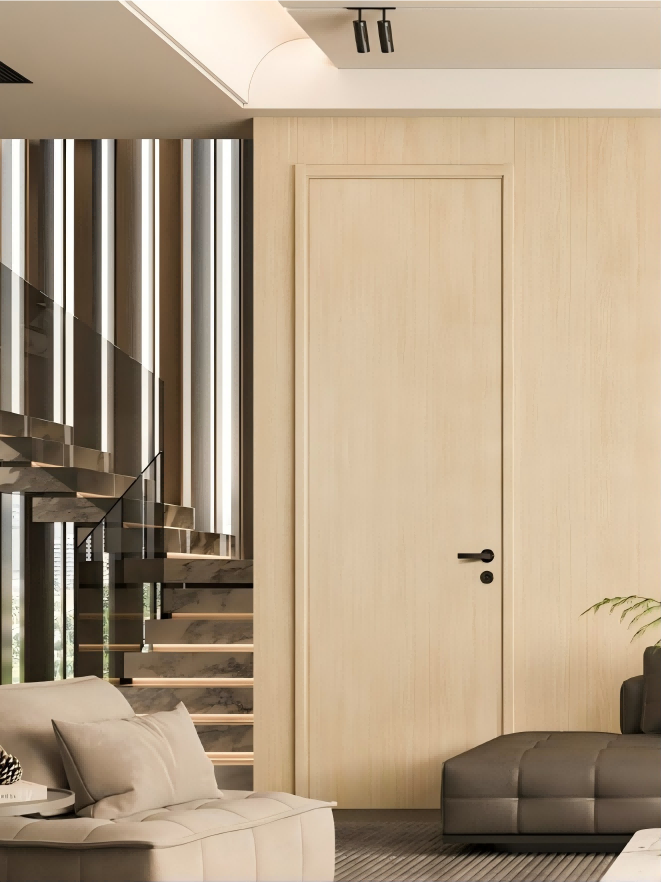
Timber’s appeal is deeply human. No manufactured surface fully replicates the tactile warmth, the grain variation, or the olfactory quality of real wood. For architects pursuing wellness-centred or biophilic design, timber often becomes a non-negotiable specification. The question is always whether the project environment and budget can support that choice responsibly.
The 7 Key Comparison Factors
1. Durability & Weather Resistance
Durability is the first metric that determines a material’s true value over time. In climates with significant temperature swings, UV exposure, moisture cycling, or coastal salt spray, material behaviour diverges dramatically.
Composite Panels
Aluminium composite panels, for example, exhibit a linear thermal expansion coefficient of approximately 23 µm/(m·°C) — predictable and manageable with standard joint detailing. Quality ACM systems carry 15–25 year performance warranties. Fibre cement and HPL composite panels are dimensionally more stable still, showing minimal moisture-related movement. Many composite products are warranted against delamination, colour fade, and mechanical degradation under standard use conditions.
Timber Panels
Natural timber expands and contracts with moisture — tangential movement in common species like European spruce can exceed 1% per 1% change in moisture content. Untreated or under-maintained timber in exposed facades can develop checking (surface cracking), biological growth (algae, mould, fungi), and colour graying within 2–5 years. Thermally modified timber and species like Accoya significantly improve this — Accoya, acetylated to reduce hygroscopicity, is warranted for 50 years above ground. However, even premium timber requires more careful detailing and periodic inspection.
Verdict: Composite panels win on predictability and low-maintenance durability. Premium treated timber can match composite longevity, but demands more design care and maintenance investment.
2. Aesthetics & Design Flexibility
Aesthetics are highly subjective, yet they drive specification decisions more than any other single factor in architecture. Both materials offer genuine design strengths — in different registers.
Composite Panels
Modern composite panels are available in thousands of finishes: solid Pantone-matched PVDF coatings, brushed and anodised metallics, digital-print naturalistic wood and stone simulations, terrazzo-look surfaces, and high-gloss architectural lacquers. The surface finish is repeatable and consistent across large areas — a major advantage on multi-storey facades where panel-to-panel colour variation would be visible and problematic. CNC routering allows complex shapes, curves, and perforation patterns that are difficult to achieve economically in solid timber.
Timber Panels
No composite surface fully reproduces the depth, variation, and sensory experience of real timber. For interior feature walls, reception areas, high-end residential cladding, and heritage-sensitive projects, the authenticity of timber is irreplaceable. Grain, knots, and natural colour shift give each installation a unique character. Timber also ages gracefully when properly specified — silvering cedar on a coastal retreat becomes a design feature, not a failure.
Verdict: Composite panels excel in large-scale consistency and finish variety. Timber panels win on authenticity, sensory richness, and biophilic quality. Many premium projects combine both strategically.
3. Cost: Upfront vs. Lifecycle
Cost comparisons between composite and timber panels are frequently misrepresented because they focus only on supply price rather than total cost of ownership over a building’s operational life.
Initial Material & Installation Cost
Standard ACM composite panels typically range from $25–$65/m² supply-only, while premium HPL and fibre cement composites can reach $80–$150/m². Entry-level treated timber cladding begins around $30–$60/m², but premium thermally modified or certified hardwood species can exceed $120–$200/m². Installation costs are broadly comparable, though complex composite cassette systems on large commercial facades may require specialist subcontractors, adding to the installed cost.
Lifecycle Cost (20–30 Year Horizon)
This is where the comparison shifts significantly. Quality composite panels require minimal maintenance — typically annual cleaning and periodic inspection of sealants. Timber panels in exposed external applications commonly require oiling, staining, or recoating every 3–5 years, with repainting or replacement of damaged boards adding further cost. A lifecycle cost analysis on a 1,000 m² commercial facade over 25 years will often show composite panels delivering 30–50% lower total cost of ownership than untreated or moderately treated timber.
Verdict: Timber may appear cheaper upfront for residential applications. Over a 20-30 year commercial lifecycle, composite panels almost always deliver a lower total cost of ownership.
4. Maintenance Requirements
The maintenance story is one of the clearest differentiators between the two material families — and one of the most commercially important for building owners and facility managers.
Composite Panels
Most composite panel systems are designed to be wash-and-go. Annual cleaning with a mild detergent solution is typically all that is required to maintain appearance and performance. PVDF-coated aluminium composite panels, for example, maintain their gloss level and colour delta within specified tolerances for 15–20 years without recoating. Fibre cement panels may require repainting at 10–15 year intervals, but this is a relatively low-cost and low-disruption operation.
Timber Panels
Timber maintenance is more demanding and more dependent on climate. In humid or wet climates, surface coatings on timber can fail in as little as 2–3 years without maintenance. Untreated timber will grey and check. Biological staining (algae, mould) is a persistent challenge on north-facing or shaded elevations. Maintenance schedules for commercial timber facades typically require specialist access, periodic stripping, re-oiling or re-staining, and individual board replacement as needed. These operations require scaffolding or rope access on multi-storey buildings — adding substantially to maintenance costs and building downtime.
Verdict: Composite panels are the clear winner for low-maintenance building envelopes. If you are specifying for a busy commercial or multi-residential building, the maintenance argument alone may determine the decision.
5. Sustainability & Environmental Impact
Sustainability in building materials is nuanced, and both material camps have legitimate environmental arguments. The conversation requires looking at embodied carbon, sourcing transparency, end-of-life processing, and durability-weighted impact.
The Timber Case
Responsibly sourced timber from certified forests (FSC, PEFC) is a renewable resource and a carbon store. The carbon sequestered during the tree’s growth remains locked in the wood for the product’s service life. For architects targeting low embodied carbon schemes, certified timber is a powerful specification tool. Where timber panels are durable and well-specified, the environmental case is strong.
The Composite Case
Aluminium composite panels carry a significant embodied carbon burden from the aluminium production process. However, aluminium is infinitely recyclable — many panel systems contain high recycled content, and end-of-life aluminium is one of the most effectively recovered construction materials. WPC composite panels made from recycled wood fibre and recycled thermoplastics can present a compelling recycled-content story. Fibre cement composites are inert, long-lived, and fully recyclable at end of life in most jurisdictions.
It is also critical to account for durability-weighted impact: a composite panel that lasts 30 years with one cleaning cycle per year has a significantly better lifetime environmental profile than a timber panel replaced at 15 years with intensive maintenance interventions over its life.
Verdict: Certified timber wins on embodied carbon and renewability. Composite panels with recycled content score strongly on recyclability and durability-weighted lifecycle impact. The right answer depends on your specific sustainability framework (LEED, BREEAM, Living Building Challenge).
6. Fire Safety & Building Code Compliance
Following high-profile building fires in multiple countries, fire performance has become a primary driver in facade specification — and it has fundamentally changed the composite panel market.
Composite Panels
The critical distinction is between standard ACM panels with polyethylene cores and fire-rated mineral-core composite panels. Modern fire-rated composites use a non-combustible mineral core (typically aluminium hydroxide or a similar filler), achieving Euroclass A2-s1,d0 or equivalent non-combustible ratings — compliant with building codes for high-rise and public building facades. Specifying to fire-rated composite is now standard practice on buildings above a specified height in most markets. These panels are available from reputable manufacturers with full EN 13501-1 or ASTM E84 test certifications.
Timber Panels
Natural timber is a combustible material. While fire retardant treatments (FRT) can improve classification to Euroclass B or C, achieving non-combustible ratings with solid timber is not possible. This limits the use of untreated or lightly treated timber on external facades of buildings above specific height thresholds in most international codes. Internally, fire-rated linings, sprinkler systems, and intumescent coatings are commonly used to enable timber in public-facing areas.
Verdict: For buildings above 11m/18m height (jurisdiction dependent), fire-rated mineral-core composite panels are the code-compliant and insurable choice. Timber cladding on mid- to high-rise buildings requires careful fire engineering review.
7. Installation & Workability
Installation efficiency directly affects project schedule and on-site labour cost — factors that matter enormously on commercial projects with tight programmes.
Composite Panels
Modern composite panel systems are designed for speed. Cassette and pressure-equalised rainscreen systems allow large panel areas to be installed efficiently with minimal waste. Panels arrive from the factory pre-cut, pre-routed, and pre-folded where required — reducing on-site fabrication. Levelling systems and clip-based subframes mean skilled installers can achieve consistently flat, aligned facades at pace. Off-site fabrication possibilities further compress programme. Thermal and moisture movement is accommodated within the system design, reducing the risk of installation error.
Timber Panels
Timber cladding installation requires skilled tradespeople familiar with moisture management principles — end-grain sealing, correct fixing zones, and appropriate gap detailing for movement. Individual board replacement when panels are damaged is relatively straightforward. However, ensuring colour consistency across replacement boards (as timber naturally varies) can be challenging. On complex facades with curved surfaces or irregular geometry, bending timber is limited without specialist treatment or lamination.
Verdict: Composite panel systems offer faster installation, lower on-site waste, and more predictable programme outcomes. Timber cladding requires higher skill levels and more careful moisture detailing for reliable performance.
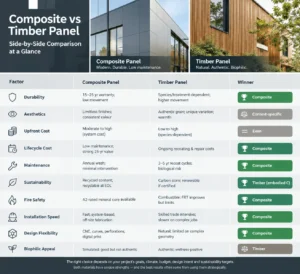
Side-by-Side Comparison at a Glance
| Factor | Composite Panel | Timber Panel | Winner |
| Durability | 15–25 yr warranty; low movement | Species/treatment-dependent; higher movement | Composite |
| Aesthetics | Limitless finishes; consistent colour | Authentic grain; unique variation; warmth | Context-specific |
| Upfront Cost | Moderate to high (system cost) | Low to high (species-dependent) | Even |
| Lifecycle Cost | Low maintenance; strong 25-yr value | Ongoing recoating & repair costs | Composite |
| Maintenance | Annual wash; minimal intervention | 3–5 yr recoat cycles; biological risk | Composite |
| Sustainability | Recycled content; recyclable at EOL | Carbon store; renewable if certified | Timber (embodied C) |
| Fire Safety | A2-rated mineral core available | Combustible; FRT improves but limits | Composite |
| Installation Speed | Fast; system-based; off-site fabrication | Skilled trade intensive; slower on complex jobs | Composite |
| Design Flexibility | CNC, curves, perforations, digital print | Natural; limited on complex geometry | Composite |
| Biophilic Appeal | Simulated; good but not authentic | Authentic; wellness-positive | Timber |
Which Is Better for Your Project Type?
No two projects are identical. Here is how the composite vs timber decision typically resolves across the most common application types:
Commercial & Office Facades
For commercial buildings — offices, retail, hospitality, and public facilities — composite panels are almost always the specification-standard choice. The combination of fire-rated compliance, low maintenance, consistent appearance over large areas, and robust manufacturer warranties makes them the default for professional facades. ACM and HPL panels dominate this sector globally for good reason: they deliver the visual quality and operational performance that commercial clients demand.
High-End Residential Exteriors
Premium residential architecture is the battleground where timber most convincingly competes with composite. A beautifully detailed Accoya or thermally modified larch facade on a bespoke residence delivers character, warmth, and lifestyle appeal that no composite panel fully replicates. If the homeowner understands and accepts maintenance commitments, and the design narrative centres on natural materiality, timber is often the superior specification. Where the homeowner values low maintenance over aesthetic authenticity, a high-quality wood-finish HPL composite offers a compelling middle path.
Interior Feature Walls & Hospitality Fitouts
Interior environments significantly favour timber. Free from the UV, moisture, and temperature extremes of exterior use, timber panels in lobbies, restaurants, retail interiors, and hotel rooms can perform beautifully with minimal maintenance. The warmth, grain, and scent of real timber elevate interior environments in ways that are measurable in occupant wellness scores and brand perception. Here, HPL composites with timber-simulated surfaces serve budget-conscious projects well, while real timber veneer and solid panels serve premium fitouts.
Heritage, Restoration & Conservation Projects
For heritage-sensitive projects, listed buildings, and conservation areas, planning authorities will almost always require the use of traditional materials — and timber is frequently mandated. Composite panels, however skilled the simulation, typically fail planning permission criteria in heritage contexts where material authenticity is a condition of approval. In these applications, the decision is often made for you.
Multi-Residential & Mixed-Use Towers
Fire code requirements and maintenance logistics on multi-storey residential and mixed-use buildings make composite panels the practical and insurable choice in most markets. Accessing and recoating timber cladding on an 8-storey building requires significant scaffolding cost and building downtime — both of which building owners and body corporates strongly resist. Fire-rated composite panel systems with low-maintenance surface finishes are the industry norm in this sector.
How to Make the Right Decision for Your Project
If you have read through the seven comparison factors and still feel uncertain, use this four-question decision framework:
Question 1: What is the building height and fire code classification?
If the building is above your jurisdiction’s threshold for non-combustible external cladding (typically 11m or 18m), specify fire-rated mineral-core composite panels. This is non-negotiable in most markets and should be the first filter applied.
Question 2: Who maintains this building, and what is their maintenance model?
If the end-user is a commercial building owner, strata body, or institutional client with limited appetite for ongoing facade maintenance, composite panels are the correct specification. If the client is a bespoke residential owner who actively values natural materials and accepts a maintenance programme, timber is viable.
Question 3: What is the design narrative and brand intent?
Projects with a biophilic, wellness, or nature-centred design brief benefit from real timber. Projects with a contemporary, technological, or brand-driven facade narrative are well served by composite panels with precision surface finishes. Projects seeking a natural aesthetic without maintenance commitment should evaluate premium wood-effect HPL composites.
Question 4: What sustainability framework applies?
If the project targets LEED, BREEAM, or similar certification and the materials credit strategy centres on responsibly sourced timber, certified timber panels may be the stronger choice. If the strategy focuses on recycled content, recyclability, or durability-weighted lifecycle impact, composite panels with high recycled aluminium or recycled-content cores may score more effectively.
The Importance of the Right Supplier
Material selection is only half the specification decision. The supplier and system behind the panel are equally critical. A correctly specified composite panel from an underqualified supplier — with incomplete fire test documentation, inadequate technical support, or unreliable supply chain — creates risk throughout the project. Equally, a poorly sourced timber panel without valid chain-of-custody certification undermines any sustainability narrative.
When evaluating suppliers for either composite or timber panels, prioritise:
- Third-party test certifications: EN 13501-1 fire classifications, FM Approvals, and relevant local building code compliance documents must be available on request.
- Technical support capability: a reputable supplier provides detailed installation specifications, fixings engineering, and thermal movement calculations — not just a material specification sheet.
- Warranty terms and exclusions: understand exactly what is and is not covered, and verify the supplier has the financial standing to honour long-term warranties.
- Supply chain transparency: for timber, FSC or PEFC chain-of-custody certificates confirm legal sourcing. For composites, request Environmental Product Declarations (EPDs) for embodied carbon data.
- Sample and mock-up service: before committing to a large commercial order, reputable suppliers provide physical samples and support on-site or off-site panel mock-ups for client approval.
Frequently Asked Questions
Can composite panels look as good as real timber?
Modern digital-print and textured HPL composite panels have closed the visual gap significantly — especially when viewed from typical facade viewing distances. For interior applications viewed up close, a trained eye will distinguish between composite simulation and authentic timber. For exterior facades, high-quality composite timber-effect panels are frequently specified successfully.
How long does timber cladding last on an exterior facade?
Service life varies enormously with species, treatment, climate, and maintenance. Standard pine with basic preservative treatment in a temperate climate may show significant degradation within 10–15 years without maintenance. Premium thermally modified timber (e.g., Thermowood) or acetylated timber (e.g., Accoya) can genuinely deliver 30–50 year exterior service life with appropriate maintenance. Climate is the most powerful variable: humid, hot, or coastal environments accelerate deterioration in all timber species.
Are composite panels safe after the high-profile facade fires?
Yes — when correctly specified. The fires that occurred in notable incidents involved ACM panels with combustible polyethylene cores. Fire-rated mineral-core composite panels — manufactured to and tested against Euroclass A2 or equivalent standards — behave very differently and are compliant with current building codes in all major markets. Specification of fire-rated composites from reputable, certified manufacturers is now standard practice and is not a safety concern when done correctly.
Can I combine both composite and timber panels on the same project?
Absolutely — and this is increasingly common in premium architecture. A typical strategy uses fire-rated composite panels for the primary facade field, achieving code compliance and low maintenance across the largest area, while timber panels are deployed as accent elements at ground level, entrance canopies, or feature zones where they can be easily accessed for maintenance and where their authentic character has maximum visual impact. This approach captures the strengths of both materials while managing the risks of each.
Ready to Specify the Right Panel for Your Project?
Every project is different, and the composite vs timber decision deserves a conversation with a specialist who understands your brief, your climate, your budget model, and your compliance obligations. Whether you are specifying a large commercial facade, a premium residential cladding, or an interior feature wall, getting the material selection right at the start is the most cost-effective investment you will make in the project.
Request a Free Sample Pack & Technical Consultation
Our panel specialists will review your project brief and recommend the right composite or timber panel system — backed by full technical documentation, fire certification, and sample materials.
Send an enquiry today — our team responds within one business day.
The composite vs timber panel debate does not have a single winner — it has a right answer for each project. Composite panels lead on durability, maintenance, fire safety, and lifecycle cost. Timber panels lead on authenticity, carbon story, and biophilic design quality. The professionals who specify best are those who understand both materials deeply enough to use each where it genuinely excels — and who partner with suppliers capable of delivering performance as well as product.
If this article has helped clarify your thinking, share it with your team or clients. And if you are ready to move from comparison to specification, contact us today.