Table of Contents
Introduction: Why Wood Species Really Matters
When you’re planning a kitchen remodel, the cabinet material decision is one of the biggest you’ll make — not just aesthetically, but financially and structurally. Cabinets account for roughly 30–40% of a total kitchen renovation budget, and the wood species you choose directly determines how well they hold up to decades of daily abuse: steam from pots, grease splatter, door slams, pet scratches, and the general chaos of family life.
Ash vs Oak kitchen cabinets is one of the most debated comparisons among homeowners, interior designers, and custom cabinet makers. Both are North American hardwoods with long histories in furniture and cabinetry. Both are beautiful. But they behave very differently — in the workshop, under a finish coat, and in a real kitchen environment.
In this guide, we break down every factor that matters: Janka hardness ratings, grain characteristics, moisture behavior, staining and finishing properties, cost per linear foot, and long-term maintenance demands. By the end, you’ll know exactly which wood fits your kitchen, your budget, and your lifestyle.
2 Ash vs Oak: Species at a Glance
Before diving into head-to-head comparisons, it’s important to understand what we’re actually talking about. Both “ash” and “oak” are umbrella terms covering several related species, and the specific variety matters.
🌳 Oak Popular Choice
- Species: Red Oak (Quercus rubra) · White Oak (Quercus alba)
- Janka Hardness: 1,290 lbf (Red) · 1,360 lbf (White)
- Color Range: Warm pink-tan (Red) · Pale golden-brown (White)
- Grain: Pronounced, open grain with medullary rays
- Origin: Eastern North America, Europe
- Best For: Traditional, Craftsman, Farmhouse kitchens
🌲 Ash Underrated Gem
- Species: White Ash (Fraxinus americana) · Green Ash
- Janka Hardness: 1,320 lbf (White Ash)
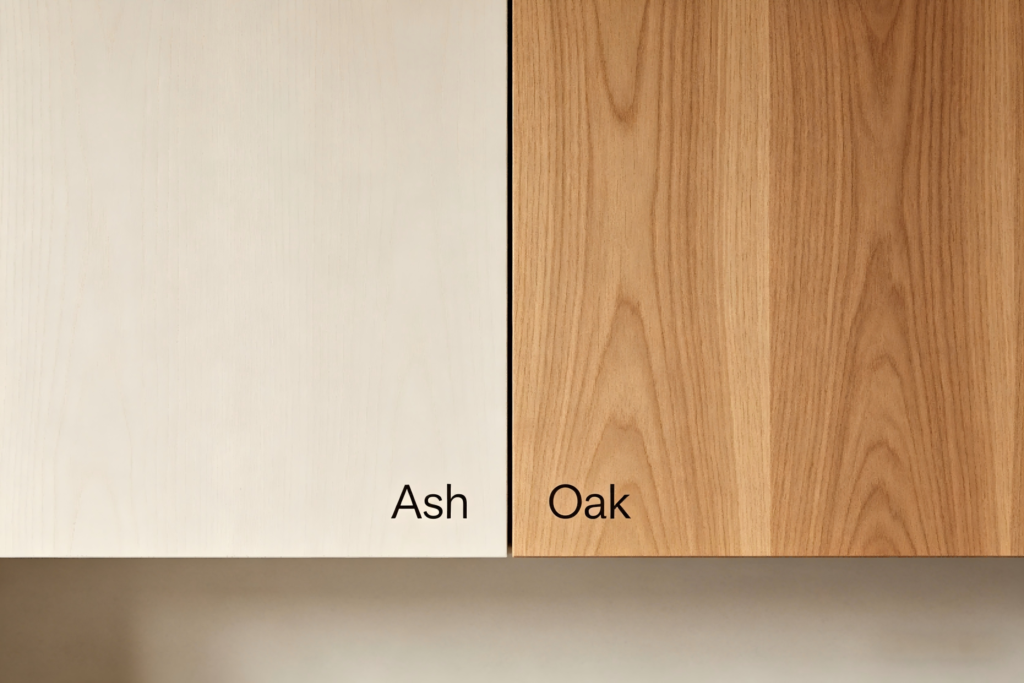
- Color Range: Creamy white to light tan with pale brown heartwood
- Grain: Straight, coarse grain — bold yet clean
- Origin: Eastern North America
- Best For: Contemporary, Scandinavian, Modern Farmhouse kitchens
When getting cabinet quotes, always specify whether you want Red Oak or White Oak, White Ash or Green Ash. Each has meaningfully different properties, and a vague “oak” or “ash” request can result in a substitute you didn’t want.
3 Durability Deep Dive: Janka Hardness & Wear Resistance
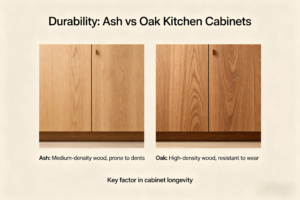
Durability is the central question in the ash vs oak kitchen cabinets debate. The gold standard for measuring wood hardness is the Janka Hardness Test, which measures the force required to embed a steel ball halfway into a wood sample. Higher numbers = harder wood = more resistant to dents and scratches.
Janka Hardness Comparison
The numbers tell a nuanced story. White Oak edges out White Ash by just 40 lbf — a difference so small that in real-world kitchen cabinet use, it’s essentially imperceptible. Both woods are significantly harder than softwoods and sit well above the threshold needed for durable cabinetry.
Shock Resistance: Ash’s Hidden Advantage
Here’s where ash surprises people: while oak has a slight edge in static hardness, ash wood has superior shock and impact resistance. This is why ash has traditionally been used for baseball bats, tool handles, and oars. Its wood fibers have a remarkable ability to absorb and distribute impact energy without cracking or splitting.
In a kitchen context, this means ash cabinet doors and face frames are less likely to crack or chip when they’re slammed shut, when a pan bangs against them, or when they receive point-impact from a ring-laden hand. For families with young children or high-traffic kitchens, this is a meaningful real-world durability advantage.
Scratch Resistance
Oak’s open grain structure actually makes it slightly more susceptible to dirt and fine scratches settling into the grain channels over time. Ash, with its similarly open grain, shares this characteristic. Both woods benefit from proper sealing. In practice, the finish coat matters more than the wood species when it comes to scratch resistance on kitchen cabinets — a quality conversion varnish or catalyzed lacquer on ash will outperform a thin water-based finish on oak every time.
Oak (White Oak) wins on raw Janka hardness by a slim margin. Ash wins on shock and impact resistance. For everyday kitchen use, both are excellent — choose based on other factors like aesthetics and cost rather than durability alone.
4 Grain Pattern, Texture & Aesthetics
This is where ash and oak diverge most dramatically — and where personal preference plays the biggest role in your decision.
Oak’s Distinctive Grain: Character with a Capital C
Oak is famous for its bold, pronounced grain pattern with prominent medullary rays — those distinctive fleck-like markings that appear when oak is quartersawn. Red oak features a warm, pinkish-brown tone that reads as cozy and traditional. White oak leans cooler and greener, with a more refined appearance that has become enormously popular in high-end contemporary design.
Oak’s open grain is wide and visible — you can feel the texture when you run your hand across an unfinished oak board. This grain character is what gives traditional Craftsman and country kitchen cabinets their soul. It’s also what makes oak slightly more challenging to achieve a glass-smooth paint finish on, as the grain can telegraph through paint layers.
Ash’s Grain: Bold Lines, Clean Canvas
Ash has a straight, coarse grain with clearly defined growth rings that create a bold striped pattern. Unlike oak’s complex figure with rays and flecks, ash grain is more linear and architectural. This makes ash an ideal choice for contemporary and Scandinavian kitchen designs where you want visible wood character without the traditional associations that come with oak.
Ash’s lighter base color — creamy white to pale tan — means it reads as brighter and more neutral in a kitchen space. It pairs beautifully with white quartz countertops, matte black hardware, and concrete-look flooring. It also takes light natural stains exceptionally well, enhancing its grain without overpowering it.
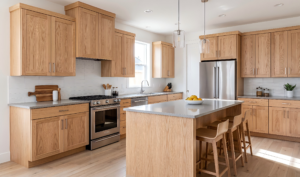
If you’re going for a warm, lived-in traditional or Craftsman kitchen, choose Red or White Oak. If you want a lighter, more modern Scandinavian aesthetic with visible but clean wood character, choose Ash. Both look premium — they just tell different stories.
5 Moisture & Humidity Resistance in the Kitchen
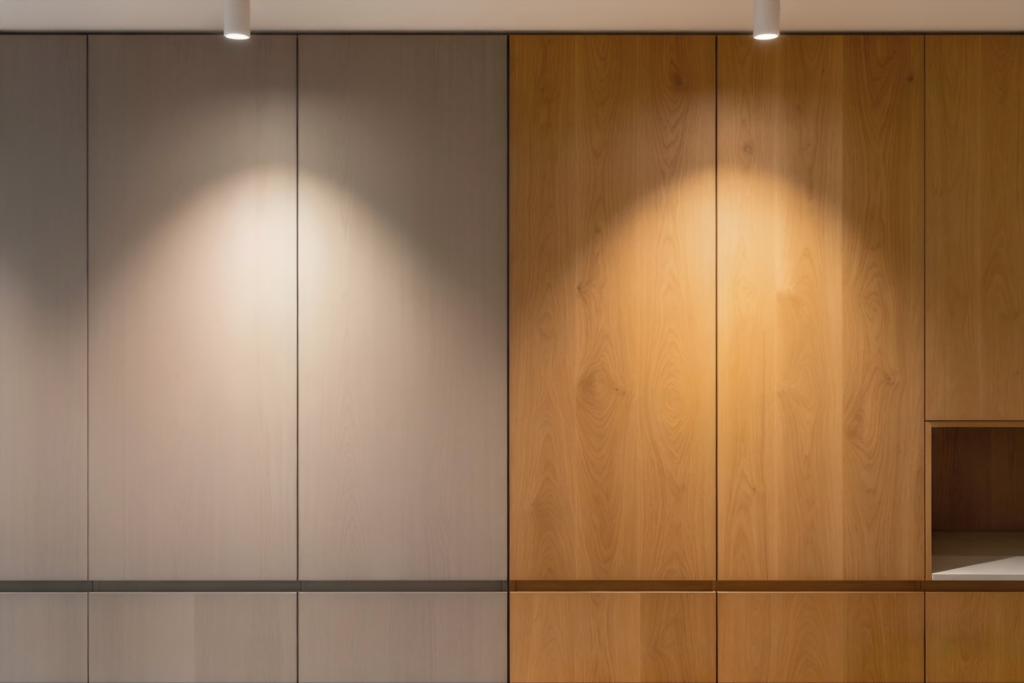
Kitchens are hostile environments for wood. Steam from dishwashers, boiling pots, and cooking creates humidity spikes. Splashes near the sink introduce direct moisture. Seasonal changes expand and contract wood with humidity fluctuations. How do ash and oak perform under these conditions?
White Oak: The Clear Winner on Moisture
This is one of the most important distinctions between oak varieties — and between oak and ash. White oak is significantly more moisture-resistant than both red oak and ash. White oak’s tyloses — microscopic structures that fill its pores — make it naturally more impervious to water penetration. This is why white oak is the traditional choice for wine barrels and boat-building. In kitchen cabinets, this translates to better resistance to warping, swelling, and moisture damage near sinks and dishwashers.
Red Oak & Ash: More Vulnerable, Still Manageable
Both red oak and ash have open pore structures that can absorb moisture more readily than white oak. This doesn’t make them bad choices for kitchens — millions of kitchens worldwide have red oak or ash cabinets that last for decades — but it does mean that proper sealing and finishing is non-negotiable. Unfinished or poorly finished ash and red oak in high-moisture zones can warp, swell, or develop mold issues over time.
Regardless of whether you choose ash or oak, always ensure cabinet interiors near sinks and dishwashers are sealed as thoroughly as the exterior faces. Many cabinet failures originate from moisture penetrating through unsealed interior surfaces, not the visible exterior.
Movement & Stability
Both ash and red oak are ring-porous hardwoods that move more with humidity changes than diffuse-porous species like maple or cherry. White oak is more dimensionally stable than both. If you live in a region with extreme humidity swings (like the American Southeast or Pacific Northwest), white oak cabinets will be noticeably more stable over the long term than either ash or red oak.
6Finishing, Staining & Painting
Staining Ash vs Oak
Both ash and oak accept stain well, but they behave differently. Oak’s pronounced grain creates dramatic depth with medium and dark stains, making the grain pattern even more prominent. This is beautiful if you want it, but it means you can’t really use dark stain to “hide” oak’s character — it amplifies it instead.
Ash takes stain more evenly due to its straighter grain pattern. Medium stains on ash create a refined, furniture-quality look. Ash also shows off natural wood-tone finishes beautifully — light oils and clear lacquers that let the pale, clean grain speak for itself are among the most popular choices for ash kitchen cabinets in contemporary designs.
Painting Ash vs Oak
If you want painted kitchen cabinets, this is where the species choice matters significantly. Oak’s deep, open grain is notoriously difficult to paint to a smooth finish. Even with grain filler, multiple coats of primer, and sanding between coats, oak’s grain can still telegraph through paint — especially in gloss or semi-gloss finishes where light rakes across the surface.
Ash, while also open-grained, paints somewhat more smoothly than red oak due to its more uniform, straighter grain structure. That said, neither ash nor oak is the ideal choice if a perfectly smooth, grain-free painted cabinet finish is your goal. For that, maple or MDF are the industry-standard substrates.
Natural/stained finish → Both ash and oak excel; choose based on tone preference.
Painted finish → Ash is slightly better than red oak; white oak is smoother still; maple or MDF is best.
Wire-brushed/cerused finish → Oak’s open grain is spectacular; ash also works beautifully.
The Wire-Brushed Trend
One of the most popular current kitchen cabinet finishes is the wire-brushed or cerused look, where the open grain channels are accentuated — often by wire-brushing the surface and then applying a white or light-pigmented finish that settles into the grain valleys. Both ash and oak are perfect for this technique, and their bold grain patterns make the result genuinely striking. If this aesthetic appeals to you, both species are excellent candidates.
7 Cost Comparison & Value Analysis
Budget is a critical real-world factor in any cabinet decision. Here’s how ash and oak compare on cost:
| Cost Factor | 🌳 Oak | 🌲 Ash |
|---|---|---|
| Lumber Cost (per board foot) | Red Oak: $3–5 · White Oak: $5–9 | $3–6 (increasingly limited supply) |
| Cabinet Box (semi-custom, per linear ft) | $150–$350 (widely available) | $200–$450 (specialty order) |
| Full Custom Cabinets | $500–$1,200/linear ft | $600–$1,400/linear ft |
| Finishing Cost | Similar | Similar |
| Availability | Excellent (widely stocked) | Good (may require lead time) |
| Long-term Value | Excellent (proven resale track record) | Good (growing premium market appeal) |
Important note on ash pricing: The emerald ash borer — an invasive insect that has devastated ash tree populations across North America — has significantly impacted ash lumber availability and will continue to do so. While ash lumber remains available from responsibly managed sources and reclaimed wood suppliers, its long-term supply is less certain than oak. This is both a cost risk and a sustainability consideration discussed further below.
Value Over Time
Well-maintained solid wood kitchen cabinets in either ash or oak can last 50+ years. From a pure cost-per-year-of-use perspective, both represent excellent value compared to MDF, plywood-core, or thermofoil alternatives. Oak has a slight edge in resale value simply due to buyer recognition — most home buyers know and trust oak, while ash remains a more design-savvy choice.
8 Kitchen Styles Each Wood Suits Best
🌳 Oak Works Best For:
- Traditional & Colonial kitchens
- Craftsman & Arts-and-Crafts style
- Farmhouse kitchens (especially white oak)
- Transitional kitchens bridging traditional and modern
- Wine cellar-adjacent or European country aesthetics
- Homes where resale value is a priority
- Kitchens near water sources (use white oak)
🌲 Ash Works Best For:
- Contemporary & Modern kitchens
- Scandinavian & Nordic-inspired design
- Modern Farmhouse with a lighter palette
- Minimalist kitchens where light tones matter
- Industrial kitchens with exposed brick or concrete
- High-design interiors where ash’s uniqueness adds value
- Open-plan living spaces needing bright, airy cabinetry
9 Long-Term Maintenance & Care
Both ash and oak kitchen cabinets have similar maintenance requirements, but there are some nuances worth understanding before you commit.
Daily Cleaning
For both species, the rule is simple: wipe spills immediately, use a damp (not wet) cloth, and follow with a dry cloth. Avoid abrasive cleaners that can scratch the finish. Mild dish soap diluted in water is safe for most cabinet finishes. Ammonia-based cleaners and bleach should be avoided on both wood types as they can degrade the finish and discolor the wood.
Refinishing Over Time
One of the great advantages of solid wood cabinets — ash or oak — is that they can be refinished when the original finish wears or the aesthetic becomes dated. This is not possible with thermofoil, rigid thermofoil (RTF), or most vinyl-wrapped cabinet doors. With solid wood, a professional can sand and re-stain or repaint cabinets to completely refresh the kitchen. This dramatically extends the useful life of the investment.
Scratch & Dent Repair
Minor scratches in both ash and oak can be addressed with wood touch-up markers or wax sticks matched to the finish color. Deeper dents can be raised with a damp cloth and a hot iron (the steam swells the wood fibers), then sanded and refinished locally. Both woods repair well due to their dense, even fiber structure.
The Open Grain Cleaning Challenge
One honest drawback of both ash and oak compared to maple or painted MDF: the open grain can collect grease and cooking residue over time, especially in a kitchen without good ventilation. This isn’t a deal-breaker, but it does mean cleaning needs to be more attentive in high-heat cooking zones. A sealed grain filler finish can mitigate this significantly.
10 Sustainability & Availability
Oak: The More Sustainable Choice Today
North American oak — both red and white — is among the most sustainably managed timber resources on the continent. Oak forests are widespread, well-regulated, and regenerating. FSC-certified oak lumber is readily available from responsible cabinet suppliers. For long-term supply security and environmental footprint, oak is the stronger choice.
The Ash Crisis: A Real Concern
American ash faces an existential threat from the emerald ash borer (Agrilus planipennis), an invasive beetle introduced from Asia that has killed hundreds of millions of ash trees across North America since its discovery in 2002. While ash lumber remains available, the long-term supply trajectory is uncertain. Some designers and cabinet makers now specifically avoid specifying new-growth ash and source only from responsibly salvaged or reclaimed ash — which can actually be more beautiful and storied than new lumber, but comes at a premium and requires more lead time.
If sustainability matters to you — and if you want confidence that your cabinet investment won’t become a sourcing headache down the line — oak is the more future-proof choice from a supply standpoint.
Look for FSC (Forest Stewardship Council) certification when sourcing either species. For ash specifically, ask your cabinet maker about reclaimed ash sourcing — ash killed by the emerald ash borer can be milled into beautiful, premium lumber that otherwise goes to waste.
11 Full Head-to-Head Comparison Table
| Category | 🌳 Oak | 🌲 Ash |
|---|---|---|
| Janka Hardness | White Oak: 1,360 lbf · Red Oak: 1,290 lbf ✓ | White Ash: 1,320 lbf |
| Shock Resistance | Good | Excellent ✓ |
| Moisture Resistance | White Oak: Excellent · Red Oak: Moderate ✓ | Moderate (requires good sealing) |
| Dimensional Stability | White Oak: Excellent ✓ | Moderate |
| Grain Aesthetics | Bold, traditional, with medullary rays | Straight, architectural, contemporary ✓ |
| Takes Stain | Excellent — dramatic depth ✓ | Excellent — even and refined |
| Takes Paint | Moderate (grain telegraphs) | Better than red oak, grain can show ✓ |
| Wire-Brush Finish | Excellent | Excellent |
| Cost (semi-custom) | Lower · More widely available ✓ | Moderate · May require lead time |
| Sustainability | Excellent — widespread, well-managed ✓ | At risk from emerald ash borer |
| Resale Value Signal | Widely recognized as premium ✓ | Premium with design-savvy buyers |
| Kitchen Style Fit | Traditional, Craftsman, Farmhouse | Modern, Scandinavian, Contemporary |
| Longevity (properly sealed) | 50+ years | 50+ years |
12 Final Verdict: Which Should You Choose?
Our Expert Recommendation
After analyzing every dimension of the ash vs oak kitchen cabinets question, here is our honest, scenario-based recommendation:
Choose White Oak If…
You want the most durable, moisture-resistant, and resale-friendly option. White oak’s tyloses make it superior near sinks and dishwashers. Its cooler gray-brown tone works beautifully in both transitional and contemporary kitchens. White oak has become the gold standard in high-end kitchen design for good reason — it delivers on every front. It costs more than red oak or ash, but it’s worth it for kitchens that will see heavy use or are in high-humidity environments.
Choose Ash If…
Your aesthetic vision is contemporary, Scandinavian, or modern farmhouse. You love the look of visible, linear wood grain without the traditional associations that oak carries. You’re working with a designer who specified ash for its unique character. And you’re willing to pay for what is increasingly a specialty wood with genuine design cachet. Just ensure your cabinet maker sources responsibly and confirms excellent sealing, particularly around moisture-prone areas.
Choose Red Oak If…
You love the warm, traditional look of classic American kitchens, and you’re working within a tighter budget. Red oak remains one of the best value-for-money cabinet woods available. It’s widely stocked, easy to work with, takes stain beautifully, and will last for decades with proper care. The resale market is comfortable and familiar with red oak kitchens. If you’re not planning to paint, red oak’s bold grain in a warm honey or medium brown stain is timelessly beautiful.
The Situation Where Oak Always Wins
If your kitchen has a sink base cabinet that’s been prone to moisture issues, or if you live in a humid climate with significant seasonal humidity swings, white oak is the clear choice over ash. This one factor — moisture resistance via tyloses — is significant enough to override aesthetic preferences in high-moisture environments.
13 Frequently Asked Questions