Table of Contents
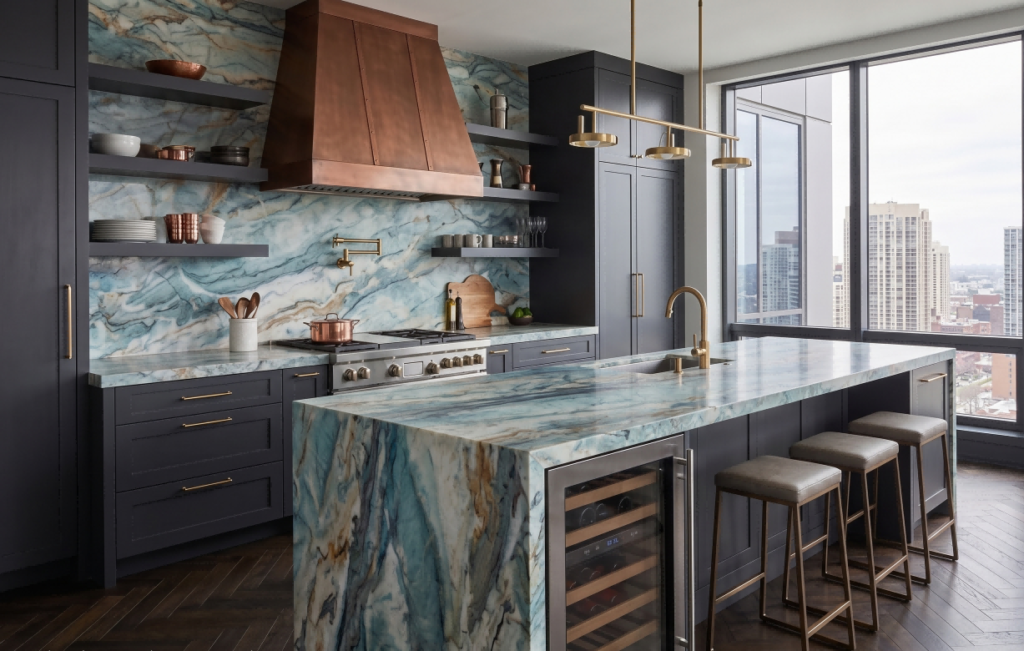
There is a moment that happens in nearly every kitchen showroom — a visitor rounds a corner, sees a slab of Aqua Fusion Quartzite Brazil kitchen stone under proper lighting, and stops mid-sentence. The surface does something that photographs only partially capture: it moves. Blues deepen toward the center of the slab, silver veins catch the light and shift as you change your angle, and the whole stone seems to carry the luminosity of shallow tropical water.
That reaction is not accidental. Aqua Fusion Quartzite from Brazil is one of the most visually complex natural stones available for residential kitchen use — and as this guide will show, it backs its extraordinary appearance with genuine, measurable performance that outpaces most competing materials.
This is the most complete guide to Aqua Fusion Quartzite Brazil kitchen design currently available online. We cover the geology, the accurate performance data (correcting several errors that circulate widely in the market), the full cost breakdown for 2026, a detailed design pairing strategy, a practical maintenance protocol, and answers to every question buyers ask before and after purchase.
What Is Aqua Fusion Quartzite? The Science Behind the Stone
Geological Origin: Brazil’s Metamorphic Heritage
Aqua Fusion Quartzite is a natural metamorphic rock quarried primarily from the mountainous regions of Espírito Santo and Minas Gerais in southeastern Brazil — two states that collectively supply a significant share of the world’s premium decorative quartzite. Brazil’s unique geological history, shaped by the ancient Gondwana supercontinent, created conditions over hundreds of millions of years that produced quartzite of extraordinary visual quality and structural density.
The stone forms through a process called metamorphism: silica-rich sandstone buried deep in the Earth’s crust is subjected to sustained extreme heat and pressure. The original sand grains dissolve and recrystallize into an interlocking mosaic of quartz crystals — a process that eliminates the original grain boundaries and produces a material far harder and denser than the sandstone it came from. The resulting stone is composed of silicon dioxide (SiO₂) at 90–99% purity, making it one of the most chemically stable building materials in residential use.
The Color Palette: Where Aqua and Green Come From
The defining visual characteristic of an Aqua Fusion Quartzite Brazil kitchen — that shifting palette of aqua blue, sage green, crystalline white, and silver-grey veining — is entirely natural. It results from trace minerals incorporated into the stone during metamorphism:
- Copper-bearing minerals (including malachite and azurite) produce the blue-green and turquoise tones that give this quartzite its name
- Chlorite contributes the cooler, softer sage greens
- Muscovite and sericite mica create the silvery shimmer and translucency characteristic of high-grade slabs
- Iron oxides introduce occasional warm amber or gold accents in certain veins
- Pure quartz zones appear as bright white or transparent areas that catch and refract light
Because mineral distribution during geological metamorphism is entirely non-uniform, no two slabs of Aqua Fusion Quartzite are ever visually identical. Each slab is, in the most literal sense, one of a kind.
Hardness and Physical Properties
On the Mohs Hardness Scale — the universal measure of a mineral’s resistance to scratching — Aqua Fusion Quartzite registers at 7 to 7.5:
| Material | Mohs Hardness |
|---|---|
| Marble | 3–4 |
| Limestone | 3–4 |
| Glass | 5.5 |
| Steel knife blade | 5.5–6.5 |
| Granite | 6–7 |
| Aqua Fusion Quartzite | 7–7.5 |
| Hardened steel file | 7–8 |
| Diamond | 10 |
A standard kitchen knife (steel, Mohs 5.5–6.5) cannot scratch Aqua Fusion Quartzite. The surface will not be marked by metal utensils, ceramic cookware, or porcelain dishes under any normal kitchen use condition.
Critical Distinction: Natural Quartzite vs. Engineered Quartz
This is the most important clarification to make before purchasing — and one that the market consistently confuses.
Aqua Fusion Quartzite from Brazil is a 100% natural stone. It contains no synthetic components, no polymer resins, and no manufactured binding agents. Its physical properties are determined entirely by its geological composition.
Engineered quartz (commercial brands include Silestone, Caesarstone, Compac, and many others) is a manufactured composite product: approximately 90–95% crushed stone particles bound with 5–10% polymer resins and pigments. It is factory-produced.
The practical implications of this difference are significant — particularly for heat resistance, which we address in detail in the next section.
Performance Analysis: How Aqua Fusion Quartzite Brazil Kitchen Stone Actually Behaves
Heat Resistance: The Natural Stone Advantage
Because Aqua Fusion Quartzite contains no polymer resin binders, it offers genuine thermal resistance that engineered quartz cannot match. The polymer resins in engineered quartz begin to degrade at relatively modest temperatures — typically above 150°C — causing scorching, discoloration, or surface delamination from direct contact with hot cookware. Natural quartzite does not have this vulnerability.
In an Aqua Fusion Quartzite Brazil kitchen, you can set a hot pot or pan directly on the countertop surface without damaging the stone itself. The recrystallized quartz matrix that constitutes the material formed under geological heat far exceeding anything your kitchen will produce.
Practical recommendation: Although the stone itself tolerates direct heat, use trivets as a routine habit for two reasons. First, repeated extreme thermal cycling — placing a 300°C cast-iron pan fresh from the oven on the same spot regularly over many years — can induce thermal stress fractures in any natural stone, particularly near seams or edges. Second, trivets protect the sealer layer on the stone’s surface, which is not as heat-tolerant as the stone itself.
Scratch Resistance
At Mohs 7–7.5, Aqua Fusion Quartzite will not be scratched under any normal kitchen use condition. Steel knives, metal utensils, ceramic dishes, and glass cookware are all softer than the stone surface.
A note worth making for buyers: use a cutting board not to protect the countertop (which does not need it) but to protect your knife blades. Cutting repeatedly on a surface harder than your knife edge dulls the blade significantly faster than cutting on wood or plastic.
Porosity and Stain Behavior
Quartzite is substantially denser and less porous than marble, but it is not non-porous. An unsealed Aqua Fusion Quartzite Brazil kitchen countertop will absorb liquids over time — cooking oils, wine, coffee, and acidic fruit juices can all penetrate the surface and cause permanent staining.
With proper sealing (detailed in the maintenance section below), this porosity is effectively closed and the surface becomes highly resistant to staining under normal kitchen use. Sealed quartzite performs well against the full range of common kitchen spills.
Acid Resistance
Natural quartzite is primarily silicon dioxide, which is chemically resistant to most common kitchen acids. Unlike marble (calcium carbonate, which reacts with and is etched by acids including lemon juice, vinegar, and wine), Aqua Fusion Quartzite does not etch from acidic exposure. A drop of lemon juice left on sealed quartzite for several minutes, then cleaned away, leaves no mark on the stone itself.
This acid resistance is a meaningful practical advantage in any active kitchen environment.
2026 Cost Breakdown: What to Budget for an Aqua Fusion Quartzite Brazil Kitchen
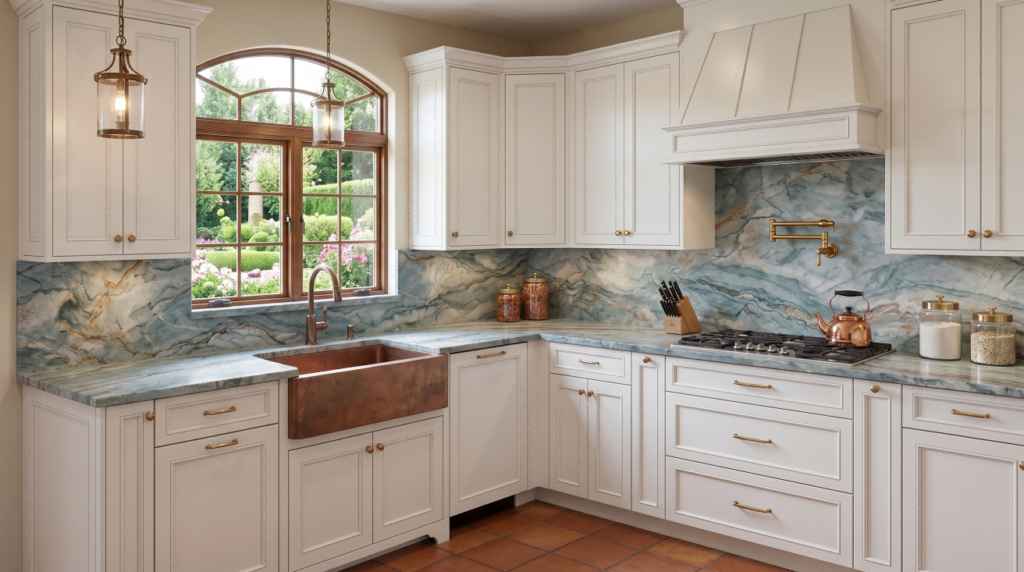
Slab Material Cost by Grade
Standard grade — lighter color background with moderate aqua-green veining, sourced from efficient quarry output: $70–$95 per square foot (material only)
Premium grade — stronger color saturation, more dramatic veining movement, carefully selected slabs with pronounced blue-green tones: $110–$160 per square foot
Exotic / exhibition grade — visually exceptional slabs with intense color distribution, unusual patterning, or extraordinary translucency; often the best pieces from a quarry’s production: $180–$260 per square foot
Fabrication Costs
Fabrication — cutting the slab to your kitchen dimensions, profiling edges, creating cutouts, and polishing — adds $30–$65 per square foot to the base material cost.
Key variables affecting fabrication pricing:
- Edge profiles: A simple straight or eased edge is the baseline. Waterfall, mitered, ogee, and dupont edge profiles add $15–$30 per linear foot.
- Slab thickness: Standard 3 cm slabs cost slightly more to fabricate than 2 cm due to weight and cutting time, but 3 cm is strongly recommended for kitchen countertops (see FAQ below).
- Cutout complexity: Each sink, cooktop, or outlet cutout adds precision cutting time.
- Bookmatching: Selecting and aligning two sequential slabs to create a mirrored veining pattern adds 15–25% to material and fabrication cost but produces a dramatically more impactful result — particularly on a large kitchen island.
Installation Costs
Professional delivery, placement, leveling, silicone setting, seam filling, and final sealing: $15–$30 per square foot for standard residential kitchen projects.
Total Installed Cost: Real Project Examples
Kitchen island (30 sq ft, premium grade, simple edge): Material $3,900 + Fabrication $1,350 + Installation $660 = ~$5,910 total
Full kitchen countertops and island (75 sq ft, premium grade): Material $9,750 + Fabrication $3,375 + Installation $1,650 = ~$14,775 total
Luxury specification (75 sq ft, exhibition grade, bookmatched island, waterfall edge): Material $16,500+ + Fabrication $5,500+ + Installation $2,000+ = $24,000+ total
Buyer’s note: Always arrange to view and approve the specific slab before fabrication begins. With a material as visually distinctive as Aqua Fusion Quartzite from Brazil, variation between slabs of the same grade can be substantial. The slab selection visit to a stone yard is not a formality — it is one of the most consequential decisions in the project.
Design Guide: Building the Perfect Aqua Fusion Quartzite Brazil Kitchen
The color palette of Aqua Fusion Quartzite — a cool range spanning aqua blue, sage green, silver-white, and teal, with occasional warm gold accent veining — gives it genuine versatility across design styles. The key is understanding which elements to pair with it and which to keep quiet.
Cabinet Color Pairings
Bright white is the most widely used and most reliably successful cabinet pairing. It allows the stone’s color to lead without competition and reads as timeless rather than trend-driven. Works across kitchen scales and architectural styles.
Sage green or dusty blue cabinetry creates a more cohesive, editorial aesthetic by drawing one of the stone’s secondary tones into the cabinet color. The critical detail: do not match exactly — select a cabinet tone that echoes the stone but is lighter or more muted. An exact color match flattens the design; a close-but-different tone creates visual harmony.
Warm grey or greige cabinetry introduces warmth that balances the stone’s inherently cool palette — particularly valuable in kitchens with limited natural light or north-facing windows.
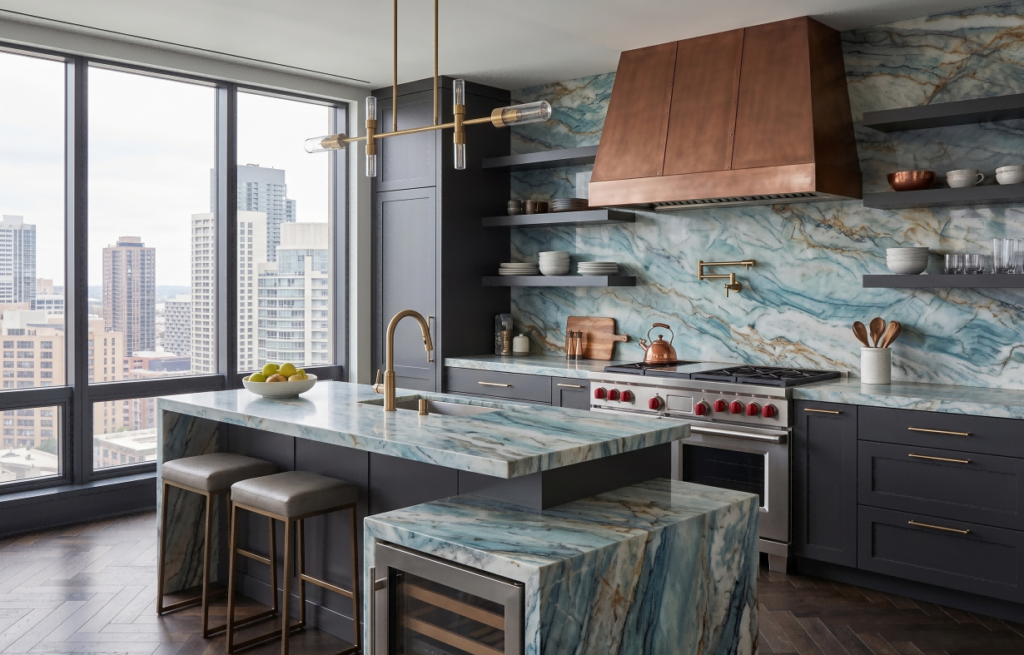
Deep navy or charcoal cabinetry produces a high-drama, luxury-hotel aesthetic. The contrast between very dark cabinetry and the luminous quartzite surface is extremely effective at larger kitchen scales.
Colors to use with caution: Highly saturated warm tones — vivid orange, terracotta, warm yellow — tend to clash with the cool green-blue range of Aqua Fusion Quartzite. If your kitchen includes significant warm-toned finishes, review your specific slab under your kitchen’s actual lighting conditions before committing.
Hardware and Fixture Selection
Brushed brass or unlacquered brass creates a warm-against-cool tension that reads as intentional and refined when applied consistently across faucet, cabinet hardware, and light fixtures.
Brushed nickel or polished chrome keeps the overall palette clean and contemporary. The stone becomes the visual statement; metal finishes stay in quiet support.
Matte black offers a graphic, modern contrast but requires discipline — used throughout an entire kitchen alongside a visually active stone, it can become overwhelming rather than elegant.
Backsplash Strategy
The most common design mistake in an Aqua Fusion Quartzite Brazil kitchen is pairing it with an equally complex backsplash. Two visually busy surfaces competing in the same space dilute each other’s impact.
The correct design principle: let the stone lead. The backsplash provides texture or subtle pattern without introducing color competition.
Pairings that consistently work:
- Matte white subway tile — proven, versatile, never competes
- Zellige or handmade white tile — adds artisanal texture without color noise
- Full slab quartzite backsplash (same stone as countertop) — the most premium option; requires bookmatching for maximum impact but creates an extraordinary result
- Venetian stucco or limewash in off-white or warm grey — organic texture, zero color competition
- Large-format neutral porcelain — practical, clean, self-effacing
Lighting Strategy: Unlocking the Stone’s Full Potential
Aqua Fusion Quartzite rewards good lighting more than almost any other countertop material. The crystalline structure of the stone refracts and responds to light in ways that opaque or manufactured surfaces simply cannot.
Under-cabinet LED strip lighting is essential in any serious Aqua Fusion Quartzite Brazil kitchen installation. Light directed at an oblique angle across the countertop surface illuminates the mineral veining and crystal facets in a way that overhead lighting alone cannot achieve. Specify warm-to-neutral color temperature (2700K–3000K) for the most natural result.
Pendant lighting over islands: Position pendants to graze the surface at a slight angle rather than illuminate it from directly overhead. This raking light creates the shimmer effect that makes quartzite kitchens photograph so distinctively.
Natural light: Aqua Fusion Quartzite reads differently under different natural light conditions. Diffuse north or east light emphasizes the cool blue-green tones and makes the surface appear crisp and luminous. Direct warm afternoon light shifts the stone toward warmer tones. Both readings are attractive — and knowing this helps you anticipate how your finished kitchen will feel throughout the day.
Flooring Pairings
Wide-plank light oak, ash, or maple (5″–8″ plank width, natural or white-wash stain): The warmth of light wood grounds the stone’s cool palette and creates a balanced, sophisticated result.
Large-format porcelain in warm white or light grey: Practical, waterproof, non-competing. Works in both contemporary and transitional kitchen styles.
Honed limestone or light travertine: Creates an all-natural-material kitchen of extraordinary tactile richness. Requires discipline in other design elements to prevent visual overload.
Polished or honed concrete: Works particularly well in modern and industrial-adjacent kitchens. The neutral grey ground directs all attention to the stone surfaces.
Complete Maintenance Protocol: Keeping Your Aqua Fusion Quartzite Brazil Kitchen Flawless
Sealing: The Foundation of Long-Term Performance
All natural quartzite requires sealing. Aqua Fusion Quartzite from Brazil is significantly denser than marble, but it retains natural microporosity that will absorb liquids on an unsealed surface.
Initial sealing: Your fabricator should apply a quality penetrating sealer before or immediately after installation. If this is not included in their service, either arrange it yourself or reconsider your fabricator choice.
Ongoing sealing frequency: For residential kitchen use, reseal every 12–18 months. The water bead test tells you when it is due: drop a small amount of water on the surface. If it beads and sits on top, the sealer is working. If it slowly absorbs and darkens the stone surface, it is time to reseal.
Product selection: Use a fluoropolymer-based penetrating stone sealer formulated for quartzite or siliceous stone. Avoid topical sealers that sit on the surface — these build up over time and progressively dull the stone’s natural finish. Reputable products from Miracle Sealants, Stonetech (DuPont), Tenax, and Dry-Treat are widely used by professional stone fabricators.
The sealing process requires no specialist equipment: clean the surface thoroughly, apply the sealer, allow it to penetrate for the time specified on the product instructions, wipe off excess, and allow to cure. Most applications take under 30 minutes.
Daily Cleaning
Routine: Warm water and a soft microfiber cloth handles everyday cleaning effectively. For a cleaning product, use a pH-neutral stone cleaner formulated for natural stone.
Strictly avoid:
- Vinegar, lemon juice, and citrus-based cleaners (degrade the sealer layer with repeated use)
- Ammonia-based cleaners (present in many glass and multi-surface cleaners)
- Abrasive scrubbing pads or scouring powders
- Bleach or strong alkalis
Spill management: Blot spills immediately — do not wipe and spread. For oil-based spills, a small amount of diluted dish soap followed by thorough rinsing removes residue without harming the surface.
Stain Removal
For set-in stains on a sealed surface: apply a poultice — a paste of fine talc or baking soda mixed with hydrogen peroxide (for organic stains such as wine, coffee, and food) or acetone (for oil-based stains). Apply over the stain, cover with plastic wrap, and leave for 12–24 hours. The poultice draws the stain material out of the stone as it dries. This is a standard professional stone restoration technique, is safe for quartzite, and is effective on most stains that have not been left untreated for extended periods.
Aqua Fusion Quartzite vs. Competing Materials: Full Comparison
| Aqua Fusion Quartzite | Calacatta Marble | Engineered Quartz | Premium Granite | |
|---|---|---|---|---|
| Hardness (Mohs) | 7–7.5 | 3–4 | 6–7 | 6–7 |
| Scratch resistance | Excellent | Poor | Good | Good |
| Heat resistance | Excellent | Good | Fair (resin scorches) | Good |
| Acid resistance | Good | Very poor (etches) | Excellent | Good |
| Stain resistance (sealed) | Very good | Fair | Excellent | Good |
| Natural visual uniqueness | Every slab unique | Every slab unique | Consistent pattern | Every slab unique |
| Maintenance requirement | Annual sealing | Frequent sealing | Minimal | Annual sealing |
| Material cost (per sq ft) | $70–$260 | $75–$250 | $50–$120 | $40–$150 |
Summary: Aqua Fusion Quartzite offers the visual distinctiveness of natural stone with durability that marble cannot match. Its only meaningful disadvantage compared to engineered quartz is the annual sealing requirement — a 30-minute maintenance task once per year.
Installation: What the Process Looks Like
Phase 1 — Templating (Day 1, 1–2 hours): A fabricator visits your kitchen to create a precise digital or physical template mapping every cabinet position, wall angle, cutout, and overhang to millimeter accuracy.
Phase 2 — Fabrication (Days 2–7): The slab is cut, shaped, edged, and polished in the fabricator’s workshop. Standard kitchen projects take 3–5 business days. Bookmatched or complex edge profile projects take longer.
Phase 3 — Installation (Day 8, 4–8 hours): Finished sections are delivered, placed, and set into silicone adhesive. Seams between sections are filled with color-matched epoxy and polished to minimize visibility.
Phase 4 — Final sealing (Day 8–9): After the adhesive cures (24 hours), the final sealer coat is applied.
From signed contract to completed kitchen: budget 2–3 weeks for a standard residential project.
Frequently Asked Questions
How much does Aqua Fusion Quartzite cost per square foot?
Slab material ranges from $70 (standard grade) to $260 (exhibition grade) per square foot. Total installed cost including professional fabrication and installation typically falls between $115 and $355 per square foot, depending on grade, edge profile complexity, and your geographic market.
Can you put a hot pan on Aqua Fusion Quartzite?
Yes — because Aqua Fusion Quartzite is a natural stone containing no synthetic resin binders, it is genuinely heat resistant and will not scorch, discolor, or delaminate from hot cookware. This is a meaningful advantage over engineered quartz, which contains polymer resins that can be damaged by direct heat above approximately 150°C. Using trivets remains advisable as a long-term habit to protect the sealer layer and prevent thermal stress near seams.
Does Aqua Fusion Quartzite need to be sealed?
Yes. All natural quartzite requires sealing before use and resealing approximately every 12–18 months. The process takes under 30 minutes using a fluoropolymer penetrating sealer. Proper sealing is what makes the stone effectively stain-resistant under kitchen use conditions.
Is Aqua Fusion Quartzite the same as engineered quartz?
No. Aqua Fusion Quartzite is a 100% natural metamorphic rock quarried in Brazil, containing no synthetic components. Engineered quartz is a manufactured composite product made from crushed stone bound with polymer resins. They have different compositions, different performance profiles, and different maintenance requirements.
How do I verify I am buying genuine quartzite and not marble?
Genuine quartzite is harder than a steel knife blade (Mohs 7+). A knife blade dragged across the surface leaves no mark on quartzite; marble (Mohs 3–4) shows a white powder scratch from the same test. Additionally, quartzite does not etch from acidic liquids — a drop of lemon juice on quartzite cleans away without marking the stone; the same drop on marble leaves a dull etched patch. Reputable suppliers maintain country-of-origin documentation and geological classification records for all natural stone.
What thickness should I specify for kitchen countertops?
3 cm (approximately 1¼ inch) is strongly recommended for kitchen countertop applications. It is structurally self-supporting across standard cabinet spans without requiring a plywood substrate, allows for premium edge profiles without laminating, and reads as more substantial visually. 2 cm slabs are suitable for backsplashes, wall cladding, and lighter-use surfaces but require a plywood substrate for countertop applications.
What is the difference between polished, honed, and leathered finishes?
A polished finish maximizes color depth and crystal shimmer with a high-gloss reflective surface — the most popular choice for Aqua Fusion Quartzite Brazil kitchen countertops. A honed finish is matte and non-reflective, softer in appearance, shows fingerprints and water marks less obviously, and is recommended for floor applications due to improved slip resistance. A leathered or brushed finish adds tactile texture with a semi-matte appearance and conceals everyday surface marks better than polished — increasingly popular for kitchen islands.
How durable is Aqua Fusion Quartzite long-term?
With appropriate sealing and routine maintenance, natural quartzite countertops last indefinitely. The stone does not chemically degrade under normal residential use. There are quartzite surfaces in historic buildings that have been in continuous use for well over a century. The only long-term failure modes are physical damage from extreme impact and the consequences of neglected sealing — both entirely preventable.
Can chips or cracks be repaired?
Minor edge chips — the most common damage type in natural stone countertops, typically caused by heavy objects dropped onto an unsupported edge — can be repaired effectively by a stone restoration specialist using color-matched epoxy fills. When executed by an experienced technician, repairs are nearly invisible. Structural cracks through the slab body are rare in properly installed countertops and may require partial slab replacement in severe cases. Prevention is the more practical approach: ensure full cabinet support below all countertop sections, particularly at edges and around cutouts.
Can Aqua Fusion Quartzite be used in bathrooms?
Yes, and it performs exceptionally well in bathroom vanity tops, shower surrounds, and feature wall cladding. For wet floor applications, specify a honed finish — polished quartzite can be slippery when wet. Sealing frequency in wet bathroom environments should increase to every 6–12 months.
Is Aqua Fusion Quartzite suitable for outdoor kitchen use?
In warm climates without freeze-thaw cycling, Aqua Fusion Quartzite performs well in covered outdoor kitchen installations. It is not recommended for fully exposed countertops in climates with below-freezing temperatures — repeated freeze-thaw cycling of absorbed moisture can cause surface micro-fracturing over time. For outdoor use, specify a honed finish and increase sealing frequency to every 6–12 months.
Final Assessment: Is Aqua Fusion Quartzite Brazil Kitchen Stone Right for You?
An Aqua Fusion Quartzite Brazil kitchen is not the right choice for every homeowner or every budget. It requires annual maintenance, it commands a premium price compared to manufactured alternatives, and its distinctive cool blue-green palette does not integrate naturally with every design direction.
But for homeowners who want a kitchen surface that is genuinely, demonstrably superior to manufactured alternatives — harder, more heat-resistant, visually unrepeatable, and more valuable at resale — Aqua Fusion Quartzite from Brazil is one of the most compelling materials available. It is the kind of surface that improves a kitchen’s character over years rather than dates with changing trends.
The three decisions that determine the outcome of any Aqua Fusion Quartzite Brazil kitchen project: selecting the right slab in person (never from a photograph alone), specifying a fabricator with direct experience working natural quartzite, and committing to the simple annual maintenance routine that keeps the stone performing at its best.
Get those three things right, and what you install is not just a countertop — it is a geological artifact, formed over millions of years in the mountains of Brazil, that will define your kitchen for the entire life of your home.