Table of Contents
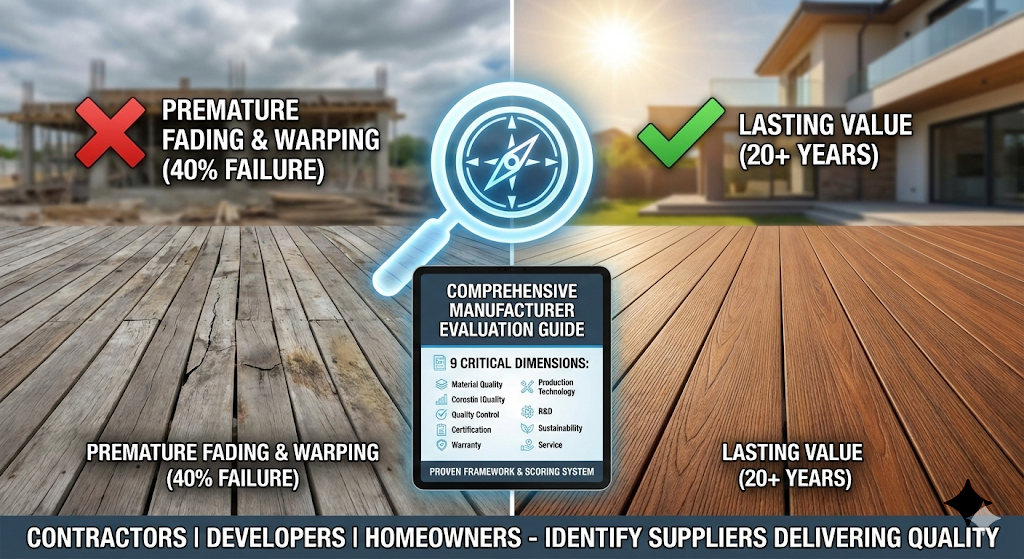
Last year, over 40% of WPC decking projects experienced premature fading or warping—not because wood-plastic composite is inherently flawed, but because buyers chose manufacturers based on price alone. The WPC market has grown to $6.5 billion globally, yet this expansion has brought both innovation and inconsistency. Selecting the right WPC manufacturer isn’t just about finding competitive pricing; it’s about ensuring your investment lasts 20+ years instead of failing within 5. This comprehensive guide provides a proven framework for evaluating manufacturers across 9 critical dimensions, complete with specific questions to ask, red flags to avoid, and a practical scoring system. Whether you’re a contractor, developer, or homeowner, this methodology will help you identify suppliers that deliver both quality and lasting value.
Manufacturing Capabilities: The Foundation of Product Quality
Not all WPC production lines are created equal. The difference between a basic single-screw extruder and an advanced co-extrusion system can mean the difference between a deck that maintains its appearance for 25 years versus one that fades within 3.
Look for manufacturers with twin-screw co-extrusion technology. This process creates a protective polymer shell (typically 0.5-1.0mm thick) around the wood-plastic core, dramatically improving UV resistance and moisture protection. The co-extrusion layer acts as a shield, preventing water penetration and color degradation that plague standard WPC products.
Annual production capacity reveals much about a manufacturer’s scale and reliability. Established producers typically operate facilities capable of 5,000-50,000 tons annually. While higher capacity doesn’t guarantee quality, it indicates established infrastructure, consistent raw material sourcing, and economies of scale that support competitive pricing without quality compromises.
Ask potential suppliers these critical questions: “What type of extrusion equipment do you use—single-screw, twin-screw, or co-extrusion?” “Can you provide documentation of your production capacity and current utilization rates?” “Do you have in-house testing facilities, and what protocols do you follow?”
Automated production lines deliver more consistent dimensional accuracy (±0.5mm tolerance) than manual operations. Request factory photos or videos showing their production process—reputable manufacturers are proud to demonstrate their capabilities. Look for climate-controlled facilities, as temperature and humidity fluctuations during production can affect final product quality.
R&D investment separates innovators from imitators. Manufacturers investing 3-5% of revenue in research typically offer improved formulations, better surface finishes, and enhanced performance characteristics. Ask about their latest product developments and how frequently they update their product lines.
Product Quality Verification: Know What You’re Actually Buying
Raw material quality determines everything. The foundation of superior WPC lies in the wood-to-plastic ratio and the quality of each component. Premium products typically contain 40-60% wood flour combined with 30-50% recycled or virgin plastic (HDPE or PVC), with the remaining 10% consisting of coupling agents, UV stabilizers, and colorants.
Here’s what matters: Virgin plastic content generally performs better than 100% recycled plastic, offering superior color consistency and structural integrity. However, high-quality recycled plastic (properly sorted and processed) can deliver excellent results at lower cost. Demand transparency—manufacturers should disclose their exact formulation ratios.
Wood flour quality varies dramatically. Premium manufacturers use kiln-dried, finely ground hardwood flour (80-200 mesh size) that’s been treated to remove moisture and contaminants. Inferior products use inconsistent wood sources or inadequate drying, leading to moisture-related expansion and contraction issues.
Coupling agents are the unsung heroes of WPC durability. These chemical compounds (typically MAPE – Maleic Anhydride Grafted Polyethylene) bond wood and plastic at the molecular level. Quality products contain 2-3% coupling agents; insufficient amounts result in poor adhesion, surface cracking, and premature failure.
Insist on seeing test results for these critical specifications:
Water absorption rate: Should be <1% after 24-hour immersion per ASTM D570. Anything above 2% indicates poor formulation or inadequate co-extrusion coverage.
Density standards: Quality WPC decking ranges from 0.9-1.2 g/cm³. Too low suggests excessive foaming agents or poor compounding; too high indicates brittleness and weight issues.
Flexural strength: Minimum 20 MPa for decking applications. This determines load-bearing capacity and resistance to sagging.
Color fastness: Request ASTM G154 accelerated weathering test results showing <5 Delta E color change after 1,000 hours. This predicts real-world fade resistance over 10-15 years.
Surface finish consistency matters for aesthetics and safety. Examine samples under strong lighting for uniform texture, consistent color distribution, and absence of surface defects. Premium manufacturers offer multiple finish options: fine-brushed for residential appeal, deep-embossed for slip resistance, or sanded for staining applications.
Certification & Compliance: Proof Beyond Promises
Certifications aren’t just bureaucratic checkboxes—they’re third-party validation that manufacturers meet rigorous standards. However, not all certifications carry equal weight.
Essential certifications by market:
For North American projects, look for ICC-ES (International Code Council Evaluation Service) certification, which confirms compliance with building codes. ASTM D7032 certification specifically addresses WPC deck board performance requirements including structural adequacy and durability.
European markets require CE marking, demonstrating conformity with EU safety, health, and environmental protection standards. The EN 15534 standard specifically governs WPC composites.
ISO 9001 certification indicates established quality management systems. While not product-specific, it demonstrates systematic quality control, continuous improvement protocols, and management accountability. Manufacturers lacking ISO 9001 after 5+ years in business should raise concerns.
Environmental certifications increasingly influence buying decisions and project eligibility. LEED (Leadership in Energy and Environmental Design) credits are available for products containing recycled content—typically requiring 25%+ post-consumer or post-industrial recycled materials. FSC (Forest Stewardship Council) certification ensures wood components come from responsibly managed forests.
Fire safety ratings matter for commercial applications and certain residential jurisdictions. Class B fire rating (ASTM E84) or Class Cfl-s1 (European classification) may be mandatory for rooftop decks, multi-family buildings, or wildfire-prone areas.
Third-party testing verification is crucial. Anyone can claim performance specifications, but independent laboratory testing (from facilities like Intertek, SGS, or TÜV) provides credible validation. Ask for complete test reports, not just certificates—you want to see actual data, testing methodologies, and sample identification.
Material Safety Data Sheets (MSDS) should be readily available, detailing chemical composition, handling requirements, and safety information. Reluctance to provide MSDS suggests questionable ingredients or non-compliance with disclosure regulations.
Customization & Technical Support: Flexibility When You Need It
Standard profiles serve most applications, but projects often require customization. A manufacturer’s willingness and capability to accommodate custom requests reveals their technical sophistication and customer orientation.
Custom profile design capabilities separate full-service manufacturers from basic producers. Can they modify existing profiles or create entirely new designs? Ask about their CAD capabilities, tooling expertise, and minimum order quantities for custom profiles. Expect MOQs of 5,000-15,000 linear meters for truly custom profiles, though color customization typically requires lower volumes.
Color matching services vary widely. Most manufacturers offer 6-12 standard colors covering common wood tones (cedar, walnut, teak, gray) and contemporary shades. Custom color matching typically requires 2,000-5,000 linear meter minimums and involves formulation development, sample approval, and production scheduling. Request physical samples rather than relying on digital images—color reproduction varies significantly across screens.
Sample provision policies indicate customer commitment. Premium manufacturers provide 6-12 inch samples free of charge, with some offering full-length board samples for significant projects (though shipping costs may apply). Reluctance to provide adequate samples suggests product quality concerns or disorganized sales processes.
Pre-sales technical consultation should include load calculation assistance, installation method recommendations, substructure requirements, and climate-specific guidance. Manufacturers with experienced technical teams can help optimize material usage, reducing costs while ensuring code compliance and performance.
Installation documentation quality varies dramatically. Look for comprehensive guides including detailed drawings, fastener specifications, expansion gap requirements, and climate-specific considerations. Video installation guides demonstrate manufacturer investment in customer success.
CAD drawings and specification sheets are essential for professional projects. Manufacturers should provide DWG or DXF files for profile cross-sections, complete material specifications for submittal packages, and performance data for engineering calculations.
Post-installation support often differentiates good manufacturers from great ones. What happens when questions arise during or after installation? Is technical support available via phone or email? How quickly do they respond? Test this during your evaluation process—email a technical question and note response time and quality.
Business Reliability: Beyond Product Quality
A manufacturer may produce excellent WPC, but operational reliability ensures you actually receive what you ordered, when you need it, and with appropriate support.
Years in business serves as a rough reliability filter. While innovative startups occasionally disrupt markets, established manufacturers (5+ years operating) have weathered market cycles, refined processes, and built sustainable operations. They’re less likely to disappear mid-project or fail to honor warranties.
Client portfolio diversity indicates market acceptance and adaptability. Manufacturers serving only one market segment (e.g., residential decking) may lack experience with your specific requirements (commercial applications, marine environments, rooftop installations). Review their project portfolio for complexity and scale matching your needs.
Case studies and project references provide invaluable insights. Request contact information for 3-5 customers with projects similar to yours in size, application, and climate. Ask references about product performance, delivery reliability, communication quality, and problem resolution. What issues arose, and how did the manufacturer respond?
Financial stability markers are harder to assess but important for long-term relationships. Publicly traded companies provide financial disclosures; private manufacturers may share basic stability indicators like credit ratings, bank references, or longevity in fixed facilities. Financial instability often manifests as payment term inflexibility, frequent price changes, or inconsistent product availability.
Factory visit policies reveal transparency and confidence. Reputable manufacturers welcome customer visits (scheduled in advance), providing tours of production facilities, quality control labs, and raw material storage. Virtual factory tours via video call are acceptable alternatives for international buyers. Reluctance to allow facility visibility should trigger serious concerns.
Response time to inquiries predicts future communication quality. During your evaluation process, note how quickly manufacturers respond to emails and calls. Professional operations typically respond within 24 hours during business days. Delayed responses (48+ hours) or inconsistent communication suggests organizational challenges that will likely persist post-purchase.
Communication quality and language capabilities matter for international transactions. Can the manufacturer communicate effectively in your language? Are technical discussions clear and precise? Miscommunication causes costly errors—ensure linguistic compatibility before committing.
Export experience for international buyers affects logistics, documentation, and customs compliance. Manufacturers experienced in your target market understand shipping requirements, duty classifications, and documentation standards. Ask: “How many containers do you ship to [your country] monthly?” “What Incoterms do you typically use?” “Can you handle customs clearance and delivery to our location?”
Warranty & After-Sales Service: Protection When Things Go Wrong
Warranties reveal manufacturer confidence and provide financial protection, but warranty terms vary dramatically in coverage and enforceability.
Warranty coverage periods typically range from 10-25 years for residential applications and 5-15 years for commercial use. However, duration alone means nothing without understanding what’s actually covered. Most warranties are prorated, meaning coverage decreases annually—a 25-year warranty might provide 100% coverage for 5 years, then decrease 5% annually.
What quality warranties actually cover:
Structural integrity against cracking, splitting, or warping under normal use and proper installation. Fading resistance, typically limiting color change to 5-10 Delta E units over the warranty period. Stain resistance against common household substances (oil, wine, food). Resistance to termites and fungal decay.
What warranties typically exclude:
Improper installation, inadequate ventilation, or code violations. Abnormal conditions (exposure to chemicals, excessive loads, commercial applications when residential-rated). Normal weathering, scratching, or changes in surface sheen. Acts of nature (hurricanes, flooding, fire).
Claim process clarity separates meaningful warranties from marketing tools. Ask these questions: “What documentation is required to file a claim?” “What’s your average claim processing time?” “Do you replace defective materials or provide refunds?” “Who covers labor costs for replacement?” “What’s your claim approval rate?”
Replacement product availability matters because products evolve. If your deck fails in year 10, can the manufacturer provide matching replacement boards? Many update their product lines every 3-5 years. Quality manufacturers maintain archived formulations or offer comparable replacements with color-matching guarantees.
Customer service accessibility should extend beyond sales. Is warranty service handled by the same responsive team you worked with during purchase, or does it get routed to a different (often less responsive) department? Test this by asking existing customers about their warranty experience.
Maintenance recommendations and support demonstrate manufacturer commitment to long-term product performance. Quality suppliers provide cleaning guides, stain removal protocols, and seasonal maintenance recommendations. They should answer maintenance questions without pushing unnecessary products or services.
Sustainability & Environmental Practices: Future-Proofing Your Choice
Environmental considerations increasingly influence purchasing decisions through regulatory requirements, green building certifications, and corporate sustainability commitments.
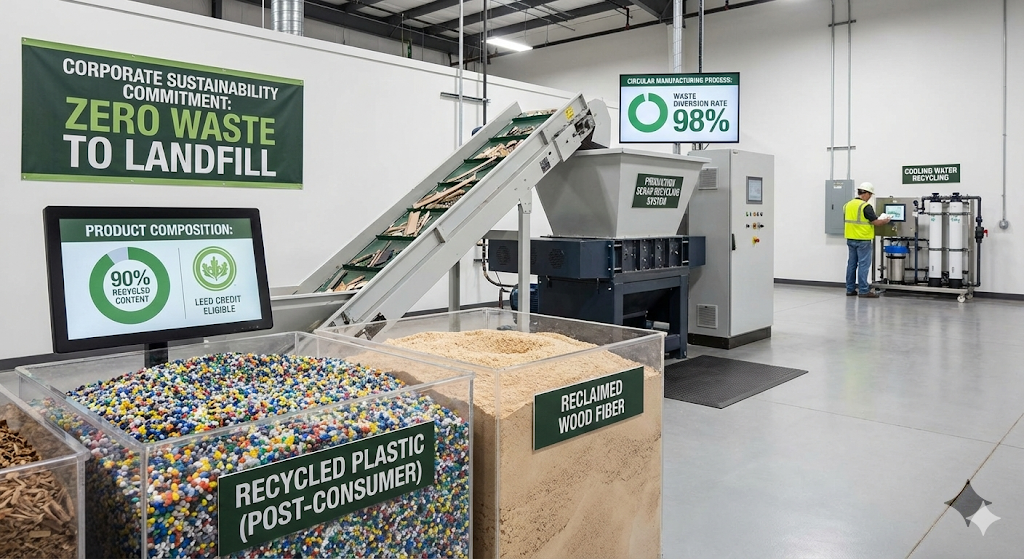
Percentage of recycled content directly impacts environmental footprint and often project eligibility for LEED credits or green building programs. Premium WPC products typically contain 60-95% total recycled content (combining post-consumer plastic waste and reclaimed wood fiber). Verify claims through environmental product declarations (EPDs) or third-party certifications rather than marketing materials.
Manufacturing waste management systems indicate environmental responsibility beyond product composition. Does the manufacturer recycle production scrap (edge trimmings, startup/shutdown material) back into production? How do they manage cooling water, dust collection, and packaging waste? Circular manufacturing processes typically correlate with overall quality consciousness.
Carbon footprint reduction initiatives are increasingly documented through lifecycle assessments (LCAs). These comprehensive studies measure environmental impact from raw material extraction through production, transportation, use, and end-of-life disposal. Manufacturers with published LCAs demonstrate transparency and environmental commitment.
Sustainable sourcing policies ensure wood components don’t contribute to deforestation. FSC certification remains the gold standard, though PEFC (Programme for the Endorsement of Forest Certification) certification is also widely recognized. For plastic components, ask about virgin plastic sourcing (is it from bio-based sources?) and recycled plastic verification (third-party certified?).
Environmental certifications worth seeking include GreenGuard (low chemical emissions), Cradle to Cradle (comprehensive sustainability), and regional programs like Nordic Swan or Blue Angel. These certifications require ongoing compliance verification, unlike one-time product testing.
End-of-life recyclability closes the sustainability loop. Can the WPC be recycled after 20-25 years of use? Some manufacturers offer take-back programs or partner with recycling facilities. While most WPC isn’t yet widely recycled in practice, manufacturers developing recyclability infrastructure demonstrate forward-thinking environmental stewardship.
Cost Analysis & Value Assessment: Beyond the Price Tag
Price varies significantly across manufacturers, but lowest cost rarely delivers best value. Understanding total cost of ownership and pricing factors enables informed comparisons.
Price range expectations per region:
North American manufacturers: $4-10 per linear foot for residential decking, $6-14 for commercial-grade products. Asian manufacturers (importing to US/Canada): $2.50-6 per linear foot FOB, plus shipping ($0.80-1.50/foot), duties (typically 10-15%), and domestic transportation.
European manufacturers: €40-90 per square meter depending on quality grade and country of origin.
Factors affecting pricing:
Material grade significantly impacts cost. Capped/co-extruded products cost 20-40% more than uncapped alternatives but deliver superior durability. Hollow profiles cost less than solid profiles but offer reduced load-bearing capacity. Color complexity affects pricing—wood-grain patterns and premium colors add 10-15% versus standard colors.
Profile complexity matters. Standard square-edge decking boards are cheapest; grooved boards (for hidden fastening) add 15-25%; specialized profiles (stair treads, railing components) can cost 50-100% more than standard decking.
Order volume creates economies of scale. Container-load orders (typically 2,000-3,000 square meters) offer 15-25% savings versus smaller orders. Multi-container orders may unlock additional discounts.
Hidden cost identification:
Shipping for international orders can equal 15-30% of product cost. Understand whether quoted prices are FOB (freight not included), CIF (cost, insurance, freight included), or DDP (delivered duty paid). Customs duties and import taxes vary by country—typically 5-15% of product value for WPC.
Installation accessories often get overlooked. Budget for starter clips, fasteners, joist tape, and end caps—typically adding $0.50-1.00 per linear foot. Some manufacturers bundle these components; others require separate purchases.
Total cost of ownership calculation framework:
Divide total project cost (materials, installation, accessories) by expected lifespan (15-25 years for quality WPC versus 10-15 for pressure-treated wood). Factor in maintenance costs—WPC requires minimal maintenance ($0.05-0.10 per square foot annually for cleaning) versus wood ($0.50-1.00 annually for staining/sealing). Include warranty value and replacement likelihood.
Value comparison methodology:
Create a weighted scoring system: Product quality (30%), warranty coverage (20%), manufacturer reliability (20%), price competitiveness (15%), customization capability (10%), sustainability (5%). Score manufacturers 1-10 on each criterion, multiply by weight, and sum scores. This prevents price from overwhelming other crucial factors.
Payment terms negotiation tips: Standard terms are 30% deposit, 70% before shipment. Established buyers may negotiate 30/60 or even 30/70 with balance due 30 days after delivery. Letter of credit provides mutual protection for international transactions but adds bank fees (typically $200-500). Avoid wire transfers to unknown manufacturers—they offer zero recourse for non-delivery.
Warning signs of suspiciously low pricing:
Prices 30%+ below market averages often indicate inferior materials (excessive filler content, low-grade recycled plastic, minimal UV stabilizers), dimensional inconsistencies, or shorter actual lengths (some suppliers quote 20-foot lengths but deliver 19-foot boards). Verify specifications and request independent testing for exceptionally cheap products.
Red Flags & Deal Breakers: Know When to Walk Away
Certain warning signs indicate problematic manufacturers. Recognizing these red flags early saves money, time, and frustration.
Reluctance to provide samples or factory visits: Legitimate manufacturers readily provide samples and welcome customer facility visits (with reasonable advance notice). Evasiveness suggests product quality issues or non-existent/substandard facilities.
No certifications or vague quality claims: “High quality” and “premium materials” mean nothing without third-party certification or test data. Established manufacturers possess relevant certifications (ISO 9001 minimum) and readily share detailed test results.
Extremely low pricing without explanation: Prices significantly below market averages (30%+ cheaper) indicate corners cut somewhere—materials quality, production process, quality control, or accurate measurements. Request detailed specifications and independent verification.
Poor communication or slow responses: If manufacturers take 48+ hours to respond during the sales process when they’re most motivated to be helpful, expect worse communication post-purchase. Communication quality predicts ongoing relationship quality.
No clear warranty terms: Vague warranty language (“we stand behind our products”) or reluctance to provide written warranty documentation suggests manufacturers plan to avoid honoring claims. Demand specific written warranty terms before purchasing.
Unwillingness to provide client references: Successful manufacturers gladly share customer references for similar projects. Refusing references indicates few satisfied customers or consistent quality/service problems.
Inconsistent product specifications: If technical specifications change between conversations or differ across sales materials, the manufacturer either lacks quality control or is making misleading claims. Demand consistent, documented specifications.
No quality control documentation: Manufacturers should provide evidence of systematic quality control: testing protocols, inspection procedures, performance data. Absence suggests inconsistent product quality.
Pressure tactics or aggressive sales approaches: High-pressure sales (“this price expires tomorrow,” “we’re almost sold out”) often indicate desperate businesses or scam operations. Legitimate manufacturers use consultative sales approaches, helping you make informed decisions rather than pushing quick commitments.
Unclear company identity or frequent name changes: Research the company’s history. Frequent name changes may indicate attempts to escape negative reviews or bankruptcy proceedings. Verify business registration, ownership, and operational history.
Decision-Making Framework: Your Step-by-Step Evaluation Process
Use this systematic framework to evaluate and compare WPC manufacturers:
Phase 1: Initial Screening (eliminate obvious poor fits)
Create a list of 8-12 potential manufacturers through industry directories, trade shows, online research, and referrals. Quickly screen using these criteria: minimum 3 years in business, relevant certifications (ISO 9001 minimum), English communication capability (if needed), and ability to serve your geographic region.
Phase 2: Information Gathering (request comprehensive details)
From remaining candidates (typically 4-6), request: product specification sheets, sample boards (at least 6 inches, preferably full-length), certification documentation, warranty terms, reference list (minimum 3 customers), pricing information including MOQ and payment terms.
Phase 3: Detailed Evaluation (score each manufacturer)
Use this weighted scoring system (0-10 scale for each criterion):
Manufacturing Capabilities (25%): Production technology, capacity, quality control systems, R&D investment
Product Quality (25%): Material specifications, test results, sample inspection, certification breadth
Business Reliability (20%): Years operating, customer references, communication quality, financial stability
Cost & Value (15%): Price competitiveness, total cost of ownership, payment flexibility
Warranty & Support (10%): Coverage terms, claim process, customer service accessibility
Customization (5%): Design flexibility, color options, technical support
Multiply each score by its weight percentage, then sum for total score. Manufacturers scoring 7.5+ merit serious consideration; those below 6.5 likely present too much risk.
Phase 4: Verification (validate claims)
Contact customer references with specific questions: “Did products match specifications?” “Were deliveries on schedule?” “How was communication quality?” “Have you filed warranty claims, and what was the outcome?” “Would you buy from this manufacturer again?”
Request third-party test reports verifying key specifications (water absorption, color fastness, structural properties). Generic certificates are insufficient—you want actual test data.
If feasible, visit manufacturing facilities or request virtual tours. Observe production processes, quality control procedures, raw material storage, and overall facility organization.
Phase 5: Final Selection (make informed decision)
Narrow to top 2-3 candidates. Request final pricing quotes with identical specifications for accurate comparison. Review all documentation: contracts, warranty terms, payment schedules. Clarify any remaining questions before committing.
Documentation checklist before purchase:
Signed contract specifying quantities, specifications, pricing, delivery timeline, payment terms. Written warranty with explicit coverage terms, claim procedures, and contact information. Product specifications including material composition, dimensional tolerances, performance ratings. Certification documentation (copies of relevant certificates). Reference letters or contact information for verification.
Timeline for proper due diligence:
Allow 3-4 weeks minimum for thorough evaluation: Week 1: Initial research and screening; Week 2: Information gathering and sample evaluation; Week 3: Detailed scoring, reference checks, verification; Week 4: Final selection and contract negotiation.
Rushing this process to save time typically results in selecting inferior manufacturers, leading to far greater time and money costs later.
When to walk away from a deal:
Manufacturer cannot or will not provide requested documentation or samples. References report significant quality, delivery, or service problems. Pricing seems too good to be true without satisfactory explanation. Gut feeling suggests something’s wrong—intuition based on inconsistencies or evasiveness often proves accurate. Terms require excessive financial risk (large upfront payments, unfavorable Incoterms, vague specifications).
Conclusion: Invest Time Now, Save Thousands Later
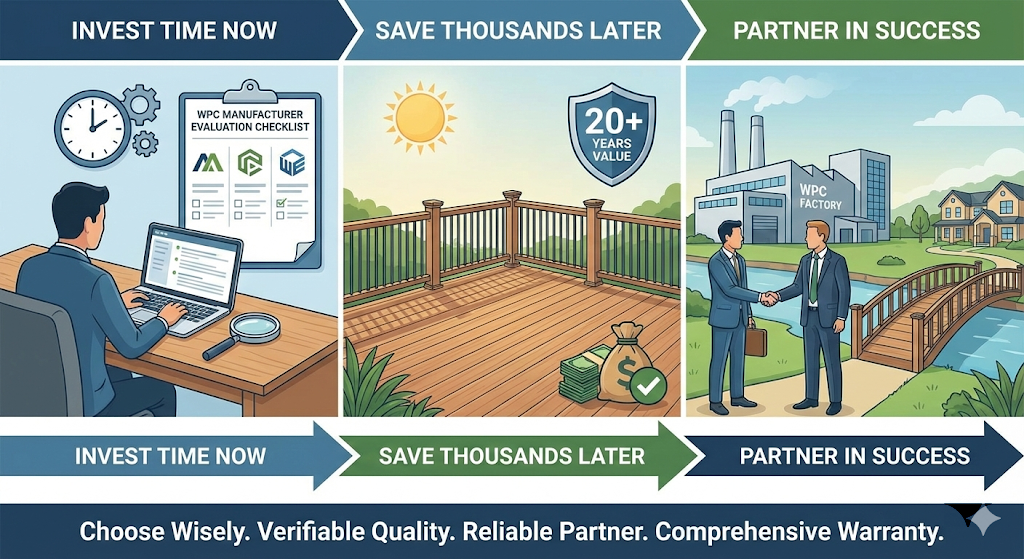
Selecting the right WPC manufacturer fundamentally determines your project’s long-term success and satisfaction. The three most critical factors are: verifiable product quality through third-party testing and certifications, not just marketing claims; manufacturer reliability demonstrated by years in business, customer references, and transparent communication; and comprehensive warranty coverage with clear terms and proven claim fulfillment.
Thorough evaluation requires time investment—typically 3-4 weeks for proper due diligence. This upfront effort prevents the far more costly consequences of premature product failure, difficult warranty claims, or complete project replacement. Remember: the cheapest manufacturer rarely delivers best value, while the most expensive doesn’t guarantee optimal results. Focus on total cost of ownership, factual specifications, and verifiable track records.
Your next steps are clear: Download our WPC Manufacturer Evaluation Checklist to systematically score candidates, request samples from 3-5 manufacturers that meet baseline criteria, and schedule factory visits (virtual or in-person) with your top choices. Use the questions and frameworks provided throughout this guide to make an informed decision that protects your investment for decades to come.
The right WPC manufacturer becomes a partner in your project’s success. Choose wisely, and your deck, railing, or cladding will deliver beauty, durability, and value for 20+ years.